• Welcome to The Tolkien Forum! Connect with fellow Tolkien enthusiasts and join a community that is over two decades old, and still going strong. We look forward to meeting you.  Register

Rings of Power Stuff

For legs maybe, but keep in mind that arms not only move constantly, but also tend to hold annoying things such as swords and shields.
But with your sword arm, you stick it out the whole time (its very inviting for your opponent). Your have a shield-arm is however completely protected if you have a shield.
 
If anyone wants to learn how warriors died in battle in real life, all the different ways they were killed or just maimed., read the Iliad.**
Probably one third of the book describes hand-to-hand combat using using sword, maces, spears... sometimes the warriors were in chariots.
Body armour for the torso, arms and legs, the head is described in detail.
Most of the body armour was bronze, helms were bronze and leather, shields were a combination of bronze and leather (typically oxhide).
The deaths are describes in brief but graphic detail.

**Excellent English translation is by Richmond Lattimore.
There are many other translations, ranging from excellent to awful.
Lattimore's ranks pretty high in the "Classics" realm.
 
If anyone wants to learn how warriors died in battle in real life, all the different ways they were killed or just maimed., read the Iliad.**
Probably one third of the book describes hand-to-hand combat using using sword, maces, spears... sometimes the warriors were in chariots.
Body armour for the torso, arms and legs, the head is described in detail.
Most of the body armour was bronze, helms were bronze and leather, shields were a combination of bronze and leather (typically oxhide).
The deaths are describes in brief but graphic detail.

**Excellent English translation is by Richmond Lattimore.
There are many other translations, ranging from excellent to awful.
Lattimore's ranks pretty high in the "Classics" realm.
I should try to find a copy of it, it sounds interesting.
 
I should try to find a copy of it, it sounds interesting.
Uhhhh.... that surprises me... didn't you say you were homeschooled?
All the kids I know that were/are home schooled receive a grounding in "Classic lit".
Not everything of course, but the Iliad and Odyssey are customary.
Then there's some Aeschylus (typically a work from Oresteia) Sophocles (Antigone, Oedipus Rex,) Euripides (Medea).
Or did you study classic lit but not any Homer?

Then again, home-schooling where you are may have different structure and requirements.
 
Last edited:
Uhhhh.... you surprise me... didn't you say you were homeschooled?
All the kids I know that were/are home schooled receive a grounding in "Classic lit".
Not everything of course, but the Iliad and Odyssey are customary.
Then there's some Aeschylus (typically a work from Oresteia) Sophocles (Antigone, Oedipus Rex,) Euripides (Medea).
Or did you study classic lit but not any Homer?

Then again, home-schooling where you are may have different structure and requirements.
I studied Tolkien.
 
But with your sword arm, you stick it out the whole time (its very inviting for your opponent). Your have a shield-arm is however completely protected if you have a shield.
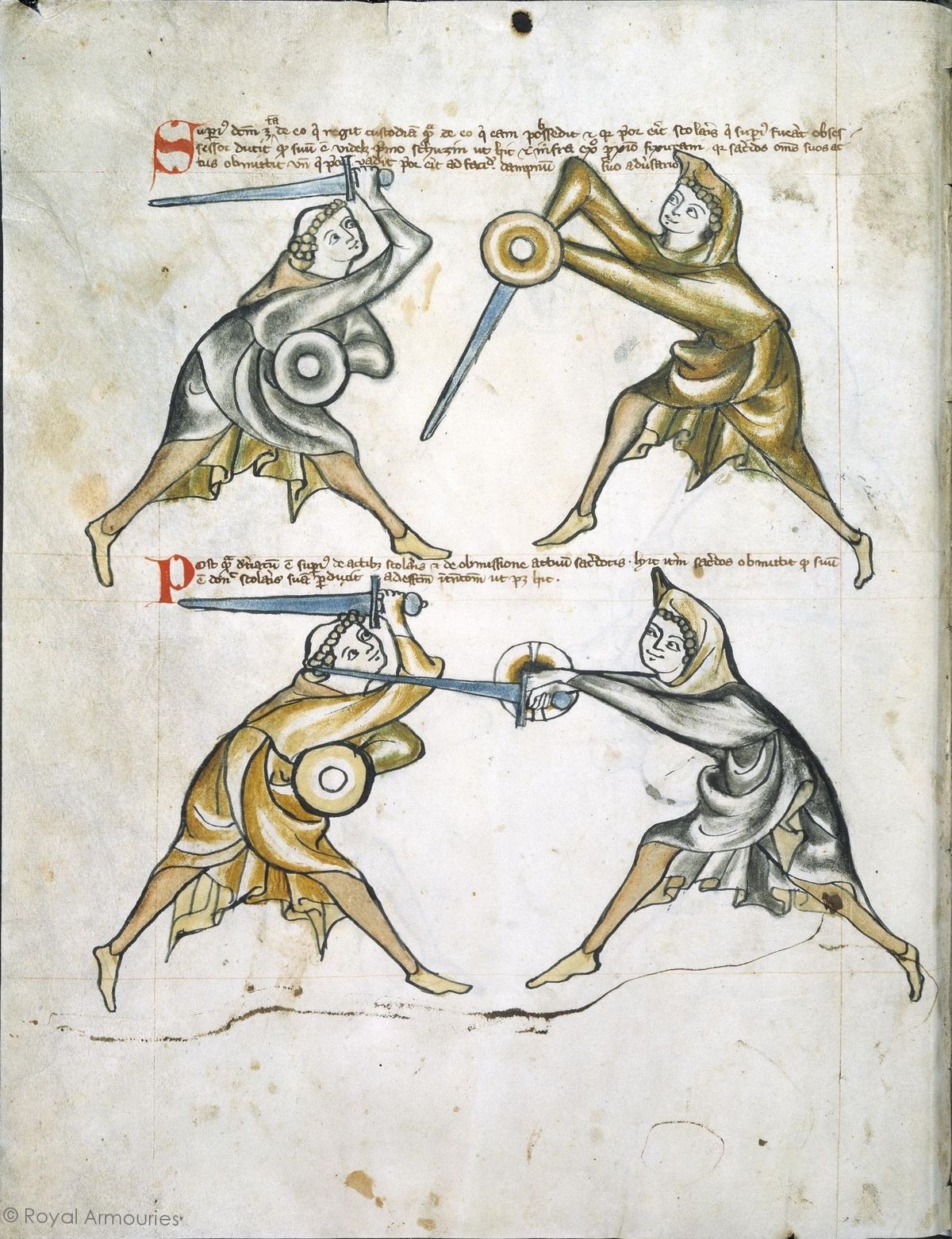
You don't, actually. If you have a sword and a shield, you keep your sword arm (and much of a sword) behind the shield, unless you are making an attack. It is still somewhat vulnerable, but in reality rather well protected. Look at the stances here:

You can also look at distribution of injuries at the Battle of Visby. It shows that the head and the lower legs were in fact the most vulnerable:

176.png


Vast majority of injuries (85%) was to head or lower legs. This makes sense: you need head to see so you cannot always keep it covered with shield, and if you get hit there, it is an immediate game over. Note that Visby skeletons show mail coif but not actual helmet, meaning that it could be cut through with heavy bladed weapons such as axes (medieval art also shows mail - and even helmets - being cut through with swords, but it is unclear whether that shows actual events or is artistic liberty). 8,5% of injuries is to thighs, and only 6,6% injuries to arms as a whole.

Torso shows no injuries, but consider that torso is a) well armored by mail, b) nearly always protected by the shield and c) unlikely to have injuries register on bones as stabs into abdomen or between the ribs are likely to leave no trace on skeletal remains. And if you look at actual historic armors, you can see fairly consistent logic to it.
- Head received the highest priority: if rigid armor was used at all, it was always the helmet that you put on first, as shown in the depiction below:
36bf66484a28bdcd5af8eec65b4bc666--gambeson-medieval.jpg

Interestingly, note that the guy at far right has only helmet and no armor at all elsewhere. No gambeson, nothing.
- Next area that you protected with rigid armor was the chest. You can see this in Greek armor (hoplites had helmet, torso armor and greaves; rest of the armor was either flexible or not there), Roman armor (lorica segmentata protected only the shoulders and upper torso), as well as early modern munitions plate (protected the head, shoulders and upper thighs) or Napoleonic cuirasses (Helmet and chest plate only).
- After that, you protected the upper arms and upper legs. Again, consider the examples above. If you had a shield and fought in a shield wall however, lower legs might receive priority over the upper legs (e.g. hoplites who protected lower legs with bronze greaves but upper legs only with flexible armor)
- Lower arms and lower legs generally had the lowest priority.
 
I saw something somewhere that said that if a Medieval soldier could only afford one piece of armour he would get a helmet, above everything else, which makes sense.

You don't, actually. If you have a sword and a shield, you keep your sword arm (and much of a sword) behind the shield, unless you are making an attack. It is still somewhat vulnerable, but in reality rather well protected. Look at the stances here:
We mostly fight without shields, because it makes it more interesting and difficult.
 
But with your sword arm, you stick it out the whole time (its very inviting for your opponent).
It depends on the type of sword, with simple hilted swords (e.g crossgaurd) the hand and arm would tend to be kept back (unless executing a strike). Note the drawings from historical fight manuals:
https://armizare.org/swordsmanship-in-the-art-of-arms-part-three-sword-in-one-hand/

With the development of more complex hilts the arm being extended became more common.
Your have a shield-arm is however completely protected if you have a shield.
In some systems of combat the shield (or buckler) would advance to cover the sword hand when striking. See some of the pictures above or here:
 
Last edited:
I saw something somewhere that said that if a Medieval soldier could only afford one piece of armour he would get a helmet, above everything else, which makes sense.
It is actually stated in the post I linked:
Helmets were the basic piece of armor kit. Even a person who could not afford any other piece of metal armor would try to procure a metal helmet. Helmet was the last piece of armor to disappear from use and the first to reappear.
 
Not defending Rings of Power but his story sounds even worse, and not sure how he has a case since he tried multiple times and Simon Tolkien basically ignored him.


Long before Sauron, the original Rings Of Power were forged by the Elven Lord Celebrimbor and Dwarven smith Narvi in Eregion, near the Misty Mountains. These first magic Rings were far more powerful than those that came after and were corrupted by Sauron to be fought for in the War of the Ring.


Elanor, daughter of Samwise, is nervous before her debutante party in the Shire. In the 22nd year of the reign of the High King Elessar, the Blue Wizards return from out of the East bearing grave and perilous news: the rest of the Rings of Power have been found and they are in deadly danger. Thus begins the War of the Rings to End All Wars of the Rings. Before it is over Elves, Hobbits, Dwarves, Men and magical races long forgotten or never seen before will join the Quest to find Celebrimbor’s originals and the last of Sauron’s corrupted Rings of Power.

Elanor, two Hobbit friends, the Crown Prince Eldarion, his Elvish uncles Elladan and Elrohir join the Wizards Alatar and Pallando in a war across Middle-earth fighting for their lives. If they fail, they will witness the return of the Vala Morgoth, the source of Evil and former Master of the long-defeated Sauron. With all the Rings of Power at his command, Morgoth will enslave the whole of Middle-earth - forever.
 
Not defending Rings of Power but his story sounds even worse, and not sure how he has a case since he tried multiple times and Simon Tolkien basically ignored him.

Oh, it does. Still, it is kinda funny that Rings of Power got sued by fanfiction author... really shows the quality of writing that went into the series.
 
If that guy managed to write worse story then ROP... then that really is... something...
Again not defending ROP but basically sams daughter and her hobbit friends help Aragorn’s son stop the new rings of power from bringing back Morgoth that the blue wizards (who are still alive) found. The first book is titled Fellowship of the King. The guy’s really lucky he didn’t get sued himself for plagiarism. Writing fan fiction is one thing, selling an entire series like that seems illegal to me. He apparently thought Simon Tolkien and the Tolkien Estate would collab with him on his stories (they ignored him).
In 2019, "with excitement to collaborate with [The Tolkien Estate] and the anticipation of publishing his book to the public," Polychron hired an attorney to contact The Tolkien Estate again. The Tolkien Estate's attorney "rebuffed any attempt at collaboration the very next day," according to the complaint. So Polychron says he then personally delivered a copy of the manuscript to Simon Tolkien "at his home" and notes that he included "the © symbol" on the manuscript.

Then, somehow he got his name as an author of Fellowship of the Ring on Amazon too 🤣

1684438161446.png

I don’t think Rings of Power was amazing. I enjoyed it for a stand-alone, random fantasy story and don’t see it as canon. But this guy seems like a delirious nutter just trying to make a buck.
 
PJ had toyed with the Idea of having Sauron appear in person at the Black Gate in RoTK, in his Annatar guise, and had actually filmed it, as can be seen in the Extended Edition "appendices". But he decided not to use it, as he had decided to dump "Xena Arwen" in TT as probably causing too much of an uproar.
 
Back
Top