• Welcome to The Tolkien Forum! Connect with fellow Tolkien enthusiasts and join a community that is over two decades old, and still going strong. We look forward to meeting you.  Register

How Old is 🧝Elrond?

Solution
We don’t know Elrond’s exact age because there are two tellings of Elrond’s age. In one telling, he is the younger brother of Elros. In the other version, Elrond and Elros are twins. We do know that Elros was 58 years old at end of the First Age. We also know the Second Age lasted 3441 years, and the War of the Ring occurred in Third Age 3119. Frodo first met Elrond in October Third Age 3118.

My preference is that Elrond is younger than Elros by a few years, maybe two, maybe four. That’s the older telling and told more often.

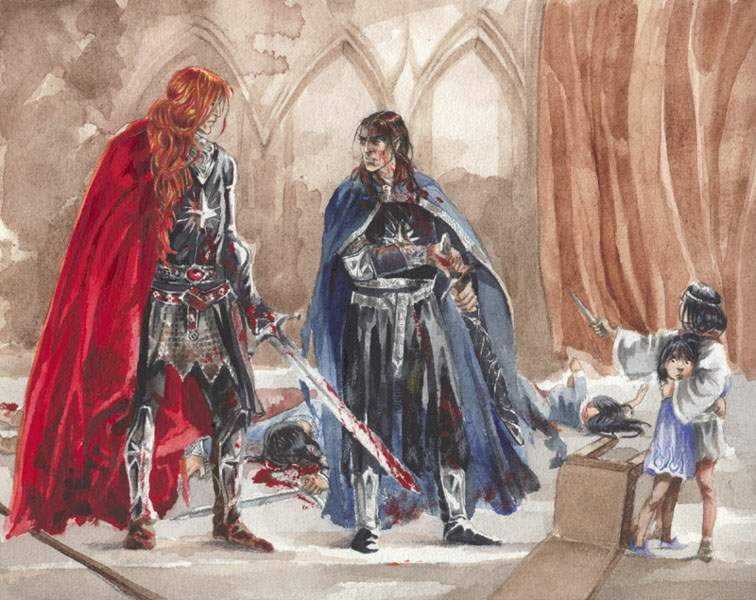
Elros was ten when the surviving Sons of FĂ«anor attacked their home and slaughtered all their friends and kin; he and Elrond were taken by Maglor, the second-oldest of FĂ«anor’s sons (apparently the most...
We don’t know Elrond’s exact age because there are two tellings of Elrond’s age. In one telling, he is the younger brother of Elros. In the other version, Elrond and Elros are twins. We do know that Elros was 58 years old at end of the First Age. We also know the Second Age lasted 3441 years, and the War of the Ring occurred in Third Age 3119. Frodo first met Elrond in October Third Age 3118.

My preference is that Elrond is younger than Elros by a few years, maybe two, maybe four. That’s the older telling and told more often.

Elros was ten when the surviving Sons of FĂ«anor attacked their home and slaughtered all their friends and kin; he and Elrond were taken by Maglor, the second-oldest of FĂ«anor’s sons (apparently the most level-headed; besides Maglor, only his oldest brother, Maedhros, survived the attack), who raised them: Tolkien tells us that Elros and Elrond actually came to love Maglor. Maglor did this in part because although Elwing, mother of Elros and Elrond, was rescued when all the Sons of FĂ«anor attacked her father Dior EluchĂ­l in Doriath in a failed attempt to seize the Silmaril his parents Beren and LĂșthien took at great risk and personal cost from Morgoth’s crown, Elwing’s twin brothers, ElurĂ­n and ElurĂ©d, who were young at the time, were left to starve to death in the forest. (You should be aware that there are many different earlier versions of that part of the story, along with different names and birth orders: Tolkien’s notes were a mess that his son Christopher spent decades sorting out.) Maglor was famed for his singing and harping and – Elrond played harp: we see him with a harp when he and Galadriel meet Frodo and Sam on the way to the Grey Havens at the end of Lord of the Rings. Elrond then has twin sons, Elladan and Elrohir. Twins run in families, but twins tend to skip generations: the first generation will have twins, the next won’t, the third will, and so on. No one knows why (and it isn’t a hard-and-fast rule), but it’s a real-world thing that’s been recognized for ages. So if Elrond’s uncles were twins and Elrond himself had twins, it’s a more likely that he and Elros were not twins.

My next reasoning is that the Peredhil, the Half-elven, were given an irrevocable choice to be numbered among Elves or Men. Their father EĂ€rendil wanted to choose mortality, but chose instead to be counted among the Elves so that he would not be parted from their mother, Elwing, who wanted to stay with the Elves. When that choice came to Elros and Elrond at the end of the First Age – remember, they were both in their fifties at this point – Elros chose to be mortal but Elrond chose to be Elven. Gee, what could explain that? If Elros were the older, he’d have known his father a little better and better understood, perhaps, his father’s mind on this matter. Elrond as the younger son might have been closer to his mother. That’s wild speculation, but as a generalization it might fit with a ten year old boy and his younger brother (and completely neglect the four or five decades that elapsed between their separation from their parents and the time of their decision).

So you get to choose. In October Third Age 3118 at the Council of Elrond, Elrond might be 58 + 3441 + 3118 = 6617 years old, or he might be 2 or even 4 years younger. He’s really old: more than two ages of the world old. Galadriel and Celeborn are one generation older, which is apparently another whole age of the world. (They’re also Elrond’s in-laws: Elrond married their daughter, Celebrían.) And Círdan the Shipwright is even older, in the generation before Galadriel and Celeborn.
 
Solution
It should be close to whatever 58 + 3,441 + (September) 3,021 equals -- this last number being the year in which Elrond sailed West Over the Sea anyway . . .

. . . and liveth still, I imagine.

Edit: Ah, I see Alcuin beat me to the finish line while I was considering doing math!
 
Last edited:
He’s really old: more than two ages of the world old. Galadriel and Celeborn are one generation older, which is apparently another whole age of the world. (They’re also Elrond’s in-laws: Elrond married their daughter, Celebrían.) And Círdan the Shipwright is even older, in the generation before Galadriel and Celeborn.
I think I often forget this point about how old the Elves are; possibly because they are part of the ongoing tale of the Ring, surrounded by puny Humans and the like - but they have been around for a seriously long time!
 
About 25 Elvish Years . . . counting in yéni
[Elrond was] about 26 when Arwen was born. 45 when he left middle-earth ...

Arwen was about 19 when she married Aragorn, and the two ruled as king and queen of the reunited Kingdom for less than a year ...

But Cirdan was pretty old in even in yéni, at least 257, perhaps closer to 260.
I’m taking these two citations out of context from another active thread, but I think they make the point: Elves don’t count the running years, as Legolas tells the Company as they ride upon Anduin:

For the Elves the world moves, and it moves both very swift and very slow. Swift, because they themselves change little, and all else fleets by: it is a grief to them. Slow, because they do not count the running years, not for themselves. The passing seasons are but ripples ever repeated in the long long stream. Yet beneath the Sun all things must wear to an end at last.
​
YĂ©ni or “long years” are the main Elvish unit of time. One yĂ©n is 144 years of the Sun. That’s why when he met Arwen on his twentieth birthday, she appeared no older than Aragorn: she was 19 yĂ©n.

One of the virtues of Valinor, including Tol EressĂ«a and Eldamar, the two regions along the coast populated by the Eldar, is to slow the effects of Time. That’s important to the Elves (and the Valar!): they don’t fade as quickly as in Middle-earth. This was also one of the powers of the Great Rings: they forestalled the effects of Time, but did so in a way that Sauron could manipulate to evil purposes. For Men, the result was that they were ensnared by their Nine Rings and brought permanently into the wraith world. In LĂłrien, however, Galadriel used Narya to preserve something of the Ancient Days. In Rivendell, Elrond used Vilya to preserve the knowledge of the Ancient Days.
 
Alcuin, can you point me to the relevant texts please? I'm lazy, although I did check a couple of older texts, at least.
I’d rather be lazy, too. When I run across them again, I’ll try to remember to catalogue several and post them here. It’s a pain looking them up. There is a painting, though, referenced here in TTF – again, I don’t recall exactly where – that sums it up nicely in my mind:
latest
 
For clarity, I only delved in further 'cause I respect your [Alcuin] attention to detail and wanted to find the references, but so far I can't come up with anything. VT maybe? Or I could be losing my mind and missing something too obvious to behold. In any case, rather than mow my lawn, I delved, and so far, unearthed the following:


HME 4

Earliest Silmarillion -- introduction of Elrond into Silmarillion

Qenta Noldorinwa (1930) -- changes made to QN add Elros as Elrond's brother.

Earliest Annals of Beleriand -- Maglor, rather than Maidros, saves Elrond (no mention of Elros in AB)

HME 5

Later Annals of Beleriand -- 325 [525] Elrond Born 329 [529] Elrond taken by Maglor -- but in a "later, hastily penciled change" to Annal 325, Tolkien altered the passage to include "the twin brethren Elrond and Elros" (born in the same year).

Quenta Silmarillion -- " . . . Earendil and Elwing, and Elrond their child."

But Elros appears in the "QS conclusion" -- with respect to choosing to be mortal compared to brother Elrond.

HME 10

The Grey Annals -- don't extend far enough.

The Tale of Years -- includes a reference to the twin sons of Elrond being born in the same year.

I checked every index reference to Elros in HME, UT, and Letters. Although I guess it's possible that the information exists in a reference to Elrond being younger without a direct use of the name Elros. Or again, that I'm missing something.


Anyway, time for a nap.
 
For clarity, I ... wanted to find the references, but so far I can't come up with anything. ... I delved, and so far, unearthed the following:...
I stand corrected. Thank you, Elthir! That’s good delving.

If you’re delving into this, what is the history of Elros and his position in Tolkien’s notes? I was working from memory, but my memory is far from perfect and needs a refresher.
 
Hmm. I think I was too focused on the age question to pay attention to too much else. Apologies Alcuin . . . I can delve again, but not right away.
 
Last edited:
I've actually read the HoME series over the years.
I basically don't feel that they are in the same league as the stuff that Tolkien published in his lifetime. I know that TS should fall into this category as well, but I've always been happy to give this the benefit of the doubt as it feels as though it was a mostly finished work around the time of Tolkien's death.
The rest of the series, especially the later ones, seem almost like the deleted scenes in a movie, or just rough notes that a writer will work up to a finished piece.
Plus, on a purely personal level, I enjoy the fact that there is a lot of interpretation left to my own devices regarding a lot of the themes in the book.
 
Assuming as per some writings of JRRT Elrond (apparently also first-named, Elros being a later addition) having been born at the latest 58 years before the end of the First Age, this ain't vector calculus (or whatever): 58 FA, 3441 SA, and 3021 TA when the three (Elven-) Ring-bearers Galadriel, Elrond, and Gandalf left Middle-earth, together with Bilbo and Frodo.

So 6520 years ...
 
Well, I didn't have time to round up 652 people (assuming the usual amount of fingers and toes) and do the math 🩊
 

Today's events

Similar threads

Back
Top