• Welcome to The Tolkien Forum! Connect with fellow Tolkien enthusiasts and join a community that is over two decades old, and still going strong. We look forward to meeting you.  Register

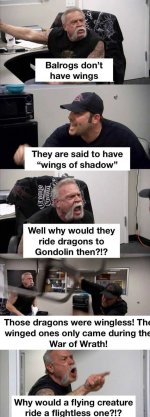
📊Poll: Do Balrogs have wings?

Do Balrogs have wings?

  • Yes

    Votes: 261 64.6%
  • No

    Votes: 141 34.9%
  • Maybe (Wing agnostic)

    Votes: 2 0.5%

  • Total voters
    404
In contrast to the concept they could routinely 'change their form, we also need to lay the fact Sauron could no longer change his form... according to textual evidence. The Balrogs were different, though of lesser power? Again, we speculate greatly.

If interested, there's a note in Ósanwe-kenta that reads:

and if interested please read between the (orange) lines ;)

________________________________________

Note 5

Here Pengolodh adds a long note on the use of hröar by the Valar. In brief he says that though in origin a "self-arraying", it may tend to approach the state of "incarnation", especially with the lesser members of that order (the Maiar). "It is said that the longer and the more the same hröa is used, the greater is the bond of habit, and the less do the 'self-arrayed' desire to leave it. As raiment may soon cease to be adornment, and becomes (as is said in the tongues of both Elves and Men) a 'habit', a customary garb. Or if among Elves and Men it be worn to mitigate heat or cold, it soon makes the clad body less able to endure these things when naked". Pengolodh also cites the opinion that if a "spirit" (that is, one of those not embodied by creation) uses a hröa for the furtherance of its personal purposes, or (still more) for the enjoyment of bodily faculties, it finds it increasingly difficult to operate without the hröa. The things that are most binding are those that in the Incarnate have to do with the life of the hröa itself, its sustenance and its propagation. Thus eating and drinking are binding, but not the delight in beauty of sound or form. Most binding is begetting or conceiving.

"We do not know the axani (laws, rules, as primarily proceeding from Eru) that were laid down upon the Valar with particular reference to their state, but it seems clear that there was no axan against these things. Nonetheless it appears to be an axan, or maybe necessary consequence, that if they are done, then the spirit must dwell in the body that it used, and be under the same necessities as the Incarnate. The only case that is known in the histories of the Eldar is that of Melian who became the spouse of King Elu-thingol. This certainly was not evil or against the will of Eru, and though it led to sorrow, both Elves and Men were enriched.

'The great Valar do not do these things: they beget not, neither do they eat and drink, save at the high asari, in token of their lordship and indwelling of Arda, and for the blessing of the sustenance of the Children. Melkor alone of the Great became at last bound to a bodily form; but that was because of the use that he made of this in his purpose to become Lord of the Incarnate, and of the great evils that he did in the visible body. Also he had dissipated his native powers in the control of his agents and servants, so that he became in the end, in himself and without their support, a weakened thing, consumed by hate and unable to restore himself from the state into which he had fallen. Even his visible form he could no longer master, so that its hideousness could not any longer be masked, and it showed forth the evil of his mind. So it was also with even some of his greatest servants, as in these later days we see: they became wedded to the forms of their evil deeds, and if these bodies were taken from them or destroyed, they were nullified, until they had rebuilt a semblance of their former habitations, with which they could continue the evil courses in which they had become fixed". (Pengolodh here evidently refers to Sauron in particular, from whose arising he fled at last from Middle-earth. But the first destruction of the bodily form of Sauron was recorded in the histories of the Elder Days, in the Lay of Leithian.)

________________________________________

Also interesting here is the Body And Spirit section of Metaphysical And Theological Themes, especially starting with the passage that begins: "p. 21 fn.: "by the birth of Lúthien [Melian]
became enmeshed in 'incarnation', unable to lay it aside while. . ."


Metaphysical And Theological Themes is Appendix I to The Nature of Middle-Earth.
 
Last edited:
Sketch of a Balrog by comic book artist Walt Simonson from from before he entered the field; I think he was in his late teens.
1739576112972.png


Accompanying text:
This drawing came up as a FB memory from some years ago. I thought I'd post it fresh just in case it displays as a larger image. I'm including the original caption below.
A Balrog, flame of Udûn. Pen, brush, and India ink. 8.5 x 11. 1965.
"HIs enemy halted again, facing him, and the shadow about it reached out like two vast wings."
One of the first drawings I ever did where I researched the subject as carefully as I could at the time. I think this is virtually all Rapidograph drawing with brush to fill in the blacks. I didn't know about whiteout at the time, so I was pretty careful.
I'm a little surprised that as early as this, I broke the border of the drawing at the bottom to suggest the beginning of the Bridge of Khazad-dûm. I had not yet discovered that one should reference figures as well as search for visual cues in texts being illustrated.
🙂
And I see that I was already Mr. Texture.
In the text, it's unclear whether Balrogs actually had wings or if the wings were a visual artifact of the play of light and shadow around the creature, so I tried to incorporate a little of both interpretations into the drawing here.
 
Ósanwe-kenta
So. Having read (and re-read, and re-read, and re-read) this post, oh catlike one locked in a coat, I believe what you're trying to suggest to me is: "anything is possible."

And having monitored the Halls of Speculation since the inception of my presence wthin these walls (and in other places before, during, and after) I would agree to these facts:
1. It is true. Anything IS possible.
2. it is true. The issue will never be 'resolved.'
3. It is true. People see and think differently.
4. It is true. The chains of Opinion are only with difficulty broken.
5. It is true. If one changes from one opinion to another, such a change is no definitive solution. It's simply another Opinion. Fleeting, Fickle. Temporary.
6. It is true. The subject will come around again, as inevitably as a cat will take a nap, or water will (of its own accord without external force) flow downhill, following the 'path of least resistance' (while making new such paths along the way depending on the force it is able to bring to bear as it flows).

I almost asked if some considered Ósanwe-kenta to be part of 'canon', but then realized such a question is inconsequential, as there will be opinions upon the opinions about the opinions on the matter of opinion.

Thus, here I stand (now) on the matter of Balrogs and Wings.

"Whatever." And that is my final word..! 😆

I do have a 'leaning'. I tend to lean slightly, away from the predominant direction of the winds exerting pressure against my frame. It comes about naturally.
 
Last edited:
Its reason why Gandalf didnt want to go to Moria. I guess its a scary topic to talk about for people who are afraid of devils or demons, since they represent evil.
And i have forgotten what the Balrog even looked like in "Fellowship of the Ring 2002 " game. But i remember Gandalf was a tough guy in that game!

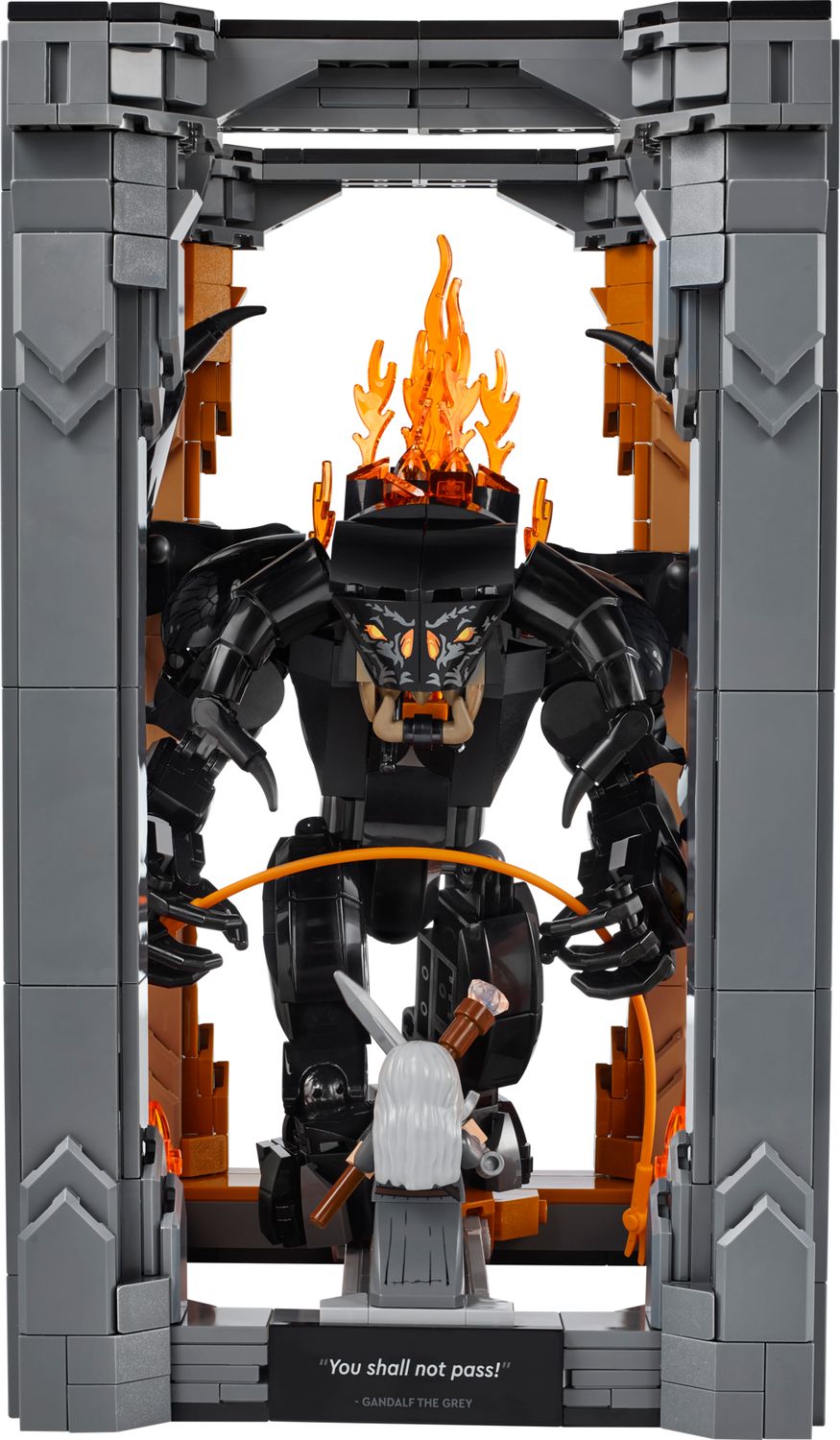
But looking it up online. I heard one misinterpretation is Balrog having wings. Which he doesnt have at all (From what people say online). He is covered in shadows and flame (Which makes Balrog seem legit dangerous if he can hide and attack) some even say he is a tall man in a sense.

But i guess if anyone is expert on the book description, then let me know what you know about it. I appreciate your help.
 
I'm no expert, but here's what I found in the chapter The Bridge of Khazad-Dum:
Something was coming up behind them. What it was could not be seen: it was like a great shadow, in the middle of which was a dark form, of man-shape maybe, yet greater; and a power and terror seemed to be in it and to go before it. It came to the edge of the fire and the light faded as if a cloud had bent over it. Then with a rush it leaped across the fissure. The flames roared up to greet it, and wreathed about it; and a black smoke swirled in the air. Its streaming mane kindled, and blazed behind it. In its right hand was a blade like a stabbing tongue of fire; in its left it held a whip of many thongs.
I would say this sounds pretty scary. It uses several of the most basic human fears: darkness; fire, a fear I can particularly relate to, having had several bad experiences with it myself; the unkown; and dangerous creatures. All these together, combined with the reactions of Legolas and Gandalf create a most heart-pounding experience, at least for me.
 

Today's events

Similar threads

Back
Top