• Welcome to The Tolkien Forum! Connect with fellow Tolkien enthusiasts and join a community that is over two decades old, and still going strong. We look forward to meeting you.  Register

A question regarding the Ainur

Avian

New Member
Joined
Jun 21, 2024
Messages
7
Once, I saw someone claim on Facebook that "Without bodies, the Ainur cannot interact with the world in any way." Also, in Unfinished Tales, it is said that they wear bodies because even the Eldar cannot perceive them if they don't wear them. And the Dead Army also couldn't fight with the humans because they cannot physically interact with the world. But I don't get one thing about this.
  • The Wights could possess skeletons and wear robes.
  • In Unfinished Tales (as I remember) it is stated that dead elves are capable of possessing the living.
  • The Nazgûl (I'm not sure if they have invisible bodies) could directly interact with the world just like living people.
Even if we don't count the Nazgûl, the spirits still possess the ability to interact with the physical world to an extent with their powers.
So, being direct offsprings of Illuvatar and existing beyond both planes (seen/unseen) of the universe, shouldn't the Ainur still be able to interact with the world in supernatural ways?
For example: mind controlling, summoning thunder, conjuring fire, breaking something with telekinesis, etc.
 
This is how I understand it, and I might be totally wrong.

The ainurs have like 3 ways of existing inside Arda.
1) Completely spiritual, in which way they can not interact with materialistic world, but can communicate with living beings.
2) Mix of spiritual and materialistic (example: Morgoth and Sauron), but after a while they loose ability to appear fair
3) Completely materialistic (example: Balrogs), and if Ainurs choose that, they will have most power in materialistic world... they still can use spells and such, but unable to resurrect (like Morgoth and Sauron), if being killed.

As for army of the dead, I think they are completely spiritualistic, but can affect living beings by inflicting insane amount of fear, so strong, that living beings could start hurting themselves.
As for Nazguls, they are sort of some mix, they have bodies, but they are invisible, and their bodies can not be harmed with regular weapons (unless the spell is broken, like Merry did it with witch king). So Nazguls are more materialistic then it seems at first glance, but they are crippled by the fact they can not perceive living world as clearly as regular living beings.
I am not really sure about Barrow Downs beings... I assume they are more spiritual like army of the dead, and can inflict fear or sleep within human beings, and make them do all crazy things (hurt each other).
  • In Unfinished Tales (as I remember) it is stated that dead elves are capable of possessing the living.

Are you sure about this?
Can't remember anywhere that I read something similar.
Dead elves just go to the halls of Mandos and waiting there end of time while forced to listen Feanor complaining about this and that. :)
 
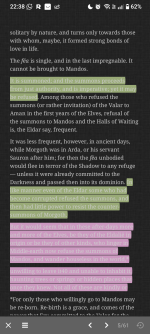
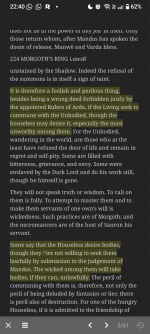
I don't remember correctly where I read this, but I read it either in Unfinished Tales, Letters from Tolkien, Morgoth's Ring, or in Tolkien Gateway. But I'm sure I read something like that—the elves who refuse to go to the Halls of Mandos and choose to linger in Middle-earth will finally go mad, and they will even tend to possess living people.
I don't remember reading that either, but it does sound like one of those theories Tolkien developed at some point and then scrapped it. In the most accepted mythology, I don't think elves can refuse to go to the hall of Mandos when they die.
 
I don't remember reading that either, but it does sound like one of those theories Tolkien developed at some point and then scrapped it. In the most accepted mythology, I don't think elves can refuse to go to the hall of Mandos when they die.
I found it. It is in Morgoth's Ring, in the Laws and Customs among the Eldar section. I think it is a canon thing because Tolkien Gateway also mentions it. (The image with the pink highlighter is the first part)
 

Attachments

  • Screenshot_20250731-224010.png
    Screenshot_20250731-224010.png
    94.4 KB · Views: 43
  • Screenshot_20250731-223844.png
    Screenshot_20250731-223844.png
    78.9 KB · Views: 50
I don't think anything in the history of Middle Earth is canon, for some people, not even the Silmarillion is canon because it wasn't put together by JRRT. Some people even say there is nothing canon because even with LOTR and The Hobbit, Tolkien changed his mind later

A good example is the parentage of Gil Galad. In the Silmarillon he is the son of Fingon, but Christopher Tolkien later found notes from his father where Gil Galad was the son of Orodreth, who in turn wasn't a son of Finarfin but of Angrod. I think the may reason for that change of mind was that it didn't make a lot of sense that Turgon succeeded Fingon instead of Gil Galad. But this change wasn't compatible with the published Silmarillion where Fingon sends Gil Galad to Cirdan to protect him.

All the stories have multiple versions, some of them very different. CT did his best to put together a coherent narrative but he even have to add his own content to some incomplete parts (like the war of the wrath). Tolkien many times would change his mind about something but then he would have to go back and change things in a number of different manuscripts. Part of the reason why he never finished the Silmarillion.

Having said all of that, I think the idea of elves spirits that could posses other being goes against most of the narrative and I think it was simply one of the ideas Tolkien toyed with (like the idea that orcs where made of stone).
 
I don't think anything in the history of Middle Earth is canon, for some people, not even the Silmarillion is canon because it wasn't put together by JRRT. Some people even say there is nothing canon because even with LOTR and The Hobbit, Tolkien changed his mind later

A good example is the parentage of Gil Galad. In the Silmarillon he is the son of Fingon, but Christopher Tolkien later found notes from his father where Gil Galad was the son of Orodreth, who in turn wasn't a son of Finarfin but of Angrod. I think the may reason for that change of mind was that it didn't make a lot of sense that Turgon succeeded Fingon instead of Gil Galad. But this change wasn't compatible with the published Silmarillion where Fingon sends Gil Galad to Cirdan to protect him.

All the stories have multiple versions, some of them very different. CT did his best to put together a coherent narrative but he even have to add his own content to some incomplete parts (like the war of the wrath). Tolkien many times would change his mind about something but then he would have to go back and change things in a number of different manuscripts. Part of the reason why he never finished the Silmarillion.

Having said all of that, I think the idea of elves spirits that could posses other being goes against most of the narrative and I think it was simply one of the ideas Tolkien toyed with (like the idea that orcs where made of stone).
Your statement makes sense. But what do you think about my original question?
So, being direct offsprings of Illuvatar and existing beyond both planes (seen/unseen) of the universe, shouldn't the Ainur still be able to interact with the world in supernatural ways?
For example: mind controlling, summoning thunder, conjuring fire, breaking something with telekinesis, etc.
 
Your statement makes sense. But what do you think about my original question?
I think there is evidence that the Ainur could interact with Arda and other beings without a body.

Olorin (Gandalf) it's said that he was always comforting and helping the elves, in a spiritual form. The elves probably didn't know he was there but could feel his influence.

Arien gave up her body to drive the sun.

Perhaps some actions weren't possible without a body, maybe Melian needed to be embodied to set the girdle (and certainly to give birth to Luthien).

I don't know any instance of the Valar being without a body in Arda, but some of the Maiar were as the examples above. I think that in that form their power was limited, to influence material things they needed a physical form, part of the reason why Morgoth lost the ability to change form, he needed a physical form to exert dominion over Arda. Their power were clearly spiritual, like lifting the spirit or communicating.
 
There may be some room for interpretation, but I think Ulmo preferred to go bodiless. My impression is that he only took bodily shape for in-person face-to-face interactions. In one version of the Tuor story, he caused a spring to appear before Tuor to get him started on his destined path. Maybe that's an example of him interacting with the World while (presumably) in his preferred bodiless state. And, later Ulmo speaks to Ecthelion using Tuor as the instrument of his voice.

Valaquenta: "...he does not love to walk upon land, and will seldom clothe himself in a body after the manner of his peers."

Ainulindale: "...the Valar took to themselves shape...their shape comes of their knowledge of the visible World, rather than of the World itself; and they need it not, save only as we use raiment, and yet we may be naked and suffer no loss of our being."
 
There may be some room for interpretation, but I think Ulmo preferred to go bodiless. My impression is that he only took bodily shape for in-person face-to-face interactions. In one version of the Tuor story, he caused a spring to appear before Tuor to get him started on his destined path. Maybe that's an example of him interacting with the World while (presumably) in his preferred bodiless state. And, later Ulmo speaks to Ecthelion using Tuor as the instrument of his voice.

Valaquenta: "...he does not love to walk upon land, and will seldom clothe himself in a body after the manner of his peers."

Ainulindale: "...the Valar took to themselves shape...their shape comes of their knowledge of the visible World, rather than of the World itself; and they need it not, save only as we use raiment, and yet we may be naked and suffer no loss of our being."
that's an excellent example. The Ainur I mentioned that were limited were Maiar, not one of the most powerful Vala.

Ulmo not only appeared to Tuor, he also appeared to Finrod and Turgon in dreams, even showed Turgon the way to where Gondolin would be built
 
Arien gave up her body to drive the sun.
Great you mention her bro...
I haven't even thought of her, and it's worth analyzing.

Hmmm... I would maybe even say the opposite... she gave up her spiritual presence, to achieve that utter materialistic stature, to be as powerful as a Sun (or star).
Now, the flaw with this theory is that she is Maia, and power of the Sun is way above any Balrog, or any Maia.
But...
What if other Valars pour some of their powers in her (the same way Melkor did with his servants) to achieve that goal?
A little bit of Manwe, bit of Yavanna, Aule sparked her fire with mighty blow of his hammer, and all is blessed by Iluvatar... what then?
Hopefully this makes some, even tiniest, logic.
--------------------------------
She of course hoped she will get some power of Tulkas, but he just stared at her with smile, looking creepy, because he thought other Valars preparing her to fight with him... for fun and laugh... and then he wanted to marry her.
But she just turned around, and became a Sun.. a little less powerful Sun.. but she was happy.
 
Great you mention her bro...
I haven't even thought of her, and it's worth analyzing.

Hmmm... I would maybe even say the opposite... she gave up her spiritual presence, to achieve that utter materialistic stature, to be as powerful as a Sun (or star).
No, the Silmarillion said clearly that she gave up her body, her garment. The Ainur couldn't give up their spirit.
It wasn't her who produced the light and heat, it was the sun. Her job was to carry it across Arda.
Now, the flaw with this theory is that she is Maia, and power of the Sun is way above any Balrog, or any Maia.
the sun is not a being, it doesn't have a soul, it's an object like a stone, or a mountain, not a living entity. It's the last fruit of Laurelin. Because Laurelin was a tree there is a chance that there is some sort of life in it, Tolkien never said. She could sail with the son because she was a spirit of fire, but needed to get rid of her body or it would be burnt.
But...
What if other Valars pour some of their powers in her (the same way Melkor did with his servants) to achieve that goal?
A little bit of Manwe, bit of Yavanna, Aule sparked her fire with mighty blow of his hammer, and all is blessed by Iluvatar... what then?
Hopefully this makes some, even tiniest, logic.
It were the song of Yavanna and the tears of Nienna (Este in some versions) that made Laurelin and Telperion give a last fruit. Aule forged the carriages that would carry the sun and the moon and they were blessed by Varda, no need for Iluvatar.
--------------------------------
She of course hoped she will get some power of Tulkas, but he just stared at her with smile, looking creepy, because he thought other Valars preparing her to fight with him... for fun and laugh... and then he wanted to marry her.
But she just turned around, and became a Sun.. a little less powerful Sun.. but she was happy.
Joke aside, she wasn't the sun, just its sailor.

I might add that before she became the conductor of the sun, even Melkor feared her, she was too bright, too hot (in the literal sense, temperature). Melkor wasn't to recruit her to no avail.

Similar to Earendil, he wasn't a Silmaril, he just carried it.
 

Today's events

Similar threads

Back
Top