• Welcome to The Tolkien Forum! Connect with fellow Tolkien enthusiasts and join a community that is over two decades old, and still going strong. We look forward to meeting you.  Register

📖👀 Chapter 6 (📔Book III): The 👑King of the Golden Hall

📖👀 LOTR Reading Project

Rivendell_librarian

Active Member
Joined
Aug 19, 2018
Messages
772
The chapter starts with a beautiful, lyrical description of the prairie like grasslands of Rohan. Given his obvious liking for wide open spaces and big skies, one wonders whether Tolkien would have preferred the countryside around Cambridge to Oxford! There is a definite Anglo-Saxon feel to the chapter with several allusions to Beowulf as described by Hammond and Scull. Tom Shppey points out these are more like the Anglo-Saxons of literature rather than history - these are Anglo-Saxons who ride horses. It is also a chapter of names - especially horses and swords.

There is some male posturing by Aragorn about leaving weapons at the door of Meduseld. Wormtongue is summarily dealt with by Gandalf with the aid of the staff that Hama allowed. Gandalf has been here before and has picked up on Wormtongue's lust for Eowyn. Did Hama know what he was doing by allowing Gandalf to keep his staff despite Wormtongue's strictures?

Theoden's dark thoughts are dispelled and rejuvenated he decides to ride out with his forces to face Saruman head on. This is a significant turning point in the story. Eowyn is given charge of those left behind. Mercy is granted to Wormtongue (as with Gollum) who takes an old slow horse to ride to Isengard. Theoden and Eowyn are fascinating characters so well described by Tolkien.

This is a beautiful chapter - one of the best in the whole story imo. It ends beautifully:

Far over the plain Eowyn saw the glitter of their spears, as she stood still, alone before the doors of the silent house.

The-Golden-Hall-Alan-Lee-480x773.jpg

Screenshot_12-6-2024_0327_www.youtube.com.jpeg


Not the same moment in the story but one of PJ's better images imo.
 
The chapter starts with a beautiful, lyrical description of the prairie like grasslands of Rohan. Given his obvious liking for wide open spaces and big skies, one wonders whether Tolkien would have preferred the countryside around Cambridge to Oxford! There is a definite Anglo-Saxon feel to the chapter with several allusions to Beowulf as described by Hammond and Scull. Tom Shppey points out these are more like the Anglo-Saxons of literature rather than history - these are Anglo-Saxons who ride horses. It is also a chapter of names - especially horses and swords.

There is some male posturing by Aragorn about leaving weapons at the door of Meduseld. Wormtongue is summarily dealt with by Gandalf with the aid of the staff that Hama allowed. Gandalf has been here before and has picked up on Wormtongue's lust for Eowyn. Did Hama know what he was doing by allowing Gandalf to keep his staff despite Wormtongue's strictures?

Theoden's dark thoughts are dispelled and rejuvenated he decides to ride out with his forces to face Saruman head on. This is a significant turning point in the story. Eowyn is given charge of those left behind. Mercy is granted to Wormtongue (as with Gollum) who takes an old slow horse to ride to Isengard. Theoden and Eowyn are fascinating characters so well described by Tolkien.

This is a wonderful chapter! I too questioned in afterthought when I first read the books about Háma the Doorwarden (who I thought was depicted well by John Leigh in the movie) as I suspected he knew much of the goings on within Meduseld, and maybe did knowingly 'lapse' in his duty when it came to Gandalf.

On Theoden's dark thoughts... I always thought from my readings that the Voice of Saruman (another good chapter) was empowered in the words of the wily Grima Wormtongue (beautifully portrayed in the movie by Brad Dourif), and he in turn was able to influence King Theoden with his counsel. It was Saruman's power of voice implemented into the subtle sound of Wormtongue's voice over the years that enchanted the king, not an outright possession as PJ wrote it. Also, I thought the 'aged' look of Theoden was more subtle when I read it as opposed to the outright physical ageing portrayed by PJ.


This is a beautiful chapter - one of the best in the whole story imo. It ends beautifully:

Far over the plain Eowyn saw the glitter of their spears, as she stood still, alone before the doors of the silent house.

Yes, that is a beautiful line to close out the chapter!


screenshot_12-6-2024_0327_www-youtube-com-jpeg.33691


Not the same moment in the story but one of PJ's better images imo.

I agree totally. The banner blowing off was a beautiful accident as well. I will add that I have issues relating the rough rocky Rohanian landscape of the movie with the rolling green fields and fens of easter Rohan as described in the book.
 
Yes the tattered banner blowing away was such a beautiful symbolic moment. And you're right to praise Brad Dourif as Wormtongue. The actors for these less attractive characters often ger overlooked in the praise but his performance was memorable imo as was his Billy Bibbit in One Flew over the Cuckoo's Nest.
 
Yes the tattered banner blowing away was such a beautiful symbolic moment. And you're right to praise Brad Dourif as Wormtongue. The actors for these less attractive characters often ger overlooked in the praise but his performance was memorable imo as was his Billy Bibbit in One Flew over the Cuckoo's Nest.

Brad Dourif indeed did a masterful job as Grima. It was yet another case of excellent casting for a role in the movie. I also remember Brad Dourif as 'Piter DeVries' in the 1984 David Lynch Dune movie. If I'm not mistaken, his role as Billy Bibbit was his first movie role.


On Theoden's dark thoughts... I always thought from my readings that the Voice of Saruman (another good chapter) was empowered in the words of the wily Grima Wormtongue (beautifully portrayed in the movie by Brad Dourif), and he in turn was able to influence King Theoden with his counsel. It was Saruman's power of voice implemented into the subtle sound of Wormtongue's voice over the years that enchanted the king, not an outright possession as PJ wrote it. Also, I thought the 'aged' look of Theoden was more subtle when I read it as opposed to the outright physical ageing portrayed by PJ.

Yes, it came across to me like that as well from the book. That whole age-regression bit of the movie was typical Peter Jackson B-grade horror movieism.
 
I too questioned in afterthought when I first read the books about Háma the Doorwarden
RL cited T.A. Shippey above concerning parallels with Beowulf; one of these is a parallel between the coastguard in that work and Hama. Shippey emphasizes the independent decision making of each, demonstrating the contrast between a relatively flexible "barbarian" society and the more rigid order of, say, a modern army. The coastguard says "A sharp shield-warrior must be able to decide, from words as well as deeds", and allows Beowulf and his band to go forward. Hama says much the same:

'In doubt a man of worth will trust in his own wisdom. I believe you are friends and folk of honour, who have no evil purpose. You may go in.'

I'll suggest at least a partial parallel to another literary, or perhaps even mythical, tradition: Theoden, when we meet him, can be seen as a traditional impotent Fisher King; he is aged beyond his years, he has just lost his only son and heir. He seems cursed. His land isn't the Wasteland, exactly -- Tolkien's intent was to show the Rohirrim as a young and vigorous people -- but the emptiness of the East Emnet in the "Riders of Rohan" chapter conveys the impression:
No moving thing could be seen. Often Aragorn wondered that they saw no sign of beast or man. . . the Horse-lords had formerly kept many herds and studs in the Eastemnet . . . But now all the land was empty, and there was a silence that did not seem to be the quiet of peace.
And, after Gandalf's (second) reveal of himself as "The White", his words to Theoden: 'Do you ask for help?' parallels the "Healing Question".

We'll meet a more explicit example of this figure, along with a cluster of associated images, in a later chapter.
 
Hama says much the same:

'In doubt a man of worth will trust in his own wisdom. I believe you are friends and folk of honour, who have no evil purpose. You may go in.'
Interesting. This echoes the sentiment of the conversation between Eomer and Aragorn a few chapters back...
"...How shall a man judge what to do in such times?"
"As he ever has judged," said Aragorn.

Also, I hadn't considered the comparison to Beowulf before. It seems there are quite a few tantalizing parallels. Perhaps it's even worth noting that Aragorn is given a horse, Hasufel, whose fallen rider was named Garulf.

Apparently, Garulf means "spear wolf". And, Beowulf perhaps means "Bee Wolf" (industrious wolf).
 
Shippey points out a number of parallels with Beowulf, which are worth exploring.

He also points to the connection of Beowulf with Beorn, the skin-changer: "Bee-Wolf" being the kind of oblique description known as a kenning, such as calling the sea the "whale-road"; in this case, because of their love for honey, the name means "bear". Several characters in this old literature are associated with, or even have names meaning, bears.
 
One of my favorite chapters in the book. :)

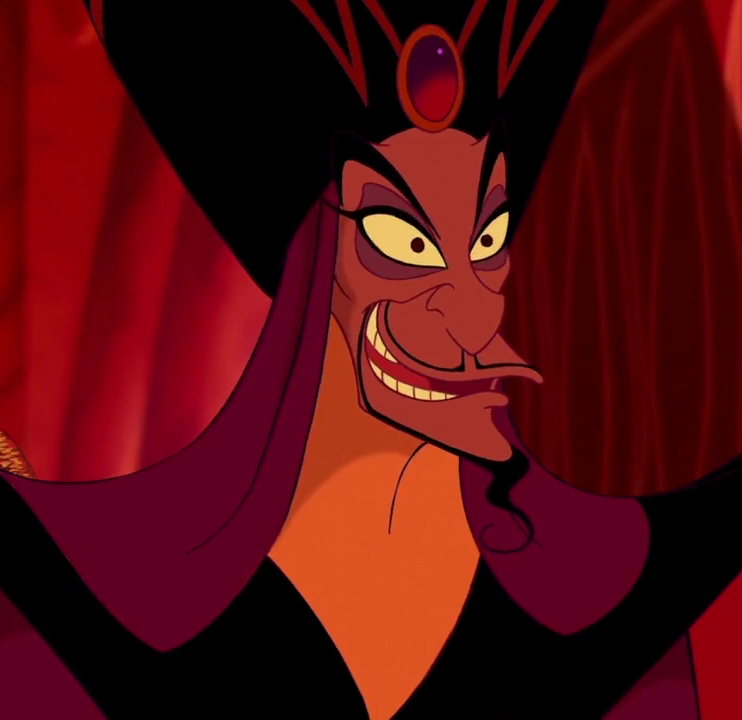
I dislike PJ Grima for his looks. It's very childlish, how they make him look evil.
Common.. it's Tolkien... not Disney.
I don't remember Tolkien describing him looking that bad, almost as an orc.
A little bit pale face, yeah... heavy eyes bag... sure.. that's fine.

But Peter is always like...
Hey.. we need bad character... let's make him look like:
-
jafar-aladdin-disney-artinsights.png
 
The chapter includes yet another grouping of “grey rain curtains, silver, glass, and green country”. That makes it four in the story that I know of: #1) The view out the window in Bombadil’s house, 2) Frodo’s dream in Bombadil’s house, 3) Frodo’s final view at the end of the story.

And now, #4…
“’Now, lord,’ said Gandalf, ‘look out upon your land! Breathe the free air again!’…From the porch upon the top of the high terrace they could see beyond the stream the green fields of Rohan fading into distant grey. Curtains of wind-blown rain were slanting down. The sky above and to the west was still dark with thunder, and lightning far away flickered among the tops of hidden hills. …Suddenly through a rent in the clouds behind them a shaft of sun stabbed down. The falling showers gleamed like silver, and far away the river glittered like a shimmering glass.”
 
I'm just listening through the Andy Serkis narrated audiobooks, and am right in this chapter. As I do with each re-read, I noticed a gem I had missed.
When Théoden gives Grima the choice of riding with him, or taking a horse and going where he wanted (and into exile), Eomer mutters: "And if any [horse] will bear him!" It's such a quick aside that it's easily missed, but it is such a Rohirric insult, I laughed so hard😂
 
Back
Top