Milantex
Member
- Joined
- Apr 4, 2010
- Messages
- 3
Good day to you all.
I am Milan Tair and I am new to Sindarin (actually, I've tried learning it some 4 years ago, but without luck).
---------------------
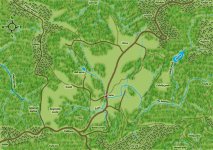
Now I'm kind of giving it a try again, and the first thing that I'm trying to do is make a map of a place called Divčibare (on mountain Maljen in Serbia), but I'm finding it really hard, so I ask for your help. Please help!
My first try was to translate the name Divčibare.
Divčibare is a Serbian compound word of two words.
The first word is dilje (meaning WILD).
The second word is bare (plural of bara, meaning PUDDLE, or any other closed part of terrain holding water).
The dictionary, or source I used for learning Sindarin and looking up the words gave me these results:
English - Sindarin
puddle - both
wild - alag
When making compounds in Sindarin I read that bot words take the same number, so in this case it is plural, making the words:
both => myth
alag => elaig
From this, following order of atr.+n. I made the compound that translates Wild puddles as Mythelaig.
I hope that this is correct and that I followed the lessons in the book well.
Would someone familiar with Sindarin confirm that it is correct and the the meaning really gives the idea that the name explains it something like:
Puddles that are wild how it is from Serbian. Or simpler as: Wild puddles.
I hope I didn't miss a mutation or something there!
---------
Now, as I have said, it was really hard and I would really appreciate if someone could help me out translate (or make compounds) of the following names of places in Divčibare, Serbia. (I will try to explain a bit the meaning):
Golubac - (golub - PIGEON, -ac is a form of making it a name of a place where there are PIGEONS in a diminutive at the same time), so making it a diminutive form of a place where there are pigeons.
Stražara - is a guard box, or... a watchtower - sentry box
Pitomine - Pitomo (a.) means tame, docile or domesticated (can also mean gentle). -ine means that the thing that is tame or domesticated is a non-live thing in plural, most probably hills, because it is the name of a group of hills covered in sparse forest under a mountain peak.
Kraljev sto means "The King's table". I'd like this to stay as two words, but I couldn't find the word for table to translate it on my own.
Nikšića gradina means Garden of (someone with last name) Nikšić. Nikšić is pronounced as Nick-shi-ty (please lookup Ć in IPA to know the exact sound).
Breza means Birch (a sort of a tree) - I didn't find it in my Sindarin dictionary.
Ljuti krš - Ljuti means ANGRY or MAD (at someone, not like mentally ill) and krš means KARST as a sort of landscape topography.
Paljevine - closest translation is Burnt fields. This was way to hard for me to even guess how to form in Sindarin.
Vražji vir - Vražji is an archaic way of saying DEVIL'S - and vir is VHIRL or SWIRL (in liquids), so meaning: DEVIL'S VHIRL
Velika pleća - Velika means BIG and pleća means Shoulders, but not just shoulders. Pleća means Back and Shoulders together as a whole. I don't know if there is a word in English for that.
Divnića polje means Field of (someone who's last name is) Divnić. So... Divnić's field. Div (as in Divide) + -ni (as in Nick) + the sound of letter Ć from above.
Crni vrh means the Black Peak (mountain peak).
Vučji dol - Vučji means THAT OF A WOLF or WOLF'S - and dol is an archaic short of dolina meaning VALLEY. So all in all: WOLF'S VALLEY
Paljba is a place where soldiers go to practice shooting targets. Pali!!! is an imperative of the verb and means FIRE!!! as an order. So Paljba is the ACT OF FIRING, but here also means the place where that act is... acted... fired... get the point I hope!
Borova strana - Bor means PINE and Borova means THAT OF A PINE or PINE'S - and strana means SIDE. So it is not actually PINE'S SIDE, but the SIDE (of something - part of landscape) WHERE THERE ARE PINES, opposed to the other side where there are none.
Bukovska reka - Bukva means BEECH (tree) and Bukovska would mean THAT OF A BEECH or BEECH'S - and reka means RIVER so: BEECH'S RIVER, or RIVER OF BEECH (not of THE Beech, but of BEECH in general - of all Beech) or Beechian river.
Tulimirski podrum - Tulimir is the first name of the first owner of the basement (podrum means BASEMENT/CELLAR), so Tulimirski (that of Tulimir) and podrum together mean: Tulimir's cellar. In that place, a very long time ago, was a vine cellar of a person called Tulimir who owned an Inn close by.
Beli narcis - beli means WHITE and Narcis is the name of a flower - in English it is Narcissus, but I couldn't find the name in Sindarin. Beli narcis means The White Narcissus.
Vidikovac translates to VIEWPOINT, but the more precise explanation is that it is a place (a point on the landscape somewhere) where you can see all other important places from. It is not like a watchtower, but rather as a cliff from which you can see everything. Remember the Prime rock from Lion King. That's the idea. Maybe Sindarin has a word for that. Praised be Tolkien.
Žujan - Means nothing really. It is a name of a water spring. Please lookup Ž in IPA and tell me which Sindarin sound can best be used to transliterate the name since it can not be translated. Additional information: The noun gender is masculine.
Galačka greda - this is a very hard one... in English, that is. Galačka means THAT OF ČALAK (CHALAK). Čalak means nothing. It is a name of a place. The root of the word is old and archaic and I do not really understand its meaning, so I'd leave it as CHALAK even for Sindarin. Now, greda means BEAM, JOIST, RAFTER according to my pocket dictionary for English. So.. CHELAKIAN RAFTER.
Galački potok - Čalački - same as above, only the thing that is CHALAK's is a RIVULET (potok).
Crna kamenica - crna is BLACK and kamenica is a name of a small river named ROCKY RIVER. So: Black rocky river is the translation of the compound.
Please help me out with this. I'd really like to make this map better and in Sindarin.
Thank you all in advanced.
All the best, Milan.
P.S. Sorry for possible misspelled or mistyped words.