• Welcome to The Tolkien Forum! Connect with fellow Tolkien enthusiasts and join a community that is over two decades old, and still going strong. We look forward to meeting you.  Register

What if Bilbo hadn't given back the Ring?

Joined
Feb 19, 2018
Messages
267
I keep wondering this. He nearly came to the point of attacking Gandalf with Sting. What if he point blank refused to part with the Ring? What was Gandalf meaning by "You shall see Gandalf the Grey uncloaked!" and how was that a threat?

I don't see how Gandalf, even in Valinor Mair-form, could have taken the Ring from Bilbo by force without being corrupted by it in the process.
 
Gandalf would not try to take it from him by force, there I certainly do agree with you, as he said so himself:

There was little else that I could do. I could not take it from him without doing greater harm; and I had no right to do so anyway. I could only watch and wait.​

The rest would make an entirely different story...

Something always puzzled me at the moment he abandoned the Ring. In telling the event to Frodo, Gandalf said i.a.:

And even so he would never have just forsaken it, or cast it aside. It was not Gollum, Frodo, but the Ring itself that decided things. The Ring left him.​

The discussions that followed next did not entirely clarify this thought... o_O
 
I'm not sure I follow you, Merroe -- are you talking about Bilbo or Gollum here? These are two different incidents: the Ring left Gollum, Bilbo left the Ring.

As for the argument in Bag End, we know Gandalf sometimes displayed a short temper, and did not suffer fools (or foolish behavior) gladly; the way I read it, it is not Bilbo's refusing to give up the Ring that angers him, but the accusation that he wants to "rob" him of it:

'Well, if you want my ring yourself , say so!' cried Bilbo. 'But you won't get it. I won't give my precious away, I tell you.' His hand strayed to the hilt of his small sword.

Gandalf's eyes flashed. 'It will be my turn to get angry soon,' he said. 'If you say that again, I shall. Then you will see Gandalf the Grey uncloaked.'


This seems explicit, when Gandalf says:

'I am not trying to rob you, but to help you.'

This, of course, after they had both calmed down a bit. Bilbo had known Gandalf for many years, and the accusation that he might try to rob him, or do anything to hurt him, would naturally rouse his ire.

Remember that at this point, Gandalf knew little about this particular ring, other than, as he later tells Frodo, that it was one of the Great Rings; so Bilbo's words come as an unexpected shock to him, and he reacts in anger.

I'm not sure where "uncloaked" entered the story; the first chapter was written and rewritten many times, and in fact, it was originally Gandalf who came up with the "joke" -- the necessity of passing on an accursed object with a "light heart" is a common motif in folktale. I'll try to find the relevant text in HoME, but I'm not certain Christopher Tolkien included it.

In any event, I wonder if the author himself was entirely clear on the meaning of "uncloaked"; certainly not something like Zeus and Semele, and anyway, the Istari were "forbidden to reveal themselves in forms of majesty". I think it would likely have been an intensification of what did happen:

He took a step towards the hobbit, and he seemed to grow talk and menacing; his shadow filled the little room.

This alone was enough to have a salutary effect on poor Bilbo! And that was no doubt the intent.
 
Last edited:
I'm not sure I follow you, Merroe -- are you talking about Bilbo or Gollum here? These are two different incidents: the Ring left Gollum, Bilbo left the Ring.

You are right SES; the complete quote is this:

But as far as I know Bilbo alone in history has ever gone beyond playing, and really done it. He needed all my help, too. And even so he would never have just forsaken it, or cast it aside. It was not Gollum, Frodo, but the Ring itself that decided things. The Ring left him.​

Both events being addressed in one breath, it got me confused.

I also want to mention limitations of Astari in the use of their powers (the use of violence, in particular) but I'm currently not at home and have no access to my books but maybe someone can clarify that Gandalf could not apply force to take Bilbo's ring.
 
I've just realized something about the scene where Gandalf tests the ring to see if it has the writing he is looking for in Shadow of the Past.

In Tolkien's text Frodo (rather unwillingly) gives Gandalf the ring who holds it in his fingers to look for the writing before casting it in the fire and then using the tongs to drop it (quite cool) into Frodo's hand. Thus Gandalf does handle the ring momentarily but doesn't put it on of course.

In PJ's film Frodo finds the envelope containing the ring in a chest and gives the envelope to Gandalf. Gandalf immediately throws the envelope into the fire (Frodo seeks to rescue the ring from the fire in both versions). Again Gandalf uses tongs to remove the ring from the fire and drops it into Frodo's hand. The envelope had quickly burned up to reveal the ring. Thus in PJ's version Gandalf avoids handling the ring. Thinking about it this works better with the whole story (heretical to say PJ improves on Tolkien I know but I think true in this instance). The ring going into Frodo's fire may be a kind of visual prophecy of its final fate.
 
Thus in PJ's version Gandalf avoids handling the ring.

It's the Black Hole theory of the Ring. I won't repeat my idea on that aspect of the scene, but you can see it here, if you like:

http://thetolkien.forum/index.php?t...st-alliance-weaknesss-or-inevitability.23609/

On your last point, yes, that is one of several aspects of the episode that are important to the structure of the story. I believe katabasis imagery is present here also, though not so pronounced as in the parallel "Mirror of Galadriel" episode.
 
Last edited:
In PJ's film Frodo finds the envelope containing the ring in a chest and gives the envelope to Gandalf.
When trying to understand something in Tolkien's works it's generally not productive to think about the scene as portrayed in the movies. Tolkien was pretty careful about what he wrote and chose his words and the ordering of them deliberately.

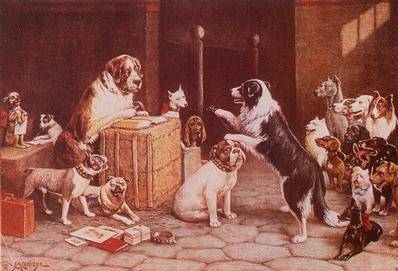
It's like trying to understand nuances of a US Supreme Court Case by analyzing this painting.

breach_of_promise_suit.jpg
 
Barliman

As I said "heretical" - but then I must be a heretic because I find the books and the films often complement each other. But the honours go to Tolkien, of course, who created Middle Earth and its literature in his own mind - whereas PJ merely portrayed Tolkien's creation.

So a better analogy may be an art gallery director who, say, puts on an exhibition of Rembrandt paintings

Thanks for that link Squint-eyed Southerner. Yes in the book, although Gandalf handles the ring he never claims it for himself though it would have been so easy to do so. Another tick for Gandalf.
 
Last edited by a moderator:
I doubt any gallery directors would replace Dr. Tulp's forceps with a bone saw because they think it would be more dramatic and improve the scene.
 
Last edited:
Not to get into a discussion about the film vs the books, but the decision by Jackson to NOT have Gandalf touch the ring at all was perhaps a good one for movie goers to understand more clearly in a short amount of time that Gandalf did not want to be tempted by the ring, but Frodo OFFERS it to Gandalf, " Will you not take the Ring?" where Gandalf springs to his feet, "....Do not tempt me!!!!"

As for the question at hand, "What if Bilbo hadn't given back the Ring?" is an interesting one. Gandalf might have tried to persuade Bilbo more and more. If that didn't work, Gandalf might have to let Bilbo leave and ask the Rangers to watch his movements more closely. Perhaps when Bilbo eventually got to Rivendell ( where he said he ended up going on his own), and Gandalf found out more that it was the "One Ring" more persuasion might be used by Elrond and Gandalf for him to give up the Ring.

Sauron would eventually find out that "Baggins" lived in Hobbiton and Frodo might be captured to find out more information. Sauron would still try to find out where Bilbo is.

I think that Bilbo would most likely end up giving up the ring if he did it sooner or later before the effects of the Ring would really begin to take a deeper hold, and perhaps it would be a bit longer if he was in Rivendell.

If, in the end, Bilbo could not or would not give up the Ring, Sauron would continue with his siege on ME with Rivendell and Lorien be like islands in the midst of war that would eventually be overcome.

I don't think anyone in Rivendell would try to steal or take the Ring from Bilbo to destroy it. Trying to possess the Ring through stealth would render the thief unable to give it himself and the Ring would not be destroyed.
 
Not to get into a discussion about the film vs the books, but the decision by Jackson to NOT have Gandalf touch the ring at all was perhaps a good one for movie goers to understand more clearly in a short amount of time that Gandalf did not want to be tempted by the ring, but Frodo OFFERS it to Gandalf, " Will you not take the Ring?" where Gandalf springs to his feet, "....Do not tempt me!!!!"
Yeah. With the addition of scenes that never occurred in the book I can see the need by Jackson to cut corners on other things actually germane to the story.
 

Similar threads

Back
Top