• Welcome to The Tolkien Forum! Connect with fellow Tolkien enthusiasts and join a community that is over two decades old, and still going strong. We look forward to meeting you.  Register

Which Black Arrow version did you prefer?

Which Black Arrow version did you prefer?

  • The Movie - there's no way Bard could take down Smaug with a regular "lucky" arrow

    Votes: 0 0.0%
  • The Book - stick with Tolkien

    Votes: 8 100.0%

  • Total voters
    8

Spirit of Fire

The Rekindler
Joined
Jun 16, 2020
Messages
129
What did everyone think of the black arrow in the movie? Did you like that it was a more devastating dart (making it more believable that Bard could kill Smaug)? Or would you have preferred the highly improbably shot with a regular arrow, taking down a Winged Fire-drake?
 
Book arrow was not a "regular" arrow. It was magic arrow which was apparently some kind of a self-guided missile, seeing how Bard said it never failed him. "Black arrow" in movie is just a ballista bolt, which... is triumph of technology over magic as I see it.

So definitely book version.
 
Book arrow was not a "regular" arrow. It was magic arrow which was apparently some kind of a self-guided missile, seeing how Bard said it never failed him. "Black arrow" in movie is just a ballista bolt, which... is triumph of technology over magic as I see it.

So definitely book version.
That's quite a stretch. I also didn't say it was just a regular arrow. I referred to it as a regular "lucky" arrow in the poll, which is in reference to it never failing Bard. The accuracy isn't really the issue with it. It's the damage that a regular-sized arrow could inflict on a massive dragon.
 
I thought Rankin-Bass did a very good job of depicting the Black Arrow. It was exactly as Tolkien had described it, and the exposition of the history and relevance of the Black Arrow in the Rankin-Bass Animated adaptation of The Hobbit continues to be the definitive adaptation, to date.

I don’t know WHAT Peter Jackson THOUGHT he was producing. But it WAS NOT the novel titled “The Hobbit, or There and Back Again” written by JRR Tolkien in the 1920s/30s as a children’s story that originally only borrowed from his greater Mythopoeia, and later was integrated into that Mythology and setting when he discovered while writing a sequel for The Hobbit that it in fact was a culmination of the last Story-Arc that began during the First Age of Middle-earth, with the rebellion of the Noldor, and their return to Middle-earth from Aman/Valinor.

Jackson certainly created a movie that HAD “hobbits” and other peoples that were similar to those in Tolkien’s novel. And it certainly had events, characters, and places/settings in the movie that were similar AT BEST to events, characters, and places/settings that were in Tolkien’s works.

But it also contained things that CATEGORICALLY COULD. NOT. EXIST. within Tolkien’s Middle-earth.

Given how the basic rules of our Universe Function, and the existence of things such as Ontology, and Logical Operations such as Universal and Existential Quantification or Qualification...

When something is defined as having “For all ‘X’, There Exists a ’Y,’ where ‘Y’ is equal to the set {a_0, a_1, a_2, a_3, a_4, ...., a_n-1, a_n} and only to that set, such that if any other elements are in the set of ‘Y’ other than {a_0, a_1, a_2, a_3, a_4, ...., a_n-1, a_n}, then that set is ‘~Y’ (not-Y); AND For All X, Y must exist as the ONLY ELEMENT OF X.” Thus... As The Hobbit, or There and Back Again by JRR Tolkien is our ‘X’, which contains within it specific elements and properties that define the “Set of ‘Y’. If some “Instance” of ‘X’ contains a ‘Y’ that has as a member or members {b_13, v_3^e, g_0, g_1, g_2, g_3, g_4, ...., g_n-1, g_n, ...}... Then whatever this is is NOT ‘X’. And it remains ‘~X’ even if it contains a ‘Y’ that contains {a_0, a_1, a_2, a_3, a_4, ...., a_n-1, a_n, ...} in addition to the other member or members I listed at the end of the preceding sentence.

It is Something Else at that point, but is NOT JRR Tolkien’s The Hobbit, or There and Back Again.

And this remains true regardless of the Production Values, Awards it May have been nominated for or won, the quality of the Acting, the Special Effects, the amount of Money it Made or ANYTHING ELSE.

As that said... One of the things that is not in JRR Tolkien’s The Hobbit, or There and Back Again is a giant ballista in Laketown (nor in Dale before it) that shot huge wrought-iron arrows. And that is just one of over 500 things people have recorded of “Things that exist neither in JRR Tolkien’s The Hobbit, or There and Back Again, nor in ANY of JRR Tolkien’s associated Sources that account either the overall Mythology of Middle-earth, or the stories of specific people and events within Middle-earth.” (I cannot recall the exact number that came-up in out detailing the deviation of Jackson’s “adaptations” of Tolkien’s works from those works. But I do recall that The Lord of the Rings contains only about ⅓ the number of such deviations from Tolkien’s works as did the production of “The Hobbit.“ I just remember becoming despondent when we hit 500 somewhere near the end of the second movie in “The Hobbit.” This was part of an assignment that a friend had for his graduate work in Film at UCLA, where we watched all of the different productions and adaptations of Tolkien’s works, whether Film, or Audio/Radio... The BBC Adaptations were the most faithful by far. They had NOTHING in them that wasn’t contained within Tolkien’s works, AND they managed to avoid a great many cuts of material as well. We have had an idea of producing some Animated Scenes using the BBC Radio Adaptation as the soundtrack and voice-actors of the characters*).

So... As to “Which Black Arrow version did I prefer?”

That would be the version that was closest to what Tolkien actually wrote, which was a guy with a Military Longbow (110lb to 220lb draw) shooting a Yard-Long, Heavy, Broadhead-Warhead (Arrow-heads are where the term “Warhead” comes from) Arrow that was likely a fire-hardened hardwood shaft (which could account for it being “Black,” beyond many Archers coloring their arrows at times) at least 36” long (they are typically about 31.5” for a typical “War Arrow”), that had a diameter of roughly ½” that could taper from 9/16”, and the Broadhead Warhead would likely weight about 2oz. Collectively that would put the arrow at about ¼ to ⅓ lb.

And, Medieval Longbowmen sometimes used Arrow-points (Warheads) that were not permanently fixed to the shaft. So that when they penetrated a Target, the shaft could often fall out of the wound, causing more bleeding (there is a lot of controversy on that subject). And this would often allow Archers to retrieve shafts that were especially good (typically used for hunting, though. You’d rarely have an arrow used in warfare returned to the archer who fired it, if it was recovered at all)

Given the Rankin-Bass Animated production is the only Adaptation that fits these categories... That’s the “preferred” version.

And technically only version, as I point-out above.

MB


* To get this out of the way... One of the first things that is taught during a formal education in a “Film Major” at a University is that there is absolutely nothing that NECESSARILY DEMANDS/requires you to “alter” an original work in adapting it to the screen. Run-Time does place constraints on an adaptation that could require some cutting of material and changing the exposition. But this is not a Necessary Requirement. It is a Contingent Requirement, meaning that if a Director was committed to creating a Faithful Adaptation, and had the backing of a studio, that Studio could grant them the run-time/screen-time for Production to do a Faithful Adaptation/Production.

And... In the case of the catastrophe that is Jackson’s failure of the three movies of The Hobbit, Jackson was given MORE THAN ADEQUATE SCREEN-TIME to accomplish what would be not just a completely faithful adaptation of The Hobbit, but he also had the luxury of about 30 to 50 minutes of Screen-Time to include materials from Unfinished Tales (Such as The Quest for Erebor), or to produce a REAL adaptation of the Assault on Dol Guldur (which wasn’t a crumbling ruin, but a fully functioning fortress city, with about 10,000 Easterlings, just as many Orcs, and probably a handful of Trolls and a slew of Dunlendings. It was assailed by some 10,000 Elves from Lórien, and about half that number in descendants of the former Peoples of Rhovanion, who were displaced from their Homes by the Wainrider Invasions of the 19th and early-20th Centuries of the Third Age).

A General Rule-of-Thumb in Hollywood for converting Written Works to Screen is “1 Page === 1 Minute of Screen-Time).

The Hobbit has roughly 290 to 360 Pages in it, depending upon the edition, and Hardback/Softback printing.

That amounts to 290 to 360 minutes, total, of Screen-Time for only The Hobbit (4hrs & 50min to 6hrs).

Another way to calculate Screen-Time is to break-down the chapters into an Average Screen-Time per Chapter.

The Hobbit has 19 Chapters. At 15min/chapter to 20min/chapter that gives a total run-time of 285 to 380 minutes, total (4hrs & 45min to 6hr & 20min), or roughly exactly what we have above. That would produce 3 movies with a maximum run-time of 2hrs-6⅔min each.

If we go with a base of 290 minutes for The Hobbit alone, that gives us an additional 90 minutes, minimum, to add additional content that itself can be completely faithful to Tolkien given how generous the Studios were with Jackson.

If each movie wound-up with a Run-Time of 2hrs-30min each, that would be a Total Run-Time of 7hrs-30min, or 450min, still far below that of the “Extended Editions.” That would be an additional 160min, or 2hrs and 40min of additional Screen-Time to include The Quest for Erebor from Unfinished Tales, background on how Sauron got to Dol Guldur to become The Necromancer, The ACTUAL fate of the Nazgûl after The Ruling Ring was taken by Isildur (Tombs!!?? There were no “Tombs” of the Nazgûl, that was the whole freaking point of being “Undead,” An actual assault on Dol Guldur, the real events in Mirkwood, the Pre-History of the Dwarves that included the War of the Dwarves and Goblins (called The Goblin Wars in General parlance of the Dwarves) where we see Azog SLAIN by Dain Ironfoot, and WHY that is such a freakishly big deal (Dain was only something like 34 at the time... For a Dwarf, that is akin to being 12 to 15. This was like a kid who just entered High-School and made the Varsity Football Team while still a Freshman, and then he killed not just a Navy SEAL, but the most dangerous Navy SEAL to have ever existed at his Prime)... As well as foreshadowing why the Dwarves did not then reclaim Moria (Dain, when killing Azog, saw the Balrog lurking just inside the East Porch of Moria).

So... Any excuse that a Novel or “Written-Work” must be changed to adapt it to film.... That isn’t a thing.

Beside the fact that if a written-work must be changed to adapt it to film, then it would be impossible to adapt any book to a film.

Because a Script IS a “Written-Work.” A Script is just a Novel that has been written in a different format. If you had to change a written-work to adapt it to film, you wind-up with a recursive infinite-loop...

Jackson was given the Holy Grail of Director’s Fantasies and Wet-Dreams... And he screwed-it up.
 
Yes, it's convenient that there happens to be a chink in Smaug's armor directly over his heart. Yes, it's convenient that there is a bird that is able to convey this information to Bard and that he can understand it. Etc.

But the book is a fairy tale. Such conveniences are expected. Tolkien didn't think that much about the book and really didn't take it all that seriously himself.

Putting the movies' attempts to make the slaying of Smaug more believable, it seems to me absurd the film created a situation where Bard should put his own son in danger.
 
Last edited:
Yes, it's convenient that there happens to be a chink in Smaug's armor directly over his heart. Yes, it's convenient that there is a bird that is able to convey this information to Bard and that he can understand it. Etc.
When it comes to chink in armour, I always thought it was because beating of Smaug's heart prevented anything from sticking there.
 
Yeah, that was always kind of my thought too. The area above the heart is hotter than the rest of Smaug and that has something to do with the treasure not stick to it.
 
Yes, it's convenient that there happens to be a chink in Smaug's armor directly over his heart. Yes, it's convenient that there is a bird that is able to convey this information to Bard and that he can understand it. Etc.

But the book is a fairy tale. Such conveniences are expected. Tolkien didn't think that much about the book and really didn't take it all that seriously himself.

Putting the movies' attempts to make the slaying of Smaug more believable, it seems to me absurd the film created a situation where Bard should put his own son in danger.

But that is the very essence of what we call “Faery Tales.”

That the Hubris of Evil leads to it succumbing to flaws that it overlooks due to that hubris.

And, that the movies contrived all sorts of things that not just Did Not Exist in Middle-earth, but Could Not Exist in Middle-earth. The situation of Bard endangering his son’s life is something that fits in both of those categories given the overall situation of the Dragon.

OH! And speaking of “The Dragon.”

It wasn’t a Dragon by the standards of Middle-earth.

Dragons in Middle earth ALL have four legs, whether they have wings or not. And if they have wings, they will also have Four Legs in addition to the Two Wings.

Tolkien left us an enormous number of sketches, paintings, and descriptions where his Dragons conform to the Nordic, Germanic, and Saxon/Goth Dragons, which are of the Four-Legged + Two-Wings IF they are also winged Dragons.

And that is true whether they are capable of breathing-fire or not.

Things that have but two-legs + two-wings: Fell-Beasts, or other corrupted/deviant flying beasts made via the corruption of carrion-birds, Bats/Vampires (again, to Tolkien and Middle-earth, a Vampire isn’t the Carpathian Undead, but an enormous Bat that might-or-might-not be capable of shape-changing into a Human. Werewolf’s, similarly, were just enormous wolves, with any who were also Ainur/Maiar — like Sauron — able to shape-change to a Humanoid body, akin to most other Ainur).

Jackson’s movies are a fan-fiction that heavily plagiarizes Tolkien’s Middle-earth Legendarium.

But as I point-out above. They are not “Tolkien’s Middle-earth.” They are “something else.”

MB

When it comes to chink in armour, I always thought it was because beating of Smaug's heart prevented anything from sticking there.
No, just the fate/doom of the Hubris of Evil.

MB
 
And, that the movies contrived all sorts of things that not just Did Not Exist in Middle-earth, but Could Not Exist in Middle-earth. The situation of Bard endangering his son’s life is something that fits in both of those categories given the overall situation of the Dragon.
I'm not sure I understand.

OH! And speaking of “The Dragon.”

It wasn’t a Dragon by the standards of Middle-earth.

Dragons in Middle earth ALL have four legs, whether they have wings or not. And if they have wings, they will also have Four Legs in addition to the Two Wings.

Tolkien left us an enormous number of sketches, paintings, and descriptions where his Dragons conform to the Nordic, Germanic, and Saxon/Goth Dragons, which are of the Four-Legged + Two-Wings IF they are also winged Dragons.
That's actually one thing I'm not too hung up about. I actually prefer four-limbed dragons. I'm kind of an enthusiast of physiological and skeletal structures and it's hard to imagine how a skeleton could accommodate two sets of sockets (not a fan of winged horses, lions, etc. either). Anyway, it's a mere detail to me. It's when the details of a story are changed or perverted that gets my goat.
 
I'm not sure I understand.
Has to do with the basic concepts of Metaphysics and Theology that form the Foundations of Middle-earth’s Identity (as explained in the Preface to Volume X of The History of Middle-earth: Morgoth’s Ring, and which Tolkien preemptively covered in Letters #200 to roughly #215 in The Letters of JRR Tolkien), concerning “What is Middle-earth” and “What is not Middle-earth” (And why that was so important to Tolkien).


That's actually one thing I'm not too hung up about. I actually prefer four-limbed dragons. I'm kind of an enthusiast of physiological and skeletal structures and it's hard to imagine how a skeleton could accommodate two sets of sockets (not a fan of winged horses, lions, etc. either). Anyway, it's a mere detail to me. It's when the details of a story are changed or perverted that gets my goat.

I’m a freaking biologist, and thus have a huge freaking interest in the Physiology of such things (I even worked on a series, tentatively for Netflix, then Amazon Prime, that again got derailed as in most past attempts, for a famous Sci-Fi Series, where I detailed the Anatomy and Physiology of a fairly well-known tripedal species involved in that Universe to explain how its various organs could function — When I am released from the NDA, or the series is ever produced, I will have a paper on the subject of Alternatives to the Eyeball for Visual Senses and Transduction of Light — and other EM Radiation — Into Visual Perception)¹.

Dragons with four legs and two wings are pretty easily dealt with, especially when you take into account the former Metaphysics and Theology.

Middle-earth has different Physics than does our world. The Basic Properties are nearly identical, save that they are incomplete.

So, while Gravity on Middle-earth remains as an Orthogonal to the Surface 9.8m/s² (even on a “Flat Earth/World,” for which there IS a topology where such a thing results on one surface of the object), and the Air Pressure is the same 1atm or 101325Pa… And where you find some basic things like F=ma, Fg = G(Mm)/r², e = mc², ΔG = ΔH + TΔS, |F_e| = k_e(|Qq|)/r², PV = k (or P∝1/V), and so on….

But there are incomplete in a Universe where Cartesian and Manichaean Dualism are True, as they are missing the components for the “Non-Material Components of the Universe.”

So instead you would have things like:

F=mθφa, Fg = G(MΘΦmθφ)/r², e = mθφc², ΔG = ΔH + TΔS +ΔθΔφ, |F_e| = k_e(|QΘΦqθφ|)/r², …

The PV = k (or P∝1/V) for Boyle’s Law of Pressure would be a bit trickier, as θ and φ (The Variables for Cartesian and Manicheaen Components of the Universe) are parts of each variable, so pressure would have a P_θ and a P_φ, as well as for Volume, with a V_θ and V_φ, each calculated by an as yet unknown relationship for how the “stuff” that makes up the non-Material Cartesian, and the Material AND Non-Material Manichaean components of Eä, and thus Arda and Middle-earth).

Trying to play it off as “It’s Magic” doesn’t fly with either Catholicism nor with Tolkien, who expressly states this in The Letters of JRR Tolkien).

In Fact, it’s a heresy in Catholicism to claim the Universe itself is not “Knowable by Mankind.” And thus claiming that things like “How Dragons Fly” or “How a Ring of Power Works” (which is freakishly simple when you include the Cartesian non-material and Manichaean components) are a “Mystery” or “Magic” would send Tolkien flying into a tizzy or even outright rage (especially since to Tolkien “Magic” === “Satanic”).

The Physiology of a four-legged Dragon in Middle-earth is no more a problem than is the Physiology of an Octopus on our Earth. And technically even in our Universe such a thing wouldn’t be impossible. We’ve just not seen HOX Genes that ever demanded an additional set of limbs that then evolved into wings.

But I know how to ADD the HOX Genes for a Bat’s Wing into a Genotype of a Lizard (as in, Go into a Lab and extract the HOX genes from a Bat’s Genome, and then stick that portion of the Genome into a random Lizard’s Genome — CRiSPER makes it even easier than with older methods based solely on PCR) to produce an additional set of limbs that are Bat’s Wings that would exist someplace in the middle of the Lizard.

Would they work?

No… Because the Bat’s wings didn’t evolve to work on a lizard.

But give me 10,000 generations or so of selecting the offspring of each subsequent generation with wings that are better adapted to flight, and breed those… and the Wings would evolve into something that WOULD WORK.

But in Middle-earth we have an even easier time of such things, as Evolution in Middle-earth does not allow for Speciation. So just forcing a Bat to mate with a Lizard is all that is needed (which is How Sauron created the Dragons for Morgoth to begin with — And Tolkien tells us in multiplayer locations that it was Sauron who did all of the heavy lifting on all of Morgoth’s projects, from the building of Utumno and Angband, to the making of Orcs, Trolls, to the conversion of Ainur to various things from Balrogs to Werewolves, to the Boldog/Boldoeg Orcs, to other critters like Thuringwethil, and so on, to the making of dragons of all kinds).

None of these issues are problems within Middle-earth.

They are only problems here in this Universe, where it is far less cooperative with Christian Theology and Metaphysics than is Eä (and thus Middle-earth inside Eä).

MB

1. Among other such things that I could write about alternatives to our Organ Systems for things like Hearts, Lungs, and even Brains, especially among a species with a genetic predisposition to paranoia and fear that they have engineered their entire civilization to avoid even accidental injury, and thus would also have genetically removed biological threats and otherwise optimized their biology to eliminate the “just-good-enough” of biological evolution, just as a start. Like distributing their circulatory organs so that the failure of one is no more of a problem for them than would be losing a toenail to us. Or doing the same for their “brains” by producing a decentralized neurology where neurological Pre-Processing is done at the sites of sensory transduction, and the various parts of a distributed “brain” are also encased in an armor, rather than being at the end of a very vulnerable “protrusion,” like Humanity’s “skull” on their “head.” Fortunately the author was prescient enough to have foreseen this, and their “brains” were already located to a thoracic cavity that was/is very well-armored and protected. I just improved upon his work a bit (I just hope that work is either preserved, or I am offered the opportunity to return to the project for whomever is now attempting to move it to production. And that if it is preserved that I get credit for it, rather than the usual Hollywood theft that occurs in situations like this, where a new production team steals everything that Remains of past attempted productions).
 
Last edited:
Scientific formulas are all well and good. I don't understand them but I appreciate the time to type them all out. I don't think it makes or breaks the fantasy to deviate from such comparatively small details. And I prefer the four-limbed dragon from both an aesthetic and physiological standpoint. If you prefer the other way, I won't contest it. It comes down to a matter of preference.

But I have to question the idea that Middle-earth physics differs markedly from real-world physics, especially since Tolkien has stated that his stories are his own version of our earth's mythical past. And there are not many indications that it's all that evident, either. Tolkien was rather reserved and understated with his use of magic, at least with what came later in the fantasy genre.

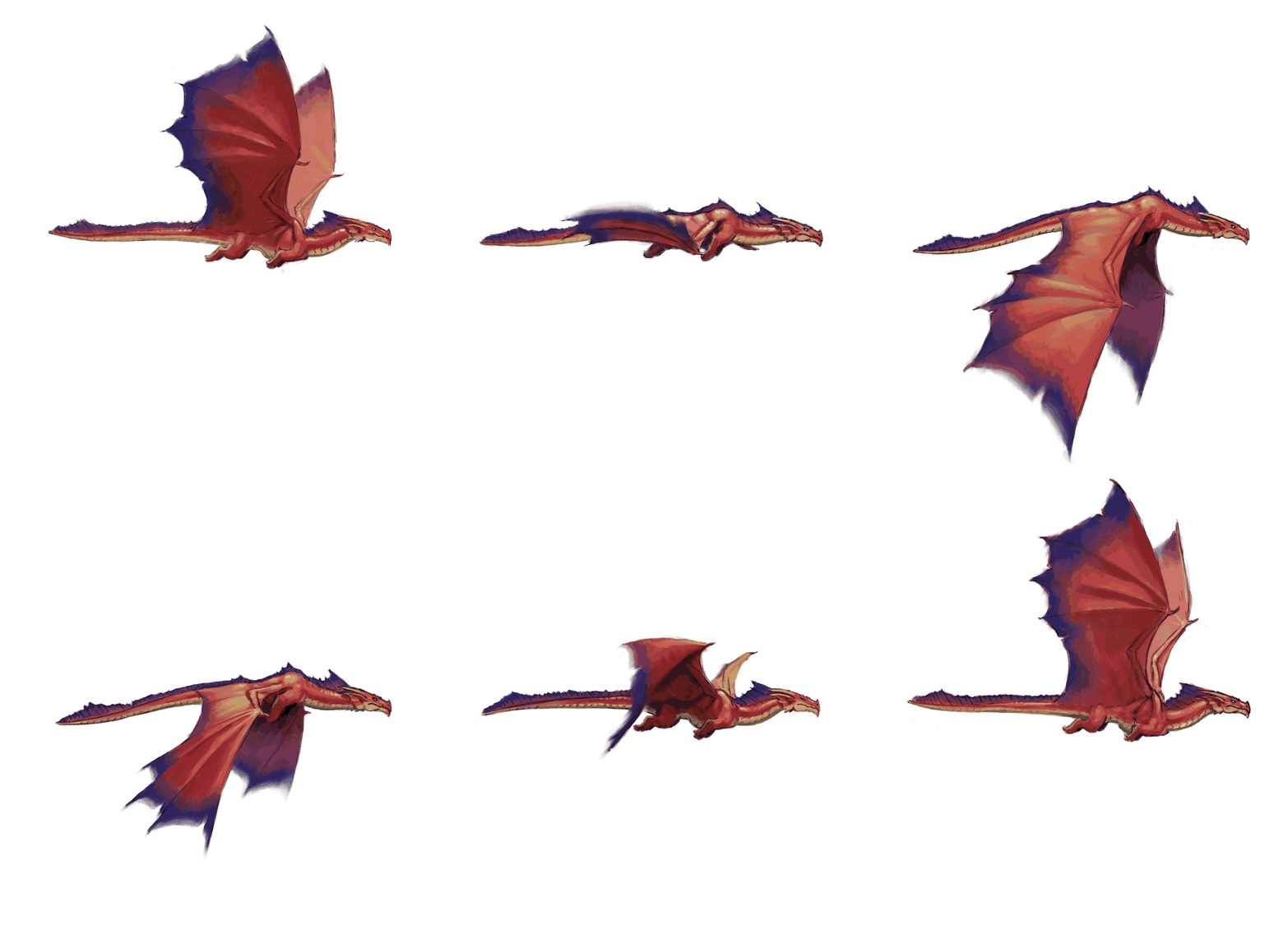
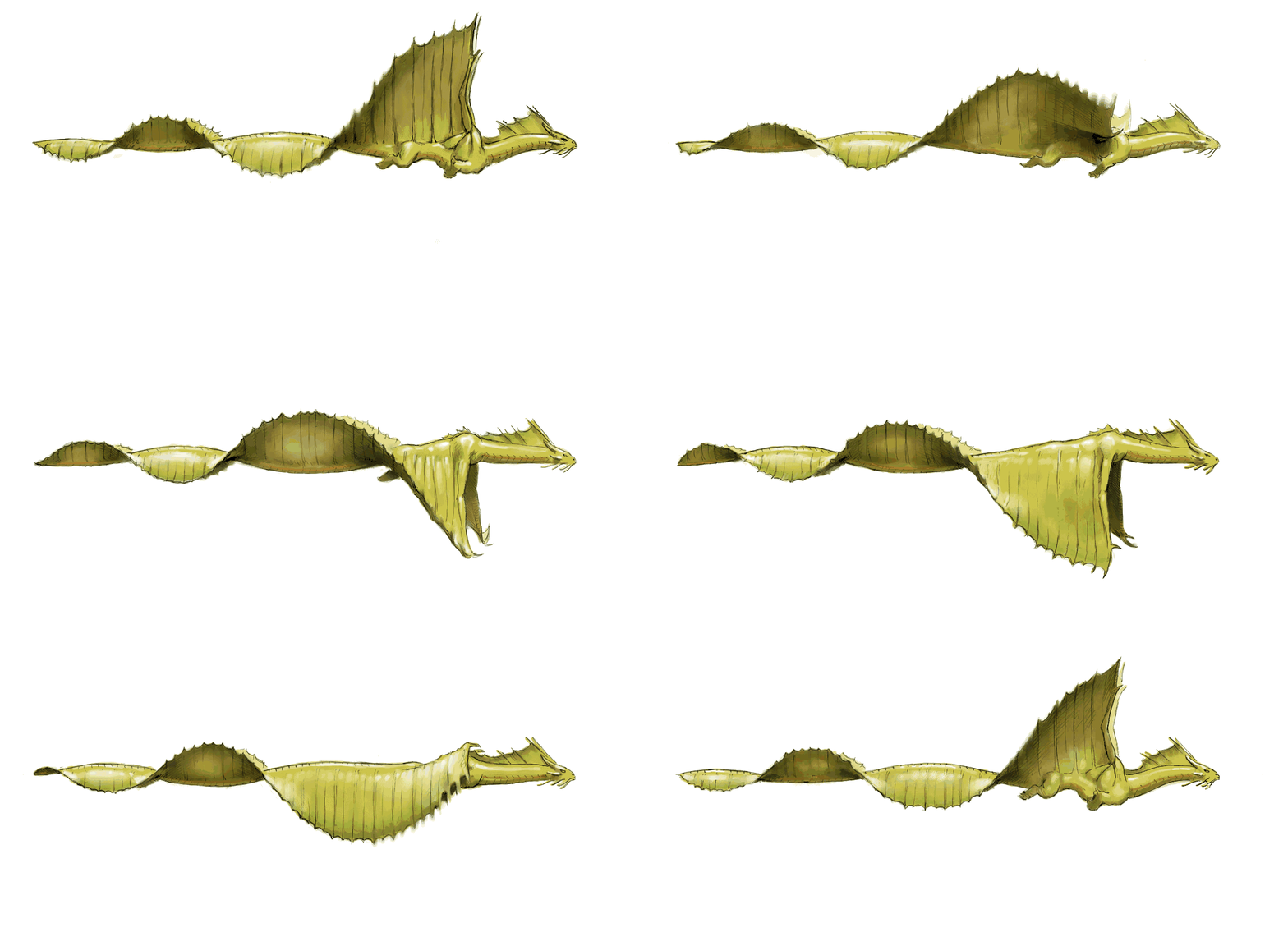
All that said, the artist who drew many of the dragons for the D&D Monster Manual did these brilliant gifs, of a red and a gold dragon in flight.

dragon-72.gif
dragon-58.gif

Still, I can't help but wonder how they attach. What does the x-ray of such an animal look like?
 
Scientific formulas are all well and good. I don't understand them but I appreciate the time to type them all out. I don't think it makes or breaks the fantasy to deviate from such comparatively small details. And I prefer the four-limbed dragon from both an aesthetic and physiological standpoint. If you prefer the other way, I won't contest it. It comes down to a matter of preference.

But the issue isn’t a “matter of preference,” as Tolkien makes clear in the references I provided on “What IS and IS NOT the Middle-earth he created.”

If I had a Dragon from Middle-earth to X-Ray, it would be, as Tolkien states in Letter #153 to Peter Hastings in September of 1954, a matter of just x-raying the thing to begin studying it. Or, as a direct quote on a subject of Biology:

“This is a biological dictum in my imaginary world. It is only (as yet) an incompletely imagined world, a rudimentary ‘secondary’; but if it pleased the Creator to give it (in a corrected form) Reality on any plane, then you would just have to enter it and begin studying its different biology, that is all.” (p. 189)

As Tolkien makes clear, all through the letters of #200 to roughly #215, what is and is not Middle-earth isn’t “open to preference.”

Different arguments can be make for different points, whether stylistic or other “preferences” in terms of what meets the ”dictums” of Middle-earth as Tolkien’s “Imaginary World,” which are constrained by the:

”… analytic speculation of the underlying postulates [of Eä, and thus Arda and Middle-earth within Eä] [that] satisfy the requirements of a coherent theological and metaphysical system.” — CJR and JRR Tolkien, The History of Middle-earth, Vol. X: Morgoth’s Ring. Harper Collins, 1993; p. x.

There are a huge number of things open to question. Nearly every one of them stylistic, with a few hinging upon the variations of Catholic Or Christian Theology and Metaphysics (and by some instances in which options can be argued concerning things such as the apparent, and heretical by most interpretation, the Manichaean Dualist examples of Light/Dark, Good/Evil whereby Tolkien presents these as things you could pick-up and put in your pocket, or bake a cake with. That and other examples of Theological and Metaphysical options can be argued based upon differences of opinion in the theological foundations).

But, Tolkien presents us with a world that conforms to specific things, without which it cannot be Tolkien’s Middle-earth, and, as Tolkien continues, the introduction of other things causes any presentation to Cease to BE Tolkien’s Middle-earth:

In the late-1950s, as someone first attempted to adapt The Lord of the Rings to film, Tolkien was send a synopsis (Story-Line) for the proposed film (to be an animation) to Tolkien for criticisms and comments (Tolkien eventually vetoed the endeavor).

Tolkien begins by noting:

“He has cut the parts of the story upon which its characteristic and peculiar tone principally depends, showing a preference for fights; and he has made no serious attempt to represent the heart of the tale adequately: the journey of the Ringbearers. The last and most important part of this has, and it is not too strong a word, simply been murdered.” — Letter #210 to Forest Ackerman, June of 1958. Letters. p. 270

“The Lord of the Rings may be a ‘fairy-story’, but it takes place in the Northern hemisphere of this earth[1]: miles are miles, days are days, and weather is weather.” — Ibid. p. 271/72

”I am sorry, but I think the manner of the introduction of Goldberry is silly, and on a par with ‘old scamp’. It also has no warrant in my tale. We are not in ‘fairy-land’, but in real river-lands in autumn. Goldberry represents the actual seasonal changes in such lands. Personally I think she had far better disappear than make a meaningless appearance.” — Ibid. p. 272 [Note: Tolkien would rather see an obliteration of his work that to see it reduced to meaninglessness, or worse: mockery, misrepresentation, or violation of the work itself — see “murdered” above]

”If details are to be added to an already crowded picture, they should at least fit the world described.” — Ibid [The World Described. I.e. There is an “Objective World” that is Middle-earth as Tolkien describes it. We can never “perfectly describe“ that world (which is no different than this world, as Catholic Theology dating back to Origen, St. Augustine, Boethius, and others make clear about our Universe as the Catholics, like Tolkien, perceive it), there are versions or accounts of that world that can become asymptotically closer to it, and there are versions that veer away from it on a continuum, like that of a white field that transitions to black, where eventually you get to a point where “It is no longer anything to do with the original “White Field” of the work itself.”]

”I can see no pictorial or story-making gain in needlessly contracting the geography.” — Ibid [Again: Contradicting the Actual World he imagined — or, if we apply the term he rejects: The world he created.]

”Why has my account been entirely rewritten here, with disregard for the rest of the tale? … I have spent some time on this passage, as an example of what I find too frequent to give me ‘pleasure or satisfaction’: deliberate alteration of the story, in fact and significance, without any practical or artistic object (that I can see); and of the flattening effect that assimilation of one incident to another must have.” — Ibid. p. 273 [Tolkien makes clear here that any “changes”/deliberate alterations of the story much meet a criteria that preserves the Identity of the original. Thus some things preserve or contain that Identity, while others depart from it, with that departure eventually reaching the point of no longer being that of the original]

“At the bottom of the page, the Eagles are again introduced. I feel this to be a wholly unacceptable tampering with the tale. ‘Nine Walkers’ and they immediately go up in the air! The intrusion achieves nothing but incredibility, and the staling of the device of the Eagles when at last they are really needed. It is well within the powers of pictures to suggest, relatively briefly, a long and arduous journey, in secrecy, on foot, with the three ominous mountains getting nearer. … It would be far better to cut the Snow-storm and the Wolves than to make a farce of the arduous journey.” [emphasis Tolkien’s in the original] — Ibid. [again… There are changes that are “acceptable” and those that are not. Omission is preferable to commission of an unacceptable alteration, as the original quote above presents.]

”Z may think that he knows more about Balrogs than I do, but he cannot expect me to agree with him.” — Ibid. p. 274 [Again: There is What is and What is not regarding the contents of Middle-earth]

”I think this deplorable in itself, and in places impertinent. Will Z please pay my text some respect, at least in descriptions that are obviously central to the general tone and style of the book! I will in no circumstances accept this treatment of Lórien, even if Z personally prefers ‘tiny’ fairies and the gimcrack of conventional modern fairy-tales. … Practically everything having moral import has vanished from the synopsis.” [Emphasis mine] — Ibid [Tolkien from this point forward is more emphatic about What is and What is not Middle-earth]

”Both modes are alien to my story.” — Ibid

“I do earnestly hope that in the assignment of actual speeches to the characters they will be represented as I have presented them: in style and sentiment. I should resent perversion of the characters (and do resent it, so far as it appears in this sketch) even more than the spoiling of the plot and scenery.” — Ibid [Again, Tolkien makes clear these changes are not just “changes,” they are perversions. Go explore what a Catholic raised on 19th Century Catholic Theology understands that word to mean, and you’ll understand the gravity of Tolkien using it]

”But he and they have really only to follow what is said, and not alter it to suit their fancy (out of place).” — Ibid. p. 275

”Actually I myself should be inclined to cut it right out, if it cannot be made more coherent and a more significant part of the story. . . . .” — Ibid. p.276

”I do not see how any author could be expected to be ‘pleased’ by such silly alterations. … Z is altogether too fond of the words hypnosis and hypnotic. Neither genuine hypnosis, nor scientifictitious variants, occur in my tale. … Z has cut out the end of the book, including Saruman’s proper death. In that case I can see no good reason for making him die. Saruman would never have committed suicide: to cling to life to its basest dregs is the way of the sort of person he had become. … (I cannot see why, where so many threads are left loose)” — Ibid. p. 276

”Part III. . . . is totally unacceptable to me, as a whole and in detail. If it is meant as notes only for a section of something like the pictorial length of I and II, then in the filling out it must be brought into relation with the book, and its gross alterations of that corrected. If it is meant to represent represent only a kind of short finale, then all I can say is: The Lord of the Rings cannot be garbled like that.” — Ibid. pp. 276, 277.

Here he leaves behind the attempt to adapt LotR to an animated adaptation to be contained in a single film[2], and he makes a comment on the Visual Style of Middle-earth to the Illustrator Pauline (née Baynes) Gasch:

“I have not much doubt, however, that you would avoid the Scylla of Blyton and the Charybdis of Rackham – though to go to wreck on the latter would be the less evil fate.” — JRR & CJR Tolkien. The Letters of JRR Tolkien. Letter #235; Dec 6, 1961. p. 312.

Tolkien here illustrates that there are things that are closer to Middle-earth than not, and especially two things to be especially avoided, particularly the Scylla or Enid Blyton’s juvenile illustrations that Tolkien considered to have the “ugly taint of Disney.” He considers the Charybdis of Arthur Rackham to be a preferable style on which to “wreck” than Enid Blyton. But he considered Rackham’s work to be too “messy” and to present a “Frenchified version of Faerie,” where elves were too diminutive, and the Humans presented to be either “too barbarous,” or “too Bertie Wooster” (P.G. Woodhouse, who was generally reviled by every English/British person alive after WWII, and by more than a few prior to WWII. Tolkien especially saw Woodhouse as “butchering the English Language,” and his liking of Gilbert & Sullivan Comedic Operas was offensive to Tolkien).


But I have to question the idea that Middle-earth physics differs markedly from real-world physics, especially since Tolkien has stated that his stories are his own version of our earth's mythical past. And there are not many indications that it's all that evident, either. Tolkien was rather reserved and understated with his use of magic, at least with what came later in the fantasy genre.


All that said, the artist who drew many of the dragons for the D&D Monster Manual did these brilliant gifs, of a red and a gold dragon in flight.

dragon-72.gif
dragon-58.gif

Still, I can't help but wonder how they attach. What does the x-ray of such an animal look like?


Middle-earth isn’t Dungeons and Dragons.

I got into an actual physical fight with Michael Moorcock in the 1980s at a couple of events in the USA and then in England (where the owner of a gaming company introduced us when I was in the process of buying a miniature gaming company in the USA, which eventually fell-through because of an idiot who got too greedy and full of himself) over this issue.

Michael was drunk. I was young and extremely belligerent. Michael knew Tolkien. I was hostile to any suggestion that Tolkien’s religious faith played the least part in his work (I had not yet read Letters or the first Volume of The History of Middle-earth, which had come out in teh first year we met, and six more volumes would come-out before the second [violent] encounter — we technically met a few times between that, at which we did not become violent due to the conversation being solely about his own work, and how it related to the work of Greg Stafford, who created Glorantha, and the Law/Chaos distinction between the Good/Evil of Middle-earth, and that Sword & Sorcery was principally about the Law/Chaos and not Good/Evil dichotomy).

Dungeons and Dragons is a Sword and Sorcery Genre, more given to worlds like Hyboria, Lankmahr, Glorantha, or the Multiverse of Moorcock’s Eternal Champion.

Middle-earth is a High-Fantasy setting.

It is also Mythology, and NOT JUST “Fiction” as the first comments above regarding Tolkien’s refusal to allow Zimmerman to produce an animated Lord of the Rings demonstrates.

Thus, it is no more open to interpretation than are the Myths of Olympian and Roman Gods; the Ancient Egyptian Myths; The Mythology of the Yamato People of Japan (Amaterasu, Susanōu, Izanagi, etc.); The Mythology of the Navaho Nation; and so on.

We find variations of these myths, as Joseph Campbell (one of my professors the first time I went through a University) points out in his canon of works (specifically in The Masks of God, Vols 1 – 4: Primitive, Oriental, Occidental, and Creative Mythology, respectively).

But Tolkien left us no shortage of statements to the effect that Middle-earth was an attempt to “create a Mythology for England and the English.” I.e. the Ancient Saxons, and then later the Anglo-Saxons of Anglalondë (alternatively: Angela-londë, Engala-Londë, Angala-Landë, Angla-Londë, Engla-landë, and so on… “England as the Anglo-Saxons” of the Venerable St. Bede). It is an irony that this mythology was destroyed by the very Religion he used as a foundation for the Pagan Saxons’ former/lost Mythology of which only scraps remain.

While people are free to imagine whatever they wish, they need to realize:

As Tolkien points out above in the quotes from Letter #210: “It’s no longer Tolkien’s Middle-earth“ at that point. It is “something else” that has only borrowed or plagiarized Tolkien’s names and places (nouns) from his work as a “Fan-Fiction” like Jackson’s movies.

Dungeons and Dragons might provide fodder for the imagination, but that is only relevant to Middle-earth is a justification allowed by Tolkien exists to make it relevant.


As alluded to previously… Tolkien produced a collection of Mythology based upon a collection of Classical and Catholic Theology and Metaphysics leading to something that isn’t as “Open to Opinion” as many confusingly assert. While there are a few stylistic points open to “taste,” there is a great deal that is firmly fixed by Tolkien’s frameworks, templates, and “Structural Foundations“ (see HoM-e, vol X, p. x quoted above) that greatly constrain what can and cannot BE within Eä (and thus within Middle-earth).

MB


1. Tolkien describes Middle-earth as This Earth, but he does warn that his comparison is analogous, and not literalist. Meaning: Middle-earth is a possible past for our Earth that did not come to pass (the first quote I make is preceded by a comment that illustrates this by pointing out that “Only if God chooses to give it reality“ would it become “an actual thing outside of a sub-creative Imagination).

Sub-creation is another thing that I’ve not met a single person outside either academia or a very small population of theologians who know the first thing about what it actually is and means. They have a rough idea given Tolkien’s comparison of the process to Aulë’s “making” of the Dwarves as a Sub-Creative Act that Eru gives reality to. To Tolkien, his work might thus be “given reality” by the Catholic/Christian God. He gives us no shortage of statements to that effect, and many signs that this might have weighed too heavily on him as he became older, resulting in his never completing the Mythology.

Our Earth is thus a “template,” as referenced by the equations I referenced earlier. They apply to Middle-earth as much as they apply to our World, but in Middle-earth, Fëar/Soul/Will, Light/Darkness, Good/Evil have an influence on the Physical Reality of Middle-earth (Eä) that must be accounted-for where that Fëa/Soul/Will of a conscious being, or a natural force affected by one of the latter (Light/Dark, Good/Evil — As “Morgoth’s Ring” IS the “Evil” that pervades Arda, and thus Middle-earth). The equations are just examples to illustrate that “our opinions” are irrelevant to a great many things in Middle-earth, no different from our Earth.

2. If Tolkien had anyone who knew the least about making film, or had the sort of personality that would have allowed him to contact one, he would have learned that any attempt to adapt even The Hobbit as a single film, animated or not, could not be accomplished in less than two, and at that leaving out a great deal of the work. By the Rules of Thumb used in Hollywood for the adaptation of Novel to Film, you get a standard of:

1 Page of Novel === 1 page of Screenplay/Script (and associated Set and Direction Notes)

1 Page of Screenplay/Script === 1 minute of Screen Time.

That puts The Hobbit at between 200 and 420 minutes (3 hrs and 20 minutes to 7 hrs), depending upon which publication is used. And it puts The Lord of the Rings into the realm of 1000 to 1200 minutes, or 16hrs-40min and 20hrs. The inclusion of the songs as written would tend to add about 3 to 5 minutes per song (again, rule of thumb for Hollywood Productions with Musical Numbers of any kind. Songs tend to add time for musical accompaniment, or for segue when unaccompanied).
 
Middle-earth isn’t Dungeons and Dragons.

...

Dungeons and Dragons is a Sword and Sorcery Genre, more given to worlds like Hyboria, Lankmahr, Glorantha, or the Multiverse of Moorcock’s Eternal Champion.
Huh? I really can't see why you would contest a visual point I made about D&D that actually agrees with your viewpoint. The reason I posted those animated gifs was to concede how a six-limbed dragon could work visually. So you're basically disagreeing with my agreement :oops: What am I missing here❓

Anyway, I stand by my preference (even with my concession) and opinion that the number of limbs a flying dragon has does not have any impact on the story of The Hobbit, or any Tolkien story featuring winged dragons, which are few (Glaurung is a ground-bound wyrm). Also, even with all the points Tolkien contested regarding Z's treatment of LotR (which I have also read), I don't think Tolkien ever made any strong point, if any, about how many limbs dragons have.

Re: designs of Smaug, I kind of like the Rankin-Bass one. A bit goofy, perhaps, and those wings aren't near large enough to carry that bulk into the air, but still cool.

phill-gonzales-hobbit-scans-smaug-smol.jpg


Also, to bring this thread back on topic, here's Smaug's death scene from that movie:

 
Last edited:

Today's events

Similar threads

Back
Top