A series of books compiled and edited by Christopher Tolkien, the son of J.R.R. Tolkien, The History of Middle-Earth has 12 volumes discussing the manuscripts related to the stories of ‘The Lord of the Rings’ and ‘The Silmarillion’. These books were published from 1983-1996 and are a demonstration of the analysis of the material from Tolkien’s fiction. The series intends to demonstrate the development of Tolkien’s conception of Middle Earth as a fictional place with its own history, people, and languages.
It describes the evolution of the earliest notions through the latest developments making up the stories. It is more of a history of the creative process undertaken by Tolkien rather than an order of events taken place in Middle Earth. The series is a collection of an independent study of the evolution of the legendarium of Tolkien containing hundreds of poems, revisions, and transcripts. [1]
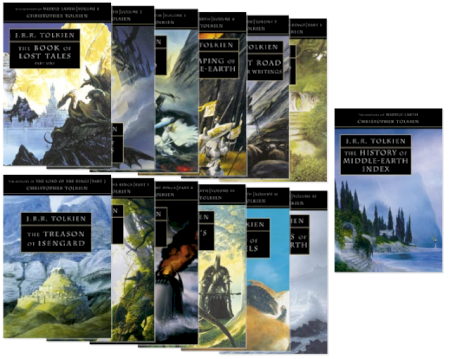 The History of Middle-Earth (Complete Set). Some of the parts of the series contain new material while others contain the earlier versions of Tolkien’s published works. All the books are highly detailed and document even the scraps of paper erased multiple times. They provide a complete evolution of numerous versions of passages written over each other. In these books, Christopher Tolkien documents the history of the writing of Middle Earth stories thoroughly with the maximum details as obtained from his father’s fictional history of Middle Earth. The first two of the 12 books introduce us to ‘The Book of Lost Tales’ from which Tolkien took inspiration to come up with the ‘Silmarillion’. The third book contains discussions about the poems about the primary characters in the First Age of Middle Earth.
The next two volumes deal with the developments of the mythology called ‘The Silmarillion’. Books 6 to 9 are about the development of ‘The Lord of the Rings’. The second half of the ninth book discusses the story of Numenor. Books 10 and 11 talk about the Annals of Aman and Beleriand that form the base of ‘The Silmarillion’. The twelfth book deals with the appendix in ‘The Lord of the Rings’. This is followed by some essays written by Tolkien during the final years of life. [2]. Christopher Tolkien decided not to include anything from ‘The Hobbit’ in this series as it was not meant to be a part of the fiction and not set in Middle Earth initially. ‘The History of the Hobbit’ was later published separately.
It describes the evolution of the earliest notions through the latest developments making up the stories. It is more of a history of the creative process undertaken by Tolkien rather than an order of events taken place in Middle Earth. The series is a collection of an independent study of the evolution of the legendarium of Tolkien containing hundreds of poems, revisions, and transcripts. [1]
Contents
The next two volumes deal with the developments of the mythology called ‘The Silmarillion’. Books 6 to 9 are about the development of ‘The Lord of the Rings’. The second half of the ninth book discusses the story of Numenor. Books 10 and 11 talk about the Annals of Aman and Beleriand that form the base of ‘The Silmarillion’. The twelfth book deals with the appendix in ‘The Lord of the Rings’. This is followed by some essays written by Tolkien during the final years of life. [2]. Christopher Tolkien decided not to include anything from ‘The Hobbit’ in this series as it was not meant to be a part of the fiction and not set in Middle Earth initially. ‘The History of the Hobbit’ was later published separately.
- The Book of Lost Tales, Part I (1983)
- The Book of Lost Tales, Part II (1984)
- The Lays of Beleriand (1985)
- The Shaping of Middle Earth (1986)
- The Lost Road and Other Writings (1987)
- The Return of the Shadow (1988)
- The Treason of Isengard (1989)
- The War of the Ring (1990)
- Sauron Defeated (1992)
- Morgoth’s Ring (1993)
- The War of the Jewels (1994)
- The Peoples of Middle Earth (1996)


