• Welcome to The Tolkien Forum! Connect with fellow Tolkien enthusiasts and join a community that is over two decades old, and still going strong. We look forward to meeting you.  Register

Tales From The Perilous Realm

My initial post was over a year ago.

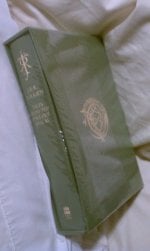
But I just received a copy of this for Christmas. (Better late than never...)

And I just started reading it. I'm really enjoying the forward.

And yet, it's been months, since my last /I] post.

I finally read the book; and loved it all. I especially liked Roverandom and Farmer Giles of Ham.
 
Last edited by a moderator:
I'm afraid to take it out of it's wrapping!! :*D
attachment.php
 

Attachments

  • talesfromtheperilousrealm.jpg
    talesfromtheperilousrealm.jpg
    30.3 KB · Views: 106
I ended up importing the deluxe edition from the UK to match my deluxe copies of Children of Hurin and Legend of Sigurd.

21JqeWcIScL._SL500_AA180_.jpg

My brother did the same thing for me (and they match my CoH and Legend of Sigurd & Gudrun, pretty close to the size of my dragon-skinned Hobbit too)

I received it back in April, but am just reading it now. I hadn't even taken it out of its plastic wrapping, I felt the book was so special :*cool:

I've held off reading Roverandom for a few years, anticipating getting a physical copy of Tales and having read the rest of the works. Diving into this new to me world of Tolkien reminded me of how magical his quality of writing is ... here's the second paragraph from his story Roverandom:

Not every old man with ragged trousers is a bad old man: some are bone-and-bottle men, and have little dogs of their own; and some are gardeners; and a few, a very few, are wizards prowling round on a holiday looking for something to do. This one was a wizard, the one that now walked into the story. He came wandering up the garden-path in a ragged old coat, with an old pipe in his mouth, and an old green hat on his head, If Rover had not been so busy barking at the ball, he might have noticed the blue feather stuck in the back of the green hat, and then he would have suspected that the man was a wizard, as any other sensible little dog would; but he never saw the feather at all.

Like The Hobbit, Roverandom was written for his children. He's writing in prose but like a poet makes such grand strokes in few words describing, or teaching us about, the environment at large of his stories. "Then he would have suspected that the man was a wizard, as any other sensible little dog would" - oh, but of course :D Just like his introduction of Gandalf in The Hobbit, his introduction of magical elements into his stories seem so natural, so in-place. Reading his words, it takes no effort on the part of the reader to receive and be truly immersed in his paintings. Right away, in a page worth of writing, I feel like I understand and am at home in what he's describing. And knowing that he did these things for his children and not for publication makes it even easier to admire his work, and him, and perhaps contributes to their sense of wonder.

Thank you, Professor Tolkien
icon7.png
 
Sorry to resurrect a zombie thread but I could not see another. I just finished this book and my overview is that it's a decent read but not even close to e.g. Hobbit or Lord of the Rings. That said it's not intended to be!
Roverandom was a really sweet albeit slightly nonsensical tale. Almost like Lewis Carroll or similar.
Farmer Giles of Ham was really nicely done and I enjoyed it a lot.
What may be surprising is that I found the Tales of Tom Bombadil rather irritating. Quite sacrilegious!
Smith of Wootton Major and Leaf by Niggle were really beautifully written and I enjoyed them much more.
On Fairy-Stories is a long essay and in parts I had to reread the sections as he lost me a little. That said some elements were very enjoyable and gave insight to his writings.
On the whole I'd recommend the book if a Tolkien fan especially as the individual short stories make for a nice break between heavier tomes. As with all Tolkien work, I think and expect to get incrementally more understanding and enjoyment after each reading. More time in = more satisfaction out!
 
What may be surprising is that I found the Tales of Tom Bombadil rather irritating. Quite sacrilegious!
At first I thought you considered them sacrilegious! 😳

Enjoyment depends on your tolerance for Tolkien's poetry, I suppose. "The Adventures of Tom Bombadil" was in the first book of his I bought, at age 17, and I retain a fondness for it.
 
I grew up on The Lord of the Rings and The Hobbit, reading The Silmarillion later in life when I was more mature. As for the Tales from the Perilous Realm, they did not cross my path until recent times, when I was desirous of getting as many of the books Tolkien wrote of his world I could. My father kindly obliged, and I listened to each of the Tales with happiness.

And then I got to The Smith of Wootton Major. I'd read what must have been hundreds of Celtic legends, myths, stories and folk tales beforehand, as a matter of interest, and in this story in particular I recognized their influence. The realm of Faerie was there portrayed with all Tolkien's signatures, but with elements so clearly drawn from Celtic roots. It made me long to visit the place, like Starbrow, and to see the Tree of the King, the Mountains barring one from the inner lands of Faerie, the Sea of Windless Storm, the grave elven mariners who fought with dangers who could topple our world should they desire to. The pool with its inner fires, the dancing of the elves and the disguised Queen. I wanted to meet Alf, and know what drew him to invite humans to his realm. It was a pleasure viewing this through Smith's eyes.

And then he was summoned before the Queen, and given a commission. And he fulfilled it, finding the King and giving him the message necessary. And then...he was bidden remove his star, to pass it on and never return to Faerie. He was to never see that land more.

Is it because I have never been there I began to cry? Was it a selfish reaction of wanting him to show me more of that land? Like Smith, I had long since committed a piece of my heart to the Perilous Realm of Faerie, and to see him so permanently taken away from it left me in tears. Yes, another child would get to see the wonders of that place, and I did not begrudge that, but Smith could never go back. Not ever. Homesickness. Hiraeth(a word I do not know the language of, but which I have heard intimates a longing as for a home one has never actually known). It pierces deeper than a dagger, sharper than any cold or hunger. It pricks my very heart without effort. It brought me sobbing into darkness and left me there.

I comforted myself with the knowledge of the child who would come to learn of the magnificence of Faerie, who could now journey and see as Smith had done. And who, perhaps, would eventually pass on the star to another and then to another. How many will be privileged in that world to see a land marvellous and mysterious to them? I confess I envy them. The Lord has made us a great and wonderful world, and perhaps it is because I have seen so little of it, but I long for the wild beauty and solemn splendour of Faerie. I have longed for it since my first myths, since the first High Fey crossed my path in the tales of King Arthur and she took a knight across the lake with her to her home, since Arthur's last voyage for Avalon. To be shut from it without ever having set foot there is a bitter, bitter wound, and every time I have listened to The Smith of Wootton Major again, it has lost none of its agony.

Strange to say, this has become my favorite of all the stories Tolkien ever wrote. Middle-earth will always have my love, and always will I long for it, but The Smith of Wootton Major told me a tale I could feel in my own heart, as though I were the Smith, even if only a little. How grateful I am Tolkien wrote it. This story very aptly sets forth how someone who has their whole life delved into the Celtic and English myths, the German and Norse myths, and then come up not for air, but for refreshment from the pain of longing for something never to be gotten in this world, feels upon the realization of this fact: Faerie is not a part of our reality, and it never will be.
 
... the pain of longing for something never to be gotten in this world, feels upon the realization of this fact: Faerie is not a part of our reality, and it never will be.
Yet , it is still a reality.

“There are more things in Heaven and Earth, Horatio, than are dreamt of in your philosophy.”
 
'Tales from the Perilous Realm'
Just downloaded it to my Kindle for free from Amazon. Kindle price only $1.99! I had a few dollars of credits, so it was free! (I love a bargain.)

I've read Farmer Giles of Ham and Smith of Wootton Major previously. Maybe I'll start with 'Leaf By Niggle' tonight. Looking forward to it!
 
I grew up on The Lord of the Rings and The Hobbit, reading The Silmarillion later in life when I was more mature. As for the Tales from the Perilous Realm, they did not cross my path until recent times, when I was desirous of getting as many of the books Tolkien wrote of his world I could. My father kindly obliged, and I listened to each of the Tales with happiness.

And then I got to The Smith of Wootton Major. I'd read what must have been hundreds of Celtic legends, myths, stories and folk tales beforehand, as a matter of interest, and in this story in particular I recognized their influence. The realm of Faerie was there portrayed with all Tolkien's signatures, but with elements so clearly drawn from Celtic roots. It made me long to visit the place, like Starbrow, and to see the Tree of the King, the Mountains barring one from the inner lands of Faerie, the Sea of Windless Storm, the grave elven mariners who fought with dangers who could topple our world should they desire to. The pool with its inner fires, the dancing of the elves and the disguised Queen. I wanted to meet Alf, and know what drew him to invite humans to his realm. It was a pleasure viewing this through Smith's eyes.

And then he was summoned before the Queen, and given a commission. And he fulfilled it, finding the King and giving him the message necessary. And then...he was bidden remove his star, to pass it on and never return to Faerie. He was to never see that land more.

Is it because I have never been there I began to cry? Was it a selfish reaction of wanting him to show me more of that land? Like Smith, I had long since committed a piece of my heart to the Perilous Realm of Faerie, and to see him so permanently taken away from it left me in tears. Yes, another child would get to see the wonders of that place, and I did not begrudge that, but Smith could never go back. Not ever. Homesickness. Hiraeth(a word I do not know the language of, but which I have heard intimates a longing as for a home one has never actually known). It pierces deeper than a dagger, sharper than any cold or hunger. It pricks my very heart without effort. It brought me sobbing into darkness and left me there.

I comforted myself with the knowledge of the child who would come to learn of the magnificence of Faerie, who could now journey and see as Smith had done. And who, perhaps, would eventually pass on the star to another and then to another. How many will be privileged in that world to see a land marvellous and mysterious to them? I confess I envy them. The Lord has made us a great and wonderful world, and perhaps it is because I have seen so little of it, but I long for the wild beauty and solemn splendour of Faerie. I have longed for it since my first myths, since the first High Fey crossed my path in the tales of King Arthur and she took a knight across the lake with her to her home, since Arthur's last voyage for Avalon. To be shut from it without ever having set foot there is a bitter, bitter wound, and every time I have listened to The Smith of Wootton Major again, it has lost none of its agony.

Strange to say, this has become my favorite of all the stories Tolkien ever wrote. Middle-earth will always have my love, and always will I long for it, but The Smith of Wootton Major told me a tale I could feel in my own heart, as though I were the Smith, even if only a little. How grateful I am Tolkien wrote it. This story very aptly sets forth how someone who has their whole life delved into the Celtic and English myths, the German and Norse myths, and then come up not for air, but for refreshment from the pain of longing for something never to be gotten in this world, feels upon the realization of this fact: Faerie is not a part of our reality, and it never will be.
What a heartfelt response to the story. It is also one of my favorite Tolkien stories because I want to be Starbrow and visit the Realm of Faerie. I wish I could visit there in reality and not just through literature.
 

Similar threads

Back
Top