I must admit I have never read Jane Austin: I hated
Pride and Prejudice and gave it up. I liked
A Christmas Carol and so tried to read more Dickens, but found it absolutely awful. I think I had to read
Wuthering Heights in college, but I’m no longer sure: I do remember I loathed it with a passion that carried over to the semaphore version.
Yes, but I don't want to get too expansive about that on this thread. … I guess I could add one more structural feature of the hero's birth, taken, like the other ideas on structure, from Frye (though moving even further from the topic at hand):
There is often a hunt for
the young hero, who must be disguised or hidden away from a false father seeking his destruction; the true father is akin to Jung's Wise Old Man archetype, who adopts, protects, and guides him through his youth.
Then by all means, let us open another! But from this, I take it you mean that
Drogo (and by coverture Primula, too?) is not
Frodo’s “true” “hero” father, but rather
Bilbo?
You're quite right on the endogamy theme, of course. In fact, I'd say that it may have been practiced more in the upper classes, in order to keep wealth, and especially land, in the hands of the nobility, and later, the gentry. Modern readers are probably made a little uncomfortable by the characters in Jane Austin, say, who are persuaded to refuse "unsuitable" matches, in order to marry a cousin. And in LOTR, we are dealing mainly with the gentry, as the family
trees show, with the exception of
Sam Gamgee, who, as the low mimetic hero, moves into an elevated social status as part of the reward for his exploits.
I am only a mathematician, and data science is my job, if you understand me, and I’m not much good at social sciences, but it seems to me from studying genealogy and medieval demographics and village censuses that it’s pretty clear that most people married their more or less distant kin in Britain and Ireland throughout the Middle
Ages and well into the modern era until, as I said before, fast, easy, inexpensive transportation enlarged the pool of eligible marriage partners. The same was true in the New World, too, except that the frontier tended to mix people across social and economic strata and in geographic origins: that’s one of the primary things that made America an unusual and even exceptional place. The situation was somewhat different in great
cities such as London or Philadelphia or New York, where the pool of eligible partners was naturally larger, and so intermarriage within large family groups was less common; but marriage according to social and economic strata remained, and still remains, for the most part.
This is the natural way in which clans form in a tribal society, and given time (and isolation), the way tribes themselves form.
Tolkien’s
hobbits are the same way: there were initially three tribes. Originally separated for a time in
Wilderland (in the Vale of
Anduin), or even before, the
Harfoots,
Fallohides, and
Stoors became somewhat distinct from one another. They resettled more or less together in
the Shire, where they mixed across tribal groups, although some differences remained: the Stoors tended to congregate along the Brandywine. Intermarriages then became less a matter of tribe and more of social strata.
From this perspective, the family trees make perfectly good sense. The tribes have been replaced with Shirefolk, who form a more or less well-intermixed tribal group, though the Bucklanders with their still-distinctive
Stoor characteristics, such as swimming and boating, are seen as different; the Breelanders, another and somewhat older and thus more thoroughly tribally intermixed group; and Outsiders, neither Shirefolk nor Breelanders, about which Tolkien as narrator says were “probably … [more numerous] scattered about in the West of the World in those days than the people of the Shire imagined.”
The Baggins,
Tooks, and Brandybucks are three of several, perhaps many, prominent clans of
Shire Hobbits, and like most clans, interrelated by marriage within their social strata.
The Ropers and
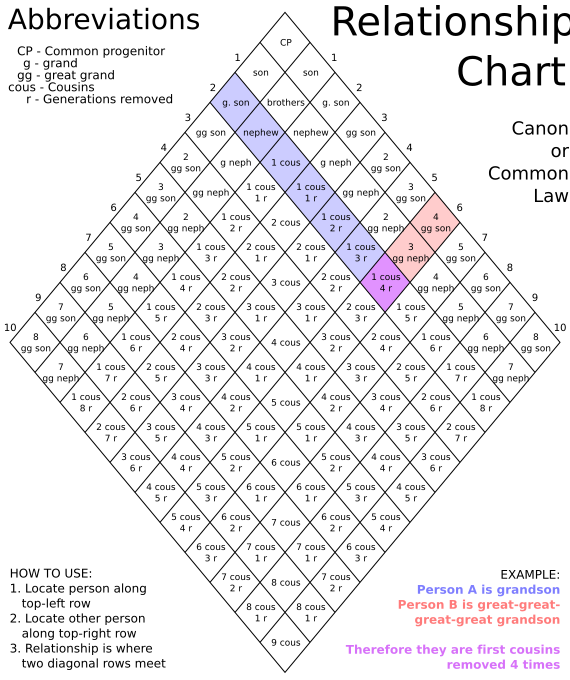
Gamgees are akin, but rather than having permanent surnames, take surnames from their occupations, as do the Cottons (their forefather is “Cottar” or tenant farmer: sharecropper), who marry into the Gamgees: Sam and Rosie share a common great-grandfather and are thus third cousins. Again, I think these are typical “live in the same neighborhood” relationships.
Long before Frodo sails into the West,
Pippin and
Merry, who initially teased Sam regularly, even to the point of making mildly disparaging remarks towards him in his presence, have completely ceased to make jests at Sam’s expense! Upon their return to the Shire, they and Frodo treat Sam as an equal, and indeed he is: all of them have grown spiritually, and Merry and Pippin physically (ent-draughts), but Sam has changed the most. As Frodo leaves, he tells Sam, “you are my heir: all that I had and might have had I leave to you.” Sam inherits all that belonged to the Baggins clan through Bilbo and Frodo – and the
Sackville-Baggins, too, now extinct, since Lobelia left all to Frodo: Bungo and Belladonna (Took)
Baggins’ beautiful hole under the Hill, their wealth, and most importantly their social position. He assumes the permanent surname Gardener from his trade; his daughter Goldilocks marries Pippin’s son and principal heir,
Faramir, and so takes the place of the Baggins clan in family relations; and his eldest and beloved Elanor not only marries one
Fastred of Greenholm, whom we may assume to be a prominent person in
Westfarthing, but royal promotion to peerage with lands and family
titles of her own, distinct from any other families in the Shire. Note that this elevation is parallel to that of Silmariën, daughter and eldest child of Tar-Elendil of
Númenor, who married Elatan of Andúnië: their son Valandil was made the first Lord of Andúnië by his grandfather the king, and was the ancestor of both
Elendil the Tall and of
Aragorn Elessar. Just as Valandil in Andúnië held the westernmost region of Númenor, the descendents of Elanor held the westernmost region of the Shire and could, were they so inclined, climb the now-abandoned White
Towers of
Gil-galad and if conditions were right, see the sea, just as Valandil could climb the tower in Andúnië and on a clear day catch a fleeting glimpse of Tol Eressëa.
Sam changes more than any other character in
Lord of the Rings.