A sneak peek inside Amazon's new Lord of the Rings series
By Russell Baillie
28 Aug, 2022 01:00 PM10 mins to read
The creators and cast of Amazon's epic series The Rings of Power talk about the show's relationship with JRR Tolkien's writing, the movies and departing New Zealand after filming just one season. By Russell Baillie.
Leon Wadham was at primary school in Wellington when
the Lord of the Rings films first arrived 20 years ago, and at drama school when The
Hobbit trilogy delivered its encore. So, while Peter Jackson's forays into JRR Tolkien's
Middle-earth helped launch the careers of many local actors, Wadham figured for him that particular ship had long since sailed.
"I did not see a universe where there was a role for me in one of these Tolkien stories, so it's completely surreal to be involved in one now."
Today, Wadham sits talking to the Listener from Los Angeles, where he's one of 20 or so lead characters gathered for promotional duties for Amazon's
The Lord of the Rings: The Rings of Power, the series otherwise known as the most expensive television show ever made.
Despite the series being made here, he's the only Kiwi among the throng of Brits, Americans and Australians talking up the show as it heads to its debut. Presumably, it will be Wadham's turn to up sticks for the UK for the show's second season after Amazon's surprise decision last year to relocate it after finishing the New Zealand filming on the first season, which was given a taxpayer-funded rebate of some $162 million for the $650 million spent. The official reason for the departure is that Amazon is consolidating its screen production in the UK facilities it has invested in. With film-making
technology being what it is, New Zealand landscapes already captured on camera may be dialled into the backgrounds of shots for years to come.
While it was here with a production based in Auckland, there wasn't much Wellywood involvement, despite the past connections. Weta Workshop knocked up
swords and
Orc prosthetics while Weta Digital was one of a group of companies working on the first season's reported 9500 visual-effects shots. Jackson wasn't involved, after Amazon made an initial approach years ago, then cut off contact. Still, it has been Middle-earth around here for a while.
"As a New Zealander and as a Wellingtonian, I found it never crossed my mind that we could tell the story anywhere else," says Wadham.
"I'm also really grateful that regardless of whether we're going, we started the story here. I don't think we could have started anywhere else."
Predictably, the international cast have only nice things to say about their time in New Zealand and diplomatic things to say about the production shift to the UK.
"One of the great privileges of being an actor is getting introduced to a culture, and you're not on the tourist trail," says UK actor Lloyd Owen, who plays the heroic figure of
Elendil. "So, you get to know people from the town you're in, and you get invited to people's homes. I had so much more planned to do on my return, but my return will just have to come a little bit later and as a tourist."
Benjamin Walker, Morfydd Clark, and Robert Aramayo in The Lord of the Rings: The Rings of Power. Photo / Supplied
Wadham plays Kemen, the nobleman son of
Ar-Pharazôn, the last king of the Atlantis-like island kingdom of
Númenor. While Ar-Pharazôn, who is played by Welsh actor Trystan Gravelle, loomed large in Tolkien's various Middle-earth histories, Kemen isn't part of the canon. Nor are many of the main characters in the show, which is set in the
Second Age that Tolkien chronicled in the appendices to The Lord of the Rings, and told of
Sauron's rise to power.
Playing a non-Tolkien character in a Tolkien universe was fine, says Wadham. "Certainly, I thought, as much as I am not in the lore, there are footholds there. There are clear parameters, and then there's room to dream. All of us had foundational stuff we were all building together, regardless of whether or not it was a character people may know."
But the liberties taken by showrunners JD Payne and Patrick McKay, in taking the sprawling mythical Second Age history and building a coherent LOTR-like saga upon it, has had some of the Tolkien faithful in online
troll mode since the production was announced.
McKay appears to be a man who isn't much worried about the disapproval. Making stuff up that wasn't in the books for the screen is something both the movie trilogies did – especially The Hobbit in its efforts to stretch the slim volume into another epic.
Wellington's Weta Workshop helped with the Orc prosthetics. Photo / Supplied
It was Payne and McKay's pitch about creating a story that wasn't a retread, a prequel or a spinoff based on a familiar LOTR character that convinced Amazon. The company paid a mammoth US$250 million to the Tolkien estate for the television rights. The deal involved Amazon boss and weekend astronaut Jeff Bezos, who insisted the streaming platform needed its own Game of Thrones.
The pair's hope was that The Rings of Power could stand on its own and even expand on the world already seen in the films, but still keep faith with the Tolkien universe.
As Payne told Empire magazine: "In his letters, Tolkien talked about wanting to leave behind a mythology that left scope for other minds and hands, wielding the tools of paint, music and drama. We're doing what Tolkien wanted."
Creating many new characters was necessary to do that, McKay tells the Listener. But the writers were fans who were steeped in the lore.
"What's so wonderful about Tolkien as an author is every leaf has a history, every mountain has a story of something that happened there. Every ruin that you encounter in Middle-earth has had three adventures that have happened there in prior
ages.
"Part of the joy of reading The Lord of the Rings is feeling that history and the landscape and the world that came before the world of the forward narrative. In the case of Lord of the Rings, that's the world of the Second Age."
Cynthia Addai-Robinson as Miriel in The Lord of the Rings: The Rings of Power. Photo / Supplied
The period was when, as the show's title alludes to, the 20 magical
rings of power were created in an effort by the
evil Sauron to sway the
rulers of Middle-earth, including the "
One ring to rule them all", which caused those
Hobbits all that bother many years hence.
"So, the backstory is a story in its own right. The Second Age is woven throughout the books. Middle-earth is so vast and bottomless that we felt that everywhere we looked in the books, there were suggestions of incredible characters, stories and
places we thought could be brought to the screen and deserved to be. It's trying to follow the trail of breadcrumbs that Tolkien left us."
The show may have gone back in time, but like many a period and fantasy show of Anglo-Saxon origin these days, it has got a diverse cast. Among the non-white faces is Sir Lenny Henry, who plays Sadoc, one of the
Harfoots, ancestors of the Hobbits, but nomadic, rustic and seemingly timid.
Elsewhere, Puerto Rican actor Ismael Cruz Córdova (The Undoing) plays an
elf soldier with feelings for human Bronwyn, played by British-Iranian actress Nazanin Boniadi. She is the single mother of Theo, played by Indonesian-Australian actor Tyroe Muhafidin, whose character is possibly another Middle-earth first: a troubled teenager.
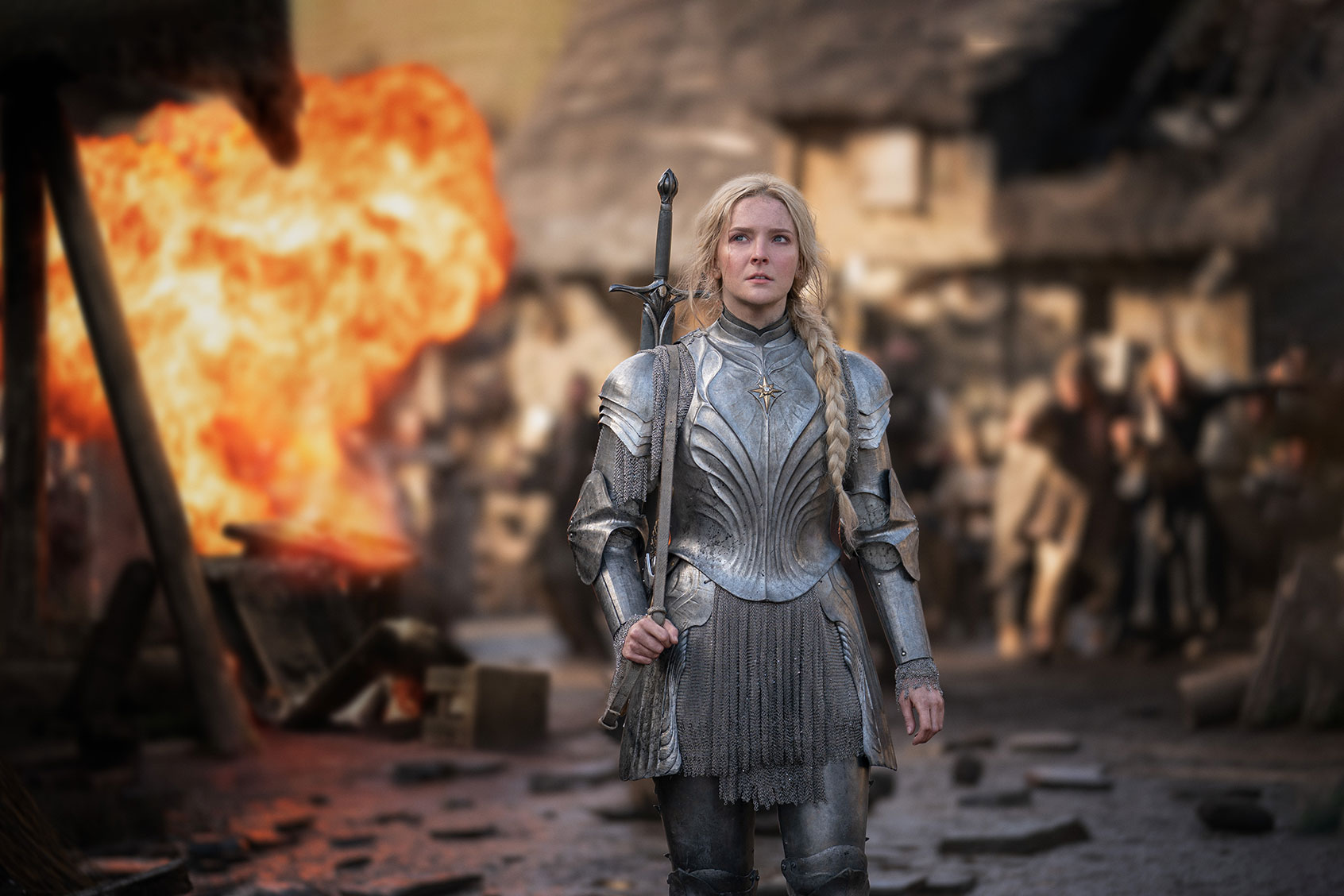
Morfydd Clark as
Galadriel in The Lord of the Rings: The Rings of Power. Photo / Supplied
There are also younger versions of immortal elf characters Galadriel and
Elrond from the films. And it's easy to draw some parallels between character duos in The Lord of the Rings and here – Harfoots Poppy Proudfellow and
Nori Brandyfoot could be the Second Age forebears to
Frodo and
Sam; the Galadriel of this era and the man, Halbrand, she encounters might remind some of
Arwen and
Aragorn; the elf Elrond's friendship with
dwarf noble Prince
Durin brings to mind the LOTR comedy odd couple of
Legolas and
Gimli.
It feels like all we are missing is a
Gandalf. But hold on, some bloke with a beard has just arrived by comet and crashlanded next to the Harfoots.
The first two episodes previewed have a similar tone and look to the first movie trilogy, and what might be a relief to some is that The Rings of Power isn't attempting to be the new Game of Thrones.
For Owen, the show belongs to another age in another way – as well as the most expensive TV show ever, and one built on the foundations of two successful movie trilogies, it's a Sunday-night drama that can be watched by multiple generations together.
"I hope this series can achieve that, then everyone can talk about it afterwards, because the Tolkien-ian themes here are as faithful and as loyal to that source material as they can be."
Elf determination
In the Lord of the Rings and Hobbit movies, Galadriel glowed as an otherworldly presence, but she really didn't have that much to do. Played by Cate Blanchett, she was one of the only main female characters. She attended a few meetings, advised a few visiting Hobbits and
wizards and spent much of her time looking exceptionally ethereal.
The Galadriel of new TV series The Lord of the Rings: The Rings of Power is different. As the first episodes show, she's an armour-wearing mountain-scaling, troll-killing wonder-elf who might already be many centuries old – she was born in Tolkien's
First Age – but isn't yet the calm cosmic sage of the trilogies. She's also a major protagonist.
In TROP, she's played by Welsh actress Morfydd Clark, a 33-year-old Blanchett lookalike who won the role after appearances in films such as Saint Maud and The Personal History of David Copperfield.
As a Tolkien reader since she was a kid, Clark was both delighted and anxious at winning the role.
"I was immediately filled with neuroses. This is a world that I had kind of been into since I was nine. There was a weight of expectation from fans and from the world, but also for myself."
Morfydd Clark at The Lord Of The Rings: The Rings Of Power Los Angeles premiere. Photo / Getty Images
Playing a far more active, sword-swinging Galadriel than was required of Blanchett made sense to her.
"I think serenity is always hard earned and you will have to go through a lot to get there.
"I'd never played someone particularly powerful, let alone magical and powerful. So that was lots of fun.
"What's excites me about her is that she's incredibly brave and unafraid to say what people don't want to hear. So, I really respect her for that, and I'd like to be a bit more like her."
Clark enjoyed working with New Zealand stunt actors, some of whom had worked on the Jackson films. She has mixed feelings about not continuing to film here after her initial two-year stint on the first series.
"It has been a lot to come to terms with, that we won't be coming back. My time in New Zealand has forever changed me and it will inform the rest of the seasons, but also inform every job I do."
The show also offers a prequel of sorts for another immortal elf character, Elrond, played by Hugo Weaving in the movies. In the show, he's played by Robert Aramayo, who has done previous service in another fantasy franchise, Game of Thrones, as a young Ned Stark.
"He's right at the beginning of all the things that make him the Elrond we know from the book," says Aramayo. "So, it was a really exciting prospect to begin playing him and see him as a young, unique creature."
The Lord of the Rings: The Rings of Power, Amazon Prime, from September 2.


 sdpict.com


/cloudfront-ap-southeast-2.images.arcpublishing.com/nzme/4BOUERE4FRCTLFH6PQYXHQG6CI.jpg "Benjamin Walker, Morfydd Clark, and Robert Aramayo in The Lord of the Rings: The Rings of Power. Photo / Supplied")
/cloudfront-ap-southeast-2.images.arcpublishing.com/nzme/UWC6GF32IQQMT2NLCKQSUICU64.jpg "Wellington's Weta Workshop helped with the Orc prosthetics. Photo / Supplied")
/cloudfront-ap-southeast-2.images.arcpublishing.com/nzme/L53SUX3GPYYPB3F6E2HBKKLN5M.jpg "Cynthia Addai-Robinson as Miriel in The Lord of the Rings: The Rings of Power. Photo / Supplied")
/cloudfront-ap-southeast-2.images.arcpublishing.com/nzme/6FMJ4H223W4IRYONIVLKLEX634.jpg "Morfydd Clark as Galadriel in The Lord of the Rings: The Rings of Power. Photo / Supplied")
/cloudfront-ap-southeast-2.images.arcpublishing.com/nzme/A3B2J3KSEYWPQ4SKJPDOBNJKNY.jpg "Morfydd Clark at The Lord Of The Rings: The Rings Of Power Los Angeles premiere. Photo / Getty Images")