

When professor Tolkien wrote his opus magni, it was his regret that many other cultures had deep mythological traditions, but his own England was largely devoid of mythic epics that drove his pen. His original intent was to provide a legendarium to what he considered to be a blank history of England. He also squarely placed his mythology in the past.
When asked when did events in his fictional work take place, Tolkien answered that the year "Bel. 310" was 16,000 years ago.
Another clue is that humans and elves can have offspring, and probably humans and orcs too. This means that they must have a common ancestor. It is literally impossible for species with different genomes to have viable offspring. It is much more probable that these “races” had common ancestors and still share most of the genes.
Númenóreans were an advanced race of men blessed with long life and ancient knowledge, capable of building high towers. They turned against the Valar, and their island home was destroyed in the last years of the Second Age. Their homeland was swept away by a great wave. If the events in the LOTR happen 0.5 to 1 million years in the future, literally every thing our civilization has created would fall to dust or be unrecognizable to medieval-level society. Legends passed over countless generations would talk about high and proud men that did wonderfull and terrible things. Some items could remain untouched, and be considered magical artifacts. For instance, a gold or diamond ring, if well protected (in a safe) could easily last as long. Titanium too. A glass or steel can last for millions of years, but geological processes would most probably bury them deep underground. Plastic may be durable, but if crushed under the tend or even hundreds of meters of sediment, ash, rocks and stone it would be probably just a thin layer of strange dust,
And why have some not escaped to space? Well, we also have that:
Aman, a continent to the west of Middle Earth where Valinor is located, would represent the current Americas, or what remained of them. The March of Noldor describes how Noldor descendants of survivors from Valinor (Northern America) came to Middle Earth over frozen Helcaraxë (Northern Sea) during the glacial period after the cataclysm
Beleriand, located in today’s Western Europe was destroyed as well as parts of western African continent and submerged, becoming the Sea of Belegar. The Blue Mountains are remnants of the Alps. River Anduin is probably in place of today’s Dnester or possibly Danube river, as it’s estuary is near Tol Fals, today’s Crimean peninsula. Black Sea was drained as the Eurasian plate was raised. Middle Earth northwest edge begins around Denmark, with Ice Bay being the Baltic Sea, continues along the central Germany and western edge of Balkan Peninsula (Harlindon being today’s Dalmatia), and ends somewhere in the eastern Mediterranean, the Bay of Belfalas being today’s eastern edge of Mediterranean Sea.
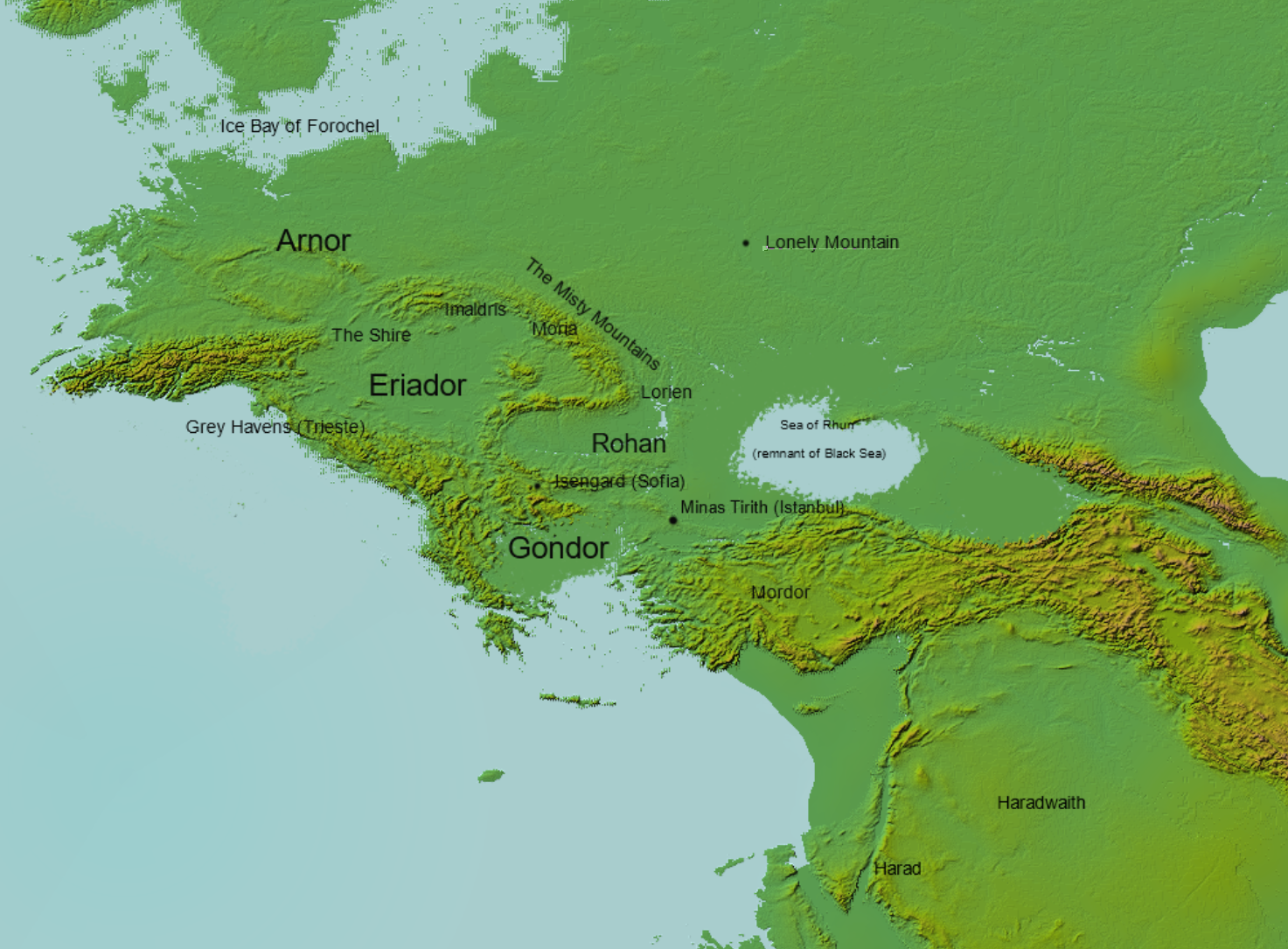
While Tolkien places Shire at Oxford, by this theory it would be somewhere on the rolling hills of northern Pannonian plains, in parts of today’s Hungary or Slovakia, an area even today called “the breadbasket” because of its fertile soil. Eriador is pannonian plain, and Arnor is in Central Europe, parts of Chech Republic, Eastern Germany and Poland. This would place Lonely Mountain at the northern edge of a great reservoir on Dnieper river (Long Lake), where Chernobyl is currently. A fitting place to find a glowing gem that leads Dwarves to madness.
River Celduin (Dniepr) flows from this lake to the Rhun (Caspian sea)
Big iron deposits are located around today's Sofia in Bulgaria, and as a coincidence, this places it conveniently where Isenguard would be, in the Gap of Rohan nested between Carpathian and Balkan mountain ranges, and a convenient place to cross from pannonian plain without the need to go over the Misty Mountains on a way to Rohan. A river that runs through Sofia is called Iskar (Izen).
Rohan would be in the current Romanian, Moldova and Ukraine plain, bordered by the Caucasus on the west (Misty Mountains). This vast plain stretches for thousands of kilometers, all the way to Kazakhstan, and is full of… you guess, wild horses. Orocarni mountains far to the east is today’s Ural mountain range, and the inland Sea of Helcar (Helkar) is the Caspian Sea, which was historically known as the Hyrcanian Ocean or Khazar Sea.
Gondor would be by this logic located in today’s Greece, while Rhovanion is central Ukraine and Belarus
In the south, Umbar is located in today’s Egypt, and Harad is what remains of Africa. Haradwaith is today’s Arabian peninsula.
Mordor is located in today’s Turkey, or in what remains of Black Sea, ravaged by volcanic activity (there is a tectonic plates split between Arabian, Iran and Eurasia plates at this location, and the volcanic activity triggered by cataclysm may have changed this to inhospitable lands. The mountain ranges around Mordor are ranges around the Anatolian plate, raised by tectonic activity.
The Sea of Núrnen also known as Lake Nurnen was an inland sea in Mordor, a remnant of the Van Golu lake, and the Sea of Rhun being the Caspian Sea.
This would place Minas Tirith to be at the location of today’s Istanbul, historically, a place where clashes between eastern and western civilization occurred numerous times.
Elves were the closest remnant to what was an advanced, post-scarcity human race with extremely long lifespan, probably as a result of genetic manipulation and artificially created immunity. This in turn meant they had to have low fertility, to keep the population stable. We can even now see that some countries have much better healthcare, that leads to much longer average lifespan and having children at later age. With current advances in genetics, it is not hard to imagine that this would lead to even longer life if done for several thousands of years.
The Orcs may be the group that was not enhanced for beauty or longevity, but for strength and speed without regards for aesthetics, much like any army would like to do with their recruits. These would have heightened aggressivity, and could resort to self-harm as a part of culture. Remember that they too preferred to live underground. There are even several “races” of orcs, like Isengard, Mordor orcs or Uruk-Hai. This means Orc could be a rather derogatory term for “outsider” or “invader” than a proper race denominator.
Even Tolkien admits that Orcs and Elves are kin, and also that humans and orcs could produce offspring. Orcs were part of Middle Earth for a long time, but not really a problem, until they got united.
Other groups have also “dug-up” in deep mines, and evolutionally became smaller to be able to survive in underground tunnels. These became known as Dwarves.
Tolkien mentions in Silmarillion, that Elves awoke beside the lake Cuiviénen. The first things they saw were the stars, and henceforth they adored them. The first sound they heard was the flowing of water, and henceforth they loved water as well. This is a memory of long time spent in shelters during post-cataclysmic ice age, when the sun was hidden and the stars they saw were artificial lightning. Tolkien himself writes:
After they were destroyed, ancestors of Elves were forced to leave shelters, and they saw two “trees of valinor”, one golden and another silver, which is how they described the sun and the moon when they saw it for the first time. This is poetically described:
Finally you have reached the end of this long post. Please comment and share your thoughts. I plan to continue this alternative take on Middle-Earth history, to explain different adversaries and creatures found in Arda, if there is enough interest.
’Middle-earth’, by the way, is not a name of a never-never land without relation to the world we live in (like the Mercury of Eddison). It is just a use of Middle English middel-erde (or erthe), altered from Old English middengeard: the name for the inhabited lands of Men ’between the seas’. And though I have not attempted to relate the shape of the mountains and land-masses to what geologists may say or surmise about the nearer past, imaginatively this ’history’ is supposed to take place in a period of the actual Old World of this planet.
Tolkien's letter No. 165
When asked when did events in his fictional work take place, Tolkien answered that the year "Bel. 310" was 16,000 years ago.
Tolkien was clear to say that the history of Middle-Earth is not to be placed in our Anthropological history. I immensely respect professor Tolkien and his work, having been a devout fan and regularly reading LOTR and other works every year. Consider this just a fan fiction if you will, but here I will explain how we could place his fictional world in the future, rather than in the past.If they [Men] awoke in VY [=Valian Year] 1050 that would give 40 VYs, or 5,760 Sun Years in which Melkor could have dealings with them and corrupt them, before his captivity. The Atani entered Beleriand in 310 Bel. That is in the 22nd Sun-year of VY 1498. Men had then existed for 448 VYs + 22 SYs: i.e., 64,534 Sun Years, which, though doubtless insufficient scientifically (since that is only – we being in 1960 of the 7th Age – 16,000 years ago: total about 80,000), is adequate for purposes of the Silmarillion, etc.
The Nature of Middle-earth - "The Awaking of the Quendi"
Archeology
Today, Archeology is a well established science, and needless to say, any civilization advanced enough to build Minas Tirith or Orthanc would be well known today. Stone is quite preserved over hundreds of thousands of years, and we would be finding lots of ruins from the Second and Third Age. Going deeper in the past, we would be sure to find skeletons of elves, dwarves and other creatures mentioned in the aforementioned works, however, there is no evidence of such creatures.
Biology
In the LOTR books, Tolkien often mentions domesticated plants, namely potatoes and tomatoes. As we all know, those plants are native to the Americas, and were introduced to Europe in the 15th century. The cabbage, also mentioned in the Fellowship of the rings, was domesticated about 3000 years ago. As those plants are common in the Shire, and probably widely known elsewhere on the Eriador, makes it more probable to be remnants of our agricultural industry, than to somehow appear in the past, then fall into oblivion only to be reintroduced again in exactly the same form.Another clue is that humans and elves can have offspring, and probably humans and orcs too. This means that they must have a common ancestor. It is literally impossible for species with different genomes to have viable offspring. It is much more probable that these “races” had common ancestors and still share most of the genes.
History
So how could our world become the world of Arda? A cataclysmic event remembered as “War of Wrath'' between the Host of the West and the forces of Morgoth caused great tectonic shifts, sunk some of the lands and ended a great civilization. This could have been remembering of a traumatic war that ended advanced civilization. One could pessimistically assume some kind of thermonuclear war (or fought by technology that is still thousands of years in future), I am more keen to assume it was maybe a hit of an asteroid, possibly intentionally guided to hit somewhere in the East Atlantic. An asteroid of roughly 10-20 km in would be a civilization - ending event (Chicxulub that ended the dominance dinosaurs was about 10km in size). This could cause a melting of polar caps at the first, then cataclysmic ice age that erased memory of previous events. A fallout from impact and resulting tsunami would bury remains of our civilization under tens if not hundreds of meters of fallout material.Númenóreans were an advanced race of men blessed with long life and ancient knowledge, capable of building high towers. They turned against the Valar, and their island home was destroyed in the last years of the Second Age. Their homeland was swept away by a great wave. If the events in the LOTR happen 0.5 to 1 million years in the future, literally every thing our civilization has created would fall to dust or be unrecognizable to medieval-level society. Legends passed over countless generations would talk about high and proud men that did wonderfull and terrible things. Some items could remain untouched, and be considered magical artifacts. For instance, a gold or diamond ring, if well protected (in a safe) could easily last as long. Titanium too. A glass or steel can last for millions of years, but geological processes would most probably bury them deep underground. Plastic may be durable, but if crushed under the tend or even hundreds of meters of sediment, ash, rocks and stone it would be probably just a thin layer of strange dust,
And why have some not escaped to space? Well, we also have that:
The Valar then set this Silmaril as a star in the sky, bound on Eärendil's brow as he sailed through the sky.
J.R.R. Tolkien, Christopher Tolkien (ed.), The Silmarillion, "Quenta Silmarillion: Of the Voyage of Eärendil and the War of Wrath"
Geography
Assuming changes that happened in relatively (as far as geology is concerned) short time, great pressure was put on tectonic plates that shifted significantly.Aman, a continent to the west of Middle Earth where Valinor is located, would represent the current Americas, or what remained of them. The March of Noldor describes how Noldor descendants of survivors from Valinor (Northern America) came to Middle Earth over frozen Helcaraxë (Northern Sea) during the glacial period after the cataclysm
“led by Fingolfin and his sons, and by Finrod and Galadriel, they dared to pass into the bitterest North; and finding no other way they endured at last the terror of the Helcaraxë and the cruel hills of ice.”
Silmarillion, Of the Flight of the Noldor
Beleriand, located in today’s Western Europe was destroyed as well as parts of western African continent and submerged, becoming the Sea of Belegar. The Blue Mountains are remnants of the Alps. River Anduin is probably in place of today’s Dnester or possibly Danube river, as it’s estuary is near Tol Fals, today’s Crimean peninsula. Black Sea was drained as the Eurasian plate was raised. Middle Earth northwest edge begins around Denmark, with Ice Bay being the Baltic Sea, continues along the central Germany and western edge of Balkan Peninsula (Harlindon being today’s Dalmatia), and ends somewhere in the eastern Mediterranean, the Bay of Belfalas being today’s eastern edge of Mediterranean Sea.
While Tolkien places Shire at Oxford, by this theory it would be somewhere on the rolling hills of northern Pannonian plains, in parts of today’s Hungary or Slovakia, an area even today called “the breadbasket” because of its fertile soil. Eriador is pannonian plain, and Arnor is in Central Europe, parts of Chech Republic, Eastern Germany and Poland. This would place Lonely Mountain at the northern edge of a great reservoir on Dnieper river (Long Lake), where Chernobyl is currently. A fitting place to find a glowing gem that leads Dwarves to madness.
River Celduin (Dniepr) flows from this lake to the Rhun (Caspian sea)
Big iron deposits are located around today's Sofia in Bulgaria, and as a coincidence, this places it conveniently where Isenguard would be, in the Gap of Rohan nested between Carpathian and Balkan mountain ranges, and a convenient place to cross from pannonian plain without the need to go over the Misty Mountains on a way to Rohan. A river that runs through Sofia is called Iskar (Izen).
Rohan would be in the current Romanian, Moldova and Ukraine plain, bordered by the Caucasus on the west (Misty Mountains). This vast plain stretches for thousands of kilometers, all the way to Kazakhstan, and is full of… you guess, wild horses. Orocarni mountains far to the east is today’s Ural mountain range, and the inland Sea of Helcar (Helkar) is the Caspian Sea, which was historically known as the Hyrcanian Ocean or Khazar Sea.
Gondor would be by this logic located in today’s Greece, while Rhovanion is central Ukraine and Belarus
In the south, Umbar is located in today’s Egypt, and Harad is what remains of Africa. Haradwaith is today’s Arabian peninsula.
Mordor is located in today’s Turkey, or in what remains of Black Sea, ravaged by volcanic activity (there is a tectonic plates split between Arabian, Iran and Eurasia plates at this location, and the volcanic activity triggered by cataclysm may have changed this to inhospitable lands. The mountain ranges around Mordor are ranges around the Anatolian plate, raised by tectonic activity.
The Sea of Núrnen also known as Lake Nurnen was an inland sea in Mordor, a remnant of the Van Golu lake, and the Sea of Rhun being the Caspian Sea.
This would place Minas Tirith to be at the location of today’s Istanbul, historically, a place where clashes between eastern and western civilization occurred numerous times.
Races of Arda
During several hundreds of thousands of years after the cataclysmic events, the population was split into several geographically different populations and split to different races. These races are still capable of producing viable offspring, meaning they cannot be split for more than a couple of hundreds of thousands years. For instance, humans and Neanderthals were evolutionally split for 400k years, but could still produce offspring, as evidenced by Neanderthal DNA present in the current population.Elves were the closest remnant to what was an advanced, post-scarcity human race with extremely long lifespan, probably as a result of genetic manipulation and artificially created immunity. This in turn meant they had to have low fertility, to keep the population stable. We can even now see that some countries have much better healthcare, that leads to much longer average lifespan and having children at later age. With current advances in genetics, it is not hard to imagine that this would lead to even longer life if done for several thousands of years.
The Orcs may be the group that was not enhanced for beauty or longevity, but for strength and speed without regards for aesthetics, much like any army would like to do with their recruits. These would have heightened aggressivity, and could resort to self-harm as a part of culture. Remember that they too preferred to live underground. There are even several “races” of orcs, like Isengard, Mordor orcs or Uruk-Hai. This means Orc could be a rather derogatory term for “outsider” or “invader” than a proper race denominator.
Even Tolkien admits that Orcs and Elves are kin, and also that humans and orcs could produce offspring. Orcs were part of Middle Earth for a long time, but not really a problem, until they got united.
Other groups have also “dug-up” in deep mines, and evolutionally became smaller to be able to survive in underground tunnels. These became known as Dwarves.
Tolkien mentions in Silmarillion, that Elves awoke beside the lake Cuiviénen. The first things they saw were the stars, and henceforth they adored them. The first sound they heard was the flowing of water, and henceforth they loved water as well. This is a memory of long time spent in shelters during post-cataclysmic ice age, when the sun was hidden and the stars they saw were artificial lightning. Tolkien himself writes:
The first sources of light for all of Arda were two enormous Lamps, Illuin, the silver one to the north and Ormal, the golden one to the south.
After they were destroyed, ancestors of Elves were forced to leave shelters, and they saw two “trees of valinor”, one golden and another silver, which is how they described the sun and the moon when they saw it for the first time. This is poetically described:
Finally you have reached the end of this long post. Please comment and share your thoughts. I plan to continue this alternative take on Middle-Earth history, to explain different adversaries and creatures found in Arda, if there is enough interest.
Last edited:


