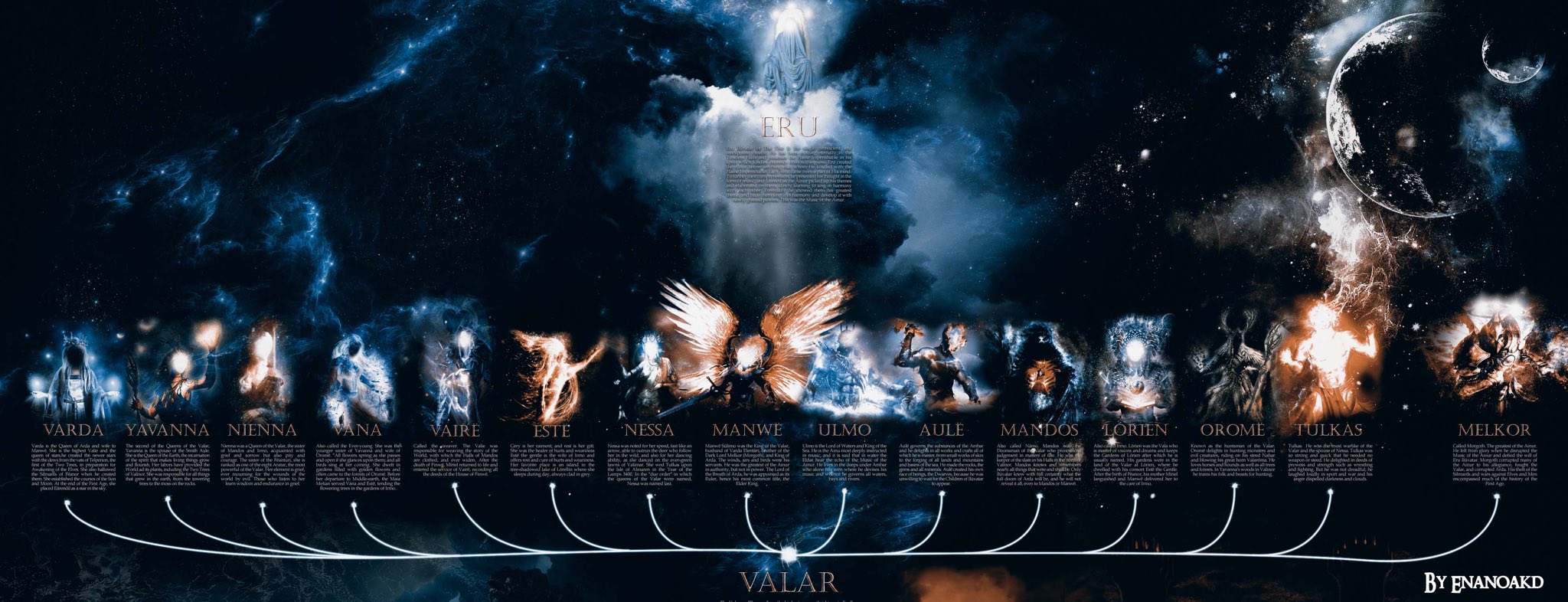
According to text published by
Tolkien himself [
The Road Goes Ever On, 1967]:
The word
fana applied to the "veils" or "raiment" in which the
Valar presented themselves to physical eyes. And (regarding the forms in which the Valar were self-incarnated), it is written:
A) the Valar "usually" took the shape of the bodies of
Elves or
Men, although . . .
B) they could also assume other wholly "inhuman" shapes, which were seldom seen by Elves
C) they appeared as persons of majestic -- but not gigantic -- stature
D) they appeared vested in robes expressing their individual natures and functions
E) the
High-Elves said that these forms were always in some degree radiant
Valaquenta [from the 1977 Silmarillion]
Manwe [delights in winds and clouds, regions of the air, all swift birds] [and from Of The Beginning of Days: "His raiment is blue, and blue is the fire of his eyes, and his scepter is of sapphire, which the Noldor wrought for him;"]
Varda "the light of Eru lives in her face"
[in a text published by Carl Hostetter:
"The hands of Varda were (like all of her fana) of shining white" The Visible Forms Of The Valar And
Maiar, The Nature of
Middle-Earth]
Ulmo "seldom" clother his body after the manner of his peers.
" . . . the arising of the King of the Sea was terrible, as a mountain wave that strides to the land, with dark helm foam-crested and raiment of mail shimmering from silver down into shadows of green."
" . . . a living shape of great height and majesty" wearing a tall silver crown, from which his long hair fell down as foam. He cast back a grey mantle (hung about him like a mist) to reveal a gleaming coat, close-fitted as the mail of a mighty fish, and a kirtle of deep green that flashed and flickered with sea-fire. "[The Fall of Gondolin, Unfinished Tales]
Aule [smith, master of crafts]
Yavanna "In the form of a woman she is tall and robed in green; but as times she takes other shapes. Some there are who have seen her standing like a great tree under heaven . . ."
Námo (
Mandos) Keeper of the Houses of the Dead (and so on)
Vaire the weaver
Irmo master of visions and dreams
Este "Grey is her raiment"
Nienna mourns for every wound suffered in the marring of Melkor
Tulkas "his hair and beard are golden, and his flesh ruddy; his weapons are his hands."
Nessa lithe and fleetfooted (deer follow her train whenever she goes in the wild)
Orome has a
great horn, rides Nahar [The Nature of Middle-Earth, same text as above:
"a great horseman mounted upon Nahar and bearing his mighty horn, the Valaroma."]
Vána flowers spring as she passes.
And in summation:
" . . . here is told in brief their likenesses, such as the Eldar beheld them in Aman. But fair and noble as the forms as in which they were manifest to the Children of Ilúvatar, they were but a veil upon their beauty and power."
__________
And from the text
Ósanwe-Kenta [printed in
Vinyar Tengwar and in
The Nature of Middle-Earth] we read the words of
Pengolodh, who states that the Valar do not beget, nor eat and drink, save at the high festivals. And that . . .
"Melkor alone of the Great became at last bound to a bodily form; but that was because of the use that he made of this in his purpose to become Lord of the Incarnate, and of the great evils that he did in the visible body."
And if we consider the
Mannish Myth regarding the "Last Battle", I think it's quite plausible to imagine a weaponless, golden-bearded Tulkas, defeating
Morgoth by hand, then allowing
Túrin Turambar (again, in this myth he's "returned from the dead"] to deliver the death-stroke.
__________
I do
not contend that this post is
exhaustive with respect to
every description of every
Vala,
but for fun (maybe): in the early source
The Book of Lost Tales it's said that Manwe was
"clad
in sapphires" -- which I would say isn't at "odds" with the "idea of Manwe" (so to speak), but in
general, one wonders what Tolkien would have kept in later attempts at physical description (if
any, that is).
For example, looking at the depiction of Ulmo in the very early
Fall of Gondolin, we find him:
" . . . robed to the middle in mail like the scales of blue and silver fishes; but his hair was a bluish silver and his beard to his feet was of the same hue, and he bore neither helm nor crown. Beneath his mail fell the skirts of his kirtle of shimmering greens, and of what substance these were woven is not known, but whoso looked into the depths of their subtle colours seemed to behold the faint movements of deep waters shot with the stealthy light of phosphorescent fish that live in the abyss. Girt was he with a rope of mighty pearls, and he was shod with mighty shoes of stone."
And here Ulmo has a musical instrument made of many long, twisted shells pierced with holes.
Compare this last bit to
the Silmarillion:
"Now Ulmo, by the counsel of the Valar, came to the shores of Middle-earth and spoke with the Eldar who waited there, gazing on the dark waves; and because of his words and the music which he made for them on his horns of shell their fear of the sea was turned rather to desire."
So certain Ulmo descriptions could be said to be alike in ways, but in the early version, Ulmo bears neither helm nor crown, while in the
Valaquenta a "helm" is at least used in description, and in the later Fall of Gondolin, Ulmo wears a tall silver crown. In the later text we can't see the "
god's" feet,
of course, so should we still imagine that Ulmo wore stone shoes?
And should we imagine that his hair and beard were bluish silver? Or did Tolkien
purposely leave this out in revision?
I can't say. I'm just sayin'