• Welcome to The Tolkien Forum! Connect with fellow Tolkien enthusiasts and join a community that is over two decades old, and still going strong. We look forward to meeting you.  Register

What are the true appearances of the Valar in Tolkien's world?

Turin_Turambar

Mormegil
Joined
Mar 25, 2021
Messages
532
DQXz_G0UQAENxry.jpg:large

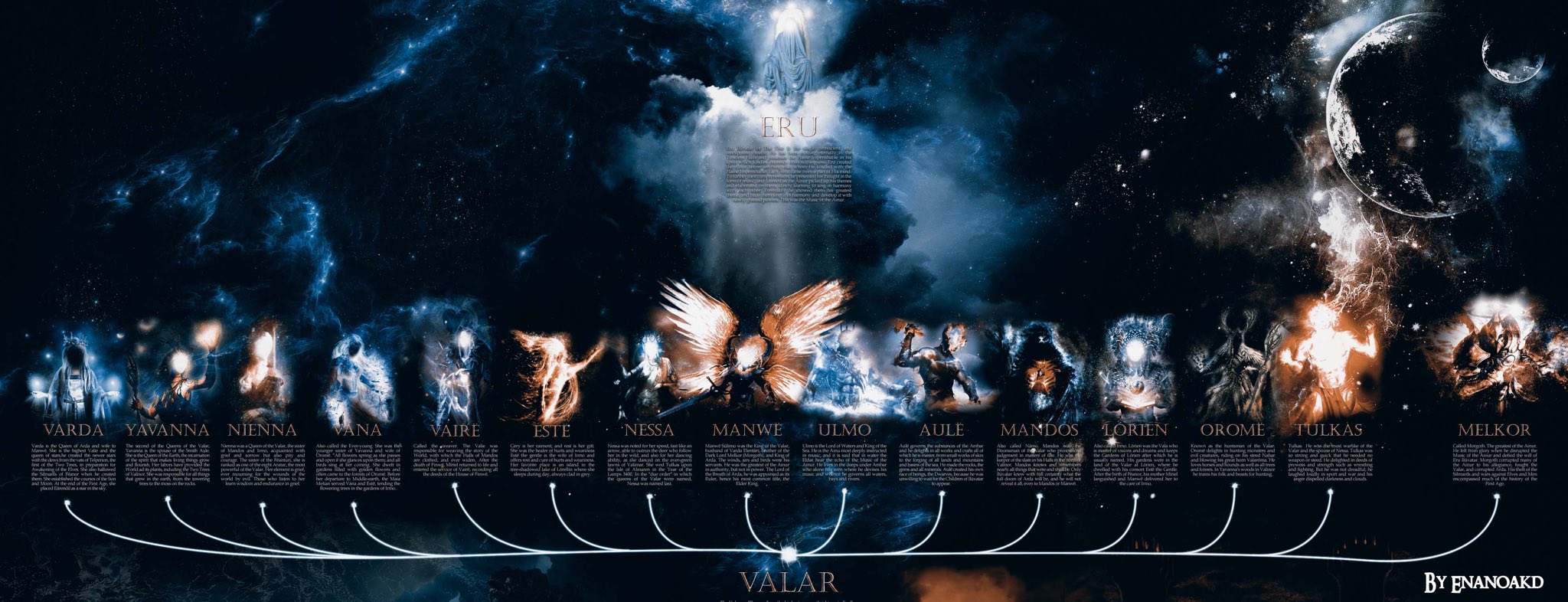
hello friends, I used to love doing research on middle earth and sharing my research on the forums while using the middle earth forums of my own country. Now, after a long time, I did some research on the internet again. I present to you the real appearances of all the valar that Tolkien has created and painted in his mind. Indeed, the power and might of all of them on this wallpaper is as written in the books. Among them, as you can imagine and you can see, of course, the tallest, largest and most majestic looking melkor. and tulkas and manwe in the closest dimension to melkor. Despite this, however, Manwe remaining like a child next to Melkor in this wallpaper. Although many of you may think differently, I think Melkor defeated Tulkas at Dagor Dagorath. already have this thought in people too on reddit and other middle earth forums. For if Melkor had not defeated Tulkas, Tulkas would have killed Melkor. that is, turin would not have killed the melkor. With Melkor and Tulkas fighting against each other, it is implausible that Turin was able to approach the two of them to kill Melkor. it already says something like this similar to in the encyclopedia below.

Note: If you saw this picture for the first time or liked it, don't forget click like and write your opinion.
 
That artwork is beautiful! I'd be curious to know, though, what's the basis for saying that it's the "true" depiction of the Valar as Tolkien imagined them? Like is there something specific that Tolkien wrote about their visual appearance?
I read this information on the site where I get this picture. In other words, it was an article like this; Based on all the written descriptions and portrayals of Tolkien, the most and correct appropriate appearances of valar. But I have no idea if it's correct or not. Because I do not know which writings of Tolkien were based on by those who made this artwork.
 
I read this information on the site where I get this picture. In other words, it was an article like this; Based on all the written descriptions and portrayals of Tolkien, the most and correct appropriate appearances of valar. But I have no idea if it's correct or not. Because I do not know which writings of Tolkien were based on by those who made this artwork.
Ah, gotcha! Would you be able to provide us the link then? I'm curious to see that. I haven't read anything about how Tolkien described the appearances of the Valar, but it's very possible it's out there and I just haven't read it yet. But I've been picking my way through some parts of History of Middle-Earth and haven't found anything about that yet.
 
Tolkien did not draw the valar anyway.
Precisely. As he did not draw the Balrog, or the Oliphaunt, or .. or....

Thus, what we see is one persons 'interpretation' of the descriptions Tolkien gave... which Ent fears, does not present sufficient detail to "know what he had in his mind" as he spoke of them, any more than we do of the others.

Ent suggests such phrases as "The true and accepted appearance and depiction of eru and all valar (gods and goddesses)" and the other seen in another post, "We all know 'it is certain' Celeborn participated in..." are inevitably controversial phrases, not based in any possible fact, and bring difficulty. They may even perhaps be used to stir up controversy.

it may be 'true and accepted' to the artist who drew the thing... and even 'true and accepted' to any individual who may accept it as such.
But it CANNOT be the 'true and accepted' version of what was in Tolkien's mind, because the artist is not Tolkien... nor is the Artist Tolkien's mind.
And Tolkien's descriptions and writings are, intentionally (as he himself said), open to interpretation.

Ent hopes this thread does not descend into a conflict based on the manner of language usage at its beginning.
We all know it is NOT the 'true and accepted appearance'.... except for by those who choose for it to be so.
Perhaps we can leave it at that.
If we cannot, the thread will be closed to comment.

If you disagree, just present a different artists rendering and say "I kind of see the descriptions more like this one"... or something... and leave it at that. Or share the part of the descriptions which bring you to that conclusion.

We will see one person interpreting the description or a piece of it one way, is no more right or wrong than another person interpreting the description, or that piece of it, another way.

Just look at what color Elves' hair are supposed to be as an example.
How can anyone conclude anything is 'the true and accurate description' when so much is left so unanswerd and without clear definition so often.

These things are all for the Halls of Speculation, not for 'true and accurate description.'

p.s. - we all also know places like Reddit and Tolkiengateway are also not "the sources" to use for the Truths of Tolkien's work.. only Tolkien's works are. Anything derivative from Tolkien's works or purporting to 'present Tolkiens works' by others, is 'interpretation.' So... we don't need to go into those things either except as possibly a comparison to what Tolkien actually wrote with resulting discussion. If the source is 'other' than Tolkien, it is to be verified against the Works before being accepted as 'fact'.


Note: Ent just reread this, and deduced he must be a little irritable today. Perhaps a bug under the bark or something..!
 
Last edited:
Precisely. As he did not draw the Balrog, or the Oliphaunt, or .. or....

Thus, what we see is one persons 'interpretation' of the descriptions Tolkien gave... which Ent fears, does not present sufficient detail to "know what he had in his mind" as he spoke of them, any more than we do of the others.

Ent suggests such phrases as "The true and accepted appearance and depiction of eru and all valar (gods and goddesses)" and the other seen in another post, "We all know 'it is certain' Celeborn participated in..." are inevitably controversial phrases, not based in any possible fact, and bring difficulty. They may even perhaps be used to stir up controversy.

it may be 'true and accepted' to the artist who drew the thing... and even 'true and accepted' to any individual who may accept it as such.
But it CANNOT be the 'true and accepted' version of what was in Tolkien's mind, because the artist is not Tolkien... nor is the Artist Tolkien's mind.
And Tolkien's descriptions and writings are, intentionally (as he himself said), open to interpretation.

Ent hopes this thread does not descend into a conflict based on the manner of language usage at its beginning.
We all know it is NOT the 'true and accepted appearance'.... except for by those who choose for it to be so.
Perhaps we can leave it at that.
If we cannot, the thread will be closed to comment.

If you disagree, just present a different artists rendering and say "I kind of see the descriptions more like this one"... or something... and leave it at that. Or share the part of the descriptions which bring you to that conclusion.

We will see one person interpreting the description or a piece of it one way, is no more right or wrong than another person interpreting the description, or that piece of it, another way.

Just look at what color Elves' hair are supposed to be as an example.
How can anyone conclude anything is 'the true and accurate description' when so much is left so unanswerd and without clear definition so often.

These things are all for the Halls of Speculation, not for 'true and accurate description.'

p.s. - we all also know places like Reddit and Tolkiengateway are also not "the sources" to use for the Truths of Tolkien's work.. only Tolkien's works are. Anything derivative from Tolkien's works or purporting to 'present Tolkiens works' by others, is 'interpretation.' So... we don't need to go into those things either except as possibly a comparison to what Tolkien actually wrote with resulting discussion. If the source is 'other' than Tolkien, it is to be verified against the Works before being accepted as 'fact'.


Note: Ent just reread this, and deduced he must be a little irritable today. Perhaps a bug under the bark or something..!
On the site where I got this picture I put here, it was written that based on Tolkien's writings outside of books and books (including notes and drafts), there are descriptions that are closest to the appearances of valar. Whether the appearances in this picture are correct or not, there are already countless pictures of valar appearances on the internet. In the meantime, it would be more reasonable and radical solution to just delete the messages instead of closing the issue for comments. Also, if Tolkien never wrote the appearance of the valar, to portray the valar as an appearance anywhere would be to undermine Tolkien's work and thought. Why don't people accept Tolkien's work in its current state? why do they create images or texts according to their minds?

Ah, gotcha! Would you be able to provide us the link then? I'm curious to see that. I haven't read anything about how Tolkien described the appearances of the Valar, but it's very possible it's out there and I just haven't read it yet. But I've been picking my way through some parts of History of Middle-Earth and haven't found anything about that yet.
Believe me, I can't find the site where I bought this picture right now because I lost it. More precisely, I didn't pay attention to the site and I was only interested in the image. The name of the site is not in my mind and there are already many pictures on the internet that depict valar like this image. To find them, just type valar on google.
 
In the meantime, it would be more reasonable and radical solution to just delete the messages instead of closing the issue for comments.
Absolutely correct. And we would never 'close a thread for comments' unless it got really out of hand with people fighting back and forth over some issue.

Generally, people are very well controlled and things don't 'get to that point' where a thread needs to be closed.

What would REALLY help, is if posts weren't started with such declarative language to begin with. Statements like 'we all know its absolutely certain', and "(this is) The True and Accepted Appearance..."

By nature, people's first reactions are "on no it's not..!!". The way the language is used is 'instigatory'. We just need to learn to "lean into our subjects" differently, to prevent the potential for a fight.

For example: the title could be "What do you think of this depiction of all the Valar and Eru"?

and the comments undern eathcould start with "This picture seems to be accepted by many as a true depiction based on Tolkien's descriptiions. What do you think?"

The declarative way... "This IS the true ...." invites conflict.
The suggested way invites discussion.

Especially since the very next post says "But I have no idea if it's correct or not. Because I do not know which writings of Tolkien were based on by those who made this artwork."

So if we "don't know" it's correct, lacking data and information, why would we start with "This IS the true and corred...?"

Language is a difficult thing, and Ent suspects language understanding may be a factor in these posts...

But no, at the end of the day we would not "close posts", if most were trying to discuss. Only if the Conflict the language of the post stirs up took over and reigned, to the point it was necessary just to shut it down. (haven't seen that happen in a very long time.)
 
Absolutely correct. And we would never 'close a thread for comments' unless it got really out of hand with people fighting back and forth over some issue.

Generally, people are very well controlled and things don't 'get to that point' where a thread needs to be closed.

What would REALLY help, is if posts weren't started with such declarative language to begin with. Statements like 'we all know its absolutely certain', and "(this is) The True and Accepted Appearance..."

By nature, people's first reactions are "on no it's not..!!". The way the language is used is 'instigatory'. We just need to learn to "lean into our subjects" differently, to prevent the potential for a fight.

For example: the title could be "What do you think of this depiction of all the Valar and Eru"?

and the comments undern eathcould start with "This picture seems to be accepted by many as a true depiction based on Tolkien's descriptiions. What do you think?"

The declarative way... "This IS the true ...." invites conflict.
The suggested way invites discussion.

Especially since the very next post says "But I have no idea if it's correct or not. Because I do not know which writings of Tolkien were based on by those who made this artwork."

So if we "don't know" it's correct, lacking data and information, why would we start with "This IS the true and corred...?"

Language is a difficult thing, and Ent suspects language understanding may be a factor in these posts...

But no, at the end of the day we would not "close posts", if most were trying to discuss. Only if the Conflict the language of the post stirs up took over and reigned, to the point it was necessary just to shut it down. (haven't seen that happen in a very long time.)
you are right. I think I used the wrong language. I have never seen a fight about a topic in this forum anyway. I also think that if the members think differently from the title or the topic, they can continue the conversation with the person who started the topic with a private message. I think this is a better way and result.
 
I have never seen a fight about a topic in this forum anyway.
You are blessed indeed, Teleporno Celeborn, not to have seen such a thing.

This forum does seem to be really appreciateve and considerate of one another at this time...something Ent hopes continues. (Ent is too old now, and easily impacted by excess conflict.... a reason this is the only forum or facebook page or any other 'internet group' he's now a part of.)

Ent's biggest concern right now is what will happen at the advent of Rings of Power season 2's release. Season 1 saw enough turmoil for all creation.

He has beseeched the other Mods to be released from Mod responsibilities before it comes out. But he's been advised there's no way he's escaping so easly..!!

So Ent is laying in a supply of "Buck Up* Ent Juice" in advance of its arrival, hoping to weather the anticipated storm.

(*Buck Up meaning - 'be tough... be ready... be strong')

But he truly hopes folks will understand how to say what they want to say without invalidating others' perspectives, and so open discussions, rather than conflicts.

Time will tell. Ent continues to try to be a 'peacemaking' type of entity for this place... (he thinks.)
 
According to text published by Tolkien himself [The Road Goes Ever On, 1967]:

The word fana applied to the "veils" or "raiment" in which the Valar presented themselves to physical eyes. And (regarding the forms in which the Valar were self-incarnated), it is written:

A) the Valar "usually" took the shape of the bodies of Elves or Men, although . . .

B) they could also assume other wholly "inhuman" shapes, which were seldom seen by Elves

C) they appeared as persons of majestic -- but not gigantic -- stature

D) they appeared vested in robes expressing their individual natures and functions

E) the High-Elves said that these forms were always in some degree radiant

Valaquenta [from the 1977 Silmarillion]

Manwe [delights in winds and clouds, regions of the air, all swift birds] [and from Of The Beginning of Days: "His raiment is blue, and blue is the fire of his eyes, and his scepter is of sapphire, which the Noldor wrought for him;"]

Varda "the light of Eru lives in her face"

[in a text published by Carl Hostetter: "The hands of Varda were (like all of her fana) of shining white" The Visible Forms Of The Valar And Maiar, The Nature of Middle-Earth]

Ulmo "seldom" clother his body after the manner of his peers.

" . . . the arising of the King of the Sea was terrible, as a mountain wave that strides to the land, with dark helm foam-crested and raiment of mail shimmering from silver down into shadows of green."

" . . . a living shape of great height and majesty"
wearing a tall silver crown, from which his long hair fell down as foam. He cast back a grey mantle (hung about him like a mist) to reveal a gleaming coat, close-fitted as the mail of a mighty fish, and a kirtle of deep green that flashed and flickered with sea-fire. "[The Fall of Gondolin, Unfinished Tales]

Aule [smith, master of crafts]

Yavanna "In the form of a woman she is tall and robed in green; but as times she takes other shapes. Some there are who have seen her standing like a great tree under heaven . . ."

Námo (Mandos) Keeper of the Houses of the Dead (and so on)

Vaire the weaver

Irmo master of visions and dreams

Este "Grey is her raiment"

Nienna mourns for every wound suffered in the marring of Melkor

Tulkas "his hair and beard are golden, and his flesh ruddy; his weapons are his hands."

Nessa lithe and fleetfooted (deer follow her train whenever she goes in the wild)

Orome has a great horn, rides Nahar [The Nature of Middle-Earth, same text as above: "a great horseman mounted upon Nahar and bearing his mighty horn, the Valaroma."]

Vána flowers spring as she passes.

And in summation: " . . . here is told in brief their likenesses, such as the Eldar beheld them in Aman. But fair and noble as the forms as in which they were manifest to the Children of Ilúvatar, they were but a veil upon their beauty and power."

__________

And from the text Ósanwe-Kenta [printed in Vinyar Tengwar and in The Nature of Middle-Earth] we read the words of Pengolodh, who states that the Valar do not beget, nor eat and drink, save at the high festivals. And that . . .

"Melkor alone of the Great became at last bound to a bodily form; but that was because of the use that he made of this in his purpose to become Lord of the Incarnate, and of the great evils that he did in the visible body."

And if we consider the Mannish Myth regarding the "Last Battle", I think it's quite plausible to imagine a weaponless, golden-bearded Tulkas, defeating Morgoth by hand, then allowing Túrin Turambar (again, in this myth he's "returned from the dead"] to deliver the death-stroke.

__________

I do not contend that this post is exhaustive with respect to every description of every Vala,
but for fun (maybe): in the early source The Book of Lost Tales it's said that Manwe was "clad
in sapphires"
-- which I would say isn't at "odds" with the "idea of Manwe" (so to speak), but in
general, one wonders what Tolkien would have kept in later attempts at physical description (if
any, that is).

For example, looking at the depiction of Ulmo in the very early Fall of Gondolin, we find him:
" . . . robed to the middle in mail like the scales of blue and silver fishes; but his hair was a bluish silver and his beard to his feet was of the same hue, and he bore neither helm nor crown. Beneath his mail fell the skirts of his kirtle of shimmering greens, and of what substance these were woven is not known, but whoso looked into the depths of their subtle colours seemed to behold the faint movements of deep waters shot with the stealthy light of phosphorescent fish that live in the abyss. Girt was he with a rope of mighty pearls, and he was shod with mighty shoes of stone."

And here Ulmo has a musical instrument made of many long, twisted shells pierced with holes.

Compare this last bit to the Silmarillion: "Now Ulmo, by the counsel of the Valar, came to the shores of Middle-earth and spoke with the Eldar who waited there, gazing on the dark waves; and because of his words and the music which he made for them on his horns of shell their fear of the sea was turned rather to desire."

So certain Ulmo descriptions could be said to be alike in ways, but in the early version, Ulmo bears neither helm nor crown, while in the Valaquenta a "helm" is at least used in description, and in the later Fall of Gondolin, Ulmo wears a tall silver crown. In the later text we can't see the "god's" feet,
of course, so should we still imagine that Ulmo wore stone shoes?

And should we imagine that his hair and beard were bluish silver? Or did Tolkien purposely leave this out in revision?

I can't say. I'm just sayin' :)
 
Last edited:
I do not contend that this post is exhaustive
Ent found this post VERY exhausting. oh.. he means... exhaustive.

Again, thank you for the detail. (another good one to print out and slide into the 'quick reference' binder.)
 
According to text published by Tolkien himself [The Road Goes Ever On, 1967]:

The word fana applied to the "veils" or "raiment" in which the Valar presented themselves to physical eyes. And (regarding the forms in which the Valar were self-incarnated), it is written:

A) the Valar "usually" took the shape of the bodies of Elves or Men, although . . .

B) they could also assume other wholly "inhuman" shapes, which were seldom seen by Elves

C) they appeared as persons of majestic -- but not gigantic -- stature

D) they appeared vested in robes expressing their individual natures and functions

E) the High-Elves said that these forms were always in some degree radiant

Valaquenta [from the 1977 Silmarillion]

Manwe [delights in winds and clouds, regions of the air, all swift birds] [and from Of The Beginning of Days: "His raiment is blue, and blue is the fire of his eyes, and his scepter is of sapphire, which the Noldor wrought for him;"]

Varda "the light of Eru lives in her face"

[in a text published by Carl Hostetter: "The hands of Varda were (like all of her fana) of shining white" The Visible Forms Of The Valar And Maiar, The Nature of Middle-Earth]

Ulmo "seldom" clother his body after the manner of his peers.

" . . . the arising of the King of the Sea was terrible, as a mountain wave that strides to the land, with dark helm foam-crested and raiment of mail shimmering from silver down into shadows of green."

" . . . a living shape of great height and majesty"
wearing a tall silver crown, from which his long hair fell down as foam. He cast back a grey mantle (hung about him like a mist) to reveal a gleaming coat, close-fitted as the mail of a mighty fish, and a kirtle of deep green that flashed and flickered with sea-fire. "[The Fall of Gondolin, Unfinished Tales]

Aule [smith, master of crafts]

Yavanna "In the form of a woman she is tall and robed in green; but as times she takes other shapes. Some there are who have seen her standing like a great tree under heaven . . ."

Námo (Mandos) Keeper of the Houses of the Dead (and so on)

Vaire the weaver

Irmo master of visions and dreams

Este "Grey is her raiment"

Nienna mourns for every wound suffered in the marring of Melkor

Tulkas "his hair and beard are golden, and his flesh ruddy; his weapons are his hands."

Nessa lithe and fleetfooted (deer follow her train whenever she goes in the wild)

Orome has a great horn, rides Nahar [The Nature of Middle-Earth, same text as above: "a great horseman mounted upon Nahar and bearing his mighty horn, the Valaroma."]

Vána flowers spring as she passes.

And in summation: " . . . here is told in brief their likenesses, such as the Eldar beheld them in Aman. But fair and noble as the forms as in which they were manifest to the Children of Ilúvatar, they were but a veil upon their beauty and power."

__________

And from the text Ósanwe-Kenta [printed in Vinyar Tengwar and in The Nature of Middle-Earth] we read the words of Pengolodh, who states that the Valar do not beget, nor eat and drink, save at the high festivals. And that . . .

"Melkor alone of the Great became at last bound to a bodily form; but that was because of the use that he made of this in his purpose to become Lord of the Incarnate, and of the great evils that he did in the visible body."

And if we consider the Mannish Myth regarding the "Last Battle", I think it's quite plausible to imagine a weaponless, golden-bearded Tulkas, defeating Morgoth by hand, then allowing Túrin Turambar (again, in this myth he's "returned from the dead"] to deliver the death-stroke.

__________

I do not contend that this post is exhaustive with respect to every description of every Vala,
but for fun (maybe): in the early source The Book of Lost Tales it's said that Manwe was "clad
in sapphires"
-- which I would say isn't at "odds" with the "idea of Manwe" (so to speak), but in
general, one wonders what Tolkien would have kept in later attempts at physical description (if
any, that is).

For example, looking at the depiction of Ulmo in the very early Fall of Gondolin, we find him:
" . . . robed to the middle in mail like the scales of blue and silver fishes; but his hair was a bluish silver and his beard to his feet was of the same hue, and he bore neither helm nor crown. Beneath his mail fell the skirts of his kirtle of shimmering greens, and of what substance these were woven is not known, but whoso looked into the depths of their subtle colours seemed to behold the faint movements of deep waters shot with the stealthy light of phosphorescent fish that live in the abyss. Girt was he with a rope of mighty pearls, and he was shod with mighty shoes of stone."

And here Ulmo has a musical instrument made of many long, twisted shells pierced with holes.

Compare this last bit to the Silmarillion: "Now Ulmo, by the counsel of the Valar, came to the shores of Middle-earth and spoke with the Eldar who waited there, gazing on the dark waves; and because of his words and the music which he made for them on his horns of shell their fear of the sea was turned rather to desire."

So certain Ulmo descriptions could be said to be alike in ways, but in the early version, Ulmo bears neither helm nor crown, while in the Valaquenta a "helm" is at least used in description, and in the later Fall of Gondolin, Ulmo wears a tall silver crown. In the later text we can't see the "god's" feet,
of course, so should we still imagine that Ulmo wore stone shoes?

And should we imagine that his hair and beard were bluish silver? Or did Tolkien purposely leave this out in revision?

I can't say. I'm just sayin' :)
I know you have your own opinion, but it is extremely wrong and unreasonable that tulkas in dagor dagorath allowed Turin to kill melkor after tulkas defeating melkor, that is, leaving turin to kill melkor after defeating melkor. because if tulkas had beaten melkor he wouldn't let melkor's kill be left to turin. because melkor would kill turin in the meantime and then he would fight with tulkas again. dagor dagorath is not a football match played with rust and assists. Considering what Melkor went through in the past because of Tulkas and considering melkor's dagor dagorath form is the most powerful form of melkor, To say that tulkas defeated melkor in dagor dagorath is tolkien's saying to himself "I am an inconsistent man".
 
because if tulkas had beaten melkor he wouldn't let melkor's kill be left to turin.

Why not? Your answer appears to be. . .

because melkor would kill turin in the meantime and then he would fight with tulkas again.

But in my scenario, Melkor can't kill Túrin in any meantime: again, Tulkas defeats Melkor, and defeated but still alive, Túrin delivers the death stroke -- and Tulkas allows this considering what Morgoth had put Turambar's family through.


dagor dagorath is not a football match played with rust and assists.

It's not football, and also not an event that happens within the history of the legendarium, nor is
it even a prophecy of a future event delivered by a "god" -- and if indeed the details here were
to survive in any "final" author-published legendarium, the Dagor Dagorath became (externally) merely part of a mannish myth -- a mythic end times scenario, imagined by Men within the story.

🐾
 
Why not? Your answer appears to be. . .


But in my scenario, Melkor can't kill Túrin in any meantime: again, Tulkas defeats Melkor, and defeated but still alive, Túrin delivers the death stroke -- and Tulkas allows this considering what Morgoth had put Turambar's family through.


It's not football, and also not an event that happens within the history of the legendarium, nor is
it even a prophecy of a future event delivered by a "god" -- and if indeed the details here were
to survive in any "final" author-published legendarium, the Dagor Dagorath became (externally) merely part of a mannish myth -- a mythic end times scenario, imagined by Men within the story.

🐾
Tulkas's hands are even tougher and deadlier than Turin's weapons. If Tulkas could, he would have killed Melkor with his hands already. But I think he could not kill melkor. Also, whether Dagor Dagorath is a men legend or a true end time event is still a matter of debate.
 
If Tulkas could, he would have killed Melkor with his hands already.

Well, here you're making an assertion that Tulkas "would" have done something, which, I'd
say, does not mean alternate scenarios (including the one I raised), are unreasonable in themselves.

In other words, they might be unreasonable to you, yes, because you think (your opinion) Tulkas "would have" killed Morgoth. I, however, do not think Tulkas need have killed him, and the honor was given to Turambar.

Also, whether Dagor Dagorath is a men legend or a true end time event is still a matter of debate.

Well, Tolkien himself characterized it as a mannish myth. Do you disagree with Christopher Tolkien's commentary concerning this?
 
Last edited:

Today's events

Similar threads

Back
Top