• Welcome to The Tolkien Forum! Connect with fellow Tolkien enthusiasts and join a community that is over two decades old, and still going strong. We look forward to meeting you.  Register

What are you writing about now?

RFBS saw "blah blah blah... Glorfindel seemed to be the obvious choice... blah blah blah... Glorfindel... blah blah blah". Great thoughts!

Jesting aside, this all sounds really very interesting! It's always a wonderful feeling when the inspiration juices start flowing. Keep up your good research/writing, @david_wendelken! 😄
Too funny! You might be displaying just a tad of bias... :)

I regret to inform you that Glorfindel isn't in Book 1, shows up for the first 2 chapters in Book 2 and then disappears until the war is well and truly over, after which he has fun things to do on the journey to Minas Tirith and back...
He only appears in the appendices in book 3 for a few brief entries.
 
Too funny! You might be displaying just a tad of bias... :)
Just maybe. 😉

I regret to inform you that Glorfindel isn't in Book 1, shows up for the first 2 chapters in Book 2 and then disappears until the war is well and truly over, after which he has fun things to do on the journey to Minas Tirith and back...
Aww, well, I'm sure he will take over in full whatever part you have for him! The guy is irrepressible!!
 
Well, I went thru all 83 uses of the adverb "quickly" and replaced all but 3 of them with a stronger phrase. The 2nd half of the list went a whole lot faster than the first half!

Now I'm starting on the 63 uses of "gently". I'm about to find out if fixing this will be just as hard as "quickly" or whether it's noticeably easier. I'll let you know!
 
Well, an hour and 8 minutes later, I've replaced all but 3 of the 63 uses of "gently" with better alternatives. Can't say it's an exciting task, but it was definitely easier and faster!

And, even better, I feel that almost all the replacements are actually better choices than the original word. I.e., they are either more apt; they more clearly express what I wanted to say. A few are just variations in style to say exactly the same thing.
 
I am currently worldbuilding my fantasy world. It is actually the latest in a series of projects, which started basically after I first read Lord of the Rings back in early 2000s. It is also the only one which I actually am serious about.
 
..I am currently worldbuilding my fantasy world. It is actually the latest in a series of projects, which started basically after I first read Lord of the Rings back in early 2000s. It is also the only one which I actually am serious about...
Do you write military fanfic of ME as well?
 
I've been working my way thru the list of potential adverb usages. As I mentioned before, I'm usually much happier with the change as the new phrasing better captures my true meaning.

With a bit of extra practice at doing this, I'm finding that the replacement text I use tends to be much better at "showing, not telling". That's a big win for a skill that will pay big dividends in the future!
 
I needed a break from the several hundred more adverb uses to review. So I checked out a few other quality control reports AutoCrit offers.

The first was the redundancies report. (No, you Brits, it's not about firing lots of people at one time.) It's about phrases composed of redundant words. Things like "knelt down" (is there any other direction on Earth one could kneel?). I'm pleased I didn't have many of those in book 2, which is what I'm editing with it. Less than 20 candidate redundancies in about 400 pages, and a half-dozen of them were either false positives or they were in dialog, where I left them 'cause people talk that way.

Next up was the cliches report. 55 in 400 pages. A number of them aren't actual cliches as they are used, they are literal statements of fact. For example, someone who suddenly hides in the woods has gone out of sight. Not "out of sight, man!" as the hippies would say when I was a lad. Half of the listings are in the first 8 phrases listed, all the rest are one-offs.

Aside from making my writing a bit more fresh by avoiding these too well-known phrases, I've actually found a number of inapt choices. For example, I used (once!) the phrase, "train of thought". Ain't no choo-choo trains in Middle-earth! Oops! That had to be replaced!

Another was an entry in the Annals of Lorien after Galadriel and Celeborn left and new management was in place - but not yet Thranduil. Remember that Legolas and Gimli used to wander around Caras Galadhon and environs whilst the fellowship rested in Lorien? In my story, Gimli made friends with an elven smith who used to live in Hollin before Sauron trashed the place. An offer was made to the dwarves in Erebor for them to come to his smithy and learn the secrets of his forge craft, some of which he had learned from dwarven friends from Khazad-dum long ago. I wrote that 3 dwarves were sent to test the waters. The cliche report picked up "test the water". A totally inapt expression to use in this instance. Bad, bad, lazy brain! Bad! I replaced it with "assay the offer" which is much more dwarven in its sensibilities.

Hope y'all find this interesting and useful!
 
For example, I used (once!) the phrase, "train of thought".

A 'train' is just a connected series of things, often pulling on or leading each other. For example, the train of a long garment, a camel train (caravan), or a retinue (a line of travelling people and/or vehicles). It comes from a Latin word, and so is related to the French 'trainer', which means 'to drag (behind)'.

I'm not sure about the origin of "train of thought", and whether the use of this phrase came before or after locomotive-pulled trains. But anyway, trains did exist before locomotives, so the comparison could have been used in the past for a string of related thoughts.

Though even if you could plausibly use it, I suppose it might make a modern reader think of the wrong kind of train, and break their immersion in the world a bit, so it might be better off changed.
You got me curious. 1651, Thomas Hobbes, Leviathan. So it's not a modern train, but I agree, it's best to change it anyway.
 
So, I've finished editing out the redundancies and the cliche' expressions.
Gone thru all the generic descriptive words that were overused (except for "looked") and tightened them up with more descriptive choices where appropriate. I have 407 usages of the word "looked" to go before that category of error is done.

In the first 5 "looked" reviews, all of them should have been words like peered, glanced, or regarded.

I also have about 1000 adverb usages to review before I explore other parts of AutoCrit.

The good news is that (a) I do believe the edits I've made make the writing clearer and more vibrant and (b), much of what I'm learning will be used as I write new material, so the editing burden will be much less in the future.

The bad news is that I have circa 1000 pages of already written material between books 1, 2 and 3 and that's a fairly heavy editing burden to bring up to snuff. Oh, well. At least I'm still having fun!

Oh, and the good news is also that (c) I have circa 1000 pages of already written material! :)
 
So it's not a modern train, but I agree, it's best to change it anyway.
The primary issue being 'it's an old, tired epithet,' for which a fresh expression can be found. Plus, one must consider whether they're addressing a 'train of thought' or a 'line of thinking'... though very similar, actually also very different.

A 'train of thought' usually follows a 'set of tracks' so to speak...in its more modern applications. A set of sequential, connected things and/or events.
A 'line of thinking' however is entirely fresh, not set on 'rails', and developing new, unconnected possibilities along the way.

We often speak of a 'train of thought' in terms of 'follow that train of thought to its inevitable conclusion.'
However, our 'line of thinking' implies 'chase that line of thinking and see where it takes you.'

As Sherlock Holmes would say, 'The distinction is clear.'
 
This book has just under 155,000 words in it.

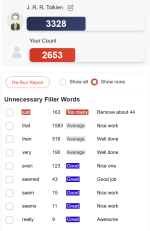
This is a sample report from AutoCrit. @Ent in particular might find it interesting.

About 1% of the book is the word "that" AND it is an average amount of usages compared to Tolkien's fantasy writing.

Surely to God I don't need that many thats!

Or should I say,

Surely to God I don't need so many thats! :)

I'm not ready to tackle this report yet. But when I do, I'll post a dozen sentences and see how many of them I can make better by removing a that from it.
 

Attachments

  • edit status filler words.png
    edit status filler words.png
    38 KB · Views: 27
Surely to God I don't need so many thats!
As you go through it you will find 80% of the ‘thats’ are ‘unnecessary that’ and of the other 20%, though they may be ‘proper,’ 95% of those can be eliminated to great advantage.

Tolkien is NO writer to emulate, nor is ‘that’ a word to be seen to be ‘average’ in. Travesty. (Barf, wretch,, puke… and other such grammatically inept words.). 😆

I’m thankful such a tool exists pointing out the many ‘filler words’ we waste space with… but I would beseech one and all to reach the ‘great’ category in each case..!!

‘That’. Ugh. Pushaw.
 
Got in several hours editing today. Worked on several different categories and word usages to give me a bit of variety. Otherwise the entire time would have been consumed with considering the usages of the word "looked".

I'm down to 234 usages from the 404 I started with. Of those 234, I've decided to keep 25 of them, so another 209 still to review! Let's just agree that I looked into looked and did not like what I saw! :)

I figure it will take several more weeks to work through the reports I understand and make the editing changes. All this is for book 2. I'll still need to clean up the ~500 pages of book 1 and the ~100 pages of book 3. But I can spread out the work on the other two books.
 
@Ent will be happy I've started working thru the usages of "that". I had 1584 usages. I've removed 76 and kept 29, for a 72% kill ratio. Removing 'that' often means one or two following words are no longer needed. Plus, I've found the sentences often become simpler and I need fewer commas in them. That's an extra bonus because I've always felt like I have too many commas in my sentences! :)

I'll do another couple hundred usages of 'that' and then cycle back to deal with more "looked" usages.
 
a 72% kill ratio.

1701826417010.gif


On the book I just finished editing, it started with 1,142, ended with 219, for an 80.8% kill ratio.
These are not at all uncommon numbers.

Were it my work, I would have eliminated the remaining 219 as well, but i need to be careful not to strip "all of an author" out of his/her work. It's important they still 'sound like themselves' at the end of the day.

So even as I'm revising other things, consideration for the author's voice and style is paramount.
 
Whilst exterminating an infestation of "that"s, it occured to me that "which" might be a useful variation when I want to keep the sentence (mostly) as is.

Then it occurred to me that I didn't really, truly, know the difference between that and which.

I found this description from Grammarly helpful:

"To understand when to use that or which, it’s important to understand clauses. A restrictive clause (also called an essential clause or a defining clause) contains information that is essential to the meaning of the sentence. In American English, only that is used for defining clauses. Here’s an example:

My bike that has a broken seat is in the garage.

From this sentence, you understand that the speaker has at least one other bike. Specifically, the bike they’re talking about is distinguished from their other bikes by its broken seat. If you removed the clause “that has a broken seat,” you would lose the implication that they own more than one bicycle, and even if you somehow knew about the other bikes, you wouldn’t know which one was in the garage.

Which introduces nonrestrictive clauses. Unlike restrictive clauses, nonrestrictive clauses (also called nonessential or nondefining clauses) don’t limit the meaning of the sentence. You might lose interesting details if you remove them, but the meaning of the sentence won’t change. These clauses are set off by commas.

My bike, which has a broken seat, is in the garage.

Here, the broken seat is simply a description of the bike in the garage. There’s no implication that the speaker owns more than one bike. Do you see the difference?"
 

Today's events

Similar threads

Back
Top