• Welcome to The Tolkien Forum! Connect with fellow Tolkien enthusiasts and join a community that is over two decades old, and still going strong. We look forward to meeting you.  Register

Trivia Thread!

I can't believe I didnt know about this:
It is believed that, in the early 1870’s, John Goodman Houshold and his brother built a glider and launched it from the top of a 300 metre precipice on the farm Der Magtenburg, in the Karkloof area of KwaZulu-Natal, South Africa. The first flight was just over 1 kilometer and a height of 50 to 80 meters was achieved. During the second flight the craft soared for a while before beginning a rapid descent in which it clipped a tree and crashed, breaking his leg in the process.

It was the first ever recorded heavier-than-air flight and Goodman and his brother could have been accorded a place in history had it not been for their mother. When she heard of the crash she persuaded them to abandon the project out of fear that the family would incur the wrath of God for challenging their natural state of being earthbound. It is believed that the glider was stored in a barn and eventually burned with other rubbish.

All drawings, sketches and calculations were supposedly burned at John Houshold’s insistence so he would abide by his promise to his mother never to discuss or attempt flying again.

This allowed the German Otto Lillienthal to take the honour when he made a successful glider flight in 1896. Eight years later, Orville and Wilbur Wright made the first powered flight at Kittyhawk in the United States. It was the dawning of a new era; an age of adventure, excitement and glamour that gripped the world, including South Africa.
 
Last edited:
The South Pole-Aitken Basin is a huge impact crater on the moon. It’s one of the largest impact craters in the solar system, measuring in at 2500 km in diameter and 6-8 miles deep.
IMG_3061.png
 
The sun is approximately 4.6 billion years old. Astronomers predict the sun is halfway through its lifespan and will continue to fuse hydrogen to helium in its core for approximately another 5 billion years.

Every second, it fuses around 600 million tons of hydrogen into helium.
 
Every second, it fuses around 600 million tons of hydrogen into helium.
...and when the hydrogen fuel begins to run low...

upper left: the last perfect day
upper right: sun begins to swell, Earth will heat, shorelines will retreat
lower left: oceans will rapidly evaporate
lower right: as the Sun evolves toward a red giant it will fill most of the sky and may engulf the Earth.

1710082861831.jpeg

from Carl Sagan's book, Cosmos, Chapter IX: The Lives of the Stars
Paintings by Adolf Schaller
 
...and when the hydrogen fuel begins to run low...
upper left: the last perfect day
upper right: sun begins to swell, Earth will heat, shorelines will retreat
lower left: oceans will rapidly evaporate
lower right: as the Sun evolves toward a red giant it will fill most of the sky and may engulf the Earth.
from Carl Sagan's book, Cosmos, Chapter IX: The Lives of the Stars
Paintings by Adolf Schaller
Not that any member of the species Homo stupidens will be around to verify the predictions of Carl Sagan and his astronomer colleagues ...
 
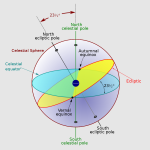
The vernal equinox occurred approximately 12 hours and 55 minutes ago.

A solar equinox is a moment in time when the Sun crosses the Earth's equator, which is to say, appears directly above the equator, rather than north or south of the equator. On the day of the equinox, the Sun appears to rise "due east" and set "due west". This occurs twice each year, around 20 March and 23 September.

I'm sure there's nothing confusing about this ;):
1710950337843.png
 

Attachments

  • 1710950187498.png
    1710950187498.png
    42.3 KB · Views: 22

Today's events

Similar threads

Back
Top