• Welcome to The Tolkien Forum! Connect with fellow Tolkien enthusiasts and join a community that is over two decades old, and still going strong. We look forward to meeting you.  Register

Trivia Thread!

A few hundred miles north of me (but still in AZ) is Meteor Crater (which i have visited) .
Go to the Wiki article HERE

Pic of the largest meteorite fragment left from the impact .
Original size is estimated to be to be 100 to 170 feet (30 to 50 meters) across.

1737366054952.jpeg


Most of the meteorite (80-90%) was vaporized on impact.
The energy released in the vaporization was equivalent to 1.4-1.7 megatons of TNT.
Pic of the Crater ...approx 0.75 miles across (1.2km) and 600ft deep (180m)


1737364645733.jpeg


Here's the neat thing, the similarity of meteorite impacts...
Look at the "rays" streaming out from the points of impact of the meteorites in Canada, the Tycho crater on the moon, the one in AZ , and the Giordano Bruno crater, (the youngest large crater on the Moon)
1737365125210.png


1737365685351.jpeg


1737365044194.jpeg


1737365352108.jpeg
 
Last edited:
The film has been identified as an unofficial remake of the Akira Kurosawa film, Yojimbo (1961), which resulted in a successful lawsuit by Toho, Yojimbo's production company. Kurosawa wrote to Leone directly, saying, "Signor Leone, I have just had the chance to see your film. It is a very fine film, but it is my film. Since Japan is a signatory of the Berne Convention on the international copyright, you must pay me." He and Toho received 15% of the film's revenue, and it is believed that Kurosawa earned more money from the financial settlement than he had made on his own film, Yojimbo.
 
Some jellyfish are so tiny they're practically invisible floating in the ocean's currents. The smallest are those in the genera Staurocladiaand Eleutheria, which have bell disks from just 0.5 millimeters to a few millimeters in diameter.

By contrast, the lion's mane jellyfish, Cyanea capillata, can extend its tentacles as far as 120 feet. The world's largest jellyfish by weight and diameter is thought to be the titanic Nomura's jellyfish, Nemopilema nomurai, which can dwarf a human diver. These beasts can have a bell diameter of 6.5 feet and weigh as much as 440 pounds.

1737660205043.png
 
It appears one of @Elthir's favorite words has a different meaning than we've all attributed to it.
View attachment 40596
Awesome! If only this racoon's name is Gregory then I'd be able to say:

Take a look at this JPEG of Greg the Egg Yegg..
1739644495535.png

(Unfortunately, his name is Phil. So, I can't say it. 😟)
 
LOL! My "yegg" is a matter of pronunciation.

my goal, among various other goals, is to make it an alternate form among English speakers. Thus, I'll be delighted if anyone chooses to employ it in "ordinary" conversation, assuming context will sort out the meaning
 
Yeah, I've hinted around with him about it, but it doesn't seem to register. Guess it isn't a term in the UK.
View attachment 40597
View attachment 40598View attachment 40600
Speaking of Looney Tunes,

Longtime Looney Tunes animator Chuck Jones hated Space Jam, so much that when Warner Brothers asked him to give a speech at a dinner for the Space Jam producers, he tried to give his honest opinion in a polite manner, but got escorted off the lot by security.
 
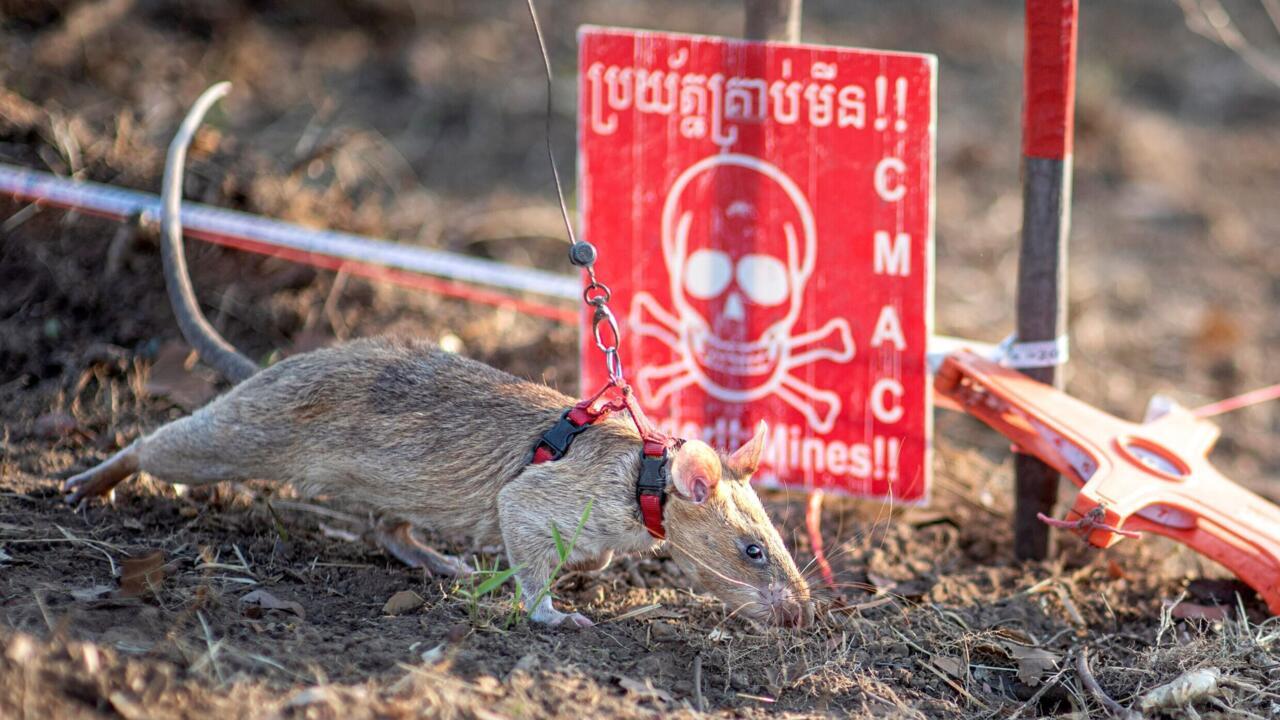
I wouldn't call this "trivial", but here's a story about a hero rat:


Short film showing him in action:
 
Sloths are famous for their bizarre bathroom habits. They will only relieve themselves once a week and can lose up to a third of their body weight in one sitting. Furthermore, they will only do it on the ground after wiggling around the base of a tree to dig a little hole. This weird weekly routine remains one of the biggest mysteries surrounding sloth behaviour. While there are many different theories, the likely explanation is that it’s all about communication and reproduction.
 
"Mad as a Hatter" – In 18th and 19th century England, mercury was used in the production of felt, which was commonly used in the hat-making trade at the time. Long-term use of mercury products often resulted in mercury poisoning-induced erethism among hat-makers. In the late 19th-century United States, a notable example occurred in Danbury, Connecticut, where hat making was a major industry. Instances of erethism were so widespread among hat-makers, the condition became known locally as the "Danbury Shakes." It was characterized by slurred speech, tremors, stumbling, and in extreme cases hallucinations.
 
"Mad as a March Hare"

Courtesy of Wikipedia:
To be as "mad as a March hare" is an English idiomatic phrase derived from the observed antics said to occur only in the March breeding season of the European hare (Lepus europaeus). The phrase is an allusion that can be used to refer to any other animal or human who behaves in the excitable and unpredictable manner of a March hare.
An early verbal record of this animal's strange behaviour occurred in about 1500, in the poem Blowbol's Test where the original poet said:
Thanne þey begyn to swere and to stare, And be as braynles as a Marshe hare (Then they begin to swerve and to stare, And be as brainless as a March hare)

Similar phrases are attested in the sixteenth century in the works of John Skelton (Replycacion, 1528: "Aiii, I saye, thou madde Marche Hare"; Magnyfycence, 1529: "As mery as a marche hare").

A later recorded use of the phrase occurs in the writings of Sir Thomas More (The supplycacyon of soulys made by syr Thomas More knyght councellour to our souerayn lorde the Kynge and chauncellour of hys Duchy of Lancaster. Agaynst the supplycacyon of beggars:[5] "As mad not as a March hare, but as a madde dogge."

Although the phrase in general has been in continuous use since the 16th century, it was popularised in more recent times by Lewis Carroll in his 1865 children's book Alice's Adventures in Wonderland, in which the March Hare is a character.

1745356578845.png
 
Last edited:
About the movie Die Hard:
In the German dubbed version, they are reinterpreted as a European group of criminals, possibly so that German audiences don't have to put up with German villains. Hans becomes Jack, Karl becomes Charlie, etc. Many sentences spoken in German in the original version are abbreviated sentences and contain serious grammatical and word errors; for example Gruber to Karl: ‘Schieß dem Fenster!’
 

Today's events

Latest posts

Similar threads

Back
Top