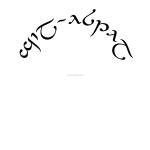
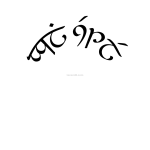
Hello! I'm hoping to get some expert help with a Tengwar rendering for a tattoo I'm designing.
What I want: The phrase "Gil-Estel" (Star of Hope) — the Elvish name given to Eärendil's star — rendered accurately in Tengwar for use in a permanent tattoo.
Context: The tattoo is an eight-pointed Polaris star on my forearm, and I'd like Gil-Estel worked subtly into the design — most likely running along one of the rays in very small script. The Tolkien layer is intentionally understated; it's a personal reference rather than a billboard.
My questions:
1. Is "Gil-Estel" the correct Sindarin form, or should it be rendered differently?
2. Which Tengwar mode is most appropriate — Beleriand mode since it's a Sindarin phrase, or would another mode be more linguistically accurate for this specific phrase?
3. Is there any meaningful difference between rendering this in the Noldorin versus later Sindarin tradition, given that Gil-Estel originates in the Silmarillion-era legendarium?
4. Is there a canonical Quenya equivalent of "Star of Hope" that Tolkien himself established, or is Sindarin the stronger choice precisely because Gil-Estel is an attested phrase? If a Quenya construction exists and is well-supported, I'd be interested to see it alongside the Sindarin rendering.
5. If you're able to provide a rendering or point me to the correct letterforms, I would be deeply grateful. I want to get this right before it goes on my skin permanently.
I'm marking a significant milestone — turning 60 — and the symbolism runs deep for me: Polaris as a fixed point, a true bearing, and Eärendil as the star that guides through darkness. Getting the rendering right matters. Thank you in advance.
What I want: The phrase "Gil-Estel" (Star of Hope) — the Elvish name given to Eärendil's star — rendered accurately in Tengwar for use in a permanent tattoo.
Context: The tattoo is an eight-pointed Polaris star on my forearm, and I'd like Gil-Estel worked subtly into the design — most likely running along one of the rays in very small script. The Tolkien layer is intentionally understated; it's a personal reference rather than a billboard.
My questions:
1. Is "Gil-Estel" the correct Sindarin form, or should it be rendered differently?
2. Which Tengwar mode is most appropriate — Beleriand mode since it's a Sindarin phrase, or would another mode be more linguistically accurate for this specific phrase?
3. Is there any meaningful difference between rendering this in the Noldorin versus later Sindarin tradition, given that Gil-Estel originates in the Silmarillion-era legendarium?
4. Is there a canonical Quenya equivalent of "Star of Hope" that Tolkien himself established, or is Sindarin the stronger choice precisely because Gil-Estel is an attested phrase? If a Quenya construction exists and is well-supported, I'd be interested to see it alongside the Sindarin rendering.
5. If you're able to provide a rendering or point me to the correct letterforms, I would be deeply grateful. I want to get this right before it goes on my skin permanently.
I'm marking a significant milestone — turning 60 — and the symbolism runs deep for me: Polaris as a fixed point, a true bearing, and Eärendil as the star that guides through darkness. Getting the rendering right matters. Thank you in advance.