• Welcome to The Tolkien Forum! Connect with fellow Tolkien enthusiasts and join a community that is over two decades old, and still going strong. We look forward to meeting you.  Register

What are you writing about now?

Got a helpful response from support. There is a highlight dialogue button I had missed, so it's now easy to focus on one part of the writing or another. Yeah.
I went about 30 pages into my document and only had a few verb tense errors. :) Support suggested I take a look at the passive indicators report as well.

According to it, I have 754 possible passive verb usages. Some passive writing is indistinguishable by the computer with correct verb tenses about events further into the past. So far, I'm 36 pages into Book 2 and I've removed 72 passive forms with simple past forms. I'm going to finish using this report and then go thru the verb tense consistency report all the way thru. At that point, I'll be ready to start back on new material in Books 1 and 3.
 
Removed 153 passive phrasings out of 754 potential candidates for change when using an auxiliary verb plus the past participle.

There are about 2500 usages of was, were, has and had in total, which includes most of the 754 mentioned above. Not sure what I'll find when I look at them.
 
I think maybe the black past tense verbs are auxiliary verbs.
Not exactly.
The difference between the ‘simple’ past tense and the ‘perfect’ past tense is one of ‘time’.
“Simple’ means “it’s happening with no reference to time whatsoever” with regard to the verb itself. It could be completed, or still happening.
“Perfect” means it is a ‘completed’ action in time.

For example”
“He walked to the park.” Vs.
“He had walked to the park.”

In the first ‘simple’ case, if we are talking about when someone was assaulted for example, a statement ‘he walked to the park’ could mean he was assaulted as he was walking to the park.

In the second ‘perfect’ (or perfected) case, ‘he had walked to the park’ contains the ‘time element’ of conclusion. The walk is finished. So his assault has to have been ‘after he had arrived’ at the park. Not during the walk.

Policeman: “When did the assault occur?”
Person: “I’m not sure”.
Policeman: “Can you tell me what happened?”
Person: “He left the house and walked to the park.” (Both simple tense verbs).
Policeman. “When did he leave the house?”
Person: About 11:00 I think.


FROM THE ABOVE the assault could well have happened while he was walking to the park. We still don’t know.

Policeman: “When did the assault occur?”
Person: “I’m not sure”.
Policeman: “Can you tell me what happened?”
Person: “He had left the house and had walked to the park.” (Both perfect tense verbs).
Policeman. “When did he leave the house?”
Person: About 11:00 I think.

FROM THE ABOVE we know by use of the perfect tense, he had left the house and made it all the way to the park before the assault occurred. The word “had” ‘perfects’ or “completes” the issue of the walk to the park.

This can make a big difference in time and timing.
If he was assaulted on his way to the park, it would be fairly easy to pin down an approximate time. Calculations of approximate walking time, location of the assault, etc. would make it simple.

However, if he had completed his walk to the park and the body was found at some time later, it could be much more difficult to pin down a time of the assault.

The same is true of the ‘perfect’ tense vs. the ‘continuous’ tense.
Note the diffference if what is said is “He left the house and was walking to the park”. Far more clear than the ambiguous “he walked to the park.”

(And frankly, this verb tense issue is hugely critical in the Hebrew, Aramaic and Greek of the Bible. Massive misunderstandings occur by sloppy translators mistranslating the verb tenses as they were given in the original texts…or the best representations of the originals we have.)

Just one example for now…. I’ll come back with more later.

Just think of the “simple” tense as being totally without ‘time’ sense at all. So ‘time’ must be extracted from surrounding text.
And the “perfect” (completed or perfected) tense as clearly indicating “time’ in the sense of what is in view being “completed in the past.”
And “Continuous” as ‘happening and still going on’…. Whether past, present and future

Example of continuous…. ‘He was walking to the park..’. I.e. it ‘was’ in the past but ‘was still going on’ when he was assaulted.
 
Yeah, I've always preferred 'perfected' or (even more) 'completed'.... "in the vernacular of the peasantry." (Wizard of Oz.)
It's also called the 'preterite tense' which is even worse.

the "continuous" is also called the "progressive".... equally misunderstood, thus I prefer 'continuous'.

Glad it helped a bit.
 
List of passive phrasings ( as defined by Auxiliary Verb + Past Participle) from the Passive Indicators report is down to 334 from the original 754. The report has false positives, i.e., tells about possible errors that aren't actually errors, so I left some of them. I'm halfway thru the text of the book.

The text generally reads cleaner now. There are fewer commas breaking up the flow and things do seem more "immediate" as well. But darn, this is a slog!

If any of you ever decide to use a program like this, I advise you to clean up a chapter at a time, right after you write it, instead of after you have an entire book to edit. Why? Because everything you learn to correct in one chapter means lots fewer things to correct in later chapters! I just wish I had started using this program a year ago!
 
I just wish I had started using this program a year ago!
You continue to give this program a good, positive plug.
I look forward to applying it to my own work(s) soon as I start on my stuff.
(I may apply it to one of my prior short works--familiarize myself with it and 'learn' some things--before I start writing anew.)

Have reached into Chapter 10 (of 12) in the book I'm editing now...so just these three last chapters and the author's Appendix to complete.

Then I'll write the new Introduction, and an Appendix of my own.. (I think he still wants one from me.)
We turned his Introduction into a Prologue given its content, so a new Intro is needed.

Hard to determine just how to "Introduce" this particular book...its content is so imperative.
Also hard to determine what to write the Appendix on...a huge array of topics are available to address!

How are the rest of you doing with your writing these days?
 
I take a break from one type of edit and work on a different one for awhile. It provides some variety in my tedium of choice. :)

Went to the Generic Descriptions report and gave it a spin. The word "great" was used 147 times, or about 3 out of every 8 pages. What's wrong with the word "great", you ask? Nothing. It's a great word! Except when it's overused as a generic description due to lazy writing or blasé descriptions!
So I clicked thru the 147 times it showed up and decided whether to keep or replace it. Now, had I gone thru 25 or so times and been happy almost every time, I would have gone elsewhere because both my time and my patience is limited. Greenwood the Great was a keeper, for example.

I now have 55 usages of the word great because a lot of my usages were just lazy writing. About 2/3rds of my not-so-great usages were replaced with alternate words or phrases that quite often better explained what I really intended.

Popped over to the Repetitive Phrase report and noticed that the phrase "closed her eyes" had been used 17 times. 17! I mean, I remember using it two times, maybe three, but 17? Surely not! So I clicked thru the usages really quickly to see if there was really a problem. Don't get me wrong, if it said there were 17 usages of "closed her eyes" there were bound to be 17. But would I like them once I looked at them again? After all, they seemed like a good idea at the time I wrote them down!

The answer is no. I no longer like them as much. I had 3 of them on the same page. Gack! I was often using it as a lazy way to show the reader that the character was thinking back on their memories. I can do better now that I'm aware of the pattern.

There are many other phrases or descriptive words that repeat many times because, well, they need to be there. I have 3 major battles and one major skirmish in book 2. I'm going to be describing the action on the left and right flanks in detail! In my Tolkien universe, the custom of the elves of Lórien, unless they are speaking to one another in their city of Caras Galadhon, is to refer to Celeborn and Galadriel as the Lord and Lady of the Galadhrim. Galadriel believes it wise to hide who leads Lórien from the outside world because if you know who the enemy leader is, and how they think based on their prior actions, you have a good idea how they will respond to the next danger they face. So, there are many valid usages of phrases like "of the Lady" or "Lady of the Galadhrim" that show up on these same reports. But they're easily ignored because I know, at a glance, they need to be there.
 
Last edited:
I just had a nice 2 hour writing session with my book. I only wrote about 600 words, very little by my standards, but part of it was making important continuity edits in my battle scene. For example, I started off the battle scene with a thunderstorm, and later forgot about it and wrote a vibrant sunset to end the battle scene. So I changed it to be a dark sunset, where the rain ended but the clouds are still around.

I also wrote almost a page moving the battle scene forward, which is very difficult for me because action is not my strong point and I have a hard time visualizing these things. Then I got stuck for a little while, but finally got a cool idea for my protagonist being tempted by a vision, planted by the villain, which will cause her and the hero to go exactly where the villain wants them. I have not yet written this vision temptation scene, but I outlined it, and in my next writing session I'll be ready to write it, so that's an achievement. I'm really excited about this vision scene because it will get the characters out of their safe place and back into the action, and spark a chain of events which will lead to some tragic deaths. And best of all, the villain tempts my protagonist not with her negative traits, but with her positive traits of selflessness and wanting to save her home and people. That's one of my favorite literary tropes, when a character's good traits are used against them and can even cause their downfall. It's certainly a Greek tragedy or Shakespearean sort of trope, and heavily utilized in The Silmarillion, of course!

Really, I need to get back to working on my book more often. The words flow easily when I've been working on it frequently, but they come sluggishly when I've been out of it for a while.

I have a serious goal to have a draft ready to send to the second round of beta readers before the tax season starts in late February. That means I need to get back to work in a regular way. So currently, I'm setting a goal to do an uninterrupted 2 hour writing session maybe 3 days a week. Would you guys here help keep me accountable on that? Especially you, @Tyelkormo the Fair , because our RPs are so much easier and more fun for me to write than my own book, lol! I'll still write plenty for our RPs, of course, but I need some accountability to work on my own book first! And @Fingon_Findekáno and @Glorfindel Goldtress , you guys have permission to pester me about working on my book 3 days a week too, lol!
 
I also wrote almost a page moving the battle scene forward, which is very difficult for me because action is not my strong point and I have a hard time visualizing these things.
I'm assuming a Tolkien world battle scene. See if there is an SCA (Society for Creative Anachronism) group near you and if they have any medieval "wars" that are taking place close enough for you to attend. Make some new friends and see first hand some aspects of medieval combat. And yes, there are differences as it's a sport that values everyone going home both hale and healthy afterwards.
 
Zoiks. So my most recent writing experience ended just minutes ago.

I received an offer for a 'special discount price' on The Sun, a revival of the New York Sun, started in 1883 (i think) but as with others, closed in recent history. It's on the road to a comeback under new leadership.

The supposed "publisher" of The Sun, one Dovid Efune, sent an email regarding the offer, touting them as, of course, a 'banner of truth and trust for the American People' as they come back, working to restore America's faith in the integrity of newspaper reporting and journalism.

Sadly, the introduction and first paragraph of the offer were poorly written, infested with 'that' in every sentence.

I just wrote them back a rather careful treatise suggesting they could not only come back representing decent factual newspaper and journalistic reporting, but could also stand as an Exemplar of how to write, and thus to speak, well, as in these arenas we've descended into muck and mire in communication, such as with use of the word 'that.'

Of course, I took time in the response to demonstrate the flaws in their Introduction and First Paragraph so they could see.

Do I think I'll hear back? Not in the least. Do I even believe the actual Publisher wrote the offer, or will read my response? Not in the least.

But I do feel good about taking some kind of positive action to try to get them to recognize they are 'talking heads' standing before the public as leaders of opinion and expression, and need to think about what they do beyond just the pouring out of what they print.

There are a lot of slack places in the world where we need to hold people accountable for their behaviors and actions these days. The opportunities abound. The question: does the leveraging of the opportunities abound as well? Or have we instead become complacent, and willingly and unthinkingly accepting of inadequate practices and performances?

(If this sounds much like what some say about the production of Rings of Power, well...in fact it is..! Many think I decry any annoyance with what was done. Yet As I've noted countless times before, I in no way say or believe we need to 'accept' or be satisfied with mediocrity. What I DO say, is we need to learn to 'take what is good' from those things for ourselves, accept them for what they are regarding the rest, and use well the opportunities they provide us for ACTION. Whining and crying ad nauseum about stuff isn't true ACTION. It's misdirection. Inaction related to anything producing a meaningful effect or result, and ultimately self-destructive inaction at that, if held too closely.)

Anyway, I'll shut up now.
I share this here only as a reminder...
EVERY writing event is an opportunity to practice the skillsets adjoined to it.
And every thing we encounter may be an opportunity for action.
May we be ever ready.
 
I just had a nice 2 hour writing session with my book.
Awesome!! Sounds like you got some great (and necessary) progress accomplished with CoX.

I have a serious goal to have a draft ready to send to the second round of beta readers before the tax season starts in late February.
Hooray! I can’t wait to read your new draft when it’s ready. 😃

And @Fingon_Findekáno and @Glorfindel Goldtress , you guys have permission to pester me about working on my book 3 days a week too, lol!
You can count on me to pester you, bestie! I wanna read that book! 😁🤣

I'm assuming a Tolkien world battle scene. See if there is an SCA (Society for Creative Anachronism) group near you and if they have any medieval "wars" that are taking place close enough for you to attend. Make some new friends and see first hand some aspects of medieval combat. And yes, there are differences as it's a sport that values everyone going home both hale and healthy afterwards.
This sounds so cool! I would love to learn about medieval combat, both for fun and for my writings.

In regards to my own personal endeavors, I don’t get to write as often as I’d like, though I am always thinking about it. Thankfully, I have had some rich opportunities recently, which have proven quite fruitful. I’ve found I work best on my iPad mini in the Notes app, alone in my room for at least a good couple hours early in the morning when there’s still peace and quiet.

Over the summer I had written a decently-sized post as an opener for an RP I’m doing with @Maedhros_Nelyafinwë. Since then I have been struggling to write my next post as a follow-up to hers, even though I think about the story literally all the time and know how I want it to go, for the most part. It’s just how my brain seems to work. Anyways, while contemplating ideas and rereading my original post a couple months back, I realized I wasn’t entirely pleased with how it was, and if I wanted to move forward, I would need to start there. So, I have spent a considerable amount of time rewriting my original post, or at least heavily editing it. I’ve added more visual details to convey action and describe the environment, as well as expanded other elements and increased the sense of danger involved. At this point my post is now well over twice the length it originally was (at least 40 paragraphs), and I’m much more pleased with it.

I must say, I have found your discussions on this thread very useful and thought-provoking for my writing, especially from @david_wendelken and @Ent. As a result, I carefully consider every word and phrase, often coming back to reevaluate various passages. I’m trying to think of different suitable synonyms and ways of expressing things, though I have yet to complete the task. The story is written in present tense, which can be a challenge in itself sometimes, and I have to go through and pay attention to instances where I instinctively wrote in past tense. I’ve also made a point of minding the sentence structure and attempting to convey action, such as when you guys have discussed the impact of using “and” or not. In addition, because the post is so long and content-heavy, I need to keep track of everything to make sure it remains both cohesive and coherent. So many things to consider and sift through!!! 😅

Suffice to say, a writer’s job is never done, and I don’t think I’ll ever be completely and totally satisfied with it, because I’ll just keep thinking of more and more things to edit in. 😂 I am much more satisfied now though, which means I have largely gotten it off my mind and can now focus on my new post. I’ve had fragments of it written for a long time, working on it a bit here and there, some sections being easier to develop than others. There was always this one section which kept stumping me, however.

Until today.

I had a chance to do some writing this morning, and I think I’ve finally had a breakthrough, and can now connect the pieces into a more coherent and fleshed-out post. It’s tricky enough just putting it all together sometimes, but since this is an RP, I also need to be careful to not be redundant in information that has already been presented from my first post. Nonetheless, progress has been made, and I’m very happy about it! 😄
 
The story is written in present tense, which can be a challenge in itself sometimes, and I have to go through and pay attention to instances where I instinctively wrote in past tense.
It's pretty funny, but I have the opposite problem. I naturally write in present tense, as the action I'm describing is happening in my head 'right now', not in the past or whenever these stories are supposed to be happening. So I need to be careful if I happen to be writing in past tense. 😁
 
This sounds so cool! I would love to learn about medieval combat, both for fun and for my writings.
Here's a link with some video (which I didn't completely watch or listen to):

https://www.medievalists.net/2019/08/pennsic/

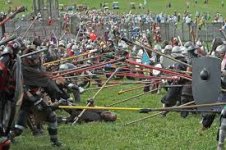
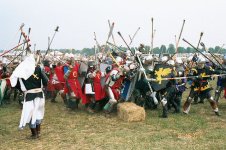
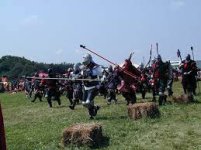
And I've attached some battle photos. But you can learn a lot from a local group and small skirmishes too.

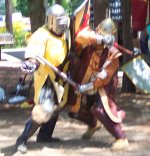
In the 4th picture, the one with just two people fighting one another, I'm the guy on the right. My opponent is in the process of losing his right arm at the elbow, which will be followed up with a backhanded axe blow to the side of his head. Note that the impact of my body forced his shield high and to the left which opened up slots for both blows to land. My foot and hip placement both pins his shield in place and will allow me to pivot into the blow, which will add a significant amount of centrifugal force to the axe blow. It was a good day. ;) I've been able to use details from a number of my combats in my writing.
 

Attachments

  • pennsic  3.jpg
    pennsic 3.jpg
    14.4 KB · Views: 27
  • pennsic 2.jpg
    pennsic 2.jpg
    89.6 KB · Views: 28
  • pennsic 1.jpg
    pennsic 1.jpg
    10.1 KB · Views: 26
  • JPG_COMBAT_01.JPG
    JPG_COMBAT_01.JPG
    115.4 KB · Views: 29
It's pretty funny, but I have the opposite problem. I naturally write in present tense, as the action I'm describing is happening in my head 'right now', not in the past or whenever these stories are supposed to be happening. So I need to be careful if I happen to be writing in past tense. 😁
Interesting! Most stories I read are written in past tense, so I’m just used to thinking in the same. Sometimes I’ll mentally change the tense to present while reading to see how it flows, and it usually translates well. I can force myself to write in present tense well-enough, but there are some instances where I’ll write something and move on, then return to it later and realize it was in past tense.

What makes it more tricky is when most of my text is written in present tense, but then I reference things of the past, so I need to switch to past tense for them. Keeping track of how it all reads and everything can be confusing at times, but worth it, I’d say. The current action is built upon events of the past, so it references them quite a bit.
 
In the 4th picture, the one with just two people fighting one another, I'm the guy on the right. My opponent is in the process of losing his right arm at the elbow, which will be followed up with a backhanded axe blow to the side of his head. Note that the impact of my body forced his shield high and to the left which opened up slots for both blows to land. My foot and hip placement both pins his shield in place and will allow me to pivot into the blow, which will add a significant amount of centrifugal force to the axe blow. It was a good day. ;) I've been able to use details from a number of my combats in my writing.
You lucky blighter!
I would love to be able to do medieval reenactments.
 
In the 4th picture, the one with just two people fighting one another, I'm the guy on the right. My opponent is in the process of losing his right arm at the elbow, which will be followed up with a backhanded axe blow to the side of his head. Note that the impact of my body forced his shield high and to the left which opened up slots for both blows to land. My foot and hip placement both pins his shield in place and will allow me to pivot into the blow, which will add a significant amount of centrifugal force to the axe blow. It was a good day. ;) I've been able to use details from a number of my combats in my writing.
Yeah, yeah. History is always told from the 'winner's' side.

Now let's hear it from the 'loser's'.

"I was just standing there getting used to the feel of my costume and preparing to get out on the field for the action. This clown comes up in my face, howling in some kind of a rant, asking me what my problem is. I spread my arms out and asked him what he was all 'on' about. The nutjob assaulted me, cutting my right arm off at the elbow and slamming his hand-axe into the right side of my helmet. Now I write left-handed and very slowly, because my right hand is gone and my brain function is impaired. To make matters worse, I lost the court case because he was deemed not responsible for his own actions, and mentally incompetent to stand trial. I'll die in poverty, unable to work for the rest of my life."

Actually though, all kidding asside, your recommendation to attend events like this and avail ourselves of other things of an 'instructive' nature regarding stuff we want to write about, is 'right on'. It's even good to consider talking to people who participate in the things in view, asking them specific questions about 'how' things are done, to enhance our understanding, mental picture, and ability to get it "put on paper." An example coming to mind is a fight between a couple karate (or other marshal-arts) masters. Who better to learn some details from than actual trained folk.
 

Today's events

Similar threads

Back
Top