Elendil is the first king of all the Dúnedain and the first high
king of Gondor and Arnor. He is known to be the greatest Dúnedain warrior and most respected leader. He goes by the
titles Elendil the Fair, Elendil the Tall, and
Ælfwine (
elf friend). What made Elendil stand out was his height. He was one of the few characters of
Tolkien whose height was given emphasis. He was described to be more than man-high and half a ranga. It was estimated that Elendil’s height was about seven feet and eleven inches. It is no wonder that he was also known as Elendil the Tall.
Biography
Elendil in Númenor
Elendil was born in the
Second Age in Númenor. His father was Amandil, the Lord of Andúnië. Amandil is the leader of
the Faithful, a group of Númenoreans who remain loyal to the
Valar and are against the practices of
Sauron and
Ar-Pharazôn. Amandil maintained a strong relationship with the
elves and led the Faithful in practicing
the old ways. Because of this, Sauron harbored a hatred for Amandil - a hatred that Elendil inherited. Elendil married an unnamed Númenorean woman, but it can be assumed that she had noble blood and had the same upbringing as Elendil. His wife bore two sons: Anárion and Isildur. Ar-Pharazôn was the
King of Númenor. His desire for eternal life caused him to be easily swayed by Sauron.
Ar-Pharazôn and Sauron planned to attack
Valinor and Amandil was able to hear about the plan. Amandil then instructed Elendil to gather the Faithful. They should meet in Romenna where they will escape as a group to
Middle-earth. Elendil followed his father’s instructions and assembled the Faithful. They were able to occupy nine
ships and waited off the coast of Romenna. The Valar spared the Faithful when they sent a great wave that sank Númenor. As the wave approached the shores of Romenna, a great storm appeared, which snapped the sails of the ships and tossed them around in the waves. The same storm helped the ships journey to Middle-earth. Tolkien did not specify if Elendil’s wife came with him to Middle-earth after the Fall of Númenor.
The Foundation of Gondor and Arnor
It was SA 3320 when Elendil, his sons, and the Faithful arrived in Middle-earth.
The nine ships were separated during the storm causing Elendil to land in a different place from his sons. They were at least a thousand miles apart. However, they had the
Palantiri with them, so they were still able to communicate and established joint
kingdoms. Elendil established Arnor where he landed while his sons started building
Gondor where they landed. Elendil stayed in Arnor, where he built the
city of Annúminas. His sons, Isildur and Anárion, remained in Gondor. Isildur founded the
fortress of
Minas Ithil in
Ithilien while Anárion founded the fortress of
Minas Anor in Anárien. In the center of Gondor,
Osgiliath, the capital was built. In the heart of Osgiliath is a great stone bridge containing the Dome of Stars. This is the tower where the city’s Palantiri or seeing stone is kept.
The Last Alliance of Elves and Men
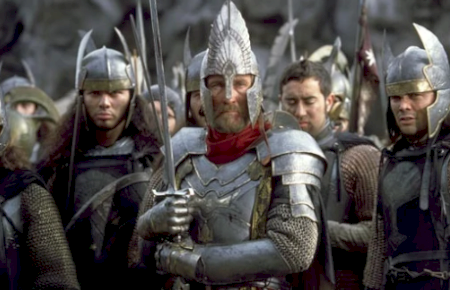 Elendil with his men during the Last Alliance.
When Sauron returned to Middle-earth, he founded his stronghold in
Mordor, which was very close to Gondor. Sauron started attacking Gondor in SA 3428 and was able to conquer Minas Ithil. This caused Isildur to flee to Arnororn, where Elendil rules. Anárion was left in charge of the rest of Gondor. In SA 3434, Elendil was able to make an alliance with the elven high king
Gil-galad. With the joint forces of Isildur, Elendil, and the elves, they marched towards Gondor together to help Anárion fight off Sauron’s forces. This became known in history as the Last Alliance of Elves and Men. The joint forces were able to defeat Sauron’s
armies, and they were able to advance to Mordor. They successfully took control of
Barad-dûr. It was during the siege of Barad-dûr that Anárion was killed. The armies of elves and men were able to continue fighting the long siege from Barad-dûr. By SA 3441, Sauron finally came out to battle personally with his enemies. Elendil and Gil-galad faced him. They were able to overthrow Sauron, but they were both killed in the process. When Elendil fell, his
sword broke under his weight. Isildur then took his father’s broken sword and cut off the finger wearing
the One Ring from the hand of Sauron. With the One Ring away from him, Sauron’s physical form was destroyed, and his spirit fled.
Elendil’s Legacy
After Sauron’s defeat, Isildur made a hidden tomb for Elendil. This was located on the top of a hill in Halifrien. This hill was named later as
Amon Anwar. In Sindarin, the name means “hill of awe.” The tomb of Isildur was great and big enough to shadow out the entire hill. The
Rohirrim called it the Halifirien meaning “holy mountain” in their language. When
Rohan was founded, Cirion, the
steward of Gondor, had Elendil’s remains moved to
Minas Tirith. Elendil was able to establish strong regimes when he brought the Faithful to Middle-earth. He was able to create a great alliance with the elves that put an end to Sauron’s reign of terror for more than a thousand years. His bloodline and leadership survived through his son, Isildur. From their bloodline, comes a line of heroic men whose actions would bring about Sauron’s end - particularly
Aragorn.
Adaptations
Movie
The Lord of the Rings Trilogy: In Peter Jackson’s portrayal, Elendil makes a brief appearance in the opening scenes of The Fellowship of
the Ring, where a short introduction to the
Battle of the Last Alliance and the defeat of Sauron is shown. Elendil is portrayed by New Zealand actor Peter McKenzie. Unlike in Tolkien’s
books, Elendil is killed by Sauron. His son Isildur is
the one who fights off Sauron and deals the fatal blow. Elendil is also shown to have the same height as his troops, unlike in the book where he is known to tower over most men.
Video Game
The Lord of the Rings Online: Elendil appears in this video game during the
War of the Last Alliance’s re-runs. In these flashbacks, Elendil can be seen battling Sauron beside Gil-galad. Just like in Tolkien’s books, Elendil is the one who deals the fatal blow at the expense of his and Gil-galad’s life.
References


