• Welcome to The Tolkien Forum! Connect with fellow Tolkien enthusiasts and join a community that is over two decades old, and still going strong. We look forward to meeting you.  Register

Why would 🧙Maiar become Balrogs?

MrsEowynBrandybuck

New Member
Joined
Jul 26, 2018
Messages
4
Forgive me if this is a stupid question, but why would Maiar become Balrogs, and why would Melkor want them to? Surely as "unclad" Maiar, they would have access to further powers than those of flame, so why would it be beneficial for them to be trapped in one form?
 
Welcome to the forum, er, "Mrs" EowynBrandybuck! ;)

It is not a stupid question. As none of the Ainur Lore Masters have appeared yet, I'll take a stab at it.

First, my (limited) knowledge about them leads me to believe that Maiar had a greater ability to affect the physical, material, aspect of Middle Earth when they themselves took physical form (I'm open to correction here, I hasten to say).

If that is the case, they would most likely take a form fitting their Ainur "angelic" nature. "Balrog" is from a Sindarin word meaning "Demon of might", which is a somewhat general term, but it appears they were associated with, or of a similar kind to, Arien, the "fiery maiden" who was given control of the Sun, but of much lesser power, of course. Therefore, their physical guise would naturally be "fiery": they would be more able to exert their innate powers in that form.

There are various possibilities in looking for sources. An interesting one is explored by Shippey, in "Author of the Century": Tolkien thought that the "Sigelwara" in the Old English poem Exodus ("invariably translated as 'Ethiopians'") should have been written *sigel-hearwa, "a kind of fire-giant". That would connect them with the Old Norse fire-giant Muspell.

Another possibility is that they are based on the seraphim, the fiery angelic beings known from the Old Testament and later Christian theology and iconography. Gandalf has clear seraphic associations, but of course the Balrogs, as we encounter them, are in their "fallen" forms, after their corruption by Melkor. What form they may have taken before that, I don't know, but I'd suspect even their unfallen forms would be somehow associated with their fiery nature. It's very suggestive, in any event, that the showdown between these two "fiery angels" results in their mutual destruction -- a sort of matter-antimatter collision.

Why they would continue in that form is another question: the concensus, based on Tolkien's writings, seems to be that, once a Maia began to interact physically with the material world, particularly if it involved self-interest (e.g., Melian), it became more difficult to "detach" oneself -- like an addiction, perhaps. And this would be much more so for corrupted beings, such as Balrogs.

There's an interesting discussion here:

https://scifi.stackexchange.com/que...nur-were-unable-to-change-their-physical-form

Hope this helps -- at least until something better comes along! :)
 
Last edited:
'The Belryg, although now more terrible in hand to hand combat than their master, disappeared into the gloom, their flames shrinking and dimming in fear, like candles in the night whose bearers do not wish to be noticed'
 
I think if Morgoth had no power to change form himself, and had given so much of his power into these different creatures, it would not have been possible for these lesser servants of him to change form. Once they were in Balrog-form, they were corrupted forever and could not be altered.
 
Important to consider too, is that the 'common representation' of Balrogs we see by illustrators is very likely not at all what Tolkien had in mind.
Although their form was dreadful in appearance, it does not mean they were necessarily horned, bent, massive looking demon-beasts.
There are one or two illustrations out there that I feel are more closely akin to what they probably looked like than our norm.
(But the more 'beastly' ones certainly make for good illustration and filmography..!!!)

We need to remember that the terms "terrible" and "dreadful" meant "instilling dread or terror" and nothing more. And these are much of the 'description' we have of them. Even our term "Terrific" originally meant "of a nature that instills fear or terror" rather than the 'wonderful' or 'great' we have abused it into.
 
Important to consider too, is that the 'common representation' of Balrogs we see by illustrators is very likely not at all what Tolkien had in mind.
Although their form was dreadful in appearance, it does not mean they were necessarily horned, bent, massive looking demon-beasts.
There are one or two illustrations out there that I feel are more closely akin to what they probably looked like than our norm.
I imagine them more enswathed in shadow than the film portrays them. Less visible. Remember, the Unknown is what our brains find frightening. Also less stony. More like this:
1668094236717.png
 
access to further powers

I also think we need to keep in mind Melkor himself feared the Elves and Dunedain at the height of their power.

We often attribute way more power to Maiar and even Valar (like Melkor) than they likely actually had, compared to the powers originally given to the other creations of Eru.

It could well be they actually focused what power they had better given the forms and whips and such they had to do battle with. Certainly one gave Gandalf an equal run for his money...
 
There are one or two illustrations out there that I feel are more closely akin to what they probably looked like than our norm.
Yup...
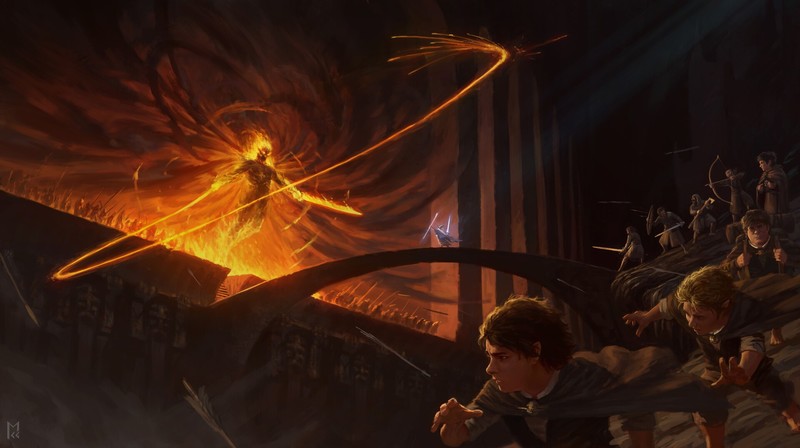
Here's an illustration that is much closer to what I imagined while reading the books, then what is shown later in the movies.

And definitely not higher then... let's say... 2,5 meters... 3 meters max.

137140-fantasy-art-The-Lord-of-the-Rings-Gandalf-Balrog-Frodo-Baggins-Samwise-Gamgee-Legolas-Aragorn-Gimli-Boromir-J.-R.-R.-Tolkien.jpg
 
And definitely not higher then... let's say... 2,5 meters... 3 meters max.
Indeed, which makes the Balrog in this artwork too a bit too tall, reviewing the proportion to Gandalf standing on the bridge.
That said, this depiction is, in my opinion, far more likely for a form the corrupted Maiar may have either taken or been forced into.
But at the end of the day, we just weren't given enough description 'to be sure'.
"The fun is in the hunt." Sherlock Holmes
 
Forgive me if this is a stupid question, but why would Maiar become Balrogs, and why would Melkor want them to? Surely as "unclad" Maiar, they would have access to further powers than those of flame, so why would it be beneficial for them to be trapped in one form?

I think Melkor/Sauron being the legendary tricksters, liars, and conmen that they were were particularly wary of underlings with similar powers. They simply were not not interested in self willed underlings. I think this might be a case of separate philosophies converging to the same result relative to the Sith. The Sith were never able to sustain more than 1 master and 1 apprentice at a time, Melkor would of feared half a dozen powerful free willed underlings more than Iluvatar himself.
 
Even our term "Terrific" originally meant "of a nature that instills fear or terror" rather than the 'wonderful' or 'great' we have abused it into.
These are compatible. Consider that a 'fear of god' is considered pious by many. Something awesome can be terrible (a word which now means no good, but once meant terrifying, and still does in some uses).
 

Similar threads

Back
Top