• Welcome to The Tolkien Forum! Connect with fellow Tolkien enthusiasts and join a community that is over two decades old, and still going strong. We look forward to meeting you.  Register

🧝Legolas Fighting The Balrog and Dagor Dagorath?

Also Is Dagor Dagorath Cannon or not?

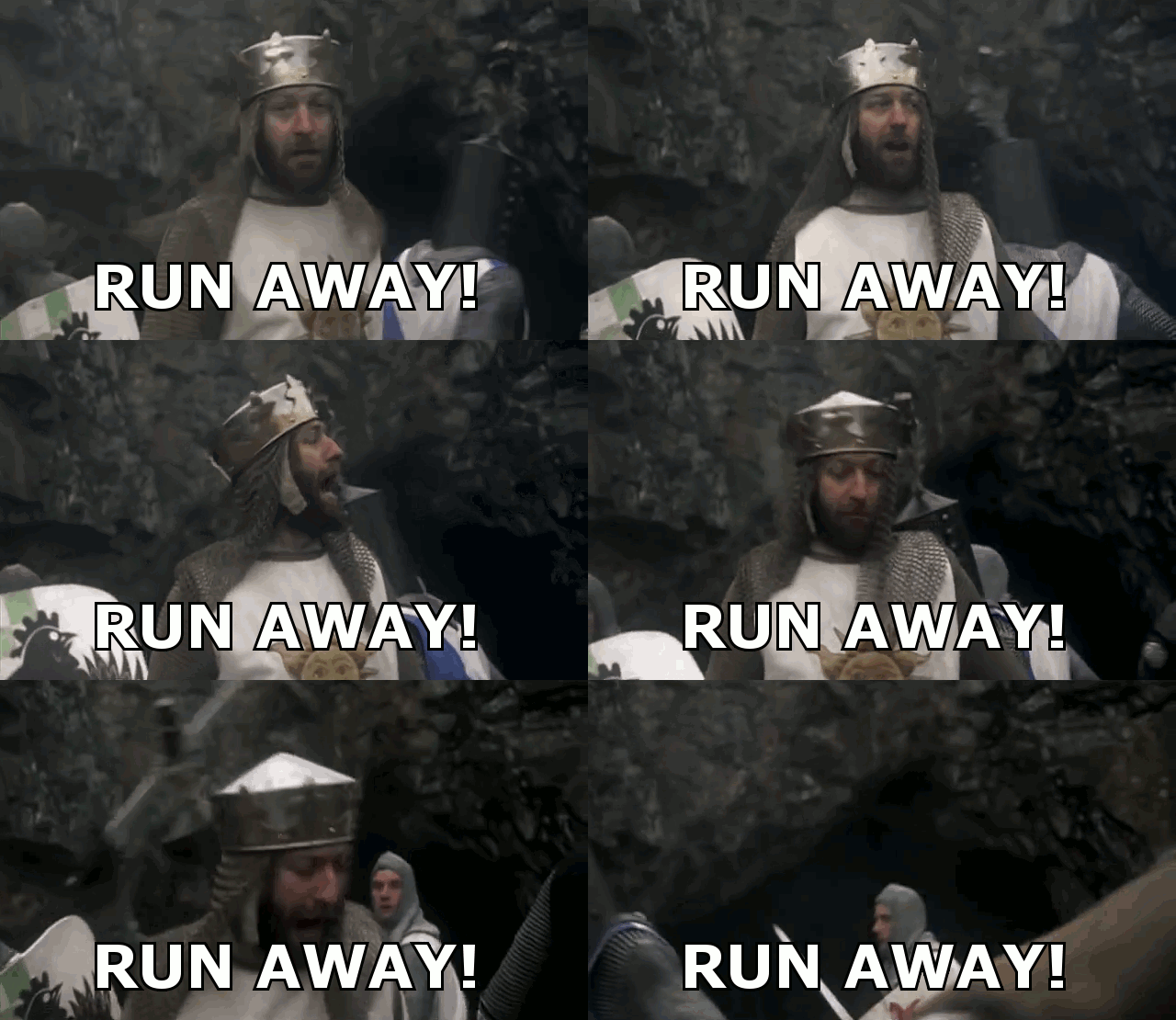
Reaction monty python GIF - Find on GIFER


;)
 
Last edited:
Legolas was weaker than the first age elves. the first age elves were high elves who saw the light of valinor. And Durins Bane grew stronger over time and became much stronger than a normal balrog. Legolas had no chance of defeating him. Perhaps Aragorn and Boromir could defeat him together. Gandalf Before they destroyed the bridge, they were thrown on the bridge to fight the balrog. the answer to the other question is i think the dagor dagorath canon.
 
Also Is Dagor Dagorath Cannon or not?

Different folks define canon differently. I define it as work published by Tolkien himself, while others define it as work written by Tolkien. Just for two examples.

In other words, beneath a given "yes" or "no" here, lies a subjective opinion for defining "Tolkien canon" in the first place.

Or as I posted earlier . . . run away ;)
 
If Elrond And Galadriel Could Fight The Balrog And Destroy It Why could Legolas Not do It?
Because IIRC concept of balrogs changed over time. You have two conceptions, of hordes of weak balrogs (didn't Hurin kill like 70 of them?), and then another one where they number only seven in total but are basically on Maiar level.
Also Is Dagor Dagorath Cannon or not?
Dagor Dagorath is definitely not a cannon, I think, unless somebody discover's Tolkien's secret basement... as for canon, I would suggest it is definitely a part of Tolkien's work from its earliest conception, and that you cannot remove it. Like, at all. After all, the Legendarium is a biblical story in its foundation. And when you look at the Bible, it opens with Genesis and closes with the Apocalypse. Alfa and Omega, the beginning and the end. So it is almost certain Tolkien will not have ommited Dagor Dagorath in any "finished" version of the Legendarium, assuming he had managed to figure out how to live for 300 years and finish the thing...
 
Different folks define canon differently. I define it as work published by Tolkien himself, while others define it as work written by Tolkien. Just for two examples.

Or as I posted earlier . . . run away ;)
Others extend this even further to vaguely outlined (but not actually written, to the best of anyone's knowledge!) plans & ideas in personal correspondence ;)

Pick a side, or run away!
 
Others extend this even further to vaguely outlined (but not actually written, to the best of anyone's knowledge!) plans & ideas in personal correspondence ;)

If you mean me here, as I say, in my opinion only work published by JRRT himself is canon.

Also Is Dagor Dagorath Cannon or not?

To drag out some citations . . . with more opinions about certain posthumously published texts . . .

. . . without going into the longer textual history here, the in-story source of the Dagor Dagorath was revised. In other words, the Dagor Dagorath was once imagined to be part of a prophecy uttered by a "god" (the Vala, Mandos) -- called The Second Prophecy of Mandos -- and then it became a Mannish (Numenorean myth), rather.

Citations concerning this include:

"The Second Prophecy of Mandos had now therefore definitively disappeared." Christopher Tolkien, commentary to the Valaquenta, The Later Quenta Silmarillion II, Morgoth's Ring

"The myth that appears at the end of the Silmarillion is of Numenorean origin; it is clearly made by Men, though Men acquanted with Elvish tradition." JRR Tolkien, note 7 to the Commentary to Athrabeth Finrod ah Andreth, Morgoth's Ring

". . . that was of old the fate of Arda Marred; and if any change shall come and the marring be amended, Manwe and Varda may know; but they have not revealed it, and it is not declared in the dooms of Mandos." JRRT, Valaquenta, Morgoth's Ring

And neither the Second Prophecy of Mandos nor the Dagor Dagorath appear in Christopher Tolkien's Silmarillion, published in 1977. Yet that said, for example, at least one reference to a "Last Battle" does appear in the Quenta Silmarillion section of The Silmarillion, with reference to Menelmacar (Orion).

Drawing a Biblical comparison for a moment (instead of Norse comparisons to Ragnarok), it might be somewhat like The Book of Revelation being seen as representing visions through holy inspiration -- but then being "revised" to representing a myth made by Men rather -- granted "Mannish Myth" isn't really giving the reader much to go on as far as how it came to be a myth, for instance, but maybe the coming book, The Nature of Middle-Earth, will add something here.

Anyway, if indeed Tolkien had chosen to publish this myth, it would be canon in my opinion.

the Túrin part

Another question (for me) here is: if Tolkien intended to keep the Dagor Dagorath as described in the 1930s (or even including the cursory corrections in the 1950s), there's a text dated 1968 or later to consider -- once again, the growingly famous Prophecy of Andreth from (a note to) The Problem of ROS!

In Andreth's prophecy (we are back to prophecy now, but obviously not from the mouth of a Vala here), Túrin returns from the dead at the end of the First Age -- not at the end of the World -- and slays Ancalagon. The description includes: " . . . before he left the Circles of the World forever, should challenge the Great Dragon of Morgoth . . ."

Thus, in earlier references, Túrin returns from the dead to participate in a Dagor Dagorath, but now, in a text dated 1968 or later, a prophecy gives his return at the end of the First Age rather, with no mention of the Dagor Dagorath -- and this is seemingly, as Christopher Tolkien states, Túrin's last deed within the World Circles: " . . . and his last deed within the Circles of the World will be the slaying of the Great Dragon, Ancalagon the Black."

His last deed within the Circles of the World? But even if Túrin is not going to return for a Last Battle at the End of Days, would that necessarily mean the entire earlier description of the Dagor Dagorath has certainly disappeared?

No, not necessarily in my opinion.

It does make me wonder though :)

And some might characterize this late prophecy of Andreth as a possibly ephemeral idea, for instance
. . . but in any case, here are some citations to chew on.

;)
 
Last edited:
If you mean me here, as I say, in my opinion only work published by JRRT himself is canon.

;)
Well I didn't, however most of the stuff you actually cited falls into the "unwritten" category AFAICT.

But for the purposes of argument, I would say that a lot of the stuff in HoME is in my mind "more canon" than the publshed Silmarillion ;)
 
Well I didn't, however most of the stuff you actually cited falls into the "unwritten" category AFAICT.

None of those citations appear in Tolkien published writing. But for me, saying X is not canon does not mean I think X is unimportant and not to be considered, for instance -- and not that you said I thought so, obviously.

I quote tons of posthumously published texts, as we all do, and give my opinions about them -- and borrow tons of them for the making of my personal Silmarillion. And here's how my canon distinction comes into play, in part (you didn't ask, but here it is):

If the Dagor Dagorath was in The Lord of the Rings, my answer would be simply yes, it's canon. The posthumously published text would still remain -- but now let's imagine that in a later text, say, something written in 1968 or later, Tolkien wrote that there was no Dagor Dagorath . . .

. . . in this invented scenario, for me, the posthumously published text bows to the author-published text (canon), just as the word ros "foam" bowed to being Elvish, not Beorian, because Tolkien realized that he'd already published this ros as Elvish . . .

. . . plus, another chance for a Problem of ROS reference?

I'm in ;)
 
I quote tons of posthumously published texts, as we all do, and give my opinions about them -- and borrow tons of them for the making of my personal Silmarillion. And here's how my canon distinction comes into play, in part (you didn't ask, but here it is):
Can you outline what is in your "personal" Silmarillion? I make no secret that I am a fan of the 1937 Eldanyare (with some very minor corrections (taken from the Grey Annals) to the Isfin/Eol/Meglin story). From some of your previous posts I would guess you are going for an "all-in" up-to-date version, but why guess when I can just ask?

I have read but am not currently up to speed with the "Ros" stuff (being very late and all), but I promise I will let you know the minute I form an opinion ;) Of course, my minimal Eldanyare is merely a summary of the story (learned "by heart"(!) by AElfwine), so I am not opposed to the later stuff as a matter of principle.
 
Can you outline what is in your "personal" Silmarillion?

I'm not young anymore and that could mean a lot of arbeit ;)

But to list a few specific texts that I incorporate into my personal legendarium, or Bilbo's Translations from the Elvish:

The Drowning of Anadune (Mannish Tradition)
The Awakening of the Quendi (Elvish tradition)
The Death of Amros (as no one calls it, Elvish tradition)

And obviously a text like "The Death of Amros" is going to impact my Quenta Silmarillion (though not "greatly" in this case, in my opinion), but I not only like the idea, I know Tolkien liked it -- as much as I can know anyway, without Tolkien actually publishing it himself -- he writes that this story is
"desirable to retain" . . .

. . . in a note [cough] published at the beginning of . . . The Problem of ROS!

I can also say that while I generally give weight to later material, again, for me, material published by
the author rules over certain "later" texts or ideas -- as I often try to illustrate with my opinions about Galadrielian history. Did Galadriel lead the Exiles over the Grinding Ice? Canon says she did (RGEO),
no matter how late the date on an adumbrated text that says otherwise.

I should add that my canon equals published-by-author in the fictive guise of translator, which does not include the revised Foreword to The Lord of the Rings (I prefer the first edition Foreword anyway).

Plus the Pauline Baynes map -- as I know Tolkien helped with the map part, and I think he was aware that it was going to be published (going by memory at the moment, without checking for certain).

Anyway. That's some stuff. For now!
 
Last edited:
And since material published by the author -- for a once and future readership -- is always in the van,
that's why, in the end, Melian is one of the Valar.

Read The Return of The King Appendix A and tell me it's not true ;)
 
Last edited:
And since material published by the author -- for a once and future readership -- is always in the van,
that's why, in the end, Melian is one of the Valar.

Read The Return of The King Appendix A and tell me it's not true ;)
". . . of the people of the Valar". Definitely a loophole there ;)

Or; the Vanimor, the Beautiful, according to the (later) Annals of Valinor!

One little detail: I would describe it as Lord of the Rings Appendix A ;)
 
Last edited:
". . . of the people of the Valar". Definitely a loophole there ;)

Yeah but Robert Foster is a published Tolkien fan. People pay money for his help!

"Melian ( . . . ) Vala, wife of King Thingol and mother of Luthien. She was probably a lesser Vala."

Robert Foster, A Guide to Middle-Earth

Purchase price (at the time): one dollar and fifty cents


One little detail: I would describe it as Lord of the Rings Appendix A ;)

In general I agree -- but for those folks who have a three book version, how is one going to know in which book the Appendices are in? Thinking?

No need!

I direct the three-book reader slash owner to the actual physical book in which Appendix A is found, thus saving precious seconds that could be better served discussing The Problem of ROS.

🐾
 
In general I agree -- but for those folks who have a three book version, how is one going to know in which book the Appendices are in? Thinking?
🐾
I admit, good advice for the reader that needs the Appendices before they have read the book, and has no time for thinking or guessing!
 
And here, in an eggshell (an eggsplanation, partly mine), is the problem of ros.

Tolkien explains: "The one -ros was supposed (at its adoption) in Elros to contain a Sindarin stem *ross- from base ROS "spray, spindrift" (as scattered by a wind from a fountain, waterfall, or breaking waves) [The Problem of Ros]

He also imagined another Elvish word ros - based on a "Common Eldarin (u)rus "used of a varying brownish red from what we should call brick-red to auburn" [Vinyar Tengwar 41]. This produced a
colour word referring to the red, red-brown hair of three of Feanor's sons, for example.

Problem A

Tolkien thought that it might be difficult to accept these two homophonic elements -- of unconnected "indeed unconnectable" meanings -- as used in Sindarin, or Sindarized names.

Problem B

Tolkien thought it unfortunate that the first ros appears too reminiscent of Latin ros ["dew"] or Greek drossos -- and the other ros, too close to well-known modern European "red" words: as Latin russus, Italian rosso, English russet, rust, etc.

"However, the Elvish languages are inevitably full of such reminiscences, so that this is the lesser difficulty." JRRT, The Problem of ROS

Proposed Solution

Associate the name Elros with that of his mother Elwing -- and remove both *ros and *wing from Eldarin [leaving the other ros in Eldarin, noting Russandol, Ambarussa, Maedros, Amros, for examples]. Elros is then supposed to contain the Beorian [Mannish] word for "foam, and the white crest of waves"

There's more to it, but in brief, Tolkien himself ultimately realized a "fatal" flaw here.

Most Of This Fails

Cair Andros "Ship of Long Foam" had been explained in an already published work, The Lord of the Rings. This -ros "foam" is Sindarin, not Beorian.

And so, defeated but happy, Tolkien took his pipe and went home.

(I'm assuming all of this last sentence).

also: a note to the text refers to a prophecy by Andreth about Túrin and Ancalagon

An Older Scenario

Back in Etymologies, decades earlier, Tolkien imagined (I'm simplifying the text here):

ROS1- "distil, drip" from which hailed a Noldorin word rhoss "rain" [Celebros]

ROS2- from which was derived a "Doriathrin" word, rost "plain, wide land between mountains" [Nivrost]

RUS- "flash, glitter of metal" -- which yielded a poetic or archaic word rhoss, "chiefly found in names such as Maedhros, Findros, Celebros etc., owing to coalescence with ROS1)"

And RUSKA- rhosc "brown"

Maedhros

This form (with -dh-) was obviously employed for the constructed Silmarillion. The later form that contains the "red, red-brown" word is Maedros.

the form Maedron aside here
 
Last edited:

Today's events

Similar threads

Back
Top