• Welcome to The Tolkien Forum! Connect with fellow Tolkien enthusiasts and join a community that is over two decades old, and still going strong. We look forward to meeting you.  Register

Second-guessing and Misunderstanding Tolkien

The question is: why is the being who has dominion over the air (Manwë) considered most senior to all the other beings, despite all of them are Valar, all created at the same time.
The phrase primus inter pares is Latin meaning "first among equals".
Likewise with the rings, why is Vilya (Ring of Air) considered the most powerful despite all three are "Rings of Power" , all crafted by Celebrimbor and all with equal power to effect something related to their integral substance (time, the hearts of men, protection from evil, etc.)
 
Last edited:
From Quora:

😕
Can anyone translate?
So now that you know what is being asked, do you have an answer?
I have a tentative answer, a surmise, but.... I am curious as to how the "lore masters" of the forum will answer it.
That is, I want to see others' answers first (because I am no ME Lore Master🙄)
 
The issue of “Agency” as connected to “Free-Will” is one that is involved in the distinction between the Pagan Religious Theology and the Christian Religious Theology that is immediate to Tolkien’s Middle-earth.

The Nordic and Germanic Myths have no real “Free-Will” for Humanity. We are “bound by Fate” to certain outcomes. Tolkien solution to this is quite novel in how he allows for “Free-Will¹“ and includes the “Fated/Doomed” outcomes.

Megatons of Ink have been spilled by Theologians over the ages on this exact subject¹, but Tolkien found a solution to it that many in the Gaming and Entertainment Industries have found:

Just “Create” a Universe where such a “Thing“ ACTUALLY EXISTS.

The Catholic Theology concerning Free-Will gives us a few Mechanisms whereby Free-Will could exist, were our Universe “Different than it is.”

We know that what Christianity, and prior Polytheistic, Animist, and other Religious Ideologies, posit to be a “Soul” is a necessity for “Free-Will” as they define it.

Tolkien calls this the “Nassër of the Fëar” (the “Materials of the Universe that make-up the “Soul/Spirit” and the “Idenity” of a person connected to the Biological components of the “Mind,” or Indo in Middle-earth). And it provides a means of connecting the “Soul” to the “Body” via what is called “Hylomorphism” in Catholic Theology.

So within Middle-earth, these things can be resolved pretty easily.

Yet we’ve not found anything in our reality that allows such a thing, given what I explained in the earlier Post regarding “Possible Answers” that exclude such things given what we already know.

That is why Pious IX put out his Syllabus of Errors, and the Vatican I and Vatican II Encyclicals, and why many of the Religious are now rebelling against the Sciences, which since the 16th Century have increasingly and more definitively/determinatively shown the Theology to be among the “Impossible things” of our Universe.

But within Middle-earth… Free-Will and Fate/Doom are resolved perfectly by conforming to that Theology as best as can be described.

MB


1. Free-Will as a Theological concept is interesting, but as the Modern Neurosciences have revealed, contrary to all the ink spilled on the Subject:

Free-Will is an impossibility.

This does not mean that we do not make choices. It only means that those Choices are:

1) Not Made Consciously (and I have participated in Hundreds of Experiments Demonstrating that our “Conscious Thoughts” are merely the Transcript fed to “us” by our Brain, who is operating anywhere from 7 seconds to many minutes ahead of the Conscious Transcript. This is rather like a “Live” broadcast that in on a “delay” so that the Directors and Editors can push the BLEEEEP! Button should someone say certain words.
2) Made based upon information and beliefs the brain has at the time, and that no other “choice” is possible based solely upon that information and the existing beliefs. This means that one possible “choice” that some will make is to “seek more information” so as to make a more informed choice. But this too is something that we have no “choice” over, Consciously.

The various attempts to “Solve” this conundrum, such as positing that the “Soul” controls the Mind from an External Source does nothing to help realize “Free-Will” as a thing.

If it is an External “Soul” that is making these “choices” then we haven’t any “Conscious Control” over the Choices, and it is no different from what Modern Neuroscience shows.

Those who try to claim that various “Quantum Events” create Randomness” that alters our Possible Choices don’t seem to understand how horrifying this is.

That particular “solution” only makes things worse by removing ALL CHOICE, and making us the victims of a random number generator that controls our thoughts and actions, where we have absolutely no more “Control” or “Conscious Choice” than does a piece of popcorn bouncing around a popcorn maker…

It would be like rolling a die to decide everything. That isn’t “Free-Will.”

Some Philosophers, like Daniel Dennett, try to “Rescue” or “Save” Free-Will by just re-defining it, as a so-called “Compatiblist.” The enormous irony of this, given Dennett’s rather Strident Atheism here is bending its knee to a Theistic Concept in order to preserve it. That has always struck me as odd.

I believe that Tolkien's belief in Free Will is much simpler than this. Just the notion that a deity is not forcing an agent to do one thing or another, but the agent is making the choice, no matter what the neuroscience explanation of how that choice came to be. This is in opposition to the concept of "Pre-destination" that was prevalent in some Protestant beliefs in the 1600's and beyond. In addition, Tolkien said in his Letters, that Frodo chose to bear the Ring to Mt. Doom, but the deity/powers that be/ Eru/ Valinor/etc. bestowed to Frodo "grace" to aid him in his quest. This is a Roman Catholic belief.
 
Last edited:
So now that you know what is being asked, do you have an answer?
I have a tentative answer, a surmise, but.... I am curious as to how the "lore masters" of the forum will answer it.
That is, I want to see others' answers first (because I am no ME Lore Master🙄)
I am not a lore master either but I think it's simply a matter of Manwë being closest to Eru and "dearest to his heart". Also, he is the analogue of Zeus, who is king of the Greek pantheon. The sky is above all (in various mythologies), therefore it is only fitting that its representative should oversee and govern all.
 
Last edited:
I am not a lore master either but I think it's simply a matter of Manwë being closest to Eru. Also, he is the analogue of Zeus, who is king of the Greek pantheon. The sky is above all, therefore it is only fitting that it should oversee and govern all.
I think this is probably right.
 
I am not a lore master either but I think it's simply a matter of Manwë being closest to Eru and "dearest to his heart". Also, he is the analogue of Zeus, who is king of the Greek pantheon. The sky is above all (in various mythologies), therefore it is only fitting that its representative should oversee and govern all.
This agrees with my then unspoken "surmise" but I was going to say it more simply: Eru wanted it that way. 😉
 
Another gem from Quora:

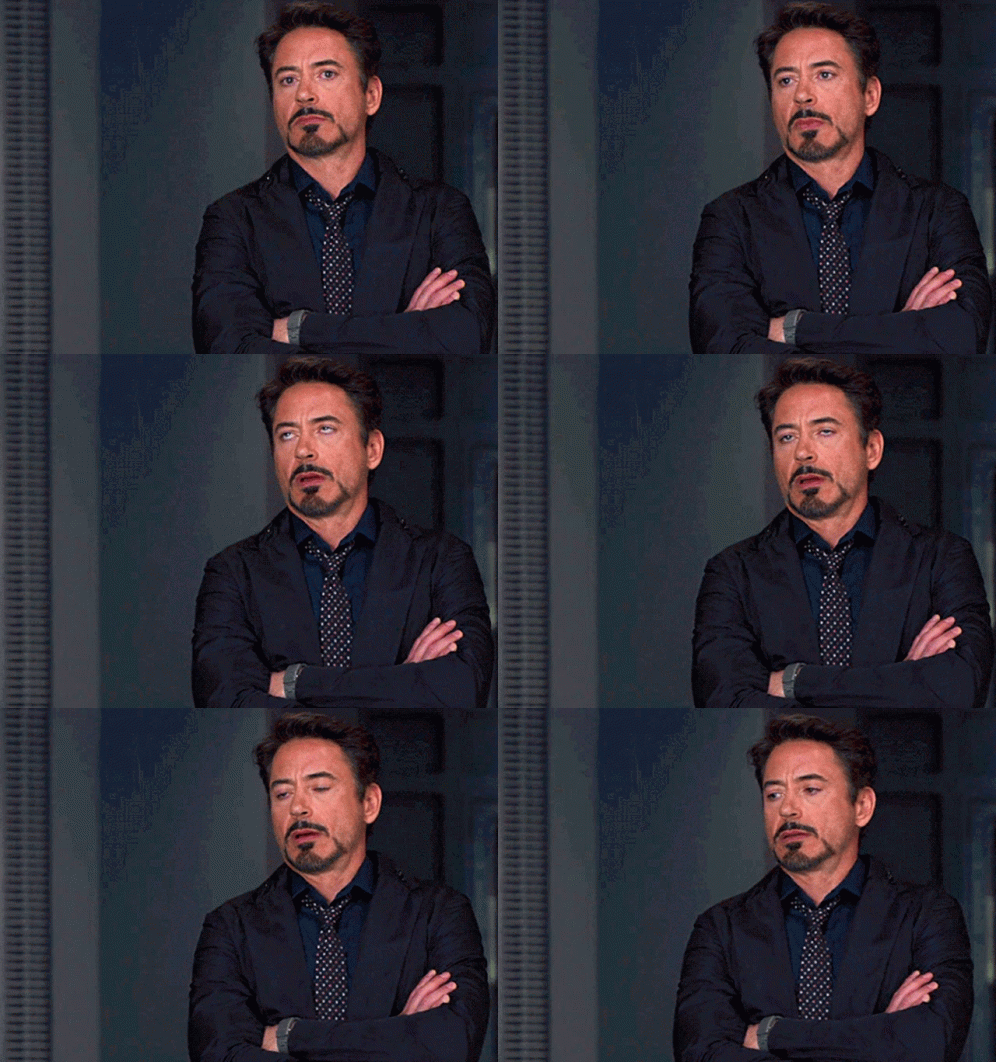
tenor.gif
 
From PJ himself, maybe? At least from the first Hobbit movie, I'd guess. CBR is in the same crowd as screenrant and such other useless sites.
 
It was in the Hobbit movie? I must have blocked it out.

But he was talking specifically of the book there, or that's how I read it.
 
It was in the Hobbit movie? I must have blocked it out.

But he was talking specifically of the book there, or that's how I read it.
You could be right, in which case I couldn't imagine where the author got that impression; maybe he is mentally conflating the movies (including the Hobbit movies) with the book.

Anyway, I noticed another error directly following that sentence
In the books, Tom Bombadil functioned as a proto-Gandalf. For the sake of the story, the Hobbits needed to encounter some resistance on the road to the lawless town of Bree, but they were not equipped to handle anything. So, Tolkien created Bombadil to get them out of trouble on more than one occasion.
Um, wow. These guys need to do better research.

He also says, "That's led to a few different movie adaptations, but Peter Jackson's version is easily the best." Uh, a few? Which others are there besides Ralph Bakshi's and PJ's?

That said, he does get at least one thing right and that is to point out that "LOTR isn't actually a trilogy"; it's something of a pet peeve of mine when people call it that.

That CBR article also helpfully quotes Peter Jackson, sparing me having to watch the video clip and listen to him:
"In the plot of The Lord of the Rings, in our movie, in its most simple form, is Frodo carrying the Ring. Eventually, he has to go to Mordor and destroy the Ring. So, you know, what does Old Man Willow contribute to the story of Frodo carrying the Ring? What does Tom Bombadil ultimately really have to do with the Ring? I know there's Ring stuff in the Bombadil episode, but it's not really advancing our story. It's not really telling us things we need to know."
Wrong, if you consider the Barrow-downs, which Peter Jackson obviously didn't. Of course, the Peej wasn't at all interested in accurately portraying Frodo, so I guess that's par for the course.

Nobody's second-guessing and misunderstanding of Tolkien is more egregious than Peter Jackson's.
 
Last edited:
Never mind the PJ stuff -- where did the writer get "the lawless town of Bree"?
That would seem obvious to me: not a single Shire Shirriff mentioned at any point!
I mean seriously, had the later legendary Hobbit Shirriff Wyatt Burp been there with a posse, they would have snapped the handcuffs on those Black Rider road rowdies and sent them off to the lockholes at Michel Delving in no time ...

Mixing genres should be left to Mel Brooks and the surviving members of the Monty Python gang (no idea why that thought just crossed my mind ... oops! seems my sarcasm damper thingy needs fresh batteries! 😬 )
 
Well, there was the Hanna-Barbera ROTK. And he might have been including their Hobbit. And the Russian one, though I'd be surprised if he knew about that.
Oh, forgot about that one. Still, I think it's stretch things to say it's been a few, especially since Rankin & Bass's RoTK was just finishing up what Bakshi wasn't allowed to.
 
Last edited:
Last edited:
This is not another "Why didn't they use the Eagles" thread though that topic is briefly discussed here. This is more a thread examining the seemingly constant stream of "Why didn't..." questions on sites like Reddit and Quora. The Eagle-related ones. Ones that ask why the Valar don't intercede. Etc.

Questions about the Eagles and the Valar might be excusable (if not valid) if the askers don't look into the logistics of the story or the background of the writing of the book or, of course, the need to create an engaging story (and, truthfully, how many works of fiction are flawless and without contrivance?). Almost needless to say, Tolkien did not set out to write a sequel to The Hobbit of his own volition, but acquiescing to publisher and public request, he came up with The Lord of the Rings. In doing so, in choosing Bilbo's ring as the genesis of the idea that he would develop, he was perhaps operating under certain constraints. So, whatever flaws one might perceive in the work, I think one must consider the circumstances under which it was composed. If Tolkien had conceived of the idea of the Rings of Power from the start on his own (meaning without the demand for a follow-up to TH) we probably would have had something very different, and one possibly even better than what we were given. And what we got is fairly magnificent, especially considering the circumstances.

But there are some questions that go beyond the pale and look at other reasons why they think the course Tolkien took was the wrong one. One such question asks (to paraphrase), "Would it not have been more reasonable to give the Ring to someone who could control it, but not too strong so that the Ring could be taken from them?" :confused: To my answer in which I basically said, no, it would not be more reasonable, the person replied that the plan in the book is "stupid"; that Sauron should logically have figured out that, since the Ring was not being used against him, that he would have figured out that the plan was to destroy it. :oops:

Honestly, I couldn't be bothered to explain that the answer to this is in the book and that it takes more than a cursory reading to find it. If you don't accept the explanation, I guess take it or leave it and find something else to read, but I didn't even feel like saying that.

How would/do others here respond to such questions, if at all?
Tolkien addresses this, somewhat, in the introduction. He says that if the story were an allegory of recent history, the The Ring would have been taken (by someone, he doesn't say who) and used against Sauron and the outcome would not be good. Tolkien despises allegory.

I would like to comment that the greatest and most pernicious misunderstander of Tolkien is Peter Jackson.
 

Today's events

Similar threads

Back
Top