Because my main point hinges around when
Sméagol first sees
the ring and murders his cousin, not after 500 years of having it. That's why I've been mostly using the name
Sméagol rather than
Gollum.
We are in agreement here more or less - my main point of reference is the intial encounter as well; I give the ring way more importance than you obviously, and I can see how I've been using
Smeagol and Gollum interchangeably, which I now realise must be somewhat confusing.
The Ring vibes were picking up on something inside Sméagol and magnifying it.
As it could do with every character it interacts with, to a greater or lesser degree; there's no controversy here - I believe
Tolkien told us about Smeagol looking downwards and not upwards for a purpose. That being said, there's nothing here to stop the ring from absolutely overwhelming such a susceptible creature instantly, which is what I believe happened.
Now as to Smeagol's (and then Gollum's) behaviour afterwards, then yes, Gollum is increasingly responsible for what he does, and he does some awful things. But he is also curiously neutral about using the ring - he kills
Orcs under the mountain, but he has to eat to stay alive, and there is no feeling that he carries the ring on his person all the time. Even at the end all he dreams about is fish three times a day, a remarkably pedestrian dream; I would say that this all adds up to a character who is still deserving of at least some pity for what has happened to him. I fully understand that my personal prediliction for the interesting baddies is colouring my judgement here, but I think there's enough in the text to support this view.
That's kind of a weird point to me. The sample size is way too small. Also, again,
Boromir does not immediately try violence to get the Ring.
And nor does
Frodo immediately attack
Sam. Smeagol does attack Deagol immediately; so why does Tolkien write the scene this way? I believe it was to show how horribly powerful the ring was; to me that makes sense of the whole thing.
Frodo passes his test, Sméagol doesn't. You seem to be affording Sméagol leeway but want to speculate that, yes, Frodo would do something horrible to Sam.
Frodo would only pass his test if he didn't attack Sam if Sam continued to withhold the ring. This doesn't happen.
Boromir (in my opinion) would have at least attacked Frodo to get the ring (even killing him if he had to), but Frodo escapes; this isn't the case with Smeagol and Deagol. To me, this is the crucial point.
Agreed. And even Tolkien himself considered Frodo dull (if not in so many words). He said something to the effect that Frodo had to be the straight man in the story:
We are in the
realm of the extra-textual here, and I basically believe that whatever is outside of the text (whether it supports my particular arguments or not) has to be given much less value precisely because it is not in the finished work, as I've previously stated.
This is an entirely personal viewpoint, I know, but it does hold true with the overall picture. It's inescapable that Tolkien published what he wanted over a long period of time, hopefully to as big an audience as he could reach. Compared to the reading audience of his finished
books the amount of people who have read the letters etc must be a tiny, tiny, fraction; that in itself counts for something.
And again, it is an incomplete record of the letters (as far as we know) that Tolkien may never have believed would be published at all. I just don't see how you can balance this out.
And further to it being a personal viewpoint, I absolutely don't want every single character, scene, theme of the books to be set down in stone as it were. I want to wonder about a particular character, I want to change my mind about certain scenes (and then change it back again the next time I read it!), and I can't do this if I give weight to something outside of the book.
Yes, so why is Sméagol so unique?
He's unique in that he doesn't get given the ring when he wants it (like Frodo with Sam), and is able to kill Deagol to get it (unlike Boromir, when Frodo escapes). It's wonderful shorthand to show what a powerful thing we are dealing with, if nothing else.
Yes, if your argument is that Sméagol was weak. But I don't equate this weakness with innocent victimhood. The fact that he walks up behind Déagol, that he had been hitherto watching him from behind a tree, is just all kinds of creepy and sinister (and telling) to me. How strong could the Ring's influence really have been that Sméagol would act so sneakily from the outset? He couldn't have been that close to it at the time. Also, the text says something about Sméagol being quicker and stronger than Déagol, which might suggest something of dominance of one over the other.
All the points you make are completely valid and backed up by the text; but does being sneaky/creepy etc equate to being a murderer? Can we make this jump? I don't think we can, so why does Smeagol kill him? I think the power of the ring (using Smeagol's possibly innate nastiness as a springboard) then overpowers him; if this isn't the case then aren't we saying that Smeagol was always going to murder Deagol, just as a plot device?
Yes, and again, Tolkien also wrote that Gollum was a "mean sort of thief". This is not a contradiction of anything in the book. Not a word.
But it doesn't equate to proof of Smeagol being a murderer, so to me it is irrelevant.
He momentarily loses his mind because of the Ring but it is not enough to immediately resort to violence. And if you resort to robbing cradles of babies, you kind of lose the sympathy vote from me.
Smeagol also momentarily loses his mind because of the ring and does resort to the most extreme violence; they are different characters whom the ring works on in different ways. I think my sympathy goes to Gollum (not Smeagol) at the end of his hundreds of years of utterly wretched existence; he is by no means innocent but he does pay a terrible price for what I believe the ring played an overwhelming part in.
Despite this,
Bilbo takes the high road and makes an almost impossible leap over Gollum instead of killing him. The difference is that Sméagol has something bad in him, twisted by the Ring into something worse.
Which makes Bilbo a really good guy (and the polar opposite to Gollum) who escapes the ring by giving it away freely.
So how does your last point about the ring twisting Smeagol into something worse not align with what I've been saying? I think we are really just disagreeing over the degree that the ring can (and will) affect people.
That seems an arbitrary viewpoint to me. If we're not going to place any value on any extracurricular text by Tolkien we may as well discount it altogether, and that seems to be what you're doing in this particular case, because it does not support your view of Gollum. So, is it really secondary or actually invalid?
Also, what's in the book does not always speak highly of Gollum either. As I said, Tolkien was supplementing what he wrote in the book, not contradicting. Gollum had to be "tamed", remember. The good side of him had to be coaxed out of him by Frodo's mercy and it sat on a razor's edge. Remember how, in the debate he has with himself (that Sam overheard) the bad side (
Stinker) has the last word (in the chapter "The Passage of
the Marshes"). Both sides want the Ring, which could never be fixed, even if the good side (Slinker) prevailed, in which case the newly redeemed Sméagol would wrest the Ring from Frodo in then and jump in the fire himself, according to Tolkien (Letter #246).
I'm not discounting the extra-textual material to support my view of Gollum; I've said before that if a letter turned up where Tolkien states that he's changed his mind about Gollum altogether, and he now believes him to be the absolute hero, I would still give it less weight, because I put the text above all other material.
Whether the letters support a particular argument or not is, to me, laregely irrelevant, as I have all the material I need already published.
So yes, I suppose that you could say I would discount all extra-textual material; I really don't see how this would adversely affect my readings of the book?
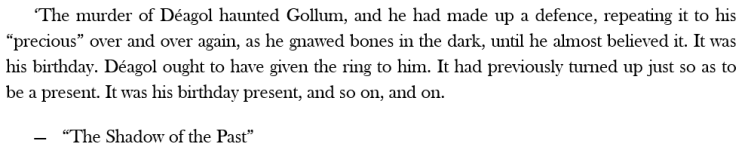
Yes, but in the full context of the quote he does not lay the blame entirely on the Ring:
So if I stick to the text my point can stand; that's basically the view I have concerning the text over any extra-textual stuff.
Tolkien clearly considered the Ring as a major factor in Sméagol's corruption and murder of his kin. But note how he qualified it with what Sméagol was like before the Ring
Maybe he isn't so much qualifying what the ring can do, but explaining? He gives us enough clues to speculate that the ring will be most powerful acting on a person who is most susceptible?
But Bilbo chose mercy, despite wearing
the One Ring, when its influence would be strongest. This explains a lot, I would say.
As I've said before, this could show Bilbo on one extreme end of the spectrum and Smeagol on the other. There's nothing here to disallow my opinion about the ring's overwhelming power.