• Welcome to The Tolkien Forum! Connect with fellow Tolkien enthusiasts and join a community that is over two decades old, and still going strong. We look forward to meeting you.  Register

"I put the fear of fire on him..."

I'm not assuming this to be the case, I'm basically just saying that the letters are, at best, an incomplete record, as opposed to the final, complete text. I'm actually convinced that HC has done a very good job - his biography of Tolkien was really good, I think. But we are still left with the fact that there could be material out there which hasn't been examined, for one reason or another.

But the text, which to me is all important, gives no indication of Smeagol being a bully or a jerk - he's described as inquisitive and curious-minded, which to me are positive traits; he then commits murder - a shocking act which I think can't be explained just as the influence of the ring - it's too extreme for that, I think.
This is true. Just speculation on my part, though I must again cite Tolkien's own description of him as a "mean sort of thief". Also, Sméagol being inquisitive, etc. would not preclude him from being a bully.

To my mind, the 'something ugly' may have been Frodo trying to kill Sam to get the ring back; I don't understand how it would have taken time - I believe that if Sam kept the ring longer than he had, then Frodo would have acted there and then.
It already takes longer for Frodo to react as he does than it does Sméagol to murder Déagol. And if we consider Frodo we must also consider Sam. He has started to feel attachment to the Ring and sees it snatched away by Frodo. But his first impulse is to feel hurt and fight back tears after Frodo's actions, not to throttle him to death.

I don't think Gollum strangles Deagol from behind, as you have emphasised - he comes up behind him, and starts talking, but he catches Deagol by the throat, so doesn't this mean he must be standing in front of him by now?
There is no indication of that in the text and one can certainly grab someone by the throat from behind. Indeed, Gollum does that to Sam twice in the story.

Frodo does indeed show remorse, as does Boromir; and so does Gollum - Gandalf tells us in 'The Shadow of the Past' that the murder of Deagol haunted Gollum which is why he makes up the satory of the ring being his birthday present.
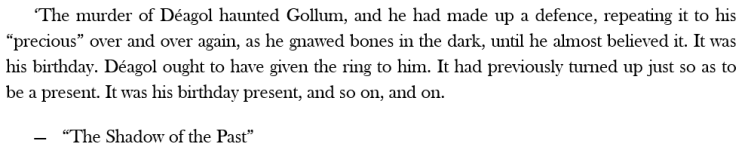
Yes, but he doesn't show true remorse. Instead, he attempts to justify it:
Screenshot 2024-08-23 095923.png
To make it seem right. It was a good thing that he killed Déagol, who deserved it for withholding what was rightfully his. That is not the action of someone truly penitent. That almost sounds like the behavior of a sociopath.

Because everyone you mention has possession of the ring and Gollum doesn't. If Deagol gave Gollum the ring, then he may not have acted in a bad way at all?
It's funny you should say this because this is what it says on One Wiki to Rule Them All:
Screenshot 2024-08-23 114830.png
It was possible that the Ring had already affected Déagol in a way that made him desire to keep it, explaining his unwillingness to give it to Sméagol.
LOLWUT?! Really? And the fact that Déagol found the confounded thing (and actually after a bit of physical effort) first isn't a consideration for why he should be unwilling to give Sméagol the Ring? 🫤 Did you write this line (JK, of course, but, honestly, it looks like you could have). If I find a chunk of gold in a riverbed after looking for hours, and someone comes up to me and demands it, I should just hand it over? That's the kind of logic I'm seeing here. And, of course, if we're going to excuse "innocent pitiable victim" Gollum at every possible turn we must also excuse Boromir for his behavior towards Frodo, or say Frodo should have just given the Ring to Boromir to prevent hostilities.

Also, even if you want to exclude Gandalf, Aragorn and Galadriel, all of whom were offered the Ring by Frodo, there were others who were in the presence of the Ring that were not seized by homicidal mania or struck by a "thunderbolt of evil". Overall, it seems like we're making too many allowances and excuses for Gollum here. He has to be held accountable at some point.

I've previously said that I believe Gollum to be the most extreme example of what the ring can do to someone, so in a sense you could say that he is almost the exception and not the rule.
So, then, we would seem to be in agreement (?) 🤔
 

Attachments

  • 1724426866241.png
    1724426866241.png
    11.3 KB · Views: 43
Last edited:
This is true. Just speculation on my part, though I must again cite Tolkien's own description of him as a "mean sort of thief". Also, Sméagol being inquisitive, etc. would not preclude him from being a bully.
So I can speculate as to Gollum being the nearest thing to a saint, but there is absolutely no textual evidence so it would be a complete dead end. The actual description in the book is quite positive, which makes what he does to Smeagol even more shocking than it is (if this actually needed). If Gollum was a bully then it's still a huge leap for him to instantly murder Deagol - a leap which I can't make sense of.
It already takes longer for Frodo to react as he does than it does Sméagol to murder Déagol. And if we consider Frodo we must also consider Sam. He has started to feel attachment to the Ring and sees it snatched away by Frodo. But his first impulse is to feel hurt and fight back tears after Frodo's actions, not to throttle him to death.
Frodo doesn't even talk about the ring for some time after Sam finds him; he's been poisoned by a huge spider, abused by Orcs, so it's understandable. As soon as he does tell Sam it's been taken and Sam tells him that he has it, that's when Frodo reacts really strongly.
Sam reacts differently to Gollum, absolutely, which tells us that the ring doesn't affect everyone in precisely the same way, which I've believed all along. Gollum is the absolute outlier as to what the ring does; is this because of certain characteristics in Gollum, as you seem to suggest, or the horrible power of the ring, as I suggest? There's room for both views I think.
There is no indication of that in the text and one can certainly grab someone by the throat from behind. Indeed, Gollum does that to Sam twice in the story.
I stand corrected. Maybe I just thought that it's more of a natural stance to grab someone from the front.
To make it seem right. It was a good thing that he killed Déagol, who deserved it for withholding what was rightfully his. That is not the action of someone truly penitent. That almost sounds like the behavior of a sociopath.
Yes, I think you may be right as to Gollum not showing true remorse. I would point out that Gollum's crime was shockingly bad, which may explain why he was trying to delude himself; Frodo and Boromir don't actually do anything as bad as killing someone over the ring.
LOLWUT?! Really? And the fact that Déagol found the confounded thing (and actually after a bit of physical effort) first isn't a consideration for why he should be unwilling to give Sméagol the Ring? 🫤 Did you write this line (JK, of course, but, honestly, it looks like you could have). If I find a chunk of gold in a riverbed after looking for hours, and someone comes up to me and demands it, I should just hand it over? That's the kind of logic I'm seeing here. And, of course, if we're going to excuse "innocent pitiable victim" Gollum at every possible turn we must also excuse Boromir for his behavior towards Frodo, or say Frodo should have just given the Ring to Boromir to prevent hostilities.
There is no reason why Deagol should give Gollum the ring - this is precisely the point I've been making as to the malignant power of this terrible thing. I was merely speculating that if Gollum obtained the ring freely (even though he had no right to it) then he may have behaved differently throughout - as other characters do. I also said that Deagol may have attacked Gollum if he kept on trying to get the ring; again, this is speculation with no textual basis.
I'm not excusing Gollum at every possible turn but I am trying to understand why he would kill someone almost instantaneously; if it's not the ring overwhelming him, then why does it happen?
Also, even if you want to exclude Gandalf, Aragorn and Galadriel, all of whom were offered the Ring by Frodo, there were others who were in the presence of the Ring that were not seized by homicidal mania or struck by a "thunderbolt of evil". Overall, it seems like we're making too many allowances and excuses for Gollum here. He has to be held accountable at some point.
The ring is always trying to get back to Sauron; perhaps it senses that Gollum (being inquisitive etc) is a better bet to achieve this than Deagol (who, by the way, is described as 'gloating' over something he has only just obtained, which is a strongly negative word from Tolkien). The ring is not all-seeing all-powerful, as it found out when it got stuck under a mountain for centuries - so it abandoned Gollum and moved on to the next person who may help it get back to Sauron. The ring can surely be quiescent when it senses that things are going its own way, and only 'acts' (in the sense that it affects people more or less strongly) when it appears that its plans are not being adhered to.
Now this is probably giving the ring an awful lot of sentience, but it would certainly help to explain why it doesn't constantly affect the ring bearers and those around them?

Gollum is held accountable, in the most awful way - look at how Sam, not exactly a cheerleader for Team Gollum, sees him on Mount Doom:
'he could not strike this thing lying in the dust,forlorn, ruinous, utterly wretched...dimly he guessed the agony of Gollum's shrivelled mind and body, enslaved to that Ring, unable to find peace or relief ever in life again'. You don't think he's paid the price for what he did?

I said that Gollum could almost be seen as the exception, and the quantifier is important. The ring has the most extreme affect on Gollum of any of the characters in the book. I simply can't understand why he would kill Deagol without the ring having a catastrophic affect on him. If we say that Gollum was always a bad guy, or was always going to be the bad guy, then this takes away from the power of the ring which to me makes no sense, as the ring is the central artefact of the book.
If we say that the ring simply works on the inherent characteristics of the person it affects, then we have to say that Gollum was always going to be a murderer - the scene won't make sense any other way, as Gollum acts immediately and shockingly, but this doesn't make sense for the character: once he has committed this awful act he doesn't carry on murdering people (he doesn't do anything good obviously) and does very little with the ring once he hides under the mountain.
Putting it simply, if the ring doesn't affect Gollum in the worst way imaginably, how do you excplain what he does to Deagol?
 
So I can speculate as to Gollum being the nearest thing to a saint, but there is absolutely no textual evidence so it would be a complete dead end. The actual description in the book is quite positive, which makes what he does to Smeagol even more shocking than it is (if this actually needed). If Gollum was a bully then it's still a huge leap for him to instantly murder Deagol - a leap which I can't make sense of.
I'm assuming you mean "So I can't speculate..." In any case, if I'm understanding you correctly, you're saying Sméagol couldn't have been a bad because of the following:
He was interested in roots and beginnings; he dived into deep pools; he burrowed under trees and growing plants; he tunnelled into green mounds; and he ceased to look up at the hill-tops, or the leaves on trees, or the flowers opening in the air: his head and his eyes were downward.
I don't know how this would preclude him being a "mean sort of thief", a phrase which, despite being extra-textual, still originates from the book's author, so must count for something. Also, note how Sméagol stops looking upward, at trees, etc., but sets his eyes ever "downward." Interesting, but I'll leave it there, for now.

Frodo doesn't even talk about the ring for some time after Sam finds him; he's been poisoned by a huge spider, abused by Orcs, so it's understandable. As soon as he does tell Sam it's been taken and Sam tells him that he has it, that's when Frodo reacts really strongly.
Frodo's recent ordeals, plus his location in Enemy territory are factors which I mentioned should be considered in how Frodo logically should act in the presence of the Ring if its effect is that immediate and horrible. But, all told, his reaction is mild compared to Sméagol's. And even after he hallucinates Sam as an orc he doesn't so much as raise a hand to strike him. If you're trying to compare Frodo with Sméagol I'm afraid the comparison falls rather short in my view.

Sam reacts differently to Gollum, absolutely, which tells us that the ring doesn't affect everyone in precisely the same way, which I've believed all along. Gollum is the absolute outlier as to what the ring does; is this because of certain characteristics in Gollum, as you seem to suggest, or the horrible power of the ring, as I suggest? There's room for both views I think.
We seem to be at least in partial agreement. But, all else being equal, there's no reason why the Ring should treat Sméagol differently than anyone else, unless we concede that Sméagol is not as nice a person as you believe he was? If the Ring's influence is so fast-acting and horrible, there's no reason it should single out Sméagol to commit murder.

I'm not excusing Gollum at every possible turn but I am trying to understand why he would kill someone almost instantaneously; if it's not the ring overwhelming him, then why does it happen?
Well, I don't know about others in general, but it's not really a big mystery to me as I've said in this thread.

The ring is always trying to get back to Sauron; perhaps it senses that Gollum (being inquisitive etc) is a better bet to achieve this than Deagol (who, by the way, is described as 'gloating' over something he has only just obtained, which is a strongly negative word from Tolkien). The ring is not all-seeing all-powerful, as it found out when it got stuck under a mountain for centuries - so it abandoned Gollum and moved on to the next person who may help it get back to Sauron. The ring can surely be quiescent when it senses that things are going its own way, and only 'acts' (in the sense that it affects people more or less strongly) when it appears that its plans are not being adhered to.
Now this is probably giving the ring an awful lot of sentience, but it would certainly help to explain why it doesn't constantly affect the ring bearers and those around them?
If the Ring is always trying to get back to Sauron (as I must accept since that's what the text says) it is absolutely, mind-bogglingly terrible at it (perhaps an oversight by Sauron; not putting an efficient enough homing device on his Precious). It could not have chosen a bearer worse than Sméagol and might as well have stayed with Isildur. It could certainly be argued that the Ring was being affected (i.e. its homing device overridden) by other forces, considering Gandalf's words to Frodo, "that Bilbo was meant to find the Ring, and not by its maker." Maybe Gollum is an unfortunate victim of forces other than mere circumstance.

Gollum is held accountable, in the most awful way - look at how Sam, not exactly a cheerleader for Team Gollum, sees him on Mount Doom: 'he could not strike this thing lying in the dust,forlorn, ruinous, utterly wretched...dimly he guessed the agony of Gollum's shrivelled mind and body, enslaved to that Ring, unable to find peace or relief ever in life again'. You don't think he's paid the price for what he did?
His pain is entirely self-chosen, but I meant that he wasn't held accountable by you, as it seems you're making him out to be an innocent victim. And his plea to Sam seems like more manipulation to me: he recognizes in Sam a quality he doesn't have, and refused the chance of having.

I said that Gollum could almost be seen as the exception, and the quantifier is important. The ring has the most extreme affect on Gollum of any of the characters in the book. I simply can't understand why he would kill Deagol without the ring having a catastrophic affect on him. If we say that Gollum was always a bad guy, or was always going to be the bad guy, then this takes away from the power of the ring which to me makes no sense, as the ring is the central artefact of the book.
If we say that the ring simply works on the inherent characteristics of the person it affects, then we have to say that Gollum was always going to be a murderer - the scene won't make sense any other way, as Gollum acts immediately and shockingly, but this doesn't make sense for the character: once he has committed this awful act he doesn't carry on murdering people (he doesn't do anything good obviously) and does very little with the ring once he hides under the mountain.
Putting it simply, if the ring doesn't affect Gollum in the worst way imaginably, how do you excplain what he does to Deagol?
Again, I must cite the example of Boromir. He is also affected by the pull of desire for the Ring. But his first impulse isn't to strangle Frodo. It's to talk to Frodo, to try to convince him to cede the Ring to him. His talk is rather lengthy (it's an encounter that lasts three pages) and full of delusions of grandeur, but at least he tries to use reason (or his version of it) before he resorts to force. Sméagol gives up on his version of reason rather quickly before violently ending his own relative's life. The difference is that Boromir is not a bad person. He'd already proved his worth by helping the Company get away from Caradhras (and saving the hobbits from death by hypothermia in the process, an incident often overlooked). Sméagol may not have acted very wickedly before the Ring but at some point the seed must have been planted in him to act as he did.
 
I'm assuming you mean "So I can't speculate..."
Oh no, speculation/interpretation is part of how we come to know the characters; I suppose what I'm trying to say is that speculation based on whatever textual evidence we champion would be much more important than, say, speculation based on personal feeling about a character - this would still be interesting and I believe everyone does it, but to me a position is much stronger if it is backed up with evidence from the book.
I don't know how this would preclude him being a "mean sort of thief", a phrase which, despite being extra-textual, still originates from the book's author, so must count for something. Also, note how Sméagol stops looking upward, at trees, etc., but sets his eyes ever "downward." Interesting, but I'll leave it there, for now.
I think I said in one of the first posts that Smeagol looking downwards brought in a sinister element to the character, so we agree on this aspect of the scene. My problem is making the connection from him looking downwards (or even being a 'mean sort of thief') to him killing Deagol in an instant.
Frodo's recent ordeals, plus his location in Enemy territory are factors which I mentioned should be considered in how Frodo logically should act in the presence of the Ring if its effect is that immediate and horrible. But, all told, his reaction is mild compared to Sméagol's. And even after he hallucinates Sam as an orc he doesn't so much as raise a hand to strike him. If you're trying to compare Frodo with Sméagol I'm afraid the comparison falls rather short in my view.
As I've said before, Gollum is the only character we know of who wants the ring and acts (successfully) to get it - and he acts in a terrible way instantaneously. Frodo is given the ring; what he would have done to Sam if Sam tried to keep the ring is a matter of speculation, as is the case with Boromir. His reaction is mild compared to Gollum because he gets what he wants. I suppose I'm comparing Gollum with all the other characters who want the ring, not just Frodo, and this is because I believe Gollum is unique in what the ring does to him.
We seem to be at least in partial agreement. But, all else being equal, there's no reason why the Ring should treat Sméagol differently than anyone else, unless we concede that Sméagol is not as nice a person as you believe he was? If the Ring's influence is so fast-acting and horrible, there's no reason it should single out Sméagol to commit murder.
My point is that the ring treats Smeagol in the same way it would have treated Frodo, or Boromir, or anyone else who wants the ring and didn't get it. There's no doubt in my mind that Boromir would have killed Frodo to get the ring, or that Frodo would have done the same to Sam - Gollum is the only character we know who is refused the ring but has the ability/opportunity to get hold of it. Now other people will read the text and believe that Boromir wouldn't have done that; that's perfectly fine and just shows how well Tolkien's text lends itself to more than one interpretation (and very enjoyable discussions!)
Not being nice (which Gollum demonstratably wasn't) and murdering your friend instantly are two very different things; if the ring doesn't have this awful power then how do we explain Smeagol's actions?
If the Ring is always trying to get back to Sauron (as I must accept since that's what the text says) it is absolutely, mind-bogglingly terrible at it (perhaps an oversight by Sauron; not putting an efficient enough homing device on his Precious). It could not have chosen a bearer worse than Sméagol and might as well have stayed with Isildur. It could certainly be argued that the Ring was being affected (i.e. its homing device overridden) by other forces, considering Gandalf's words to Frodo, "that Bilbo was meant to find the Ring, and not by its maker." Maybe Gollum is an unfortunate victim of forces other than mere circumstance.
I agree, getting stuck under a mountain for five hundred years is not exactly efficient. I'm uneasy about giving the ring too much sentience, maybe I should have said something more along the lines of the ring having an almost blind instinct to get back to Sauron? I appreciate your point about the ring itself being affected by other forces - it isn't all-powerful, things absolutely don't go it's own way.
His pain is entirely self-chosen, but I meant that he wasn't held accountable by you, as it seems you're making him out to be an innocent victim. And his plea to Sam seems like more manipulation to me: he recognizes in Sam a quality he doesn't have, and refused the chance of having.
Well I think that he doesn't choose this pain as the ring gives him no choice in the original encounter. It's a blink of an eye scene where he goes from possible not too nice a guy to a murderer; I can't see a rational choice here. I see him as a victim of the ring, but I don't see innocence (possibly before he meets the ring, but definitely after) - he does bad things, he does evil things, but he is not some pantomime villain only ever doing this, which makes him so interesting to me.
I really can't see Smeagol refusing the chance of being someone like Sam in the scene as written, it's too shockingly abrupt for this; the decisions he makes once he has the ring, yes they are deliberate and conscious, but I feel pity more than anything else for what he has become.
Again, I must cite the example of Boromir. He is also affected by the pull of desire for the Ring. But his first impulse isn't to strangle Frodo. It's to talk to Frodo, to try to convince him to cede the Ring to him. His talk is rather lengthy (it's an encounter that lasts three pages) and full of delusions of grandeur, but at least he tries to use reason (or his version of it) before he resorts to force. Sméagol gives up on his version of reason rather quickly before violently ending his own relative's life. The difference is that Boromir is not a bad person. He'd already proved his worth by helping the Company get away from Caradhras (and saving the hobbits from death by hypothermia in the process, an incident often overlooked). Sméagol may not have acted very wickedly before the Ring but at some point the seed must have been planted in him to act as he did.
So Boromir's interaction with the ring covers three pages; Smeagol's covers a few lines. How on earth can we make sense of this shockingly abrupt action? You seem to be saying that the difference between Boromir and Gollum is that Boromir is not a bad person; which makes Gollum, necessarily, bad. I'd say that this reduces the power of the ring, which doesn't make any sense to me. If we say that the seed must have been planted for Gollum to act the way he did, aren't we just saying that he was always going to do this, which reduces him to a rather one-dimensional character?
 
Last edited:
As I've said before, Gollum is the only character we know of who wants the ring and acts (successfully) to get it - and he acts in a terrible way instantaneously. Frodo is given the ring; what he would have done to Sam if Sam tried to keep the ring is a matter of speculation, as is the case with Boromir. His reaction is mild compared to Gollum because he gets what he wants. I suppose I'm comparing Gollum with all the other characters who want the ring, not just Frodo, and this is because I believe Gollum is unique in what the ring does to him.
What would he have done? We see what he already does do, which is not kill Sam (we also see Sam have no thought to take Frodo's life). Why are we giving Frodo more time to do something awful? It seems like you're shifting the goalposts to favor Sméagol over Frodo, when Frodo deserves far more leeway, having suffered tremendous ordeals and been keeper of the Ring for 17 years. You're speculating that Frodo will do something bad so as to explain Sméagol's murder of Déagol (we'd also have to re-imagine Sam as the kind of person who would do as you imagine, i.e. keep the Ring from Frodo, which is to imagine a different character). Why is Gollum unique? Why is he the only one of the Ringbearers who, besides the Dark Lord himself, has ever murdered anyone? Doesn't seem to me to be any great mystery to me. Maybe Frodo is just a good sort and Sméagol isn't. Maybe it's just that simple.

My point is that the ring treats Smeagol in the same way it would have treated Frodo, or Boromir, or anyone else who wants the ring and didn't get it.
But that is speculation. In any case, as I've said, you're giving the others more time to do awful things (that they've not actually done) while totally blaming Sméagol's immediate murder as on the Ring. Frodo shakes off any malign influence of the Ring to commit atrocity, and after his will to resist suffered some erosion. Sméagol doesn't despite not having suffered anything of the sort. Boromir is tempted by the Ring but does not immediately resort to violence to attempt to get it. He tries diplomacy first.

Not being nice (which Gollum demonstratably wasn't) and murdering your friend instantly are two very different things; if the ring doesn't have this awful power then how do we explain Smeagol's actions?
The Ring is a terrible thing indeed but not quite in the way you suggest. Obviously, good people have some resistance to it, as demonstrated throughout the book, most notably by Frodo. This can only leave the conclusion that Sméagol is not a good person, or one too easily influenced to evil, just as his "dawning love for Frodo" is "too easily withered" by Sam's "rough word".

Tolkien himself didn't think the Ring was ultimately "resistible by incarnate creatures, however ‘good’", but some had stronger resistance than others. Of Frodo he said:
Frodo was in such a position: an apparently complete trap: a person of greater native power could probably never have resisted the Ring's lure to power so long; a person of less power could not hope to resist it in the final decision. (Already Frodo had been unwilling to harm the Ring before he set out, and was incapable of surrendering it to Sam.)
  • The Letters of JRR Tolkien, #181
Frodo cannot ultimately resist the inability to destroy the Ring and in the end succumbs to it, but he otherwise and up to that point shows amazing resistance to it. Smeagol, on the other hand, shows zero resistance from the very start. He is basically the antithesis of Frodo (and Bilbo). Boromir is perhaps an example of a person of a "person of greater native power".

Well I think that he doesn't choose this pain as the ring gives him no choice in the original encounter. It's a blink of an eye scene where he goes from possible not too nice a guy to a murderer; I can't see a rational choice here. I see him as a victim of the ring, but I don't see innocence (possibly before he meets the ring, but definitely after) - he does bad things, he does evil things, but he is not some pantomime villain only ever doing this, which makes him so interesting to me.
Again, it seems you're absolving him of any responsibility whatsoever. An alternative of "the Devil made me do it."
So Boromir's interaction with the ring covers three pages; Smeagol's covers a few lines. How on earth can we make sense of this shockingly abrupt action? You seem to be saying that the difference between Boromir and Gollum is that Boromir is not a bad person; which makes Gollum, necessarily, bad. I'd say that this reduces the power of the ring, which doesn't make any sense to me. If we say that the seed must have been planted for Gollum to act the way he did, aren't we just saying that he was always going to do this, which reduces him to a rather one-dimensional character?
And yet, the power of the Ring was held in check by Boromir long enough for him to resist violently going after Frodo for what is likely at least a good 10-15 minutes or so. You're saying it reduces the power of the Ring if Sméagol is necessarily bad, so how do you explain Boromir not immediately killing Frodo then, if your argument is that the Ring is totally to blame for Déagol's murder? Why didn't Boromir sneak up behind Frodo, say, and run him through? The answer is that Boromir is good and Sméagol is... less good. Neither can obviously resist the Ring for very long, but Boromir can resist for significantly longer.

As I said, there are degrees of resistance to the Ring. Sméagol-Gollum is at the extreme low end of the scale, and that's in part because of who he is. Again, I cite Tolkien's own words about Gollum being a "mean sort of thief" which should hold weight, whether officially published or written in a yet-to-be published letter. Those words weren't mere speculation on his part. That's what he really thought of Gollum. That's why he had Sméagol kill Déagol rather than get the Ring by other means. It is very telling that Tolkien once wrote that he was "most grieved by Gollum's failure (just) to repent when interrupted by Sam" (Letter # suggesting that, as much as he was saddened by this outcome, it seemed to him the more honest one (as well as the more interesting one).
 
It seems like you're shifting the goalposts to favor Sméagol over Frodo, when Frodo deserves far more leeway, having suffered tremendous ordeals and been keeper of the Ring for 17 years
Frodo has the ring for 17 years, Gollum for 500 or so. So if anyone deserves leeway on this point it would surely be Gollum?
Gollum has the ring taken from him and it takes him decades to get it back (if only for the tiniest moment), during which time he is captured and tortured in Mordor very possibly by Sauron himself.
Frodo has the ring taken from him, and gets it back almost immediately - a crucial point which I don't think you are giving any credence to.
He is given the ring freely at the beginning, he embarks on the quest (first from the Shire and then from Rivendell) in the company of supportive companions, and he knows exactly how dangerous this thing is. Gollum has none of this knowledge or support; he is completely alone for hundreds of years (hundreds of years where it's only the ring keeping him alive). I just don't see how anyone could say that Frodo deserves more leeway.
You're speculating that Frodo will do something bad so as to explain Sméagol's murder of Déagol
I simply can't explain the murder without reference to the ring. It's such a shocking act. Thee's nothing in the text to give us any indication of why this happened, and yet this is the scene as Tolkien wrote it.
Why is he the only one of the Ringbearers who, besides the Dark Lord himself, has ever murdered anyone?
Because he is the only ringbearer who is denied the ring and successfully takes it from the person denying him it. This to me is a simple explanation.
Doesn't seem to me to be any great mystery to me. Maybe Frodo is just a good sort and Sméagol isn't. Maybe it's just that simple.
Being a good sort and not being a good sort is an entirely different kettle of fish than murdering someone in an instant; this scene makes absolutely no sense to me unless you have an extremely good reason for Gollum to do what he does - being bad is simply not a serious enough stance for me.
But that is speculation. In any case, as I've said, you're giving the others more time to do awful things (that they've not actually done) while totally blaming Sméagol's immediate murder as on the Ring.
Agreed, it is speculation, but the text does have Frodo reacting very angrily to Sam having the ring; I don't think it's entirely baseless to suggest that things could have taken a much worse turn if Frodo was denied the ring further.
Yes, I do blame Smeagol's immediate murder on the ring, as I can't see any other reasonable justification fro the text.
The Ring is a terrible thing indeed but not quite in the way you suggest. Obviously, good people have some resistance to it, as demonstrated throughout the book, most notably by Frodo. This can only leave the conclusion that Sméagol is not a good person, or one too easily influenced to evil, just as his "dawning love for Frodo" is "too easily withered" by Sam's "rough word".
I agree. Gollum is not good, (but to me very interesting) and Frodo is (but to me rather dull). The ring affects them (and other people) differently; it also affects people differently the longer they are in contact with it. None of this would be controversial.
But making the leap from Gollum not being good to saying that this explains him immediately committing murder is too big for me. This is the only time in the entire text where Tolkien shows us what the ring can do; surely this is more about the power of the ring than anything else?

The letter you quoted is extra-textual and I think you know I have reservations there anyway, but isn't he actually stating that the ring was a complete trap - if you are strong it will get you in one way, if you are weak it will get you in another? Doesn't this support my argument?
Smeagol, on the other hand, shows zero resistance from the very start. He is basically the antithesis of Frodo (and Bilbo). Boromir is perhaps an example of a person of a "person of greater native power".
Agreed. I think I said before that Gollum and Bilbo are basically polar opposites. Both characters can have equal value and believability as to what the ring can do to different people; why not allow the ring to have enormous power over Gollum right from the instant he sees it? I think this is exactly what Tolkien wtote.
Again, it seems you're absolving him of any responsibility whatsoever. An alternative of "the Devil made me do it."
For the initial encounter, yes. Sauron's fault probably. Gollum is completely overwhelmed and his actions both haunt him (even though he doesn't show what you would call true remorse) and completely ruin his life. I pity the poor creature more than condemn him.
As I said, there are degrees of resistance to the Ring. Sméagol-Gollum is at the extreme low end of the scale, and that's in part because of who he is.
Again, I don't disagree that Smeagol is an extreme outlier; he reacts differently to Bilbo, Frodo, Boromir. If the ring can instantly turn a person who may not be good into a murderer, then how can it not be a hugely powerful thing? If we say Smeagol was always going to murder Deagol then the scene (and character) becomes completely one-dimensional.
That's what he really thought of Gollum. That's why he had Sméagol kill Déagol rather than get the Ring by other means.
I would counter that what he really thought of Gollum, and what he wanted everyone else to think about Gollum was in the text. The external letters etc will always be secondary to me I'm afraid.
And couldn't you make the case that Tolkien has Smeagol murdering Deagol to show the extreme malignancy of the ring? This makes more textual sense to me.
 
Frodo has the ring for 17 years, Gollum for 500 or so. So if anyone deserves leeway on this point it would surely be Gollum?
Gollum has the ring taken from him and it takes him decades to get it back (if only for the tiniest moment), during which time he is captured and tortured in Mordor very possibly by Sauron himself.
Frodo has the ring taken from him, and gets it back almost immediately - a crucial point which I don't think you are giving any credence to.
He is given the ring freely at the beginning, he embarks on the quest (first from the Shire and then from Rivendell) in the company of supportive companions, and he knows exactly how dangerous this thing is. Gollum has none of this knowledge or support; he is completely alone for hundreds of years (hundreds of years where it's only the ring keeping him alive). I just don't see how anyone could say that Frodo deserves more leeway.
Because my main point hinges around when Sméagol first sees the ring and murders his cousin, not after 500 years of having it. That's why I've been mostly using the name Sméagol rather than Gollum.

I simply can't explain the murder without reference to the ring. It's such a shocking act. Thee's nothing in the text to give us any indication of why this happened, and yet this is the scene as Tolkien wrote it.
I don't either, but I don't blame it entirely on the Ring. The Ring vibes were picking up on something inside Sméagol and magnifying it.

Because he is the only ringbearer who is denied the ring and successfully takes it from the person denying him it. This to me is a simple explanation.
That's kind of a weird point to me. The sample size is way too small. Also, again, Boromir does not immediately try violence to get the Ring.

Agreed, it is speculation, but the text does have Frodo reacting very angrily to Sam having the ring; I don't think it's entirely baseless to suggest that things could have taken a much worse turn if Frodo was denied the ring further.

Yes, I do blame Smeagol's immediate murder on the ring, as I can't see any other reasonable justification fro the text.
But speculation is speculation. Frodo passes his test, Sméagol doesn't. You seem to be affording Sméagol leeway but want to speculate that, yes, Frodo would do something horrible to Sam.

I agree. Gollum is not good, (but to me very interesting) and Frodo is (but to me rather dull). The ring affects them (and other people) differently; it also affects people differently the longer they are in contact with it. None of this would be controversial.
Agreed. And even Tolkien himself considered Frodo dull (if not in so many words). He said something to the effect that Frodo had to be the straight man in the story:
Cert. Sam is the most closely drawn character, the successor to Bilbo of the first book, the genuine hobbit. Frodo is not so interesting, because he has to be highminded, and has (as it were) a vocation. The book will prob. end up with Sam. Frodo will naturally become too ennobled and rarefied by the achievement of the great Quest, and will pass West with all the great figures; but S. will settle down to the Shire and gardens and inns.
  • Letters, #93
But making the leap from Gollum not being good to saying that this explains him immediately committing murder is too big for me. This is the only time in the entire text where Tolkien shows us what the ring can do; surely this is more about the power of the ring than anything else?
Yes, so why is Sméagol so unique?

The letter you quoted is extra-textual and I think you know I have reservations there anyway, but isn't he actually stating that the ring was a complete trap - if you are strong it will get you in one way, if you are weak it will get you in another? Doesn't this support my argument?
Yes, if your argument is that Sméagol was weak. But I don't equate this weakness with innocent victimhood. The fact that he walks up behind Déagol, that he had been hitherto watching him from behind a tree, is just all kinds of creepy and sinister (and telling) to me. How strong could the Ring's influence really have been that Sméagol would act so sneakily from the outset? He couldn't have been that close to it at the time. Also, the text says something about Sméagol being quicker and stronger than Déagol, which might suggest something of dominance of one over the other.

Agreed. I think I said before that Gollum and Bilbo are basically polar opposites. Both characters can have equal value and believability as to what the ring can do to different people; why not allow the ring to have enormous power over Gollum right from the instant he sees it? I think this is exactly what Tolkien wtote.
Yes, and again, Tolkien also wrote that Gollum was a "mean sort of thief". This is not a contradiction of anything in the book. Not a word.

For the initial encounter, yes. Sauron's fault probably. Gollum is completely overwhelmed and his actions both haunt him (even though he doesn't show what you would call true remorse) and completely ruin his life. I pity the poor creature more than condemn him.
Yet no one else is so overwhelmed. Again, Boromir, whom you do not seem to have a high opinion of, doesn't commit murder. He momentarily loses his mind because of the Ring but it is not enough to immediately resort to violence. And if you resort to robbing cradles of babies, you kind of lose the sympathy vote from me.
'The Wood-elves tracked him first, an easy task for them, for his trail was still fresh then. Through Mirkwood and back again it led them, though they never caught him. The wood was full of the rumour of him, dreadful tales even among beasts and birds. The Woodmen said that there was some new terror abroad, a ghost that drank blood. It climbed trees to find nests; it crept into holes to find the young; it slipped through windows to find cradles.'
  • "The Shadow of the Past"

Again, I don't disagree that Smeagol is an extreme outlier; he reacts differently to Bilbo, Frodo, Boromir. If the ring can instantly turn a person who may not be good into a murderer, then how can it not be a hugely powerful thing? If we say Smeagol was always going to murder Deagol then the scene (and character) becomes completely one-dimensional.
Because it doesn't do the same to Boromir, etc. Bilbo, in particular, had a good reason to kill Gollum. He had tried to kill and eat him, and was blocking Bilbo from escape. Despite this, Bilbo takes the high road and makes an almost impossible leap over Gollum instead of killing him. The difference is that Sméagol has something bad in him, twisted by the Ring into something worse.

I would counter that what he really thought of Gollum, and what he wanted everyone else to think about Gollum was in the text. The external letters etc will always be secondary to me I'm afraid.
That seems an arbitrary viewpoint to me. If we're not going to place any value on any extracurricular text by Tolkien we may as well discount it altogether, and that seems to be what you're doing in this particular case, because it does not support your view of Gollum. So, is it really secondary or actually invalid?

Also, what's in the book does not always speak highly of Gollum either. As I said, Tolkien was supplementing what he wrote in the book, not contradicting. Gollum had to be "tamed", remember. The good side of him had to be coaxed out of him by Frodo's mercy and it sat on a razor's edge. Remember how, in the debate he has with himself (that Sam overheard) the bad side (Stinker) has the last word (in the chapter "The Passage of the Marshes"). Both sides want the Ring, which could never be fixed, even if the good side (Slinker) prevailed, in which case the newly redeemed Sméagol would wrest the Ring from Frodo in then and jump in the fire himself, according to Tolkien (Letter #246).

And couldn't you make the case that Tolkien has Smeagol murdering Deagol to show the extreme malignancy of the ring? This makes more textual sense to me.
Yes, but in the full context of the quote he does not lay the blame entirely on the Ring:
The domination of the Ring was much too strong for the mean soul of Sméagol. But he would have never had to endure it if he had not become a mean sort of thief before it crossed his path.
  • Letters, #181
Tolkien clearly considered the Ring as a major factor in Sméagol's corruption and murder of his kin. But note how he qualified it with what Sméagol was like before the Ring. He had no ability to resist the Ring; zero. Perhaps he even welcomed this feeling like a drug (as the Ring actually sort of behaved with Gollum, the ultimate "Ring junkie"). It was too strong for his "mean soul" to resist. "Mean" connotes something negative, which the Ring took and intensified into a shocking act of atrocity. Also, just to be clear, I never claimed Sméagol was always intending to murder Déagol, with or without the Ring. I do blame the Ring, but Sméagol would not have committed murder if it had nothing to work with. Again, look at Bilbo, who, if he killed Gollum, could reasonably be argued as being justifiable homicide. But Bilbo chose mercy, despite wearing the One Ring, when its influence would be strongest. This explains a lot, I would say.
 
Because my main point hinges around when Sméagol first sees the ring and murders his cousin, not after 500 years of having it. That's why I've been mostly using the name Sméagol rather than Gollum.
We are in agreement here more or less - my main point of reference is the intial encounter as well; I give the ring way more importance than you obviously, and I can see how I've been using Smeagol and Gollum interchangeably, which I now realise must be somewhat confusing.
The Ring vibes were picking up on something inside Sméagol and magnifying it.
As it could do with every character it interacts with, to a greater or lesser degree; there's no controversy here - I believe Tolkien told us about Smeagol looking downwards and not upwards for a purpose. That being said, there's nothing here to stop the ring from absolutely overwhelming such a susceptible creature instantly, which is what I believe happened.
Now as to Smeagol's (and then Gollum's) behaviour afterwards, then yes, Gollum is increasingly responsible for what he does, and he does some awful things. But he is also curiously neutral about using the ring - he kills Orcs under the mountain, but he has to eat to stay alive, and there is no feeling that he carries the ring on his person all the time. Even at the end all he dreams about is fish three times a day, a remarkably pedestrian dream; I would say that this all adds up to a character who is still deserving of at least some pity for what has happened to him. I fully understand that my personal prediliction for the interesting baddies is colouring my judgement here, but I think there's enough in the text to support this view.
That's kind of a weird point to me. The sample size is way too small. Also, again, Boromir does not immediately try violence to get the Ring.
And nor does Frodo immediately attack Sam. Smeagol does attack Deagol immediately; so why does Tolkien write the scene this way? I believe it was to show how horribly powerful the ring was; to me that makes sense of the whole thing.
Frodo passes his test, Sméagol doesn't. You seem to be affording Sméagol leeway but want to speculate that, yes, Frodo would do something horrible to Sam.
Frodo would only pass his test if he didn't attack Sam if Sam continued to withhold the ring. This doesn't happen. Boromir (in my opinion) would have at least attacked Frodo to get the ring (even killing him if he had to), but Frodo escapes; this isn't the case with Smeagol and Deagol. To me, this is the crucial point.
Agreed. And even Tolkien himself considered Frodo dull (if not in so many words). He said something to the effect that Frodo had to be the straight man in the story:
We are in the realm of the extra-textual here, and I basically believe that whatever is outside of the text (whether it supports my particular arguments or not) has to be given much less value precisely because it is not in the finished work, as I've previously stated.
This is an entirely personal viewpoint, I know, but it does hold true with the overall picture. It's inescapable that Tolkien published what he wanted over a long period of time, hopefully to as big an audience as he could reach. Compared to the reading audience of his finished books the amount of people who have read the letters etc must be a tiny, tiny, fraction; that in itself counts for something.
And again, it is an incomplete record of the letters (as far as we know) that Tolkien may never have believed would be published at all. I just don't see how you can balance this out.
And further to it being a personal viewpoint, I absolutely don't want every single character, scene, theme of the books to be set down in stone as it were. I want to wonder about a particular character, I want to change my mind about certain scenes (and then change it back again the next time I read it!), and I can't do this if I give weight to something outside of the book.
Yes, so why is Sméagol so unique?
He's unique in that he doesn't get given the ring when he wants it (like Frodo with Sam), and is able to kill Deagol to get it (unlike Boromir, when Frodo escapes). It's wonderful shorthand to show what a powerful thing we are dealing with, if nothing else.
Yes, if your argument is that Sméagol was weak. But I don't equate this weakness with innocent victimhood. The fact that he walks up behind Déagol, that he had been hitherto watching him from behind a tree, is just all kinds of creepy and sinister (and telling) to me. How strong could the Ring's influence really have been that Sméagol would act so sneakily from the outset? He couldn't have been that close to it at the time. Also, the text says something about Sméagol being quicker and stronger than Déagol, which might suggest something of dominance of one over the other.
All the points you make are completely valid and backed up by the text; but does being sneaky/creepy etc equate to being a murderer? Can we make this jump? I don't think we can, so why does Smeagol kill him? I think the power of the ring (using Smeagol's possibly innate nastiness as a springboard) then overpowers him; if this isn't the case then aren't we saying that Smeagol was always going to murder Deagol, just as a plot device?
Yes, and again, Tolkien also wrote that Gollum was a "mean sort of thief". This is not a contradiction of anything in the book. Not a word.
But it doesn't equate to proof of Smeagol being a murderer, so to me it is irrelevant.
He momentarily loses his mind because of the Ring but it is not enough to immediately resort to violence. And if you resort to robbing cradles of babies, you kind of lose the sympathy vote from me.
Smeagol also momentarily loses his mind because of the ring and does resort to the most extreme violence; they are different characters whom the ring works on in different ways. I think my sympathy goes to Gollum (not Smeagol) at the end of his hundreds of years of utterly wretched existence; he is by no means innocent but he does pay a terrible price for what I believe the ring played an overwhelming part in.
Despite this, Bilbo takes the high road and makes an almost impossible leap over Gollum instead of killing him. The difference is that Sméagol has something bad in him, twisted by the Ring into something worse.
Which makes Bilbo a really good guy (and the polar opposite to Gollum) who escapes the ring by giving it away freely.
So how does your last point about the ring twisting Smeagol into something worse not align with what I've been saying? I think we are really just disagreeing over the degree that the ring can (and will) affect people.
That seems an arbitrary viewpoint to me. If we're not going to place any value on any extracurricular text by Tolkien we may as well discount it altogether, and that seems to be what you're doing in this particular case, because it does not support your view of Gollum. So, is it really secondary or actually invalid?

Also, what's in the book does not always speak highly of Gollum either. As I said, Tolkien was supplementing what he wrote in the book, not contradicting. Gollum had to be "tamed", remember. The good side of him had to be coaxed out of him by Frodo's mercy and it sat on a razor's edge. Remember how, in the debate he has with himself (that Sam overheard) the bad side (Stinker) has the last word (in the chapter "The Passage of the Marshes"). Both sides want the Ring, which could never be fixed, even if the good side (Slinker) prevailed, in which case the newly redeemed Sméagol would wrest the Ring from Frodo in then and jump in the fire himself, according to Tolkien (Letter #246).
I'm not discounting the extra-textual material to support my view of Gollum; I've said before that if a letter turned up where Tolkien states that he's changed his mind about Gollum altogether, and he now believes him to be the absolute hero, I would still give it less weight, because I put the text above all other material.
Whether the letters support a particular argument or not is, to me, laregely irrelevant, as I have all the material I need already published.
So yes, I suppose that you could say I would discount all extra-textual material; I really don't see how this would adversely affect my readings of the book?
Yes, but in the full context of the quote he does not lay the blame entirely on the Ring:
So if I stick to the text my point can stand; that's basically the view I have concerning the text over any extra-textual stuff.
Tolkien clearly considered the Ring as a major factor in Sméagol's corruption and murder of his kin. But note how he qualified it with what Sméagol was like before the Ring
Maybe he isn't so much qualifying what the ring can do, but explaining? He gives us enough clues to speculate that the ring will be most powerful acting on a person who is most susceptible?
But Bilbo chose mercy, despite wearing the One Ring, when its influence would be strongest. This explains a lot, I would say.
As I've said before, this could show Bilbo on one extreme end of the spectrum and Smeagol on the other. There's nothing here to disallow my opinion about the ring's overwhelming power.
 
As it could do with every character it interacts with, to a greater or lesser degree; there's no controversy here - I believe Tolkien told us about Smeagol looking downwards and not upwards for a purpose. That being said, there's nothing here to stop the ring from absolutely overwhelming such a susceptible creature instantly, which is what I believe happened.
Could do, but doesn't, except with Sméagol. Yes, Sméagol is susceptible to the Ring. Because his "mean soul" has no resistance to it. I think the main thing here is you do seem not to want to accept this meanness about Sméagol. You seem to want to believe him an innocent, unsuspecting victim, perhaps, overwhelmed by a "thunderbolt of evil". I can't get on board with that.

Now as to Smeagol's (and then Gollum's) behaviour afterwards, then yes, Gollum is increasingly responsible for what he does, and he does some awful things. But he is also curiously neutral about using the ring - he kills Orcs under the mountain, but he has to eat to stay alive, and there is no feeling that he carries the ring on his person all the time. Even at the end all he dreams about is fish three times a day, a remarkably pedestrian dream; I would say that this all adds up to a character who is still deserving of at least some pity for what has happened to him. I fully understand that my personal prediliction for the interesting baddies is colouring my judgement here, but I think there's enough in the text to support this view.
Yes, Gollum is an odd one indeed. As sneaky and malicious as he is, he does not have any grand designs on dominating a large group of people, and he does not seem to have a lot of imagination overall. But his implied robbing of cradles for food is not excusable to me. But, generally, he is in the same "alignment" as Shelob (i.e. neutral evil).

And nor does Frodo immediately attack Sam. Smeagol does attack Deagol immediately; so why does Tolkien write the scene this way? I believe it was to show how horribly powerful the ring was; to me that makes sense of the whole thing.
What makes it make sense to me is Sméagol's "mean soul" and his being a "mean sort of thief" for whom the Ring was too powerful to resist. The horrible power of the Ring does not work the same way with anyone else. It's not a mystery to me.

Frodo would only pass his test if he didn't attack Sam if Sam continued to withhold the ring. This doesn't happen. Boromir (in my opinion) would have at least attacked Frodo to get the ring (even killing him if he had to), but Frodo escapes; this isn't the case with Smeagol and Deagol. To me, this is the crucial point.
Again, you're giving Frodo—and Boromir—more hurdles to clear than you give Sméagol, which is simply bizarre to me. Also, for how long does Déagol withhold the Ring before being throttled to death? Yet, somehow, Sméagol gets a pass? And you continue to not acknowledge the trials faced by Frodo, and the attempt at diplomacy by Boromir.

We are in the realm of the extra-textual here, and I basically believe that whatever is outside of the text (whether it supports my particular arguments or not) has to be given much less value precisely because it is not in the finished work, as I've previously stated. I just don't see how you can balance this out.
This is a very weird point that you keep harping on, especially since, in this case, it's in regards to a point about Frodo on which Tolkien agreed with you (i.e. Frodo not being very interesting) 😕

But, anyway, say you yourself were to write to Tolkien to ask him a question about The Lord of the Rings and he answered you in a personal letter, would you then answer back saying, "I'm sorry, but I cannot accept this answer as it has not been officially published in a book"? That is pretty much what this viewpoint amounts to because that's what many of these letters are: answers to questions about the book.

And further to it being a personal viewpoint, I absolutely don't want every single character, scene, theme of the books to be set down in stone as it were. I want to wonder about a particular character, I want to change my mind about certain scenes (and then change it back again the next time I read it!), and I can't do this if I give weight to something outside of the book.
That's very strange to me. There is really no room for interpretation in the story, as far as events and the characters (at least the main ones) and their motivations. It's a story in which certain characters do certain things for certain reasons, whether it be Gandalf, Frodo or Gollum. They are set in print if not in stone. You cannot personally change the motivations for these actions on a whim. The story is the story.

All the points you make are completely valid and backed up by the text; but does being sneaky/creepy etc equate to being a murderer? Can we make this jump? I don't think we can, so why does Smeagol kill him? I think the power of the ring (using Smeagol's possibly innate nastiness as a springboard) then overpowers him; if this isn't the case then aren't we saying that Smeagol was always going to murder Deagol, just as a plot device?
They don't equate to Sméagol being a murderer no matter way, but they contribute to the Ring turning him into one. They are the personal characteristics (sneakiness and selfishness aided by having greater strength and speed) that the Ring grabs onto and magnifies. No, we aren't saying Sméagol was always going to murder Déagol, at least I'm not. Without the Ring, S would have no reason to murder D as it wouldn't be there to influence him. And the plot device begins with Déagol finding the Ring, not Sméagol killing Déagol; the Ring is obviously crucial to the plot. Anyway, contrast with Bilbo, who had no meanness in his soul. He had very little for the Ring to grab onto, which is why Bilbo was able to resist its power for so long and give it up of his own accord (albeit with some encouragement from Gandalf), and even when Bilbo was faced with a possible need to kill, he avoided it.

But it doesn't equate to proof of Smeagol being a murderer, so to me it is irrelevant.
It's one of the factors that shows why it happened. It is the thing inside or about Sméagol that the Ring amplifies to make him a murderer. Again, I've never argued for Sméagol being innately a murderer.

Maybe he isn't so much qualifying what the ring can do, but explaining? He gives us enough clues to speculate that the ring will be most powerful acting on a person who is most susceptible?
Yes, I don't see where the disagreement here is unless it's about the "thunderbolt of evil" stuff, i.e. the reason he was so susceptible. If Sméagol was overwhelmed it's because of who he was deep inside. If we agree with that then I guess that settles the debate.

As I've said before, this could show Bilbo on one extreme end of the spectrum and Smeagol on the other. There's nothing here to disallow my opinion about the ring's overwhelming power.
Except that Bilbo is not overwhelmed by it. You can see where my confusion about your argument comes from, perhaps?
 
Last edited:
Again, you're giving Frodo—and Boromir—more hurdles to clear than you give Sméagol, which is simply bizarre to me
No, the test as you defined it was Smeagol killing for the ring but no one else doing the same thing; I'm arguing that this is the only scene where a character doesn't get given the ring but still manages to obtain it - Frodo gets the ring back from Sam voluntarily, Boromir fails to get it from Frodo; the circumstances for Smeagol are unique (and perhaps that's what I should have said instead of saying Smeagol was uniqe)
Also, for how long does Déagol withhold the Ring before being throttled to death?
No time whatsoever; so Smeagol killing him makes absolutely no sense to me without the ring playing an absolutely major part.
And you continue to not acknowledge the trials faced by Frodo, and the attempt at diplomacy by Boromir.
I did point out that Frodo had been attacked by Shelob and abused by the Orcs at Cirith Ungol. I also pointed out that Gollum's travails (including very possibly being tortured by Sauron himself) were actally much worse than Frodo's, but I don't think you engaged with that.
Boromir attempted diplomacy to get the ring, absolutely; and he talks about what he will do with it, which seems to consist of a lot of personal aggrandizement on his part. He then resorts to violence. All of this makes him very different to Smeagol, but doesn't, to my mind, lessen the affect that the ring has.
This is a very weird point that you keep harping on, especially since, in this case, it's in regards to a point about Frodo on which Tolkien agreed with you (i.e. Frodo not being very interesting) 😕
I've said already that even if a point were being made which supports my argument, I would still regard it in a lesser light than what is in the finished books. I'd say that this just shows consistency, not weirdness.
But, anyway, say you yourself were to write to Tolkien to ask him a question about The Lord of the Rings and he answered you in a personal letter, would you then answer back saying, "I'm sorry, but I cannot accept this answer as it has not been officially published in a book"?
Not 'a' book, but 'the' book; the work he himself described as his opus. My basic feeling is that whatever he wanted us to know and think about his characters, will be in LoTR and TH; he spent years and years writing these works so if there was something he wanted us to know about a particular character, why would he leave it out of these works and put it into a private letter instead?

You talk of Gollum's 'meaness of soul' and I talk of Gollum's 'pitiable state'; but your reference is from a private letter, while mine is from the finished opus. I would say, therefore, that what Tolkien meant us to think about Gollum is there in the text above all else.

There is, of course, another issue with the letters in that they are an incomplete selection by a third party; surely you can see that this is a problem? We are at the very least arguing from an incomplete source, which can never be as strong as a finished body of work?
That's very strange to me. There is really no room for interpretation in the story, as far as events and the characters (at least the main ones) and their motivations. It's a story in which certain characters do certain things for certain reasons
I think there is huge room for interpretation as to why (obviously not what) certain characters do certain things - what, for example, is the certain reason for Smeagol killing Deagol? You and I have been discussing this at length, and will no doubt discuss a great many more aspects of the book.
I probably worded my post badly - I don't mean that I change my mind about what happens in a scene, more in the way of me thinking differently about just what someone might have been thinking when they did a certain thing, or is something that just happened a reference to an earlier event? Who is older, Bombadil or Treebeard? What's old Tracker Orc up to nowadays? That sort of thing
They don't equate to Sméagol being a murderer no matter way, but they contribute to the Ring turning him into one. They are the personal characteristics (sneakiness and selfishness aided by having greater strength and speed) that the Ring grabs onto and magnifies

I think we are actually very close to agreement here, it's simply a matter of degree.
Without the Ring, S would have no reason to murder D as it wouldn't be there to influence him.
And again, I'm simply giving more power to the ring than you, but we are definitely in the same ballpark.
Anyway, contrast with Bilbo, who had no meanness in his soul. He had very little for the Ring to grab onto,
Yes, I think Smeagol and Gollum are polar opposites as much because of their characters, as well as what the ring can and will do to someone.
It's one of the factors that shows why it happened. It is the thing inside or about Sméagol that the Ring amplifies to make him a murderer. Again, I've never argued for Sméagol being innately a murderer.
We disagree as to the ring's effect here: I have it that the ring is much more the prime mover, but it does need something to work on. I just think that what it had to work on would not allow it to commit murder without the ring being horrendously powerful/malignant/evil.
Yes, I don't see where the disagreement here is unless it's about the "thunderbolt of evil" stuff, i.e. the reason he was so susceptible. If Sméagol was overwhelmed it's because of who he was deep inside. If we agree with that then I guess that settles the debate.
Yes, if we say that it's who he was deep inside plus what the ring can do. Or what the ring can do to a certain type of person, and not to everyone, as Bilbo shows.
Except that Bilbo is not overwhelmed by it. You can see where my confusion about your argument comes from, perhaps?
I'd say that Bilbo isn't just not overwhelmed, but he actually freely gives it up; this is his unique interaction with the ring. Smeagol/Gollum is overwhelmed and spends decades trying to get it back in an almost hopeless quest; this is his unique interaction. The zenith and the nadir perhaps, if I'm using those terms correctly?
 
No, the test as you defined it was Smeagol killing for the ring but no one else doing the same thing; I'm arguing that this is the only scene where a character doesn't get given the ring but still manages to obtain it - Frodo gets the ring back from Sam voluntarily, Boromir fails to get it from Frodo; the circumstances for Smeagol are unique (and perhaps that's what I should have said instead of saying Smeagol was uniqe)
I don't recall defining the test, but in any case, the uniqueness of Gollum to me comes from Sméagol's character, confirmed by the work's own author, which you have decided to discount. You seem to want to blame the Ring entirely, but Sméagol met it part of the way.

No time whatsoever; so Smeagol killing him makes absolutely no sense to me without the ring playing an absolutely major part.
Here's the thing: Sam actually withholds the Ring for longer than Déagol did.
Screenshot 2024-08-30 102543.png

But, no, Frodo had to have withheld it longer for Frodo to be truly tested, I suppose (Frodo even acknowledges the "horrible power of the Ring, but it doesn't amount to violence on his part)? Note how Gollum could have lied to Gandalf about how he got the Ring, which would have been in keeping with his character. But, however Gandalf got the truth out of him (the actual topic of the original post), we must assume that that is the actual truth. And why wouldn't Gollum lie (I would guess he did but Gandalf just saw through it)? He could just say he found it Déagol did, by diving into the water after a fish and coming up with the Ring. Aside from that, why kill Déagol? Seems a bit extreme. And that's another lie he could have told; he could have just left Déagol out of the story altogether. That Tolkien chose this particular truth for Gollum tells me all I need to know, with or without the "mean soul" letter.

I did point out that Frodo had been attacked by Shelob and abused by the Orcs at Cirith Ungol. I also pointed out that Gollum's travails (including very possibly being tortured by Sauron himself) were actally much worse than Frodo's, but I don't think you engaged with that.
Because Gollum being tortured in Mordor has no relevance to his killing of Déagol.

Boromir attempted diplomacy to get the ring, absolutely; and he talks about what he will do with it, which seems to consist of a lot of personal aggrandizement on his part. He then resorts to violence. All of this makes him very different to Smeagol, but doesn't, to my mind, lessen the affect that the ring has.
But it does show different people have different degrees of resistance. Also, Boromir's concerns about his homeland (even if he does display delusions of grandeur) are serious and legitimate whereas Sméagol has no concerns, only a desire for personal satisfaction and a sense of entitlement.

I think there is huge room for interpretation as to why (obviously not what) certain characters do certain things - what, for example, is the certain reason for Smeagol killing Deagol? You and I have been discussing this at length, and will no doubt discuss a great many more aspects of the book.
I believe we both agree the Ring has much to do with it, but we don't seem to agree about Sméagol having a "mean soul".

And again, I'm simply giving more power to the ring than you, but we are definitely in the same ballpark.
Agreed again, which makes me think this is much ado about nothing (as engaging as this discussion has been).

Yes, I think Sméagol and Gollum are polar opposites as much because of their characters, as well as what the ring can and will do to someone.
I don't think Sméagol and Gollum are polar opposites, though perhaps they are sides of the same coin, as we see later with "Slinker" and "Stinker". Or did you mean Bilbo?

I'd say that Bilbo isn't just not overwhelmed, but he actually freely gives it up; this is his unique interaction with the ring. Smeagol/Gollum is overwhelmed and spends decades trying to get it back in an almost hopeless quest; this is his unique interaction. The zenith and the nadir perhaps, if I'm using those terms correctly?
Bilbo doesn't leave the Ring easily and not without protest. But that he does help underline his extreme contrast with Sméagol (I will not compare Bilbo to Frodo since he never went through half of what Frodo does). And Gollum is unique in at least a few other ways as well. For one, he seems to acquire super-powers from the Ring. His life is unnaturally extended for one (though is not a Wraith); he develops webbed extremities and glowing eyes (which he can apparently turn on and off), and he can climb certain vertical surfaces.

Anyway, I'll end this post with this summation: You seem unwilling to accept the author's own words about Sméagol's character, which is I think where the disagreement mainly lies. This seems more than a bit odd to me, since the statement was written in response to a question by a reader. And Tolkien took time out of his insanely busy schedule to answer these letters, so they should be counted for something for that reason alone instead of simply dismissed (again, if you were to write a letter to Tolkien asking a question would you dismiss any answer because it wasn't published in a book?) That said, there is also your idea that Gollum should be pitied, which I somewhat disagreed with, but pity is indeed the quality exercised by both Bilbo and Frodo, and that ultimately leads to the success of the Quest. So who am I to say different?
 
Last edited:
I don't recall defining the test, but in any case, the uniqueness of Gollum to me comes from Sméagol's character, confirmed by the work's own author, which you have decided to discount. You seem to want to blame the Ring entirely, but Sméagol met it part of the way.
The test in the sense that Smeagol kills for the ring, but no one else does is what I meant.
As I said before, the letters are a selection chosen by a third party, which Tolkien may never have intended to be anything other than private correspondence; plus there is the problem of what has been deliberately ommitted by HC or simply never discovered. You don't seem to want to engage with the point that it has surely to be seen as an incomplete source for those reasons.
I'm simply putting the text above anything extra-textual which I think is a fairly uncontroversial stance.
Here's the thing: Sam actually withholds the Ring for longer than Déagol did.
Which makes Smeagol's actions even more shocking; too shocking for me to make sense of without the ring playing the major part - using the innate characteristics of Smeagol, no doubt.
That Tolkien chose this particular truth for Gollum tells me all I need to know, with or without the "mean soul" letter.
I don't fully understand your point about whether Gollum could lie to Gandalf. I'm almost certain that's what he would do.
Doesn't your last point align with what I've been saying about the text? If all we ever had from Tolkien was TH and LoTR, wouldn't this actually be enough?
Because Gollum being tortured in Mordor has no relevance to his killing of Déagol.
I was basically comparing the two characters' trials and tribulations as you said that I hadn't given Frodo any leeway for what he had been through.
I can see I was wrong there; Gollum's troubles are, as you say, nothing to do with the original encounter. So perhaps I do need to give Frodo much more credit.
But it does show different people have different degrees of resistance.
We are absolutely in agreement here (even if not about Boromir!) - Smeagol shows zero resistance and other characters much more. I simply believe that Tolkien was showing us what an extremely dangerous thing the ring actually was.
I believe we both agree the Ring has much to do with it, but we don't seem to agree about Sméagol having a "mean soul".
Well he might have a mean soul. I still say that only the enormous evil of the ring could then turn that meanness to a shockingly abrupt act of murder. The ring (very luckily I suppose) found someone who it could work on immediately.
Agreed again, which makes me think this is much ado about nothing (as engaging as this discussion has been).
Yes. This is part of what I was trying to say about me changing my mind about how I feel about characters - having enjoyable discussions like this really makes you focus on the book. (Though I'm almost certainly never going to change my mind about poor old Gollum!)
I don't think Sméagol and Gollum are polar opposites, though perhaps they are sides of the same coin, as we see later with "Slinker" and "Stinker". Or did you mean Bilbo?
Oops! I was trying so hard not to use Gollum when I meant Smeagol (and vice versa) that I used both. Yes, I meant Bilbo. By far the most interesting Hobbit I know.
For one, he seems to acquire super-powers from the Ring. His life is unnaturally extended for one (though is not a Wraith); he develops webbed extremities and glowing eyes (which he can apparently turn on and off), and he can climb certain vertical surfaces.
Yes, the ring really does change him utterly. I wouldn't think of it as acquiring super-powers though, more like being cursed!
Anyway, I'll end this post with this summation: You seem unwilling to accept the author's own words about Sméagol's character, which is I think where the disagreement mainly lies.
Yes, I believe we only slightly disagree as to what the ring does to certain characters, and it's more or less a matter of degree as to how powerful the ring is compared to the innate qualities of the characters.

Text vs extra-text is probably our biggest bone of contention. I see it really simply. If Tolkien had written TH and LoTR and nothing else, then I feel we have the complete tale. He worked for decades on it, he saw it published as he wanted (more or less, as I think he didn't want a trilogy?), in his lifetime.
Now the letters are his own words, obviously; but they were not published by him. They were not chosen by him, but by a thirs party who, for whatever reasons good or bad, has presumably left a lot of material out. There is also the problem that there may be letters which have never seen the light of day. It's therefore an incomplete source.

I'm not discounting this material in the sense of giving it no credence at all, but I am giving it less weight than the finalised published novels, for the reasons above.

If there were an edition of every letter Tolkien wrote about his work which he had always wanted published, I would devour it. We have no such work; but that's ok, because we have the text.

Maybe it's better expressed as me elevating the text above all other material, instead of me discounting the extra-textual sources?
 
As I said before, the letters are a selection chosen by a third party, which Tolkien may never have intended to be anything other than private correspondence; plus there is the problem of what has been deliberately ommitted by HC or simply never discovered. You don't seem to want to engage with the point that it has surely to be seen as an incomplete source for those reasons.
I'm simply putting the text above anything extra-textual which I think is a fairly uncontroversial stance.
I'm sorry, but as much as you stick by this point, I refuse to acknowledge or engage with it as a viable argument. HC may have left out certain letters. Maybe there are undiscovered letters. Sorry, these don't hold any weight for me. First off, we know to whom these letters are addressed. They are not "greyed out" (so to speak) in the book. This particular letter was addressed in response to one Michael Straight, editor of The New Republic. This particular letter was only a draft but this doesn't invalidate its contents. Here is the introductory note to letter #181 by the editor:
[Before writing a review of The Lord of the Rings, Michael Straight, the editor of New Republic, wrote to Tolkien asking a number of questions: first, whether there was a 'meaning' in Gollum's role in the story and in Frodo's moral failure at the climax; second, whether the ‘Scouring of the Shire’ chapter was directed especially to contemporary England; and third, why the other voyagers should depart from the Grey Havens with Frodo at the end of the book – 'Is it for the same reason that there are those who gain in the victory but cannot enjoy it?'
Presumably the actual letter was sent but was not recovered for Letters, but I doubt its content was much different. This draft itself is about three pages. Again, I don't think Tolkien would take the time out of his crazily busy schedule to write such letters if he were not serious about what he was writing.

Which makes Smeagol's actions even more shocking; too shocking for me to make sense of without the ring playing the major part - using the innate characteristics of Smeagol, no doubt.
Except that the common factor between the two is the Ring, so it should logically affect both the same per your argument. The difference is one is Frodo, the other is Sméagol. So, how you can continue to blame the Ring entirely is a mystery to me. One resists (all the way to the site of the Ring's making), the other clearly doesn't.

I don't fully understand your point about whether Gollum could lie to Gandalf. I'm almost certain that's what he would do.
Doesn't your last point align with what I've been saying about the text? If all we ever had from Tolkien was TH and LoTR, wouldn't this actually be enough?
He did lie, as Gandalf says, and he had to "sift his words" but eventually got the truth out of Gollum "bit by bit". Anyway, that Tolkien chose this truth for Sméagol-Gollum says a lot about how he envisioned Sméagol-Gollum's personality, before you even look at any letters. I'm not sure what would be enough and what it would be enough for, though. As I've said, Sméagol does not strike me as a good sort even before the Ring. His behavior of hiding behind a tree and then sneaking up behind Déagol are creepy as heck, and I don't believe the Ring is a factor in that.

Yes, the ring really does change him utterly. I wouldn't think of it as acquiring super-powers though, more like being cursed!
Cursed, yes, but those adaptations definitely have their uses.

If there were an edition of every letter Tolkien wrote about his work which he had always wanted published, I would devour it. We have no such work; but that's ok, because we have the text.
But we do have such a work, including an update edition of Letters. Again, you refuse to believe Sméagol was any kind of a bad sort, which is what this disagreement is all about. You (let's face it) utterly reject words by the book's own author based on ideas that there might be other letters and he might have written definitely elsewhere, or that he wasn't serious about what he wrote. Oh, well, c'est la vie 🤷‍♂️

Actually, now that I think about it this debate began when you suggested Gollum deserves a "gold star". I disagreed saying Gollum deserves no credit for his actions. He does not do what he does for altruistic reasons and does not intentionally destroy the Ring (and certainly not himself). This is in the book itself, before we even get to the letter in which Tolkien says Gollum's actions leading to good were "no credit to him". If one does the right thing for the wrong reasons, or when one is not even trying to do good but it comes to good anyway, that person is no hero. That fact is inescapable.
 
Last edited:
HC may have left out certain letters. Maybe there are undiscovered letters. Sorry, these don't hold any weight for me
We will have to agree to disagree here, as I simply feel the finished text to be of more weight than anything outside of the books, however interesting such material can be. The letters, to me, are no doubt full of material pertaining to what is in the text, but I feel that Tolkien's finished work has to be paramount. Discounting the idea that there are letters not used/never discovered seems quite radical to me; you seem to be arguing that an incomplete set of materials is as important as the finished books, which I can't agree with.
So, how you can continue to blame the Ring entirely is a mystery to me.
I don't think I am; I said that Smeagol is not a blank slate and that Tolkien has him always looking downward for a reason. I do put much, much more emphasis on the power of the ring, but not entirely.

I don't think Tolkien would take the time out of his crazily busy schedule to write such letters if he were not serious about what he was writing.
Absolutely. The letters are serious and are focused on what is in the text. This doesn't mean (to me at least) that they should be regarded as equal (or even) superior to the text itself.
As I've said, Sméagol does not strike me as a good sort even before the Ring. His behavior of hiding behind a tree and then sneaking up behind Déagol are creepy as heck, and I don't believe the Ring is a factor in that.
Well the actual text has him 'watching him from behind a tree', which is different from him hiding; and 'Smeagol came softly up behind' and then talking to Deagol over his friend's shoulder, doesn't strike me as sneaking in any way. But even if this were true, then he would still only be, as you say, creepy - my argument is that it is the ring (using the innate nature of Smeagol) which instantly transforms this creepiness into murder.
Cursed, yes, but those adaptations definitely have their uses.
Oh yes, the climbing up vertical surfaces would be rather useful!
But we do have such a work, including an update edition of Letters.
I'd disagree. The Letters doesn't seem to be an exhaustive and complete edition of everything he wrote in private correspondence, so it's still, to me anyway, incomplete. Have I got it wrong here? Is the new edition something along the lines of the Collected Poetry of Tolkien which seems to be a complete collection?
You (let's face it) utterly reject words by the book's own author based on ideas that there might be other letters and he might have written definitely elsewhere, or that he wasn't serious about what he wrote
I'm utterly championing the text. I'm stating that, as we can't be sure there are not other letters out there, then I'm not going to treat the letters as a complete source in the way that I do the finished text. They are valid, they are interesting, they are indeed, his own words, but if none of them existed, we would still have the full tale that Tolkien wanted published.
you suggested Gollum deserves a "gold star". I disagreed saying Gollum deserves no credit for his actions
The gold star thing was a bit light-hearted, but it can still almost be credible if we agree that we see Gollum from vastly different viewpoints (extreme ends of a spectrum as it were).
If one does the right thing for the wrong reasons, or when one is not even trying to do good but it comes to good anyway, that person is no hero. That fact is inescapable.
Yes, me calling Gollum a hero was probably incorrect, and the book absolutely shows that he isn't one. This doesn't take away from my belief that he is probably the most interesting character in the book - I really can't imagine having such a prolonged debate about Frodo, say - so perhaps that's what I should have labelled him at the start.
 
Well the actual text has him 'watching him from behind a tree', which is different from him hiding; and 'Smeagol came softly up behind' and then talking to Deagol over his friend's shoulder, doesn't strike me as sneaking in any way. But even if this were true, then he would still only be, as you say, creepy - my argument is that it is the ring (using the innate nature of Smeagol) which instantly transforms this creepiness into murder.
Why be behind a tree if not hiding? Sounds like semantics on your part. Also, approaching someone "softly from behind" does not suggest sneaking? 🫤 And, yes, Sméagol's murder of Déagol is shocking. Curiously so, even. But the fact that Tolkien had him commit this act says more to me about how he envisioned his character and arc than how the Ring affected him.

The gold star thing was a bit light-hearted, but it can still almost be credible if we agree that we see Gollum from vastly different viewpoints (extreme ends of a spectrum as it were).

Yes, me calling Gollum a hero was probably incorrect, and the book absolutely shows that he isn't one. This doesn't take away from my belief that he is probably the most interesting character in the book - I really can't imagine having such a prolonged debate about Frodo, say - so perhaps that's what I should have labelled him at the start.
Okay, fair enough. That clears up a lot and I don't think there is any great disagreement here (though I continue to be baffled by your refusal to accept the author's own words). I think we safely say this discussion resolved, as interesting as it has been.
 
Last edited:
Why be behind a tree if not hiding? Sounds like semantics on your part. Also, approaching someone "softly from behind" does not suggest sneaking? 🫤
Well he has to be standing somewhere, and I'm sure Tolkien would have used stronger language if he wanted us to feel that way about Smeagol, but perhaps I'm giving him a little too much leeway here.
the fact that Tolkien had him commit this act says more to me about how he envisioned his character and arc than how the Ring affected him.
Whereas I'm happy to link the two things: his character is important, but the affect of the ring is more important the way I see things.
(though I continue to be baffled by your refusal to accept the author's own words). I think we safely say this discussion resolved, as interesting as it has been.
Agreed that this has been both resolved and interesting.
I suppose I'm looking at the letters as if they were a 20th century version of sending a colleague an email discussing some larger work; it would still be relevant and credible, but never as important as the actual work being discussed.
 
Well he has to be standing somewhere...
🫤😆 Sorry, I just find that to be too rich. I don't mean to be disrespectful but I honestly find that hilarious. It is rather strange that he would be hiding behind a tree, but again, it seems an indication to me of what Tolkien thought of the character. Tolkien strikes me as a writer who always chose his words very carefully.

...but perhaps I'm giving him a little too much leeway here.
I should say so! 😁
 
Last edited:
It is rather strange that he would be hiding behind a tree, but again, it seems an indication to me of what Tolkien thought of the character. Tolkien strikes me as a writer who always chose his words very carefully.
Yes, so he has Smeagol watching from behind the tree, not hiding - these are your words and not his. I definitely think Tolkien wanted us to think of Smeagol as perhaps sinister, which is why he has him looking downwards.
I should say so! 😁
Well someone has to stand up for the poor old fellow;)
 
Yes, so he has Smeagol watching from behind the tree, not hiding - these are your words and not his. I definitely think Tolkien wanted us to think of Smeagol as perhaps sinister, which is why he has him looking downwards.
Yes, hiding is my word, but it is implied by the fact that he's behind a tree. But, again, if you agree there is a sinister bent to him then we're not really in disagreement.

Well someone has to stand up for the poor old fellow;)
You're not the only one. You should read one YayGollum's posts. This individual took Gollum appreciation to new, unguessed at heights. For instance, this person seems to believe that Gandalf extracted a false confession out of Gollum about killing his cousin 🫤
 
Last edited:

Similar threads

Back
Top