• Welcome to The Tolkien Forum! Connect with fellow Tolkien enthusiasts and join a community that is over two decades old, and still going strong. We look forward to meeting you.  Register

NUMBERS of the NUMENOREANS

childoferu

Member
Joined
Jun 17, 2009
Messages
284
On reading some Numenorean-related threads, I found myself really intrigued with their population count(which I think might have numbered a million), mainly because: they eventually split off into two factions, the kings' men and the faithful, the faithful being outnumbered nine-to-one(?), now i'm a little hazy, but I belive the faithful dwindled in number over the years, yet HOWEVER there was still enough of them(the faithful, who was just a really small faction of the whole Numenorean race) to people TWO ENTIRE kingdoms, those kingdoms being Gondor and Arnor of course

So basically, I was wondering if my fellow TTF'ers can help me in getting actual numbers, thanks ;)
 
There is really nothing more in the texts to go on than that which you have already identified. Perhaps the best indication would be to compare Numenor with highly advanced pre-industrial civilzations from history: that can tell us the maximum population a given territory can support given prolonged peace and prosperity, but limited by non-industrial productivity.

Ancient Greece, without counting its colonies probably reached some 4 million, and Athens may have reached half a million at its height.

Ancient Egypt may have reached some 8 million, with perhaps 300.000 in Alexandria.

Ancient Rome reached some 1 million in the city itself, and 10 million in Roman Italy.

In order to extrapolate these figures to Numenor, we need to know the surface area of the island of Numenor itself, and then whether we include her colonies.

Just as a general impression, though, I think we can consider the population to be well over a million, indeed I would suggest Armenelos alone would have been a city of at least half a million.
 
There is really nothing more in the texts to go on than that which you have already identified. Perhaps the best indication would be to compare Numenor with highly advanced pre-industrial civilzations from history: that can tell us the maximum population a given territory can support given prolonged peace and prosperity, but limited by non-industrial productivity.

Ancient Greece, without counting its colonies probably reached some 4 million, and Athens may have reached half a million at its height.

Ancient Egypt may have reached some 8 million, with perhaps 300.000 in Alexandria.

Ancient Rome reached some 1 million in the city itself, and 10 million in Roman Italy.

In order to extrapolate these figures to Numenor, we need to know the surface area of the island of Numenor itself, and then whether we include her colonies.

Just as a general impression, though, I think we can consider the population to be well over a million, indeed I would suggest Armenelos alone would have been a city of at least half a million.

Thank you very much for your input WW, and thats right, I forgot about their colonies :p

So I guess we can conclude that they were quite NUMERous indeed...
 
Well the atlas says Numenor area was 167,961 square miles quite large.I like your guys high population estimates most people's pop estimates are much lower. One million people seems completly fair. Thanks
 
It really doesn't matter how many people lived in Numenor and what percentage were The Faithful......

The question is how two Kingdoms grew out of nine boatloads (OK, shiploads) of people in a mere 100 years or so.

Those must've been some HUGE ships that landed in Middle'earth after the Akallabeth. ;)
 
There were a lot of Númenóreans living in Middle-earth at the end of the Second Age. We cannot imagine that they were all “pure” Númenórean, either: hence the disregard Castamir the Usurper had for Eldacar, the rightful King of Gondor during the Kinstrife. Eldacar’s mother was a princess of Rhovanion. (If not from the ancestors of the Rohirrim, likely from their kindred or the kinsfolk of the Men of Dale. She is also, by the way, the only non-Númenórean ancestor of Aragorn.) Remember Gandalf’s comment that Denethor
…is not as other men of this time, … and whatever be his descent from father to son, by some chance the blood of Westernesse runs nearly true in him, as it does in his other son, Faramir, and yet did not in Boromir…
The “high” houses, like Elendil’s descendents and the nobility, would have been altogether Dúnedain, while the common folk were probably of mixed heritage.

Most of the Númenórean settlements were south of Umbar. The Faithful settled north of Umbar. We are not explicitly told when Umbar was founded, but the Tale of Years says that in II 2280, it was “made into a great fortress of Númenor.” (I take that to mean that it already existed as a port and was fortified as part of a new, imperial policy promulgated under Tar-Ancalimon; but it is a point that might easily be argued otherwise.) Pelargir was built 70 years later and became the chief port of the Faithful, who settled mostly the northwestern coasts of Middle-earth, nearer settlements of the Eldar with whom the Edain had long been allied.

In the Great Armada of Ar-Pharazôn, we must consider that the greater portion of the fighting men of Númenor and its colonies in Middle-earth were assembled for the assault on Aman. Tolkien tells us that after the destruction of Númenor, the coastlands were devastated by a great tsunami, the same that brought Elendil and his sons and followers to Middle-earth. This would imply that a great many Númenóreans living in towns along the coasts were probably killed. So the population of the Dúnedain would have collapsed at the end of the Second Age: all that were left were a remnant, perhaps a tithe or less of what had been before.

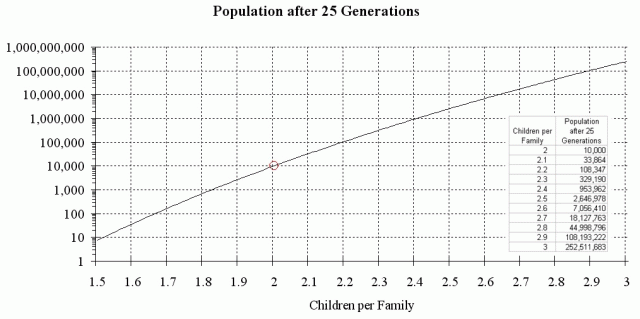
Back to the question, “how many Númenóreans were there?” Assuming that the population grew, there would have to be more on average than 2 children per family. (Two children per family on average is just stable. It makes sense if you consider it.) Anything less, and the population shrinks over time – which means, by the way, that in the Third Age, the Dúnedain were not probably not averaging 2 children per family, besides the fact that the population was being hit with wars, civil wars, pestilence, and so forth. We know how kings there were in Númenor – 25 – and if we use that for the number of generations of Númenóreans (there were actually more, because the kings, the House of Elros, lived longer than the rest of the folk of Atalantë), you can pick how big you think the families were, and pull your estimate for how many Dúnedain there were at the end of the Second Age, just before the downfall of Númenor and the tidal wave. This figure includes population in the colonies.

I figured 10,000 people were taken by the Elves to the island of Anadûnê at the beginning of the Second Age. (That’s the red circle.) If you think there were 1,000, divide the numbers in the chart by 10; if you think there were 2,500, divide the numbers by 4; and so forth.

Finally, you should consider losses to warfare. There was no warfare among the Númenóreans until they came to Gil-galad’s succor at the end of the seventeenth century of the Second Age. After that, losses to warfare would be increasingly common, and would be effectively represented by a lower birth rate, since those killed before fathering children would be indistinguishable in this formula (but not in fact, that is outside the formula: they had an impact on life in Middle-earth, as they do in real life) from people who had not been born. That is not accounted for in this chart: losses to warfare would represent a downward break or drift in the curve, unless family sizes expanded to make up for them, which would seem unlikely.


HowManyNumenoreansSmaller.gif
 
If we talk about the population of the Numenoreans, we should talk about a certain point in time. But I suppose the question asks about a maximum. Even growth rates I think would have varied widely over the years.

I tend to favor a smaller contingent of initial settlers to Numenor. Maybe only 1000 or less, maybe 1500 or 2000, possibly up to 5000. But the Men of Beleriand had been largely wiped out in all the warfare, and I don't think there would have been a great remnant to settle the new island at first.

It was year 32 of the Second Age when they reached Numenor. I cannot find it, but I believe I've read that they first landed at the site of Romenna. It's logical to me that they would have also begun the building of Armenelos. At first there would have been a lot of work to do, and a lot of land to take possession of. I think families would have been large and yet there was plenty of room for most people to spread out right along that Romenna-Armenelos corridor, either in those two towns or in farmlands just beyond. They were probably mostly farmers (read: big families - and I don't think most would wait as long as the royals to start families of their own - so I think far more than 25 generations total), though some lived in their new cities (towns?).

The Numenoreans were granted greatly increased lifespans. I wonder... was it 100 years or more after their arrival before anyone even died? Maybe they would have become so used to the idea of living, they thought it might go on forever.

Their first king, Elros Tar-Minyatur, lived and reigned until 442. Some other significant things happened relatively soon after. Silmarien (b. 521, corrected date) became the mother of Valandil, first Lord of Andunie, and Numenorean ships reached Middle Earth for the first time in 600. This indicates to me that the Numenoreans may have only just about that time begun to spread out across the island and live in all parts of it. The population had grown enough to do that. By the time of "Aldarion and Erendis" the island is largely settled, but still seems pretty pastoral.

Fast forward to 1700 when the Numenoreans intervene in the war between Sauron and the Elves. By then, much larger population, I would think, and still all living on the island. Lots of contact with Middle Earth, but no colonies yet.

Colonization truly begins around 1800 and significant later dates are 2270 when Umbar is reinforced (as mentioned above) and 2350 when Pelargir is built. In the midst of all this, "Rebellion and division of the Numenoreans begins" when Tar-Atanamir takes the sceptre in 2251.

I would think that when colonization begins, many Numenoreans view their island as 'full'. Most growth after that would be in the colonies. Birth rates have probably dropped already since those early years, and might now drop to something just slightly above 2.0. Birth rates might have been higher in the colonies - especially since there was presumably a lot more 'elbow room'.

So by the time of the Fall - there may have been far more Numenoreans living in the colonies than in Numenor itself. But some of these would have not been full Numenoreans, so how do we count them?

It's also important to realize that one million people is not really a lot, when spread out over a good-sized chunk of land. I read once what the population of England was in 1066 - and I don't recall exactly, but I think around either 3 million or 5 million (and it's now prob over 50 million - at just over 50,000 sq miles). For those in the US, think about a reasonable-sized state - even without big cities - one whose land mass is fairly close to Numenor's, and see what the population is. Minnesota is a little smaller than half, and Colorado a little larger than half, the number cited above for Numenor's area - and the one has 5 million and the other 4.5 (and Colorado has some very sparse areas). It's easy to imagine a Numenor of 5 million that is still only sparsely populated.

So - my postulations (without doing the math of actual family sizes and average time between generations):

Year / Island Population / Colony Population
32 / 2500 / -
600 / 1,500,000 / -
900 / 3,000,000 / -
1700 / 15,000,000 / -
2350 / 20,000,000 / 10,000,000
2900 / 30,000,000 / 30,000,000
3319 / 40,000,000 / 60,000,000
3320 / - / 6,000,000*

* if only 10% survived the tsunami - but maybe it was 20,000,000 - but remember, scattered around along the rivers of Eriador, and along the coasts of Eriador, and what would later become Gondor, and Umbar and further south from there - including inland dwellings.

But we can play with whatever numbers we like. :)
 
I'am not sure i could possibly add anything better than Valandil GREAT POST Valandil.
 
...we can play with whatever numbers we like. :)

Maybe we can back into an estimate.

In “The Last Debate” in Return of the King, the Captains of Gondor set off for Mordor with 6,000 infantry and 1,000 horsemen, 7,000 soldiers in all. Imrahil says that it is “scarce as many as the vanguard of its army in the days of [noparse][Gondor’s][/noparse] power”. Now, that might be the height of its power in the twelfth century of the Third Age, or perhaps he means the power of the exiled Númenóreans under Elendil during the Last Alliance – probably the former – but let’s just suppose for a moment that 7,000 men would the vanguard of Elendil’s army during his alliance with Gil-galad.

I’m not a military man, but the vanguard and rearguard might together account for a fifth of its strength: a tithe in the front, a tithe at the rear. Perhaps these might be bolstered as a fifth in the front and a fifth in the back if things are particularly rough: someone with more education and experience please correct me, but I don’t think that these are hard or fast numbers. Let’s just suppose the vanguard was a tenth of the army: think about a Roman legion of 10 cohorts on the march with one in the front as vanguard and one in the back as rearguard. We might then suppose that Elendil had an army of 70,000 men.

The War of the Last Alliance was an all-out war, what we would call a total war. During World War II, the last great total war (others have been fought since then, but on much smaller scales), one-sixth of the population of the British Commonwealth and the United States were under arms; one-fifth of the population of the USSR; one-tenth of Japan; and one-quarter of Germany. Let’s use a figure of one-sixth the population – all but the boys and old men, and none of the women – are under arms. 70,000 men under arms indicates a population of about 420,000 Faithful Dúnedain living in Middle-earth at the end of the Second Age.

By the end of the Second Age, most of the Faithful had immigrated to Middle-earth to escape the depredations against them by the last Númenórean monarchs, particularly Ar-Gimilzôr and Ar-Pharazôn, who actively pursued policies designed to expel them from Númenor. Almost none of these Faithful Dúnedain would have joined in Ar-Pharazôn’s invasion of Valinor, none of the Dúnedain living in Arnor would have been affected the tsunami after the ruin of Númenor. Let’s agree with Valandil that 90% of the Númenóreans died in the destruction of their island home or along the coastlands in the tsunami.

If half the survivors were Faithful Dúnedain, half of them King’s Men (Black Númenóreans), there were roughly 800,000 – 1,000,000 Númenóreans left in Middle-earth, less serious losses among the Black Númenóreans because they sent their menfolk off to fight the Valar with crazy old Ar-Pharazôn. Ten times that would be the pre-rebellion, pre-disaster population of Númenóreans, about 8 – 10 million people.

It’s a loosey-goosey number, a (very) rough estimate. As rough estimates go, it’s within shouting distance of Valandil’s estimate. Alter the ratios along the way to suit your tastes: the proportion of the vanguard, the size of Elendil’s army, the proportion of population in the army, the ratio of Faithful to Black Númenóreans, the proportion of survivors after the downfall, and get your own backed-in number.
 
I’m not a military man, but the vanguard and rearguard might together account for a fifth of its strength: a tithe in the front, a tithe at the rear. Perhaps these might be bolstered as a fifth in the front and a fifth in the back if things are particularly rough: someone with more education and experience please correct me, but I don’t think that these are hard or fast numbers.

The vanguard is definitely not a fixed number. Sometimes it can be as much as the main host. I think that a vanguard accounts for about roughly 1/5 of the army's strength. First of all, Imrahil said "scarcely", so 7000 is more than the vanguard was. And I think you are correct when you assume that he was referring to Hyarmendacil's reign. We know that Gondor was most powerful then, so Elendil clearly had much less. After all, he had just arrived, and was setting up kingdoms. Let's say the vanguard of Elendil's Arnorian army was 4000, which I think is very generous. That would put his military forces at 20000, and Anarion's Gondorians at around 15000. Now let us look at the Numenorian population.

If the Elendili represented a 10th of the population, then the total fighting strength of Numenor would probably be about 350,000. Because it wouldn't be a "total war", i think we can bump this number down to 300,000. With an army of 300,000 that would put the male population somewhere between 500-600 thousand, and the female would probably be between 600-700 thousand.

Given these estimates, I estimate the total population to be between 1.2 million and 1.5 million.
 
It really doesn't matter how many people lived in Numenor and what percentage were The Faithful......

The question is how two Kingdoms grew out of nine boatloads (OK, shiploads) of people in a mere 100 years or so.

Those must've been some HUGE ships that landed in Middle'earth after the Akallabeth. ;)

Considering that the largest aircraft carriers TODAY hold 3000, that gives you a maximum of 27,000....

They must've had 90% women & some very 'hearty' men to say the least. ;*)


As far as that very highly speculative chart & population guessing, what about the fact that the Numenorean kings waited until late in life to have children? Did the rest of the people do so too? I find that completely guesswork without the least bit of fact for any reliable truth ~ so typical of Tolkien fans these days.

BTW: about 10%, not 16% (1/6) of the USA (16 million) was in WWII.
 
Hey Bucky, I was very very astounded when 9 shiploads = 2 kingdoms. But then look at it. In the Last Alliance around 100,000 troops combined were marshalled. Dwarves, probably 5-10, 000, since Khazad-dum was very powerful, but no other dwarves fought. The elves of Greenwood, Rivendell, and Lindon, somewhere around 30 thousand. Other men, maybe 5,000 at the most.

That leaves around somewhere between 50 to 60 thousand Numenoreans. That is soldiers. With their families, (let's say each family has 1 wife and 2 children), and elderly persons, the population would be around 200,000.

One thing you must remember is that the Faithful existed on Middle-earth before the Downfall. They were persecuted, as is told, but doubtless some survived. These would have joined themselves to Elendil and Anarion, swelling their numbers. Now, on to the 9 ships.

You brought up aircraft carriers. However, aircraft carriers, as you know, are that immense size to accomodate planes. I would liken the Numenorean ships more to destroyers or frigates. (Also for the aircraft carrier, that is the crew size, not the maximum capacity). I think they would be much like the frigates of the Napoleonic war, so let us examine that.

Now the English galleon Ark Royal of 1587 had a crew of 300, plus 100 marines. That is 400 total. However, in a time of great need you could swell that to 1000. Let us go from there.

So 9,000 Faithful escape. 4,000 in the north and 5,000 in the south. Around 2,000 men and 3,000 others with Anarion. Let us say that in Gondor, 1,000 Faithful already there joined him. So he has 6,000. Over 100 years the maximum that could die from old age is 6,000. The original starters. However some would just be kids and therefore after 100 years they would be fine.

So there are about 6000 people. Going by the growth formula, and saying the growth rate is around 2 percent, in 100 years, that puts the population upwards of 40,000. However, these people know the danger, and they would get making babies as much as possible. So we're looking at more like 2.5 percent growth rate, which puts the population at about 70,000. Now, since nearly every able man would have been enlisted for the Last Alliance, Anarion's count would be around 25,000. A very reasonable estimate. Elendil's numbers would have been similar.
 
Last edited:
Bard: Where do you get the number that there were 100,000 in the Last Alliance?

Total speculation or an actual number in Tolkien's works?

Imrahil's statement is rather 'grey' at best, like "There must be a million troops coming at us from the Black Gate" ~ hardly to be taken as gospel fact, but as a jestly exaggeration made at the pitifully small total of the host; hardly was Tolkien expecting people to take that statement & make formulas out of it.

It's kinda like Tolkien describing the Balrog in Moria......

....It's darkness as 'shadow about it reached out LIKE two vast wings'. He then says 'the fire in it seemed to die, but the darkness grew', and finally: 'and it suddenly drew itself up to a great height, and it's wings were spread from wall to wall.' ~ Here, Tolkien is so obviously using metaphoric speech for the darkness being wings ('like two wings'; 'the fire seemed to die, but the darkness grew')

Why bring this up?

Because neither is meant to be taken literally, yet look how folks twist Tolkien's words to fit wacky theories the Good Prof would scoff at.
 
Yeah Bucky sorry I'm looking for the actual quote on the numbers of the Last Alliance. I remember it saying that the numbers were like 10 times 10 thousand.

And why are you coming at me with the Imrahil statement? Wasn't I the guy who said the vanguard isn't a set number? It could be 1/10 or 1/5 or 1/3 of the actual force.

However, 7,000 does seem to be fitting, since Hyarmendacil probably fielded about 50,000 active troops with reserves and the vanguard could be about 7,000. Also you'll notice Imrahil isn't using figures of speech here, so it's a lot easier to take it literally.
 

Today's events

Similar threads

Back
Top