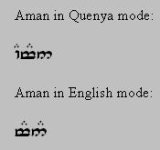
What do you mean?
Originally posted by Lantarion
What do you mean?
The only simliarities between tengwar and tehtar I can see are:
'Full' vowel "e" = yanta [Qu.: (consonantal) y; W/BS: i; S: e]
'Full' vowel "u" = úre [Qu.: -u; W/BS and S: u]
But those two 'tengwar' just mentioned above aren't actually consonants, except for yanta.
(The tehta for "e" looks like a 'shortened' tengwa halla, "h" (which looks like the Greek letter lambda). Perhaps that's what you meant?
Sorry, could you rephrase that? Didn't catch it.. What do you mean 'previous chart'?Originally posted by Morgoth"sBane
But when it says the value of the vowel tengwa, it matches the previous part of the charts, but only for sindarin and not quenya. And with the two tengwar for "a," one isnt even on the previous part of the chart and the other (even the sindarin value) didn't match the vowel at the bottom of the chart.
The tengwa Vala has the value of 'v' in Quenya, and 'w' in "English".Originally posted by BlackCaptain
But there's a 'W' letter in the Tengwar. I think it's called Vala. You could just put the ~ nasalation symbol above it to show an 'N' before it. But I guess you could do it your way too... Iduno, I might be wrong.
And the tehtar don't go above the letter that they're after. If you were writing 'Man' you'd put the 'M' symbol then the 'N' symbol with an 'A' tehtar over it.
Originally posted by BlackCaptain
I find it simple to just spell words differently... Like take Manwë. I just spell it with the
*M*
*W, A symbol above, N nasal symbol above*
*Y symbol, E above*
I still get across that it's Manwë, but I just spell it Manwey, which is pretty close to how it's pronounced. I think...