• Welcome to The Tolkien Forum! Connect with fellow Tolkien enthusiasts and join a community that is over two decades old, and still going strong. We look forward to meeting you.  Register

Romaneness of Numenoreans

Aldarion

Active Member
Joined
May 30, 2019
Messages
982
OK, I remembered how Gondorian kings got epithets for successful military campaigns: Umbardacil, Hyarmendacil etc. That is the same thing as Roman military commanders did - Scipio Africanus, Tiberius Claudius Britannicus, and so on. So what are other cultural parallels between Numenor and/or its kingdoms in exile, and Rome?
 
OK, I remembered how Gondorian kings got epithets for successful military campaigns: Umbardacil, Hyarmendacil etc. That is the same thing as Roman military commanders did - Scipio Africanus, Tiberius Claudius Britannicus, and so on. So what are other cultural parallels between Numenor and/or its kingdoms in exile, and Rome?
I'll try geography first. "Somewhere" (Alcuin?) JRRT wrote that he imagined Hobbiton to be "at about the latitude of Oxford" (oh, really?). "Somewhere else" (Alcuin??) that he imagined Minas Tirith to be "at about the latitude of Rome (and Mordor was about the Balkans)". I'll try this out with my two secondary sources, Karen Wynn Fonstad's "Atlas of Middle-earth", and Barbara Strachey's "Journeys of Frodo". Now Fonstad (died 2005 at age only 60) was a professional university cartographer, while Strachey (died 1999 at age 87) self-admittedly was not.
Fiddling around with several of Fonstad's maps, all at a scale of pretty exactly 7 centimeters for 150 miles, I arrive at Minas Tirith being about 664 miles or 1068 kilometers due south of Hobbiton.
Oops.
Strachey has it at pretty exactly 527 miles, or 848 kilometers.
Non-cartographer here, possible projection issues (basically spheroid earth projected onto a flat map, Mercator & Co.) there.
OK, so I'll take them as minimum and maximum distances, 848 respectively 1068 kilometers (my real-world atlas is metric).
Oxford (as per Wikipedia) is pretty exactly at 51.75 (in decimals) degrees north. Taking Strachey's estimate, this brings us about to Florence - not a bad place, from what I've read, but a good deal too far north of Rome. Fonstad doesn't hit the latitude quite exactly (more likely my fiddling that I mentioned above is the source of the error), but gets within a short car drive (distance-wise; I have no idea of the traffic jam situation around Rome).

But then, "somewhere else again" (Alcuin?!?) JRRT stated as per my memory that he envisioned the Gondorians to be more like the Egyptians. This would have to have been at the latest at the time of the end of the bronze age (roughly 1200 BC), as after that Middle Eastern empires (Assyrian, Babylonian, Persian, Alexander t.G.) tended to dominate. So at least 400 years before Rome's legendary founding. Not sure how far archaeology was at the time of JRRT's writing of LoTR, and how much of that had been published so that he would have been able to read it (if he had been interested) ...
 
Last edited:
I'll try geography first. "Somewhere" (Alcuin?) JRRT wrote that he imagined Hobbiton to be "at about the latitude of Oxford" (oh, really?). "Somewhere else" (Alcuin??) that he imagined Minas Tirith to be "at about the latitude of Rome (and Mordor was about the Balkans)". I'll try this out with my two secondary sources, Karen Wynn Fonstad's "Atlas of Middle-earth", and Barbara Strachey's "Journeys of Frodo". Now Fonstad (died 2005 at age only 60) was a professional university cartographer, while Strachey (died 1999 at age 87) self-admittedly was not.
Fiddling around with several of Fonstad's maps, all at a scale of pretty exactly 7 centimeters for 150 miles, I arrive at Minas Tirith being about 664 miles or 1068 due south of Hobbiton.
Oops.
Strachey has it at pretty exactly 527 miles, or 848 kilometers.
Non-cartographer here, possible projection issues (basically spheroid earth projected onto a flat map, Mercator & Co.) there.
OK, so I'll take them as minimum and maximum distances, 848 respectively 1068 kilometers (my real-world atlas is metric).
Oxford (as per Wikipedia) is pretty exactly at 51.75 (in decimals) degrees north. Taking Strachey's estimate, this brings us about to Florence - not a bad place, from what I've read, but a good deal too far north of Rome. Fonstad doesn't hit the latitude quite exactly (more likely my fiddling that I mentioned above is the source of the error), but gets within a short car drive (distance-wise; I have no idea of the traffic jam situation around Rome).

But then, "somewhere else again" (Alcuin?!?) JRRT stated as per my memory that he envisioned the Gondorians to be more like the Egyptians. This would have to have been at the latest at the time of the end of the bronze age (roughly 1200 BC), as after that Middle Eastern empires (Assyrian, Babylonian, Persian, Alexander t.G.) tended to dominate. So at least 400 years before Rome's legendary founding. Not sure how far archaeology was at the time of JRRT's writing of LoTR, and how much of that had been published so that he would have been able to read it (if he had been interested) ...
Wasn't King Tut discovery during the early 1900's?


CL
 
... "Somewhere" (Alcuin?) ... "Somewhere else" (Alcuin??) ... But then, "somewhere else again" (Alcuin?!?)...
It’s Friday the thirteenth. I’m going to be blamed for everything. ;)

This idea works better if rather than saying, “The Shire is Oxford, and Minas Tirith is Byzantium/Rome/etc.,” we say something along the lines of, “The Shire is like old rural Warwickshire, and Minas Tirith is like old Byzantium.”

In the “Foreword” to The Fellowship of the Ring, Tolkien writes,
​
An author cannot of course remain wholly unaffected by his experience, but the ways in which a story-germ uses the soil of experience are extremely complex, and attempts to define the process are at best guesses from evidence that is inadequate and ambiguous. It is also false, though naturally attractive, when the lives of an author and critic have overlapped, to suppose that the movements of thought or the events of times common to both were necessarily the most powerful influences. … [I]t has been supposed by some that “The Scouring of the Shire” reflects the situation in England at the time when I was finishing my tale. It does not. … It has indeed some basis in experience, though slender …, and much further back. The country in which I lived in childhood was being shabbily destroyed before I was ten… Recently I saw in a paper a picture of the … once thriving corn-mill beside its pool that long ago seemed to me so important. I never liked the looks of the Young miller, but his father, the Old miller, had a black beard, and he was not named Sandyman.​
​
Tolkien will refer to this description as explicitly relating the Shire to his early rural life in Sarehole, Birmingham, England. This is in the West Midlands, and Tolkien’s primary scholarly pursuits centered upon the history of the old Anglo-Saxon kingdom of Mercia: He considered himself a Mercian, or at least a descendent of Mercians.

From Tolkien’s Letter 190:
​
“The Shire” is based on rural England and not any other country in the world… The toponymy [study of place names] of The Shire … is a “parody” of that of rural England, in much the same sense as are its inhabitants: they go together and are meant to.​
​
In Letter 211 he first writes,
​
…I was born in 1892 and lived for my early years in “the Shire” in a pre-mechanical age.​
​
and later,
​
All I can say is that, if it [The Lord of the Rings] were “history”, it would be difficult to fit the lands and events (or “cultures”) into such evidence as we possess, archaeological or geological, concerning the nearer or remoter part of what is now called Europe; though the Shire, for instance, is expressly stated to have been in this region (I p. 12).​
​
“(I p. 12)” refers to the “Foreword” to The Fellowship of the Ring and is in fact the passage I first cited.

So the Shire is, more or less, an idealized version of the rural West Midlands near the end of the nineteenth century. And as an aside, Humphrey Carter, Tolkien’s biographer, quotes him as saying,
​
My “Sam Gamgee” is indeed a reflection of the English soldier, of the privates and batmen I knew in the 1914 war, and recognized as so far superior to myself.​
​
A “batman” in this context is a soldier assigned to an officer as an orderly, aide-de-camp, or servant, as you please to take the position; and though Sam repelled down the Emyn Muil and passed through a number of caves, he doesn’t have a secret identity nor a sidekick named Robin. Just to be sure, though, there really was a man named “Sam Gamgee,” and he really did write to JRR Tolkien: he was from Tooting in South London, which Tolkien described as “a mo[st] Hobbit-sounding place.” (See Letter 185. For more on this, see the essay “Sam Gamgee and Tolkien’s batmen” by John Garth, author of Tolkien and the Great War.)

Back to Letter 211, where Tolkien describes the Númenóreans as
​
best pictured in (say) Egyptian terms. In many ways they resembled “Egyptians” – the love of, and power to construct, the gigantic and massive. And in their great interest in ancestry and in tombs. (But not of course in “theology” : in which respect they were Hebraic and even more puritan…) I think the crown of Gondor … was very tall, like that of Egypt, but with wings attached, not set straight back but at an angle.​
d3c1825aaf036172542fe9e5c34fa5ef--tolkien-crowns.jpg
​
In the long Letter 131 to Milton Waldman, he compares Gondor to Byzantium:
​
…Gondor rises to a peak of power, almost reflecting Númenor, and then fades slowly to decayed Middle Age, a kind of proud, venerable, but increasingly impotent Byzantium.​
​

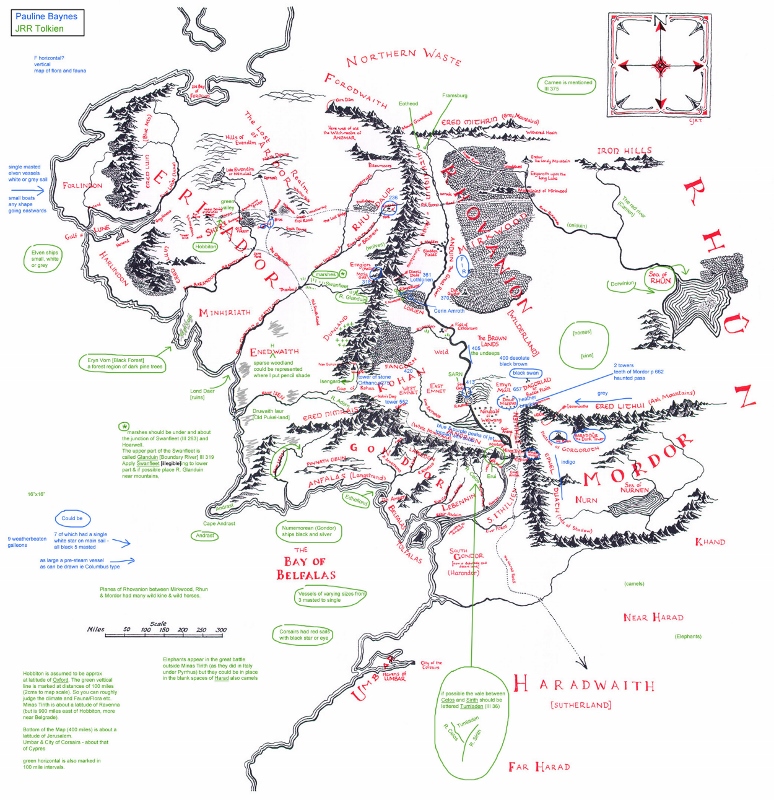
But the best evidence that Tolkien had specific places in mind regarding places in Middle-earth may have emerged recently. There was an article published in The Guardian in 2015 relating that Tolkien annotated a map for Pauline Baynes. An article written about this (in French) cites “fragment 20” from the map,
​
Hobbiton is assumed to be approx. at the latitude of Oxford. The green vertical line is marked at distances of 100 miles (2 cm: acc. to map scale). So you can judge roughly climate and fauna / flora etc. Minas Tirith is [about?] a latitude of Ravenna (but is 900 miles east of Hobbiton more near Belgrade). Bottom of the Map 1450 miles is about the latitude of Jerusalem. Umbar City of Corsairs about that of Cyprus.​
​
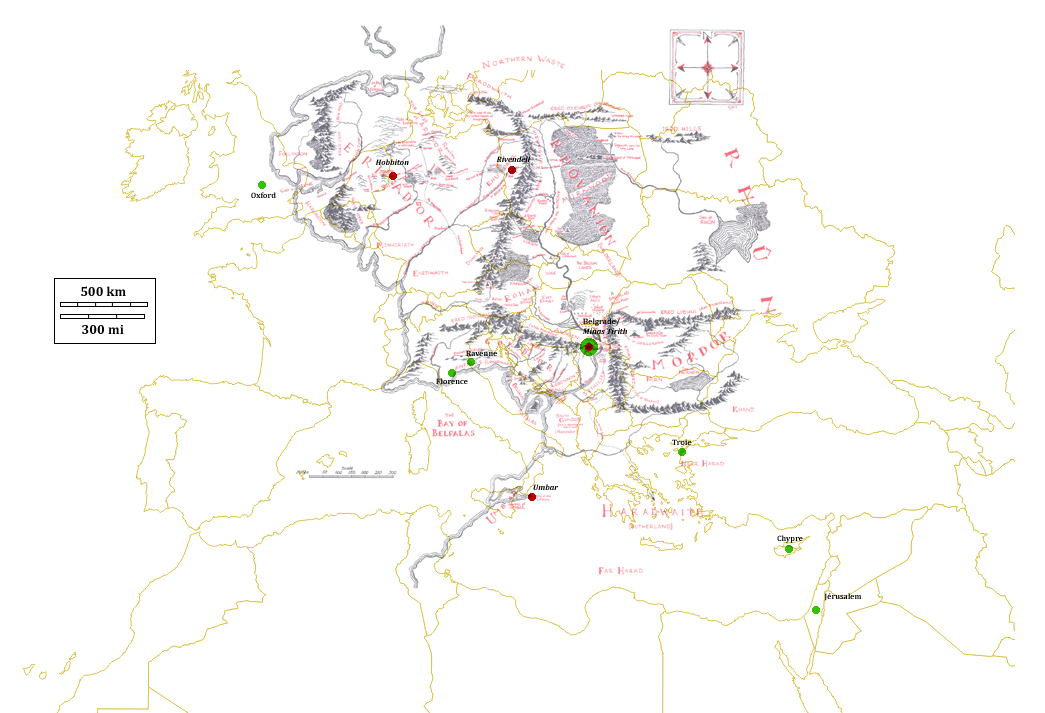
Now that doesn’t mean that the Shire is Oxford, that Minas Tirith is Ravenna or Belgrade, or that Umbar is Cyprus, but that they are on the same latitudes, more or less. Here is the annotated map:
map_reconstructed_tolkien_baynes_transcribed_774x800_.jpg


You can overlay a map of Middle-earth and a map of Europe to get various comparisons. This has been quite a game for several decades now. Here are some examples; many more can be readily found.
594702cartemontage.jpg


main-qimg-b7bd6a1326aa9afbe1e5596a55d24d16-c


Didier_Willis_-_Middle-earth_and_Europe_projection.png

Wasn't King Tut discovery during the early 1900's?
I'm thinking 1912? Perhaps earlier.
1922.
 
Last edited:
OK, I remembered how Gondorian kings got epithets for successful military campaigns: Umbardacil, Hyarmendacil etc. That is the same thing as Roman military commanders did - Scipio Africanus, Tiberius Claudius Britannicus, and so on.
I’ve been editing and editing, but didn’t address your original – important – point.

Without question, I think, the most important parallel between the Númenórean kingdoms and Rome (and Byzantium, which lasted until 1453!) is that Rome and Byzantium are the real-world examples of high and admirable civilization: global (for its day); dominant; just in its laws, of honest and honorable citizenry (at least in memory); magnificent in its architecture, knowledge, engineering, and science (such as it was); untouchable militarily (or so it seemed for centuries); the admiration and inspiration of generations for centuries until this very day. That is what Númenor, Arnor, and Gondor were in Tolkien’s world: lost Westernesse; its lost daughter kingdom, Arnor (the Hobbits “chose a Thain to take the place of the King, and were content; though for a long time many still looked for the return of the King. But at last that hope was forgotten, and remained only in the saying When the King comes back, used of some good that could not be achieved, or of some evil that could not be amended.” (RotK, Appendix A, III)); and venerable but vulnerable Gondor, a living memory of ancient days long past and seemingly unretrievable – until the Return of the King Elessar.
 
is that Rome and Byzantium are the real-world examples of high and admirable civilization: global (for its day); dominant; just in its laws, of honest and honorable citizenry (at least in memory);
Well, when Constantine took over, because beforehand, Boudicca, her daughters, and Christianity would disagree.


But that's me being pedantic. Carry on. XD

CL
 
Well, when Constantine took over, because beforehand, Boudicca, her daughters, and Christianity would disagree.
But that's me being pedantic. Carry on. XD
CL
And in the 1700 years since Constantine, zillions (read many dozens times more people, like the entire American continent and all of the settled islands of the Pacific Ocean) would not consider that to be any improvement over Caligula, Nero and company …
 

Today's events

Similar threads

Back
Top