• Welcome to The Tolkien Forum! Connect with fellow Tolkien enthusiasts and join a community that is over two decades old, and still going strong. We look forward to meeting you.  Register

Tolkien's "Special" Words

Birds' words...

gorcrow The Mewlips: "Beside the rotting river-strand; The drooping willows weep, And gloomily the gorcrows stand; Croaking in their sleep.", [Definition: a carrion crow. Etymology: combination of ‘gore’ and ‘crow’.]

throstle The Adventures of Tom Bombadil, Preface, : "The wind so whirled a weather-cock; He could not hold his tail up; The frost so nipped a throstle-cock; He could not snap a snail up. ‘My case is hard!’ The throstle cried; And ‘All is vane’ the cock replied; And so they set their wail up.", [Definition: a song thrush. A bird with a habit of cracking open snail shells by smashing them onto rocks.]
 
I’m adding muck-raker to my basket of TTEE’s (Tolkien’s Terminological Easter Eggs). And, of course, I’ve added it to the list of words at the beginning of this thread.

As always, comments/criticisms are welcome (especially if you know anything about The Pilgrim’s Progress; I only learned about it recently because I noticed Grishnakh used the word muck-raker.)

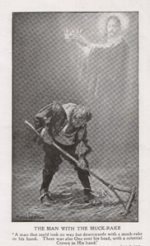
muck-raker The Uruk-hai: “’Aye, we must stick together,’ growled Ugluk. ‘I don’t trust you little swine. You’ve no guts outside your own sties…’…’…I Grishnakh say this…Swine is it? How do you folk like being called swine by the muck-rakers of a dirty little wizard?...’”, Meaning #1: One who rakes muck/filth. Meaning #2 (muckraker): reform-minded journalists, writers, and photographers in the Progressive Era in the United States (1890s–1920s) who claimed to expose corruption and wrongdoing in established institutions. Meaning #3: the “Man with the muck-rake” in John Bunyan’s 1678 classic ‘The Pilgrim’s Progress’. The man could look no way but downward with the muck-rake in his hands; who was offered a celestial crown for his muck-rake, but who would neither look up nor regard the crown he was offered, but continued to rake to himself the filth of the floor.

Comment #1: a few chapters after Grishnakh uses the word muck-raker, Grima assigns a similar term to Gandalf, “Lathspell” or “Ill-news”. It seems to me Lathspell and muckraker are almost synonyms.

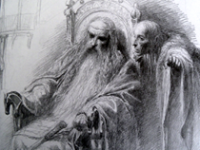
Comment #2: Upon Gandalf and Company’s arrival at Meduseld, I think Theoden has something in common with John Bunyan’s “Man with the muck-rake.” (Explanation below.)

The Man with the Muck-Rake, from ‘The Pilgrim’s Progress’ (1678) by John Bunyan
1741313475492.png


When we first meet him, Theoden’s demeanor and predicament are perhaps similar to the Man with the muck-rake in some ways. They both are encumbered, in a lowered state of being, and could (with just the slightest of effort) shake the shackles of their encumbrances.
1741313532830.png


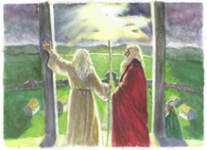
Theoden, in contrast to the Man with the muck-rake, is able to snap out of it and “take the proffered crown”:
Slowly the old man rose to his feet, leaning heavily upon a short black staff with a handle of white bone…
“…Cast aside your prop!”
From the king’s hand the black staff fell clattering on the stones
[dropped his muck-rake, maybe?]. He drew himself up, slowly, as a man that is stiff from long bending over some dull toil. Now tall and straight he stood, and his eyes were blue as he looked into the opening sky.
1741313578853.png


Excerpt from The Pilgrim’s Progress:
This done, and after those things had been seen and thought of by Christiana and her company, the Interpreter takes them apart again, and has them first into a room where was a man that could look no way but downwards, with a muck-rake in his hand. There stood also one over his head, with a celestial crown in his hand, and proffered to give him that crown for his muck-rake; but the man did neither look up nor regard, but raked to himself the straws, the small sticks, and the dust of the floor.

Then said Christiana, "I persuade myself that I know somewhat the meaning of this; for this is a figure of a man of this world. Is it not, good sir?"

Inter. "Thou hast said the right," said he; "and his muck-rake doth show his worldly mind. And whereas thou seest him rather give heed to rake up straws and sticks, and the dust of the floor, than to do what he says that calls to him from above with the celestial crown in his hand; it is to show that heaven is but a fable to some, and that things here are counted the only things substantial. Now, whereas it was also showed thee that the man could look no way but downwards; it is to let thee know that earthly things, when they are with power upon men's minds, quite carry their hearts away from God."

[240]Chr. Then said Christiana, "Oh, deliver me from this muck-rake!"


Teddy Roosevelt:
Origin of the journalistic term muckraker: President Theodore Roosevelt complained about journalists wallowing in the mud. In a speech on April 14, 1906 he drew on a character from John Bunyan's 1678 classic, Pilgrim's Progress, saying: ‘...you may recall the description of the Man with the Muck-rake, the man who could look no way but downward with the muck-rake in his hands; who was offered a celestial crown for his muck-rake, but who would neither look up nor regard the crown he was offered, but continued to rake to himself the filth of the floor.’,

Wormtongue:
“Why indeed should we welcome you, Master Stormcrow? Lathspell I name you, Ill-news; and ill news is an ill guest they say.”
 

Attachments

  • 1741313328008.png
    1741313328008.png
    17.8 KB · Views: 50
  • 1741313356822.png
    1741313356822.png
    16.2 KB · Views: 44
  • 1741313390629.png
    1741313390629.png
    25.6 KB · Views: 46
Last edited:
Note on words like “Muck” and “Filth.”

I did not see if this has been addressed, but these words were polite terms for poop in the Early and Pre-20th Century Anglophone Societies.

A “Muck-raker” rakes up Horse and Cow poop, and sometimes even the Human Variety if the place of the “Muckraker’s employ” happens to have “outdoor facilities” that have no flow of water.

The Romans and SOME Saxon Homes that used a Roman plan for such things, would have the “Toilet areas” set-up over a small stream that ran to a swamp that most villages liked to have nearby. Swamps are EXCELLENT at “cleaning water.” And the arrangement allowed for the creation of potent fertilizer from all village waste that tended to flow down to the swamp.

I need to ask a friend who is soon to be starting her Graduate Work on Medieval Clothing and Textiles about this, as I recall discussing the “Town Swamp” with her, but it even has a specific name, that might be derived from Latin or Greek. In some cases the “swamp” was simply the edge of a nearby river, where the “banks” weren’t too ‘specific,’ save at fords or in tended pastures or meadows. They tended to been filled With reeds, thrushes, water-lillies, and other aquatic plants, and no small number of funguses, including moss, lichens, and the famous mushrooms, which grow best in “muck” or “filth” (the modern grower of such fungi will be well-aware of where such fungi are best found, among the “muck” and “filth” of “cow Pastures, and thus the domestication of the products would grow best in a similar medium).

One wonders about Farmer Maggott in that regard. Was his name also an indication of his horticultural predilections regarding Mushrooms? As “Maggotts” tend to be prolific in such fungi-beds, and are usually chopped back into the “soil” (another word that can have an identical meaning as “muck” and “Filth” depending upon where and when this “soil” is referenced) to provide greater nutrients for the Mushrooms (and to keep them from EATING the Mushrooms).

Tolkien tended to shy away from mentioning anything that might give away an explicit indication that he was talking about poop when using such words. So mentioning the “smell” of it would likely only come-up if dealing with Orcs or others fallen under the Shadow. But the selection of the name Maggott, aside from other etymological associations, such as its proximity to the word “Mathom” with its Saxon form “*Matho(n)”. As a name, it comes from the diminutive “Margot” or “Maggo(t).” But those two have some sideways association(s) with “Muck” and “Filth” in the form of meaning “Sick/Nauseating” (Mawke-ish) and “irritating/distracting” or “sickening sentimentality.”

In “Polite Society” there are all manner of such terms where there are sideways references to things that are “just not discussed.” Many of these make for means of insulting or belittling others, and are similarly obscure.

MB

Edit: “Lath-“ is a different form of “ill” than “Muck” or “Filth.” It would be closer to “Vomit” than the referent to “Muck” and “Filth.”

But more properly “Lath-“ is from “Læððe” or “Laþþ,” and if with that last example, you do not think of “lapping” as a nautical timber, then you will likely miss the reference to what the “Læððe/Lath-“ are: They tend to be the small lapping-boards underneath the plaster that used to be an inside wall (wattle is sometimes used instead of the more expensive plaster), and were also synonymous with “Complex and Complicated” or “Weaving” and “Convoluted” as well as “Concealing.”

ALL things Wormtongue was known for: Obfuscating, Muddying the waters, Prevarication behind complex and complicated Truth, etc. And “-Spell” is “News” so wormtongue is saying “Ill-News” in an ironic self-accusation.

THAT IS SO Tolkien to put the words of a person’s own Failings and Failures into their accusations of others. Wormtongue is so quick to accuse Gandalf of being “Ill-News” that he uses a term that means not just “Ill-News” but “Speaking badly/wrongly/deceptively.”
 
Last edited by a moderator:
I added autothalassic to the list, but I'm not sure if I have it quite right (it not being directly in the dictionary).

autothalassic Roverandom: "…the Sea-serpent is much too enormous and strong and old and idiotic for any one to control (primordial, prehistoric, autothalassic, fabulous, mythical, and silly are other adjectives applied to him)…", [One definition of thalassic: formed in or by the sea. Meaning of the Greek prefix auto: self. So, putting them together, perhaps autothalassic would be: self-formed in or by the sea.]
 
I added marrow #2 to the list today. (Previously listed, marrow #1 was from Tom Bombadil's threat to a certain misbehaving willow tree: "...I'll freeze his marrow cold, if he don't behave himself.")

marrow (#2) Roverandom: "…Rover lay down on the hot sand and went to sleep, and dreamed of bones, and of chasing cats up plum-trees only to see them change into wizards with green hats who threw enormous plums like marrows at him.", [Definition: the mature fruit of certain Cucurbita pepo cultivars (a mature zucchini.) Note: Giant marrows are grown competitively in the United Kingdom, where the term "marrow" is often restricted to the striped, thick-skinned cultivar.]

Marrow:
1743355858210.png


Unripe plums (I suppose they look a bit marrowish.):
1743355877601.png


Gromit tends to his marrow.
[Meanwhile…Wallace (up to no gouda) gets pinched, spoiling his grated expectations.]…
 
Draught (3) - LOTR, “A Long-expected Party” A draught of cooks, from every inn and eating-house for miles around, arrived to supplement the dwarves and other odd folk that were quartered at Bag End.

I checked several online dictionaries to find a definition that fit. The best I found was from Dictionary.com.
[a selection or drawing of persons, by lot or otherwise, from the general body of the people for military service]
Though, obviously, in this case it wasn’t for military service.
 
Thanks @Starbrow. Tweaking them just a bit, five words have been added today.

Coppice Three is Company: “They went in single file along hedgerows and the borders of coppices, and night fell dark about them.”, [Definition: A small wood or thicket consisting of underwood and small trees grown for the purpose of periodical cutting.]

Doughty Prologue: “Though slow to quarrel, and for sport killing nothing that lived, they were doughty at bay, and at need could still handle arms.”, [Definition: determined, brave, and unwilling ever to stop trying to achieve something.]

Draught (3) A Long-expected Party: “A draught of cooks, from every inn and eating-house for miles around, arrived to supplement the dwarves and other odd folk that were quartered at Bag End.”, [Definition: British spelling of draft; a selection or drawing of persons, by lot or otherwise, from the general body of the people, especially for military service.]

Provender A Long-expected Party: “Bringing up young hobbits took a lot of provender.”, [Definition: food, provisions.]

Province The Shadow of the Past: “The lore of the Elven-rings, great and small, is his province.”, [Definition: a department or branch of learning or activity.]


Over the years I’ve cut plenty of trees only to have those annoying shoots grow back around the circumference of the stump. Until today I didn’t know this is a practice sometimes done specifically for harvesting the regrown shoots.

Diagram illustrating the coppicing cycle over a 7- to 20-year period
1744677284268.png


One year's regrowth: Coppiced alder in Hampshire, UK
1744677324547.png
 
Last edited:
Today, two animals leapt onto the list...

pard Tales from the Perilous Realm, “Cat”: "…the pard dark-starred, fleet upon feet, that oft soft from aloft leaps on his meat where woods loom in gloom…", [Meaning: leopard (Panthera pardus).]

tode Tales from the Perilous Realm, “The Mewlips”: “Beyond the Merlock Mountains, a long and lonely road, Through the spider-shadows and the marsh of Tode, And through the wood of hanging trees and the gallowsweed, You go to find the Mewlips—and the Mewlips feed.", [Definition: (variant of toad), a tailless amphibian of the family Bufonidae.]

“Rowr! I’m a pard. Deal with it. Rowr!”
1744756935480.png


“Ribbit! I’m a tode. Deal with it. Ribbit!”
1744756968745.png

("And...no, I'm not a wet sprocket.")
 
Last edited:
Coppice Three is Company: “They went in single file along hedgerows and the borders of coppices, and night fell dark about them.”, [Definition: A small wood or thicket consisting of underwood and small trees grown for the purpose of periodical cutting.]
We lived near a coppice wood when I was a child. Lovely place to play, and the ground was absolutely covered in bluebells every spring. And then one year we came and it was absolutely destroyed - trees cut down, mud and tire tracks everywhere. It was such a shock :eek:. It has grown back now; my brother lives nearby and has sent family photos taken in the old haunts. I guess it will be due for another harvest soon!
 
Two words for today.
I like the way Tolkien splits Withywindle into Withy-weir and Windle-reach in these lines; it makes a nice little word symmetry.

reach Bombadil Goes Boating: "Tom came to Withy-weir. Down the river rushing, foamed into Windle-reach, a-bubbling and a-splashing…", [Definition: a segment of a stream, river, or arm of the sea, usually suggesting a straight, level, uninterrupted stretch. Also: the tack sailed by a ship with the wind coming just forward of the beam or with the wind directly abeam or abaft the beam.]

weir Bombadil Goes Boating: "Tom came to Withy-weir. Down the river rushing, foamed into Windle-reach, a-bubbling and a-splashing…", [Definition: a barrier across the width of a river that alters the flow characteristics of water and usually results in a change in the height of the water level.]


A map of the reaches of the River Thames; it can be seen that a reach is a straightish stretch (and can therefore be sailed in one reach, one straight-line path between tacks, unless the wind is too close to head-on to allow the sailing-boat to reach.
1744919919452.png


A weir on the Yass River, New South Wales, Australia, directly upstream from a shared pedestrian-bicycle river crossing
1744919941232.png
 
@Starbrow wrote:
Scored - Many Meetings “his shining shield was scored with runes to ward all wounds and harm from him; [Definition - cut or scratch a notch or line on (a surface).]

Thanks Starbrow. I added it.

scored Many Meetings: "Earendil was a mariner…In panoply of ancient kings, in chained rings he armoured him; his shining shield was scored with runes to ward all wounds and harm from him…”, [Definition: cut or scratched a notch or line on a surface.]

Hand-scored decorative brass
1745197951920.png
 
Afore the weekend,
Just in time.
Three more words.
They kinda rhyme…


argosy Tales from the Perilous Realm, ‘Errantry’: "He called the winds of argosies with cargoes in to carry him across the rivers seventeen that lay between to tarry him.", [Definition: a merchant ship or a fleet of such ships.]

filigree Tales from the Perilous Realm, ‘The Man in the Moon Came Down too Soon’: "On a filigree stair of glimmering hair then lightly down he went, And merry was he at last to be free on a mad adventure bent.", [Definition: ornamental work especially of fine wire of gold, silver, or copper made with tiny beads or twisted threads, or both in combination, soldered together or to the surface of an object of the same metal and arranged in artistic motifs. It often suggests lace.]

sigaldry Tales from the Perilous Realm, ‘Errantry’: "She scorned him and she scoffed at him, she laughed at him unpitying; so long he studied wizardry and sigaldry and smithying.", [Definition: enchantment, sorcery.]

Gold filigree intricate work from Portugal
1745635279006.png
 
Here's a word I've been meaning to look up for a while:

doggrel The Houses of Healing (the herb-master speaking): "…rhymes of old days which women such as our good Ioreth still repeat without understanding. ‘When the black breath blows and death’s shadow grows and all lights pass, come athelas! come athelas! Life to the dying In the king’s hand lying!’ It is but a doggrel, I fear…”, [Meaning: (variant of doggerel) poetry that is irregular in rhythm and in rhyme, often deliberately for comic effect. Alternatively, it can mean verse which has a monotonous rhythm, easy rhyme, and cheap or trivial meaning.]

I guess a doggrel is a dog of a poem. I'll give it a try:

Were I appointed Poet Laureate,
The President would perhaps regret it.
At my speech inaugural
I’d recite a silly doggerel.
The next morning I’d wake to find,
I’d been asked to resign.
 
Here's a word I've been meaning to look up for a while:

doggrel The Houses of Healing (the herb-master speaking): "…rhymes of old days which women such as our good Ioreth still repeat without understanding. ‘When the black breath blows and death’s shadow grows and all lights pass, come athelas! come athelas! Life to the dying In the king’s hand lying!’ It is but a doggrel, I fear…”, [Meaning: (variant of doggerel) poetry that is irregular in rhythm and in rhyme, often deliberately for comic effect. Alternatively, it can mean verse which has a monotonous rhythm, easy rhyme, and cheap or trivial meaning.]
...
The limerick is one of the best known forms of doggerel.
Here are a few Tolkien inspired ones (not my compositions... I am no way thus talented)

Sauron, it is said, had One Eye,
Which one day developed a stye.
Although the pain was quite dire,
Wreathed as it was in a fire,
His tears dried up as he cried.

When Gandalf to Hobbiton came
with fireworks ready to flame
the hobbit kids shouted,
and old farmers pouted,
'Be careful, that wizard's not tame.'

There once was a Hobbit from Shire,
Who went on a quest oh-so dire,
He walked a long way,
for many a-day,
and threw some old ring into fire.

About time the Ents had a meeting,
Just a shame it wasn’t more fleeting.
Too long did it last;
War had long passed
By the time they’d finished their greetings.


(This next one is well written and definitely evokes sadness...anyway, for me it did)
I’ll tell you a tale of great sadness
Of a Steward who succumbed to a madness.
In the darkness it came,
War and grief fanned the flame -
A flame he leapt into with gladness
.
 
Last edited:
I added one term today.

bed of state The Houses of Healing: "…before the dais lay Theoden King of the Mark upon a bed of state; and twelve torches stood about it, and twelve guards, knights both of Rohan and Gondor. And the hangings of the bed were of green and white, but upon the king was laid the great cloth of gold up to his breast, and upon that his unsheathed sword, and at his feet his shield.”, [(Also “state bed”) Meaning: a grand bed, typically richly decorated and with a canopy, used by a monarch or other person of high rank when receiving visitors, or for laying out the corpse of a distinguished person.]

At Versailles, the Chambre de la Reine features the centrally-placed state bed delivered for Queen Maria Leszczinska, (Queen of France from 1725 to 1768).
1749007114135.png


1749007375531.png

(Apparently, it’s also good to be the queen.)
 
Today I learned about hue and cry and added it to the list.

hue and cry The Land of Shadow: "With a desperate spurt Frodo and Sam dashed along the bridge; but they had hardly reached its further end when they heard the hue and cry begin. Away behind them…the tower of Cirith Ungol…its harsh bell clanged…then broke into a shattering peal. Horns sounded…answering cries…they heard the tramp of iron-shod feet…”, [Meaning: a loud outcry formerly used in the pursuit of one who is suspected of a crime. By the Statute of Winchester of 1285 it was provided that anyone, either a constable or a private citizen, who witnessed a crime shall make hue and cry, and that the hue and cry must be kept up against the fleeing criminal until the felon is apprehended and delivered to the sheriff. All able-bodied men, upon hearing the shouts, were obliged to assist in the pursuit of the criminal. "Hue" appears to come from the Old French huer, which means "to shout”.]

(I've not seen this movie, but the poster seems to capture the spirit of the term “hue and cry”.)
Hue and Cry is a 1947 British film directed by Charles Crichton and starring Alastair Sim, Harry Fowler and Joan Dowling.
1749084254653.png


An entertaining paragraph from Merriam-Webster:
Let’s say it’s the Middle Ages in England and a villainous highwayman has just made off with your purse of gold. What do you do? You can’t call the police, because in medieval England there is no organized police force, much less telephones; indeed, 911 is even less than a joke in your town—it doesn’t exist! Instead, the job of fighting crime belongs to ordinary citizens. The first step is to raise a stink—victims of or witnesses to a crime are expected to yell something like “stop thief!” so that anyone who hears the “hue and cry” will be legally bound to join in the pursuit of the perfidious pilferer. Fast-forwarding to today, although hue and cry (hue comes from an Old French word meaning “noise” or “outcry”; cry comes from the synonymous Anglo-French cri) was used in legal contexts upon entering English in the 15th century, it now more often refers to general alarm, complaint, or protest.
 
Last edited:

Today's events

Similar threads

Back
Top