• Welcome to The Tolkien Forum! Connect with fellow Tolkien enthusiasts and join a community that is over two decades old, and still going strong. We look forward to meeting you.  Register

Tolkien's "Special" Words

I decided to backtrack to Moria for this one.

On my previous read-throughs I may have read sinuous but interpreted it as sinewous. However, thinking of the Watcher in the Water as a squid-like creature I’d expect it to be without sinews.

If the creature were a vertebrate with an unusual bone structure in the arms Tolkien could have written (with a snicker on his face): “Out from the water a long sinuous sinewous arm had crawled.”

sinuous A Journey in the Dark: "Out from the water a long sinuous tentacle had crawled; it was pale-green and luminous and wet. Its fingered end had hold of Frodo’s foot…Twenty other arms came rippling out. The dark water boiled, and there was a hideous stench.”, [Definition: characterized by or abounding in turns or curves. (Not to be confused with sinewous: a strong fibrous cord serving to connect a muscle with a bone or other part; tendon.]

1719083679940.png

Jules Verne’s creature, complete with sinuous tentacles
 
I was thinking of the concourses at the airport and wondered what those could have in common with Aragorn's trumpets. Now, I see: definition #1 works well for the trumpets and definition #3 for the airports.

Also, in this part of our story, the Pelennor Fields themselves become a great concourse.

concourse The Last Debate (Aragorn at Pelargir): "Then he let sound a great concourse of trumpets taken from the enemy; and the Shadow Host withdrew to the shore…’…Depart and be at rest!’…captives set free…great gathering of men out of Lebennin and the Ethir…in the morning the fleet set forth…", [Definitions: 1—an act or process of coming together and merging, 2—a meeting produced by voluntary or spontaneous coming together, 3—an open space where paths meet and crowds come together.]
 
scree The Land of Shadow: "They did not know the time, nor how long they had slept; but after a morsel of food and a sip of water they went on up the ravine, until it ended in a sharp slope of screes and sliding stones.", [Definition: a collection of broken rock fragments at the base of a cliff or other steep rocky mass that has accumulated through periodic rockfall.]

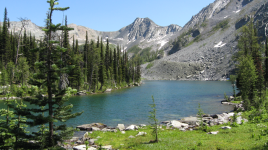
Scree makes some appearances in these photos from a day in August 2016 when I was visiting my friends in British Columbia, Canada.

There’s me.
Goin’ up to see some scree.
1721768164810.png


Scree and flowers.
1721768191628.png


Scree and a lake.
1721768242712.png


Scree and Peaks.
1721768267043.png


Scree and Bart and Annemarie.
1721768291356.png
 

Attachments

  • 1721768233716.png
    1721768233716.png
    169.3 KB · Views: 39
“You cursed peaching sneakthief!”

I can see why the tracker calls the soldier “peaching”. Sneakthief, however, seems unjustified; unless I missed it, I don’t think there’s been any news of him stealing anything.

peaching The Land of Shadow: "’I’ll give your name and number to the Nazgul,’ said the soldier…The other halted, and his voice was full of fear and rage. ‘You cursed peaching sneakthief!’ he yelled.", [Definition: informing against, betraying.]

sneakthief The Land of Shadow: "’I’ll give your name and number to the Nazgul,’ said the soldier…The other halted, and his voice was full of fear and rage. ‘You cursed peaching sneakthief!’ he yelled.", [Definition: one who steals items easily taken (without violence or breaking into buildings).]

tell-tale The Land of Shadow: "’We’re trapped at last!’…he sat down beside Frodo under the shadow of the cliff…Those in the foremost files bore torches…File after file passed, and the tell-tale torchlight was already some way ahead…", [Definition: one that imparts knowledge or news against another, informer.]

ghyll The Black Gate Opens: "They went openly but heedfully, with mounted scouts before them on the road, and others on foot upon either side, especially on the eastward flank; for there lay dark thickets, and a tumbled land of rocky ghylls and crags, behind which the long grim slopes of the Ephel Duath clambered up.", [British definition: (alternate spelling of gill), a ravine or a narrow stream.]
 
Nar! Ar! Garn!

Even these utterances I would have dismissed as orcish gibberish are in the dictionary (and of course used perfectly in the dialog.)

nar The Land of Shadow: "Hardly twenty paces from where the hobbits lurked the small orc stopped. ’Nar!’ it snarled. ‘I’m going home.’", [One definition: representing the growling or snarling of a dog.]

ar The Land of Shadow: "’…First they say it’s a great Elf in bright armour, then it’s a sort of small dwarf-man, then it must be a pack of rebel Uruk-hai; or maybe it’s all the lot together.’ ‘Ar!’ said the tracker. ‘They’ve lost their heads…’", [Definition: used to express a range of emotions or responses, especially agreement or affirmation. Frequently in representations of rural speech.]

garn The Land of Shadow: "’Why, before I knew he was wanted I shot him, as neat as neat, at fifty paces right in the back; but he ran on.’ ‘Garn! You missed him,’ said the tracker. ‘First you shoot wild, then you run too slow…’", [Definition: same as ‘go on’, often used to express disbelief or ridicule of a statement.]
 
Four words added today.

The discipline of heraldry (flags, banners, shields, coats-of-arms, etc.) seems to be quite complex with a long list of associated terminology. Today, in this category, I'm adding argent and charge. Device was already on the list; Gimli was proud to bear the device of Rohan on the shield he was given.

argent The Steward and the King: "…the standard of the Stewards, bright argent like snow in the sun, bearing no charge nor device, was raised over Gondor for the last time.", [Definition: the heraldic color silver or white. There’s also an archaic meaning: the metal silver.]

charge The Steward and the King: "…the standard of the Stewards, bright argent like snow in the sun, bearing no charge nor device, was raised over Gondor for the last time.", [Definition: a figure borne on a heraldic field.]

serried The Field of Cormallen: "…knights of Gondor, Riders of Rohan, Dunedain of the North, close-serried companies, drove against their wavering foes, piercing the press with the thrust of bitter spears.", [Definition: crowded or pressed together.]

tor The Land of Shadow: "There, peeping among the cloud-wrack above a dark tor high up in the mountains, Sam saw a white star twinkle for a while.", [Definition: a high rock on the top of a hill, or a rocky peak.]
 
One word added today…

scion The Steward and the King: "’…Lo! Here is a scion of the Eldest of Trees!’...And Gandalf coming looked at it, and said: ‘Verily this is a sapling of the line of Nimloth the fair; and that was a seedling of Galathilion, and that a fruit of Telperion of many names, Eldest of trees…ere the kings failed or the Tree withered in the court, a fruit must have been set here…’”, [Definitions: 1. a detached living portion of a plant (such as a bud or shoot) joined to a stock in grafting. 2. descendant, especially a descendant of a wealthy, aristocratic, or influential family.]

I wonder if Tolkien is being playful with his use of scion. The word has one definition that applies specifically to trees in a technical manner (involving a grafting operation). Then, it has another definition that applies to people of aristocratic heritage. However, in this quote, the “tree definition” absolutely does not apply because there was no grafting involved. Instead, the definition used for aristocratic (human) descendants works quite well.

He could easily have written: “Here is a descendant of the Eldest of Trees!”
Instead, he gives us: “Here is a scion of the Eldest of Trees!”

1724801209438.png

In this V-grafted cherry tree the part above the V is the scion, and the lower part is the rootstock. A piece of one tree has been grafted onto another tree.

 
Today, I added stirrup-cup to the list.

stirrup-cup Many Partings: "When the feast was over, those who were to go took leave of King Eomer…and…made ready to ride…they drank the stirrup-cup, and with great praise and friendship they departed…", [Definition: a small serving of drink (as wine) taken by a rider about to depart, the cup in which such a drink is served, or simply a drink taken before departure as a token of farewell.]

1727822873108.png

Scottish silver stirrup cups, Hallmarked Edinburgh, 1917

1727822894184.png

Stirrup cup drink, 1879

Although, stirrup-cup is the only term I’m adding to the list, just for fun I collected a few other occasions where “drinks of farewell” were in the story. (All these moments are little gems of a similar type, in my opinion.):

Now Galadriel rose from the grass, and taking a cup from one of her maidens she filled it with white mead and gave it to Celeborn.
‘Now it is time to drink the cup of farewell,’ she said. ‘Drink, Lord of the Galadhrim! And let not your heart be sad, though night must follow noon, and already our evening draweth nigh.’
Then she brought the cup to each of the Company, and bade them drink and farewell. But when they had drunk she commanded them to sit again on the grass…’We have drunk the cup of parting’…’I have brought in my ship of gifts…’

When the burial was over and …Theoden was left at last alone in his barrow…Eowyn Lady of Rohan came forth, golden as the sun and white as snow, and she bore a filled cup to Eomer.
Then a minstrel and loremaster stood up and named all the names of the Lords of the Mark in their order…and Theoden the latest. And when Theoden was named Eomer drained the cup. Then Eowyn bade those that served to fill the cups, and all there assembled rose and drank to the new king, crying: ‘Hail, Eomer, King of the Mark!’

Last of all Merry and Pippin said good-bye to the old Ent, and he grew gayer as he looked at them. ‘Well, my merry folk,’ he said, ‘will you drink another draught with me before you go?’
‘Indeed we will,’ … And Treebeard filled three bowls, and they drank; and they saw his strange eyes looking at them over the rim of his bowl. ‘Take care, take care!’ he said. ‘For you have already grown since I saw you last.’ And they laughed and drained their bowls.

Pippin went out for a last stroll in the garden. Sam disappeared…
Frodo stepped inside the dark door. ‘Sam!’ he called. ‘Sam! Time!’
‘Coming, sir!’ came the answer from far within, followed soon by Sam himself, wiping his mouth. He had been saying farewell to the beer-barrel in the cellar.


Let me know if you can think of any other drinks of farewell in any of the stories.
 
During a reread last night of my favorite conversation between Man and Vala, I noticed “ness” tacked onto the end of Taras and wondered what it might mean. I thought maybe I’d find a meaningful connection with the only ness that came to mind, the famous Loch Ness, but that Ness seems to be just the name of the river feeding the loch. So…no connection, I think.

ness The Fall of Gondolin (The Last Version): "Now Tuor felt his feet drawn to the sea-strand, and he went down by long stairs to a wide shore upon the north side of Taras-ness; and as he went he saw that the sun was sinking low into a great black cloud that came up over the rim of the darkening sea; and it grew cold, and there was a stirring and a murmur as of a storm to come.", [Definition: a point or extension of land jutting out into water as a peninsula or as a projecting point. Cape, promontory.]

I found an interesting “ness” symmetry between England and Beleriand (whether coincidental or intentional): The eastern-most point in Great Britain is called Lowestoft Ness. The western-most point in Beleriand is called (in this one version of the tale) Taras-ness.

Ness Point, also known as Lowestoft Ness, is the most easterly point of England, Great Britain, the United Kingdom and the British Isles.
1728597867781.png


1728597902799.png
 
I always thought the Breelanders’ brand of pipeweed, Southlinch, had an agricultural ring to the name. Now I see it’s perfect for Bree. Though I don’t see it mentioned as a place on any map or even in Fonstad’s book, I can imagine Southlinch is a south-facing terrace built into Bree’s hillside. Maybe south of the road.

linch Homeward Bound (Gandalf and Barliman): "’…if you have any pipeweed, we’ll bless you.’…When he came back he brought them enough to last them for a day or two, a wad of uncut leaf. ‘Southlinch,’ he said, ‘and the best we have; but not the match of Southfarthing, as I’ve always said, though I’m all for Bree in most matters, begging your pardon.’", [Definition: alternative spelling of lynch, an Old English term for an agricultural terrace. Sometimes used in the diminutive form lynchet, meaning a small lynch.]

1729028220575.png

Lynchet system near Bishopstone in Wiltshire, Southwest England.
 
One term from Bree and a word from Wootton Major…

I wonder why Tolkien substituted Monday for Sunday in the existing idiom “a month of Sundays”. I think either he was just being superficially playful or maybe there’s some technical reason I couldn’t decipher within the calendar system(s) he invented.

a month of Mondays Homeward Bound (Butterbur): "Well, this has been the nicest chat I’ve had in a month of Mondays…”, [I can find no precedent for a month of Mondays. However, a month of Sundays has been used since the early 1800’s to mean a nonspecific long period of time. The origin of the idiom is unclear, but one writer suggests it originally connoted a long dreary time, since games and other kinds of amusement used to be forbidden on Sunday.]

firedogs Smith of Wootton Major: "For by that time he was the best smith between Far Easton and the Westwood, and he could make all kinds of things of iron in his smithy…pots and pans…hinges…firedogs, and horse-shoes, and the like.", [Definition: same as andirons, a pair of metal supports for firewood used on a hearth and made of a horizontal bar mounted on short legs with usually a vertical shaft surmounting the front end.]

Simple firedogs, 1780’s America
1729280481945.png


Fancy firedogs from Tiffany and Co., 1895
1729280509331.png


A cavalcade of firedogs
1729280525919.png


They even made a firedog for cookin’ taters!
19th century, Gourmet Museum, Belgium
1729280542637.png
 
I wonder why Tolkien substituted Monday for Sunday in the existing idiom “a month of Sundays”. I think either he was just being superficially playful or maybe there’s some technical reason I couldn’t decipher within the calendar system(s) he invented.

a month of Mondays Homeward Bound (Butterbur): "Well, this has been the nicest chat I’ve had in a month of Mondays…”, [I can find no precedent for a month of Mondays. However, a month of Sundays has been used since the early 1800’s to mean a nonspecific long period of time. The origin of the idiom is unclear, but one writer suggests it originally connoted a long dreary time, since games and other kinds of amusement used to be forbidden on Sunday.]
It might be because it's alliterative and sounds nicer or more poetic. Or 'a month of Sundays' might have been avoided because Sunday does not have the same cultural significance in the story (being set in a distant legendary past of our world).

Also, in English, both 'Monday' and 'month' are named after the Moon.
 
It might be because it's alliterative and sounds nicer or more poetic. 'A month of Sundays' might also have been avoided because Sunday does not have the same cultural significance in the story (being set in a distant legendary past of our world).

Also, in English, both 'Monday' and 'month' are named after the Moon.
Yes, all good thoughts. I definitely agree the alliterative sound is nice for a month of Mondays.

Interesting, until now I didn't realize Sunday is "day of the Sun" and Monday is "day of the Moon. (Or maybe I used to know that and forgot it.)
 
An imp now resides on the list.

imp The Black Gate Opens, The Mouth of Sauron: "’So, you have yet another of these imps with you!’ he cried. ’What use you find in them I cannot guess…’", [Definitions: a mischievous child or a small demon. Folkloric imps were often mischievous rather than evil or harmful. In some religions, they were attendants of the gods.]

A legend in Lincolnshire dating to the 14th-century recounts that the devil, being annoyed with the completion of the cathedral, paid a visit, accompanied by two imps who proceeded to wreak havoc in the building. An angel appeared and ordered them to stop. One turned to throw a rock at the angel and was instantly petrified.

For the tiniest angel, with amethyst eyes,
And hair spun like gold, 'fore the alter did rise,
Pronouncing these words in a dignified tone
"O impious imp, be ye turned to stone!"
​

While his companion fled, the unfortunate imp remains enslaved by the Angel Choir at the east end of the cathedral. The imp is also depicted on the emblem of the local football team Lincoln City F.C. They are also nicknamed The Imps.

1730925545169.png

A statue of the Lincoln Imp inside the medieval Lincoln Cathedral in Lincoln, England. It has now become a symbol of the city.

An imp on a shirt:
1730926032181.png
 
Last edited:
I added two words to the list tonight.

stripling Appendix A, Section III, Durin’s Folk, (Dain Ironfoot slays Azog before the doors of Moria): "That was held a great feat, for Dain was then only a stripling in the reckoning of the Dwarves.", [Definition: a young person, especially a young male between adolescence and maturity.]

grange The Scouring of the Shire: "…they gasped…The Old Grange on the west side had been knocked down, and its place taken by rows of tarred sheds.", [Definitions: a storehouse for grain, a barn, or a farmhouse with outbuildings.]

Here’s an historic grange barn from Tolkien’s neck of the woods, Newhouse grange barn, built in 1506 in Leicestershire England.
1731633169390.png

1731633194819.png

Newhouse Grange was a grange of nearby Merevale Abbey. The great barn, built in 1506, is probably the largest in Leicestershire. It is 44 metres long and 11 metres high. It is a timber-framed aisled barn with six major trusses dividing it into five bays with a half bay at each end. It has a tiled, half-hipped roof with gablets but may originally have been thatched.

The half bay at the eastern end is cased in stone and has a loft at first floor level which may have been for the reeve or granger. Some of it is now encased in brick and it is surrounded by modern farm buildings, so it is difficult to get a view of the outside, but the interior is magnificent. Many modifications have been made over the years, the latest being walls between the bays to facilitate grain storage, but the medieval timber frame is still almost complete with arched braces to the aisle posts and raked struts supporting an upper collar.
 
Moving on to the vicinity of Ham, I added one boisterous word today. 'Thundergun!'

blunderbuss Farmer Giles of Ham: "Well then, Farmer Giles took down the blunderbuss, and he put in a good charge of powder…and into the wide mouth he stuffed old nails and bits of wire, pieces of broken pot, bones and stones and other rubbish.", [Definition: a 17th to mid-19th-century firearm with a short, large caliber barrel which is commonly flared at the muzzle, to help aid in the loading of shot and other projectiles. Etymology: by folk etymology from obsolete Dutch donderbus, from Dutch donder thunder + obsolete Dutch bus gun.]

1732130403115.png

Farmer Giles loading his blunderbuss. Illustration by Pauline Diana Baynes.

1732130451299.png

An 1808 Harper's Ferry blunderbuss, of the type carried on the Lewis and Clark Expedition.
 
I had a little extra time, so I added three more words today.

nosey-parker Farmer Giles of Ham: "The farmer choked in his beer. ‘Dragon?’ said he. ‘Drat you for a good-for-nothing nosey-parker! What d’you want to go and find a dragon for, at this time of the year…", [Chiefly British Definition: an officious or inquisitive person, busybody.]

tumbledown Farmer Giles of Ham: "There was one giant in particular…Fortunately, he lived far off in the Wild…He had a great tumbledown house away up in the mountains; but he had very few friends, owing to his deafness and his stupidity, and the scarcity of giants.", [Synonyms: dilapidated, ramshackle.]

uncials Farmer Giles of Ham: "…he took a good look at both scabbard and blade. He was a lettered man, but the farmer could only spell out large uncials with difficulty, and was none too sure of the reading even of his own name. That is why he had never given any heed to the strange letters that could dimly be seen on sheath and sword.", [Definition: a handwriting used especially in Greek and Latin manuscripts of the fourth to the eighth centuries a.d.]

1732158094329.png

The Book of Kells, c. AD 800, is lettered in a script known as "insular majuscule", a variety of uncial script that originated in Ireland.
 
I'm in the homestretch for this here list. Two more:

Exchequer Farmer Giles of Ham: "The royal retinue ate up nearly all the bread, butter, eggs, chickens, bacon and mutton…But the King paid handsomely for everything (in tallies to be honoured later by the Exchequer…)…so the folk of Ham were well satisfied, not knowing the actual state of the Exchequer.", [Definition: a department or office of state in medieval England charged with the collection and management of the royal revenue and judicial determination of all revenue causes, or simply the royal treasury.]

suzerain Farmer Giles of Ham: "The King ordered the whole village to assemble…He explained carefully that the wealth of the miscreant Chrysophylax all belonged to himself as lord of the land. He passed rather lightly over his claim to be considered suzerain of the mountain-country (which was debatable)… ", [Definition: a dominant state controlling the foreign relations of a vassal state but allowing it sovereign authority in its internal affairs.]

1732217856664.png

Exchequer of Ireland (Facsimiles of Irish Manuscripts, volume III, plate xxxvii.)

The Exchequer’s rather unusual name was derived from the chequered cloth on which the confrontational audit process took place between the powerful Barons of the upper Exchequer and the hapless accountants summoned before them, who were regularly interrogated about the state of their accounts. The cloth was used to visually record the sums of money that were demanded and received, and an accountant was only discharged of their debt on the provision of evidence – a writ authorising expenditure on behalf of the Crown, or a wooden tally denoting that a payment had been made into the lower Exchequer. All these transactions were then carefully recorded on parchment rolls.

1732217918498.png

Kingdom of England Exchequer note, 5 Pounds, dated 6 August 1697
 
Three words added today.

Normally I wouldn’t think plural needed any further explanation. However, when a monarch is involved the word has this interesting little twist. (And, of course, I won’t pass up a chance to cite The Dude.)

broomstale Farmer Giles of Ham: "’Ten Thousand Thunders!’ said the King…’And broomstales and fiddlesticks!’", [Definition: Broomstale is not in the dictionary. However, there’s an old definition of stale: a long slender handle as the handle of a rake, etc. So, broomstale is probably: broomhandle.]

chaffering Farmer Giles of Ham (haggling with a dragon): "’Not a brass button!’ said Giles. And so they kept on for a while, chaffering and arguing like folk at a fair. Yet the end of it was as you might expect; for whatever else might be said, few had ever outlasted Farmer Giles at a bargaining. ", [Definition: a haggling about price.]

plural Farmer Giles of Ham (The King gets angrier and angrier and eventually forgets his plural.): "’We are much displeased.’…’Your manners are unfit for our presence,’…hanged you shall be, unless you beg our pardon here and now…’…’Give me my sword!’ shouted the King, finding his voice, but forgetting his plural.", [Definition of royal plural: The royal we, majestic plural (pluralis majestatis), or royal plural, is the use of a plural pronoun (or corresponding plural-inflected verb forms) used by a single person who is a monarch or holds a high office to refer to themselves.]

The Dude knows about the royal plural…
 

Today's events

Similar threads

Back
Top