• Welcome to The Tolkien Forum! Connect with fellow Tolkien enthusiasts and join a community that is over two decades old, and still going strong. We look forward to meeting you.  Register

What are you writing about now?

But enough of my progress!

Where did you get the inspiration for your characters from?

For example, my main character is a blend of four people:

1) My lovely bride: whose supreme competence and ability to learn/remember/master anything she sets her mind to (and it's a lengthy list!) is awe inspiring. She has a quick wit and the ability to flash a smile with her face and eyes that will grab your heart and yank it in her direction. Or freeze the marrow in your bones with a glare. And she's lovely!

2) Me: I'm very adaptable in social situations and can get along with anyone (and usually choose to). I have an ability to see situations using all the various stacks of knowledge I have and come up with novel plans that work. I'm very good at recognizing patterns. I trained to go into the foreign service as a diplomat, but my plans changed when a certain lady smiled at me.

3) Galadriel: She's a very interesting person with a unique set of skills and world-view. She was a very direct, action-oriented person who was forced to realize her real strength was in acting indirectly in ways that were not easily attributed back to her. Think about the various gifts she gave the fellowship and how handy they ended up being. Legolas shot a Nazgul out of the sky before it could identify the fellowship had the Ring. Frodo's vial of light. Sam's garden soil. In my take on her, she applies that indirect action to as many of her deeds as she can. She hides her identity from the outside world also. Think about it, the heir of Gondor does not know who she is! Why? Because over time, if you know enough of a leader's actions, you know how they think. And once you understand that, you know what they'll do, and can plan for how to defeat them.

4) Mariko Toda from the 1980 Shogun series. She was physically pretty, but she had such grace, charm, wit, and social skills that she seemed orders of magnitude lovelier than the actress playing her actually was. (Don't get me wrong, the actress was very pretty.) Her character had way more social status than her mere social rank would allow her because of the aforementioned characteristics. Plus, she had a quick mind with a real ability to sieve thru various strands and know just the right thing to do. (PS - the 1980 Shogun is well worth watching!)

How about you?
 
So I have a kind of unusual writing project, that's kind of done. It's more meant to be a reading guide prompt/assist, with the goal of exploring if an alternative way of reading War and Peace can be accomplished.

I've been doing some research prep work in the interest of reading War and Peace (stuff like familiarizing myself with some French and Russian history, for example). Some of this prep has been gauging the unusual structure of the book, so as to adjust my expectations going in. From what I can gather, there are essay-ish digressions throughout the book. And then, at the end of War and Peace is the approximately 36-page second part of the epilogue, where all narrative content is left behind, and the book goes into full essay-mode.

Some readers have suggested reading that block of text first. Other readers have suggested just skipping it altogether. I never found any advice about spreading the second part of the epilogue out, though. I'm pretty sure it will take me more than 36 days to read all of War and Peace, and if I take the second part of the epilogue a page a day, it'll be knocked out before I even get to the end, probably.

Another alternative occurred to me, though. I skim read through the epilogue and took notes on key words, themes and ideas. The paper I have now will work as a prompt for me: if the themes or ideas pop up in the main narrative of War and Peace, I'll try reading that section of the epilogue in parallel with the actual narrative content. To see if the epilogue can be anchored to parts of the rest of the book.

The end goal is to see if I can create a more elegant way of incorporating the reading of the 36-pages of the epilogue into the rest of War and Peace. So readers don't have to hit a wall after the story of War of Peace, with the tedium of a large essay at the end. I've spend the last year or so designing an 8-page expanded reading guide for the Tolkien Legendarium for myself, I think that's partly where the idea came from.

It's kind of a reading/writing project. It's meant to help me engage with the reading of the book, and get the most out of it.
 
Most of my character inspiration comes from certain types of people. My favorite type of character is the type who faces great perils and dangers, who must struggle through most of the story against these obstacles, and yet who pulls through victorious in the end. This is why much of the Middle Earth world appeals to me, as Tolkien makes a lot of trouble for a lot of his people. Amandil will probably have to go through a lot as well.

I don't exactly have any particular person I base my characters on. There are elements I do borrow from other people and use my understanding of them to further the concept of my characters, but no one is consciously a blend of people together. For example: Amandil already had some character development given him by Tolkien. Given this and several necessities his character would have to fulfil to get where he has in life, I had some idea of who he would be. It was roleplay from there.

A better example: a story idea I have been toying with for almost five or six years now has five main characters, one of whom I decided would be a British sniper who had spent some time in the army(of which I know next to nothing as yet). I drew ideas of this character's personality from the type of person who sees beauty in destruction or chaos, and decided to make it a quality for potential good. He turned out a somewhat twisted character, but someone who was genuinely trying to do the right thing. He was just broken inside. I like him very much. :]

I tend to pay a lot of attention to people everywhere, whether in stories, movies, real life, etc. Whatever I hear them say about their thoughts, the way they view the world, their morals or lack thereof, I listen and gather information. I use that information later to create my people.

This may have been unnecessarily long...but I think I'll leave it as is. I know I tend to ramble and have yet to learn to speak succinctly, and that is a piece of information for you to do with as you please.
 
So I have a kind of unusual writing project, that's kind of done. It's more meant to be a reading guide prompt/assist, with the goal of exploring if an alternative way of reading War and Peace can be accomplished.

I've been doing some research prep work in the interest of reading War and Peace (stuff like familiarizing myself with some French and Russian history, for example). Some of this prep has been gauging the unusual structure of the book, so as to adjust my expectations going in. From what I can gather, there are essay-ish digressions throughout the book. And then, at the end of War and Peace is the approximately 36-page second part of the epilogue, where all narrative content is left behind, and the book goes into full essay-mode.

Some readers have suggested reading that block of text first. Other readers have suggested just skipping it altogether. I never found any advice about spreading the second part of the epilogue out, though. I'm pretty sure it will take me more than 36 days to read all of War and Peace, and if I take the second part of the epilogue a page a day, it'll be knocked out before I even get to the end, probably.

Another alternative occurred to me, though. I skim read through the epilogue and took notes on key words, themes and ideas. The paper I have now will work as a prompt for me: if the themes or ideas pop up in the main narrative of War and Peace, I'll try reading that section of the epilogue in parallel with the actual narrative content. To see if the epilogue can be anchored to parts of the rest of the book.

The end goal is to see if I can create a more elegant way of incorporating the reading of the 36-pages of the epilogue into the rest of War and Peace. So readers don't have to hit a wall after the story of War of Peace, with the tedium of a large essay at the end. I've spend the last year or so designing an 8-page expanded reading guide for the Tolkien Legendarium for myself, I think that's partly where the idea came from.

It's kind of a reading/writing project. It's meant to help me engage with the reading of the book, and get the most out of it.
This is a fascinating project. I wish you all the best with it!
 
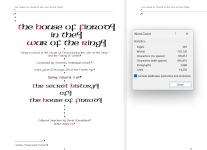
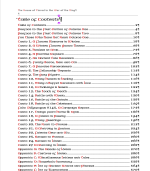
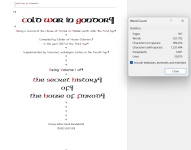
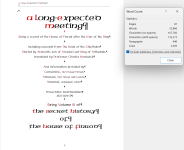
Screen shots of progress for Volume 1!

The printer will be busy for a goodly while!
 

Attachments

  • vol 2 with stats screen shot.png
    vol 2 with stats screen shot.png
    55.9 KB · Views: 40
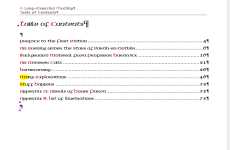
  • vol 2 toc screen shot.png
    vol 2 toc screen shot.png
    34.8 KB · Views: 34
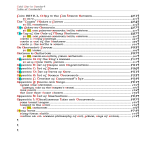
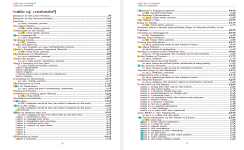
Screen shots of progress for Volume 1.
The actual table of contents won't show the date/location line underneath each chapter. I just have that visible for myself to help me get the timeline sorted out. (Still have a few items I haven't locked down in time.)

If a chapter heading has yellow on it, it has little to no work done in it.
If blue, it has a substantial amount of work done.
If neither yellow or blue, that chapter (or sub-chapter) is done.
(For this purpose, Ignore the datelines where it has a year or (????) when the year isn't known. The yellow on the dates means the date isn't locked down, it has no meaning about the completion of the chapter.)

As you can see, lots done and lots left to do!
 

Attachments

  • vol 1 toc 2 screen shot.png
    vol 1 toc 2 screen shot.png
    30.5 KB · Views: 31
  • vol 1 toc 1 screen shot.png
    vol 1 toc 1 screen shot.png
    226.8 KB · Views: 36
  • vol 1 with stats screen shot.png
    vol 1 with stats screen shot.png
    47.6 KB · Views: 37
Where did you get the inspiration for your characters from?
When writing fanfiction about the Silmarillion, I extrapolate from what's written about the characters in the text. How they're described, what they say, how they treat others, and what is not said about them. For example, Curufin is said to have inherited his father's skill, yet he's never mentioned as creating anything of note. His named dagger Angrist is dwarf-made.
I don't take these traits and stretch them out to make an entire personality, as this creates a caricature more than a character. Instead, I consider what underlying personality traits and thought processes might cause them to act the way they do. It's like I am given a 'punchline', and I have to find the 'joke' that fits it and gives it meaning.

With my own invented characters, I suppose I give each one a few traits or aspects from my own personality. But I don't think about it beforehand, I only really notice it afterwards. Sometimes things can get a bit weird. When I was developing my characters further (at around the age of 12 maybe), I gave one of them interests and preferences which were quite different to mine. In my later years of high school, I was very surprised to note I had now developed those traits myself. So somehow I was able to pull from my own future personality development.
 
Hi Ent. It's been a while I know, but my writing took a bit of a back burner for quite a few months as my family and I had other and far more important things to do. I am currently 2/3 of the way through my historical novel 'The Kings of Kaltis' and that will take up much of my time on research and developing the last 12 chapters over the next 6 months. As far as my 'Elrond and the Blue Wizards' fanfic is concerned, I busied myself over Xmas/New Year evenings by reading 'The History of Middle' Earth (All 12 volumes) to familiarise myself with any backstory, timeline and Family name issues (Nothing like accuracy!)

Your list of writings is both impressive and onerous sounding, and I wish you nothing but the best of luck, especially if you can get #1 completed soon. But like @Tyelkormo the Fair, I am looking most forward to the characters of Middle-earth.

All the best my friend.

How interesting. I was just reminiscing over Elrond and the Blue Wizards yesterday, as I was reorganizing my computer's file folders.
Your The Kings of Kaltis sounds intriguing..!! Somehow it slipped my mind, or I've not heard of it yet.

I'm very excited, as @1stvermont's Middle-earth Lore comes out in just a few days now - on Tolkien Reading Day. (I haven't heard of any change yet, anyway.)

The Tolkien market I'm entering into is pretty saturated, As I work on my first book I'm struggling to highlight what makes my book 'different' from the numbers of authors already dealing with the arena. (I've finally completed the first draft of the Preface. As you may guess, there's not a single 'that' in the thing. 😁) From the outset, even the Title of the book will need to show the different angle of my approach. But I'm getting closer.

I'll post an updated list of my books soon... it's changed a bit. (And of course, it's likely exactly zero of them will ever see completion, but we'll see.)

"More at 11...."
 
Here's my current list of books. Probably in their order of work.

The Moral and Religious Elements Of J.R.R. Tolkien's Works Unveiled: What the Works Themselves Have To Say

Mankind, Life, and the Religion of Opinion

Tolkien’s Characters

TRILOGY:
- Peregrin Took: My Road
- Elessar: Architect of the Fourth Age
- After Elessar

366 Days of Encouragement from J. R. R. Tolkien's Works
 
With my first book, we know the issue over his inclusion of religious/Christian/Catholic elements has invited debate - even conflict.
I've some 14 books in my library dealing directly with it alone, and a number of others dancing tangentially all around it.

But here's the deal...there really is no argument, because fundamentally, most people simply misunderstand (or ignore) what he really said. (I'll clarify all this in the Introduction to the book, using his own words from several places, then get on to what's really important.)

So why write the book to begin with, if it's covered 'ad nauseum' ?
First, because there are some still missing the mark on what he said.
Next, because they all 'tend' to approach the issue from the same angle... Tolkien's 'background and worldview' to sum it up.
In other words, they focus on Tolkien himself... and his ability or inability to include or exclude his background.

Hint: he never indicated he intended to.

What's different in my work?
Tolkien always spoke of, focused on, and appealed to his WORKS. He did not turn his eyes on himself.

So the question is: What do the WORKS themselves say? This is what we must locate, unveil, expose and position with regard to "the Religion and morality of of Middle-earth."

Yes, Tolkien said he felt including "overt reference to Christianity a mistake" in any work. Yet in the 2nd sentence following, he said "the elements of morality and religion MUST be included...."

And in another place he stated "LoTR is, of course, a fundamentally religious and Catholic work."

Case closed... there is simply no argument. Get a hint. We should simply find in his work NO overt references to Christianity, but many elements of morality and religion.

Thus we appeal to the Works. Not to Tolkien, his background, character or worldview. What do the WORKS say.
What elements of morality and religion do they speak to?
Are those elements exclusinve to Christianity? Or even Catholicism? (The two are not the same in many respedts.) Or are they elements also found in other religions, mythologies, and fantasies, all of which he included in his perspective on this matter?

With only fleeting thought I jotted out 24 religious elements the Works reveal. And I've not begun on the moral issues yet.

This is the ground my work will tread. Not the age old "is there and did he..." Of course he didn't (overt Christianity) and did (massive references to elements of Religion.)

My ground is the appeal to the works themselves, unveiling their voice into the matter.

And this is what I need to find expression for, even in the title of the book...else it will just be lost in the mass of authors bleating into and around Tolkien himself, rather than his own preference... the works.

SO: As you review the title I'm currently sitting on in my "list" above, please feel free to make suggestions. All will be thankfully accepted and readily considered.
 
Last edited:
Well.
It's very clear Freeman's work Tolkien Dogmatics and Kreefts The Philosophy of Tolkien are scholarly works covering very well the fundamental principles and issues moving me toward the exposition and ananlysis of what Tolkien's works actually have to say.

It strikes me too, if a person doesn't grasp these works - i.e. 'the principles in play' (which many either don't or won't), and 'the practical application' side of them - nothing I intended to write regarding how the actual works themselves demonstrate the principles and application, will have an impact.

Unless in fact actual 'demonstration' directly from the works has some use. I do know people learn things in very different ways.

Here, the question becomes "for how many will it have a use?"
Those who grasp Kreeft and Freeman need no such guide. The practical application is seen naturally.
Of those who do not grasp a Kreeft and a Freeman, how many are ernest seekers?
How many will dig inductively, rather than deductively? How many will want to go from the specific demonstration to the principle behind it?
In other words, is there a sufficient audience of 'seekers' remaining? Or is it comprised mostly of those simply stuck in The Religion of Opinion?
As a not-so-famous Ent once said, "those who will not look cannot see."

The jury is very much out now. In a saturated market, it is most often not worth 'opening a new business.'

For those wanting to increase their appreciation of the depth of Tolkien's works, I strongly recommend Kreeft and Freeman. (And possibly two others, though I think one of them might be a bit out on the proverbial limb.)
 
Sorry to bore you all with my 'ponderings' - but once again, I've found it good to go to the Source when things seem unclear, and unease is at hand.
The drive to work is always useful for this, as it provides good, uninterrupted time for a Chat.

Above, I mentioned this in passing... "Naturally, when I get to "Tolkien's Characters", there is a very close link between the "Moral and Religious Elements" and "Tolkien's Characters." The two are,quite frankly, inseparable."

What I failed to recognize, was the thought was not my own. The solution to my current unease is to merge the concepts of the two books, and create an entirely different one - a work blending the romp of Tolkiens' characters and events as it turns out, with what they show with regard to Middle-earth's morality and religion. We will be meeting these folks and things in quite some depth. Who are they, why are they, and what do they show us.

This takees on a whole different tone and approach now... and will need an added appendix, and probably an index as well. But the whole nature of the affair is very, very different now...more in line with the original intent of the "Characters of Tolkien" work... expanded a bit.

On we go. (I trust I'm not alone in struggling through a winding, overgrown path, while seeking the right direction. It's an intriguing journey of its own.)
 
Well.
It's very clear Freeman's work Tolkien Dogmatics and Kreefts The Philosophy of Tolkien are scholarly works covering very well the fundamental principles and issues moving me toward the exposition and ananlysis of what Tolkien's works actually have to say.

It strikes me too, if a person doesn't grasp these works - i.e. 'the principles in play' (which many either don't or won't), and 'the practical application' side of them - nothing I intended to write regarding how the actual works themselves demonstrate the principles and application, will have an impact.

Unless in fact actual 'demonstration' directly from the works has some use. I do know people learn things in very different ways.

Here, the question becomes "for how many will it have a use?"
Those who grasp Kreeft and Freeman need no such guide. The practical application is seen naturally.
Of those who do not grasp a Kreeft and a Freeman, how many are ernest seekers?
How many will dig inductively, rather than deductively? How many will want to go from the specific demonstration to the principle behind it?
In other words, is there a sufficient audience of 'seekers' remaining? Or is it comprised mostly of those simply stuck in The Religion of Opinion?
As a not-so-famous Ent once said, "those who will not look cannot see."

The jury is very much out now. In a saturated market, it is most often not worth 'opening a new business.'

For those wanting to increase their appreciation of the depth of Tolkien's works, I strongly recommend Kreeft and Freeman. (And possibly two others, though I think one of them might be a bit out on the proverbial limb.)
Personally, I would also consider a few other aspects:

Some don't have access to Kreeft and Freeman, or don't know about them. Some who do may find them difficult to understand. Perhaps a new perspective, a long-grown, cultivated perspective, could be a useful addition to these two authors.

Those who are not eager or earnest seekers may become so through reading your work. Some who are indeed seekers may find pleasure in reading your work and comparing it with the thoughts provoked by Kreeft and Freeman.

Then there's the additional fact some may want to read your work because...well they want to better understand you. Members of this forum would be the ones to fit that role. In any case, just thought I'd offer these up. I'll go read your next post now.
 
Sorry to bore you all with my 'ponderings' - but once again, I've found it good to go to the Source when things seem unclear, and unease is at hand.
The drive to work is always useful for this, as it provides good, uninterrupted time for a Chat.

Above, I mentioned this in passing... "Naturally, when I get to "Tolkien's Characters", there is a very close link between the "Moral and Religious Elements" and "Tolkien's Characters." The two are,quite frankly, inseparable."

What I failed to recognize, was the thought was not my own. The solution to my current unease is to merge the concepts of the two books, and create an entirely different one - a work blending the romp of Tolkiens' characters and events as it turns out, with what they show with regard to Middle-earth's morality and religion. We will be meeting these folks and things in quite some depth. Who are they, why are they, and what do they show us.

This takees on a whole different tone and approach now... and will need an added appendix, and probably an index as well. But the whole nature of the affair is very, very different now...more in line with the original intent of the "Characters of Tolkien" work... expanded a bit.

On we go. (I trust I'm not alone in struggling through a winding, overgrown path, while seeking the right direction. It's an intriguing journey of its own.)
Oh, this sounds like a very fascinating work! Personally, I would love to read a work of this sort. I would be able to put it to so much use in my ponderings.
 
How interesting. I was just reminiscing over Elrond and the Blue Wizards yesterday, as I was reorganizing my computer's file folders.
Your The Kings of Kaltis sounds intriguing..!! Somehow it slipped my mind, or I've not heard of it yet.

I'm very excited, as @1stvermont's Middle-earth Lore comes out in just a few days now - on Tolkien Reading Day. (I haven't heard of any change yet, anyway.)

The Tolkien market I'm entering into is pretty saturated, As I work on my first book I'm struggling to highlight what makes my book 'different' from the numbers of authors already dealing with the arena. (I've finally completed the first draft of the Preface. As you may guess, there's not a single 'that' in the thing. 😁) From the outset, even the Title of the book will need to show the different angle of my approach. But I'm getting closer.

I'll post an updated list of my books soon... it's changed a bit. (And of course, it's likely exactly zero of them will ever see completion, but we'll see.)

"More at 11...."
Looking forward to reading them, even if incomplete!
 
Sometimes it gets discouraging to realize the progress you made doesn't actually work...and now I have to redo my theme and plot-theme for my story. Well...all my work wasn't for nothing, so I've been told.

I have to find a theme difficult to answer, because this is part of what makes a memorable and intelligent story(according to the standards I'm working with). I have to find something I don't necessarily have the answer to myself, because then I can explore the issue with my characters and see where their answers take them. This means a lot of reading and...possibly days of thought, though I'm told days is considered quick work in these circumstances. Given I'm not sure where to start, the task looks big. But it's okay. I'll find a way into it and figure out something. Writing this little message helps, too. I'll figure something out.

I'm focusing on the theme because of the way I view stories. To me, each story, especially the good ones, is a thought experiment designed to answer some particular question. The memorable ones either answered difficult questions or produced answers people have been grappling with for years since. I want my story to be remembered. I want to make something last beyond my years. In the end, that is what I want for all my stories. I guess I have a lot of work ahead of me.
 
Oh, this sounds like a very fascinating work! Personally, I would love to read a work of this sort. I would be able to put it to so much use in my ponderings.
Nice to know it might have application.

So here's the final decision as I lay out the future... and the question I put to you.

Do I handle it somewhat like a 'dictionary/encyclopedia' layout? Or do I start at the beginning of SIL and unfold the characters and events chronologically as they are introduced - who/what they are, why they're there, what they reveal to us, and how they speak to the moral and religious elements Tolkien infused.

For example, the 'encyclopedia type', would place character "Bilbo" under B, unveil Bilbo and his fit within the whole, what he reveals for us, and speak to how he demonstrates the 'moral and religious elements'.

The event "Khazad-dûm," with its myriad revelations, what they are, show, and how they fit into the 'moral and religious' elements they incorporate, would naturally be under "K".

However, working chronologically starting at SIL and simply unfolding characters and events as they are introduced and occur in the timeline could be handled much more narratively, and feel more like an unfolding story than a research presentation. The entire mode and manner of handling is different.

Personally, I'm leaning toward the chronoligical narrative form. Will be much more exciting to write...and I suspect, more engaging to read. And anyone wanting to know "where to find it" would easily know to simply go to the chronological section within the stories to review.

(Thus the need for a decent Index, too. If one wants to look up, for example every place I note the moral character of jealousy, or envy, or lust, or such being demonstrated, the Index will provide.)

Either way, it is going to be a very large work... likely separate works for SIL, TH and LoTR in the end.

So the concept of an initial version one-volume, and a revised and expanded edition later in 3 volumes, surfaces again.
 
Last edited:

Today's events

Similar threads

Back
Top