• Welcome to The Tolkien Forum! Connect with fellow Tolkien enthusiasts and join a community that is over two decades old, and still going strong. We look forward to meeting you.  Register

Where did Tolkien get his names from?

Rivendell_librarian

Active Member
Joined
Aug 19, 2018
Messages
772
I'm reading a book about the early history of Byzantium (intrigue, intrigue and more intrigue) and I came across the name Prince (later King) Gundobad of the Burgundians (or Suevians). In the absence of anything written by Tolkien on the place name Gundabad, how does one know whether this is coincidence or not. It wouldn't be surprising if the well studied Tolkien knew about this historical figure.

I was also wondering about Saruman and King Suleiman of the Arabian Nights - known for imprisoning djinns or genies on magic bottles or lanterns. Coincidence?
 
With respect to Saruman I'd say Old English searu "skill, cunning, a cunning art . . . " compare Elvish Curunír "Man of Craft/Skill"

In general this is a somewhat complicated matter -- considering, just for example, that some names are purposely taken from Primary World sources to be seen as translations, while other names are meant to be true, in-story names.

🐾

By the way, I think it was Shippey who said that saru was a hypothetical, unrecorded Mercian form of West Saxon searu.

In any case I read it somewhere, but am not expert enough to further comment!
 
With respect to Saruman I'd say Old English searu "skill, cunning, a cunning art . . . " compare Elvish Curunír "Man of Craft/Skill"
...
By the way, I think it was Shippey who said that saru was a hypothetical, unrecorded Mercian form of West Saxon searu.
Yes, Shippey's "The Road to Middle-earth" is a good source for such information, being written from a linguistic point of view.
Shippey paralleled JRRT both in schooling (King Edward's in Birmingham!), in university studies (though here it might have been closer to what Christopher had studied perhaps 20 years earlier than what JRRT had half a century earlier), and professionally teaching at universities; he used JRRT's syllabus while teaching at Oxford, and succeeded to the Chair of English Language and Medieval English Literature at the University of Leeds created for JRRT in the early 1920's. So he looks to be the "go-to" as far as Old and Middle English is concerned.

For things Elvish, the Wikipedia article "Elvish Linguistic Fellowship" might be more helpful for pointers.
 
Tolkien seems a bit annoyed (in a letter) about Sauron . . . and lizards :)

"It is therefore idle to compare chance-similarities between names made from "Elvish tongues" and words in exterior "real" languages, especially if this is supposed to have any bearing on the meaning or ideas in my story. To take a frequent case: there is no linguistic connexion, and therefore no connexion in significance, between Sauron a contemporary form of an older *thaurond- -- derivative of an adjectival *thaurá (from a base THAW) "detestable" and the Greek saura "a lizard".

Anyway, for another example Tolkien mentioned: he took the name Moria from the Primary World
(Soria Moria Castle), but the meaning or significance in the real world source was beside the point.

With respect to Elvish names, there's an in-world history of the languages they are drawn from, down through the imagined timeline.

🐾
 
Last edited:
Tolkien seems a bit annoyed (in a letter) about Sauron . . . and lizards :)
Tom Shippey casts some more light on the reasons for JRRT's irritation at this in his contribution to the 2011 book edited by Jason Fisher "Tolkien and the Study of His Sources: Critical Essays". It's the first contribution after Fisher' preface, entitled "Introduction: Why Source Criticism?"

"Tolkien rejected the connection, but such guesses were especially annoying to him as being "pre-philological". If there was one discipline dear to Tolkien's heart, it was that of Comparative Philology, one of the great discoveries of the nineteenth century, and perhaps its central statement was that similarities of sound meant nothing, unless they were embedded in a coherent and consistent system of phonetic change. Two words in different languages with the same sound and meaning might well prove nothing about connection [that dreaded coincidence again!]. Conversely, two words in different languages with the same meaning and utterly different sound could be proved to be connected [those dreaded sound shifts]."
 
Thumbs up Gando.

Another name Tolkien himself mentioned is Rohan . . .
__________

"Rohan is a famous name, from Brittany, borne by an ancient proud and powerful family. I was aware of this, and liked its shape; but I had also (long before) invented the Elvish horse-word, and saw how Rohan could be accommodated to the linguistic situation as a late Sindarin name of the Mark ( . . . )"

"Incidentally the ending -and (an), -end (en) in land names no doubt owes something to such (romantic and older) names as Broceliand(e), but is perfectly in keeping with an already devised structure of primitive (common) Elvish (C. E.), or it would not have been used."

"The element (n)dor "land", probably owes something to say such names as Labrador (a name that might as far as style and structure goes be Sindarin. But not to Scriptural Endor ( . . . )"

JRRT, letter 297, 1967
__________

Tolkien noted that this letter contains some reflections in preparing a response to a Mr. Rang, and:
"In the event only a brief (and therefore rather severe) reply was sent, but I retain these notes."

Turns out Mr. Rang was actually a bell from a church in Lincoln!

🐾
 
Last edited:
I'm reading a book about the early history of Byzantium (intrigue, intrigue and more intrigue) and I came across the name Prince (later King) Gundobad of the Burgundians (or Suevians). In the absence of anything written by Tolkien on the place name Gundabad, how does one know whether this is coincidence or not. It wouldn't be surprising if the well studied Tolkien knew about this historical figure.

I was also wondering about Saruman and King Suleiman of the Arabian Nights - known for imprisoning djinns or genies on magic bottles or lanterns. Coincidence?
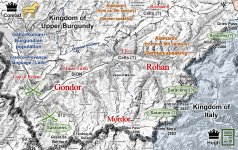
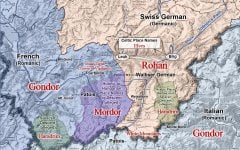
Hello, as to Gundobad, I also believe that the mountain is connected to the king. I actually just wrote a book about Tolkien's sources of inspiration for Middle-earth in Switzerland (Martins S. Monsch, Switzerland in Tolkien's Middle-Earth) and it makes perfectly sense. After the defeat of the Burgundians against the Romans and the Huns (which is connected to the saga of the Nibelungs and the Ring), the Burgundians were settled by the Roman commander Aëtius in the region of Lake Geneva and the Alps.

Now, on his trip to Switzerland, Tolkien actually followed the path of the Burgundians (and the Ring). According to his fellow traveler Colin Brookes-Smith, they went first by riverboat on the Rhine through close to the region where the legend of Sigurd and the Nibelungs is set. And then he travelled to Switzerland and the Alps where the Burgundians (the sons of Isildur so to speak) moved to. It thus seems that Tolkien took the idea that somebody (like Alberich/Andvari) took the treasure and brought it to the new settlement place.

On the left map, I should have put Gondor also to the regions south of the Alps, of course. On the right map, you can also see Tolkien's path and the languages.
 

Attachments

  • 2_9Jahrhundert_4_eng2.jpg
    2_9Jahrhundert_4_eng2.jpg
    574.2 KB · Views: 60
  • 3_Sprachen_4_eng2.jpg
    3_Sprachen_4_eng2.jpg
    550.2 KB · Views: 60
Gundobad/Gundabad . . . not sure I see much resemblance there . . . not as much as Tirion upon Túna, for a fishy example, but whatever.

Anyway. Welcome msmonsch!

and I apologize too :)

Thumbs up Gando

By the way, that should have read Gandobad

Mybad
 
Welcome to TTF, msmonsch. From your maps, it would appear Tolkien thought of the German-speaking parts of Switzerland as Mordor. :eek:

In addition to “Rohan” and “Gundabad”, you can add “Gondor”, which in the real world is a city in northern Ethiopia. (When I first became aware of this some 30 years ago, it was always spelled “Gondor” in English. I see that Wikipedia, that font of sometimes skewed information, has changed its spelling to “Gondar” and added the warning, “Not to be confused with Gondor.” Alas! there is nothing Karen won’t spoil.) In addition, the “Stone of Erech” is not to be associated with the ancient Sumerian city of Erech in Mesopotamia. (Wikipedia again in its faux-wisdom has changed the name to “Uruk” and appended the note, ‘“Erech” redirects here. For the fictional location in the works of J. R. R. Tolkien, see Erech (Middle-earth). For the advanced breed of orcs in the same works, see Uruk-hai. For other uses, see Uruk (disambiguation).’)

Besides these examples, the Black Speech word nazg meaning “ring”, root of the Black Speech word “Nazgûl”, is cognate with the Gaelic (Irish Celtic) nasc (nasg in Scottish Celtic), also meaning “ring”. In Letter 297 Tolkien admits that he probably borrowed that one unconsciously. And in the same letter, in the next paragraph, he points out that Eärendil is derived directly from the Anglo-Saxon éarendel in the poem Crist:
éala éarendel engla beorhtast
ofer middangeard monnum sended
and sodfasta sunnan leoma,
tohrt ofer tunglas þu tida gehvane
of sylfum þe symle inlihtes.
Swa þu, god of gode gearo acenned,
sunu soþan fæder swegles in wuldre
​
Translated
Hail Day-Star! Brightest angel
Sent to man throughout the earth, and
Thou steadfast splendour of the sun, bright above stars!
Ever Thou dost illumine with Thy light the time of every season.
As Thou, begotten God of God,
Son of the True Father, without beginning
​

But for the most part, Tolkien’s names came from his increasingly intricate systems of languages, particularly Sindarin and Quenya (i.e., “Elf-Latin”, as he called it), as well as Adûnaic (Númenórean, the source language of Westron in Lord of the Rings) and Khuzdul, Dwarvish. The names of the Dwarves – and of Gandalf! – in The Hobbit are taken from the Elder Edda edited by the lawspeaker Snorri Sturluson, famed in Icelandic history, around the end of the twelfth century. He also used Frankish names (e.g., Pippin), Cornish (or Brittonic) names (e.g., Meriadoc), Anglo-Saxon names (especially for the Rohirrim), and other northern European names.
 
I tend to think that Tolkien was after all a writer, and a writer lives to make things up.
I imagine him using pure imagination to give characters a name, then, amending them with his knowledge of real world languages, so they may fit seamlessly into the larger picture.

FRODO's name for example seems very apt for the ROAD he must follow, '...down from where it first began!'. And with the psychology of the Ring it wouldn't surprise me to learn that Tolkien chose that name with FREUD in mind. However that may be, for the time being I like the idea of FRODO as an anagram, 'door' + '(F) key'. Although to be perfectly precise on the nature of keys, Frodo might only have half.
 
Last edited:
As regards Frodo, Tom Shippey discusses this name at length in both of his books, "J.R.R. Tolkien - Author of the Century" (2000) and "The Road to Middle-earth" (3rd edition 2003). I'll quote from the latter.

"... Tolkien left two very strong clues. One is the name of the 'hero' of The Lord of the Rings, Frodo. The other is the note in Appendix F, which says that some hobbit-names have been retained by Tolkien without translation, 'though I have usually anglicized them by altering their endings, since in Hobbit-names a was a masculine ending, and o and e were feminine.' 'Frodo', in other words, is an English form of original 'Froda'. But what kind of name is that? ... On the other hand 'Frodo', surprisingly, is never mentioned in the name-discussion of that Appendix. ...

'Froda' actually is a name from the dimmest reaches of Northern legend. It is mentioned once in Beowulf (not in the main story), when the hero, discussing politics, says the the king of the Danes means to marry his daughter glædum suna Fródan, 'to the fortunate son of Fróda'. By this means he hopes to heal the feud between the Danes and the 'Bards' over whom Fróda once ruled. His idea won't work, says Beowulf, for the pressure on heroes to take blood-revenge is too strong - it seems, though this is speculation from other sources, that Ingeld's father Fróda was killed by the Danish king who now wants to make alliance with his son. ...

Nothing else is ever heard of Fróda in Old English, but the Norse form of the word - it means literally 'the wise one' - is Fróthi, and round this there are several stories. The most persistent is that Fróthi was a contemporary of Christ, alleged by both Saxo Grammaticus (c. A.D. 1200) and Snorri Sturluson (c. 1239). During his reign there were no murders, no wars, no robberies, and gold rings lay untouched in the open, so that everyone referred to his age as Frótha-frith, the 'peace of Fróthi'. But it came to an end because of greed, or maybe over-altruism. ...

This is a story, one can see, about the incurability of evil. Has it anything to do with Beowulf? There is no overt connection, but Tolkien was used to 'reconstructing' stories. The point that seems to have struck him is the total opposition between son and father, Ingeld/Ingjaldr and Fróda/Fróthi. The one is an example of the Ragnarök-spirit undiluted, of heroic conventionality at its worst; in the Beowulf lecture Tolkien called Ingeld 'thrice faithless and easily persuaded'. The other has about him a ring of nostalgic failure; in his time everything was good, but it ended in failure both personally (for Fróthi was killed) and ideologically (for Fróda's son returned to the bad old ways of revenge and hatred, scorning peace-initiatives and even apparently his own desires). Of course the Frótha-frith could have been just an accident, a result of the Incarnation which not even virtuous pagans knew about. For all these reasons the composite figure of Fróda/Fróthi became to Tolkien an image of the sad truth behind heroic illusions, a kind of ember glowing in the dark sorrow of heathen ages. ...

There is something grimly appropriate, further, in the fact that 'Ingjaldr' remained a common Norse name for centuries. 'Fróthi', however, was quickly forgotten.
All this sounds very much like Tolkien's 'Frodo'. He is a peacemaker, indeed in the end a pacifist. One can trace his progress from p. 316, when he stabs the Moria troll, to p. 600, when he threatens to but does not stab Gollum. On pp. 670-73 he saves Gollum's life from the archers, against Sam's strong inclination to keep quiet and let him die. He gives Sting away on p. 905, keeping an orc-blade but saying, 'I do not think it will be my part to strike any blow again.' He throws even that away ten pages later, saying, 'I'll bear no weapon, fair or foul'. In 'The Scouring of the Shire' his role is to forbid killing (pp. 983 and 986-87), and later, after a battle in which he has not 'drawn sword', to protect prisoners. He will not kill Saruman even after his mithril-coat has turned a treacherous stab. ...

This sense of age perhaps motivates the general unconcern for Frodo shown by the Shire, his unfair though unintended supplanting by the large and 'lordly' hobbits Merry and Pippin, the rudeness or much-qualified respect shown to him by Sharkey's men and Gaffer Gamgee too. Saruman knows better, and so do some others, but 'Sam was pained to notice how little honour [Frodo] had in his own country'. It is prophets who proverbially have no honour in their own country, and Frodo is increasingly a prophet and a seer. ...

The end of Frodo's quest, in the memory of Middle-earth, is nothing. Bilbo turns into a figure of folklore ('mad Baggins'), the elves and dwarves percolate through our world as time-shifters and ring-makers, even 'the Dark Tower' remains as an image for 'poor Tom' in King Lear. Of Frodo, though not a trace: except hints of an unlucky, well-meaning king eclipsed on the one hand by the fame of his vengeful son, on the other by the Coming of the true hero Christ."
 
Last edited:
Just to add: Tolkien did consider referring to Frodo's real name (in Appendix F) as Maura.

Note the masculine ending here (seemingly here), in Hobbit names. It was also noted that there
was no word maur- in contemporary Westron, but in archaic Rohirric it meant "wise, experienced."

Love it. Author published or not!

🐾
 
Last edited:
One of the French versions of Frodo Baggins is Frodon Sacquet. I don't know why the "n" was added - maybe Frodo was thought to be too Germanic a name.

For anyone who follows horse racing there is a successful UK steeplechaser called Frodon which was originally French owned and bred, although I don't think any racing journalists have mentioned the Tolkien connection. This is Frodon (Frodo) winning the King George VI Steeplechase:

Frodo wins King George
 
Last edited:
Thank you S-eS :)

For some reason, I was proud of that one.
 
Last edited:
Welcome to TTF, msmonsch. From your maps, it would appear Tolkien thought of the German-speaking parts of Switzerland as Mordor. :eek:

In addition to “Rohan” and “Gundabad”, you can add “Gondor”, which in the real world is a city in northern Ethiopia. (When I first became aware of this some 30 years ago, it was always spelled “Gondor” in English. I see that Wikipedia, that font of sometimes skewed information, has changed its spelling to “Gondar” and added the warning, “Not to be confused with Gondor.” Alas! there is nothing Karen won’t spoil.) In addition, the “Stone of Erech” is not to be associated with the ancient Sumerian city of Erech in Mesopotamia. (Wikipedia again in its faux-wisdom has changed the name to “Uruk” and appended the note, ‘“Erech” redirects here. For the fictional location in the works of J. R. R. Tolkien, see Erech (Middle-earth). For the advanced breed of orcs in the same works, see Uruk-hai. For other uses, see Uruk (disambiguation).’)

Besides these examples, the Black Speech word nazg meaning “ring”, root of the Black Speech word “Nazgûl”, is cognate with the Gaelic (Irish Celtic) nasc (nasg in Scottish Celtic), also meaning “ring”. In Letter 297 Tolkien admits that he probably borrowed that one unconsciously. And in the same letter, in the next paragraph, he points out that Eärendil is derived directly from the Anglo-Saxon éarendel in the poem Crist:
éala éarendel engla beorhtast​
ofer middangeard monnum sended​
and sodfasta sunnan leoma,​
tohrt ofer tunglas þu tida gehvane​
of sylfum þe symle inlihtes.​
Swa þu, god of gode gearo acenned,​
sunu soþan fæder swegles in wuldre​
Translated
Hail Day-Star! Brightest angel​
Sent to man throughout the earth, and​
Thou steadfast splendour of the sun, bright above stars!​
Ever Thou dost illumine with Thy light the time of every season.​
As Thou, begotten God of God,​
Son of the True Father, without beginning​

But for the most part, Tolkien’s names came from his increasingly intricate systems of languages, particularly Sindarin and Quenya (i.e., “Elf-Latin”, as he called it), as well as Adûnaic (Númenórean, the source language of Westron in Lord of the Rings) and Khuzdul, Dwarvish. The names of the Dwarves – and of Gandalf! – in The Hobbit are taken from the Elder Edda edited by the lawspeaker Snorri Sturluson, famed in Icelandic history, around the end of the twelfth century. He also used Frankish names (e.g., Pippin), Cornish (or Brittonic) names (e.g., Meriadoc), Anglo-Saxon names (especially for the Rohirrim), and other northern European names.
*Uruk* is the normal form of Sumerian UNUG in English, because *Uruk* is what UNUG became in Akkadian, the ancient East Semitic language that was spoken alongside, and in succession to, Sumerian. *Erech* is the Latin and English rendering of the Hebrew written form *Erek* - see here: https://biblehub.com/text/genesis/10-10.htm In the Septuagint Greek, the name is transliterated as Ὄρεχ.

Neither Sumerian nor Akkadian was an alphabetic language - both used cuneiform signs, unlike Hebrew, Greek, Latin, English, all of which are alphabetic. So UNUG in Sumerian would be written with the logogram UNUG, followed by the determinative KI, to show that UNUG is a place.
 
Last edited:
Welcome to TTF, msmonsch. From your maps, it would appear Tolkien thought of the German-speaking parts of Switzerland as Mordor. :eek:

In addition to “Rohan” and “Gundabad”, you can add “Gondor”, which in the real world is a city in northern Ethiopia. (When I first became aware of this some 30 years ago, it was always spelled “Gondor” in English. I see that Wikipedia, that font of sometimes skewed information, has changed its spelling to “Gondar” and added the warning, “Not to be confused with Gondor.” Alas! there is nothing Karen won’t spoil.) In addition, the “Stone of Erech” is not to be associated with the ancient Sumerian city of Erech in Mesopotamia. (Wikipedia again in its faux-wisdom has changed the name to “Uruk” and appended the note, ‘“Erech” redirects here. For the fictional location in the works of J. R. R. Tolkien, see Erech (Middle-earth). For the advanced breed of orcs in the same works, see Uruk-hai. For other uses, see Uruk (disambiguation).’)

Besides these examples, the Black Speech word nazg meaning “ring”, root of the Black Speech word “Nazgûl”, is cognate with the Gaelic (Irish Celtic) nasc (nasg in Scottish Celtic), also meaning “ring”. In Letter 297 Tolkien admits that he probably borrowed that one unconsciously. And in the same letter, in the next paragraph, he points out that Eärendil is derived directly from the Anglo-Saxon éarendel in the poem Crist:
éala éarendel engla beorhtast​
ofer middangeard monnum sended​
and sodfasta sunnan leoma,​
tohrt ofer tunglas þu tida gehvane​
of sylfum þe symle inlihtes.​
Swa þu, god of gode gearo acenned,​
sunu soþan fæder swegles in wuldre​
Translated
Hail Day-Star! Brightest angel​
Sent to man throughout the earth, and​
Thou steadfast splendour of the sun, bright above stars!​
Ever Thou dost illumine with Thy light the time of every season.​
As Thou, begotten God of God,​
Son of the True Father, without beginning​

But for the most part, Tolkien’s names came from his increasingly intricate systems of languages, particularly Sindarin and Quenya (i.e., “Elf-Latin”, as he called it), as well as Adûnaic (Númenórean, the source language of Westron in Lord of the Rings) and Khuzdul, Dwarvish. The names of the Dwarves – and of Gandalf! – in The Hobbit are taken from the Elder Edda edited by the lawspeaker Snorri Sturluson, famed in Icelandic history, around the end of the twelfth century. He also used Frankish names (e.g., Pippin), Cornish (or Brittonic) names (e.g., Meriadoc), Anglo-Saxon names (especially for the Rohirrim), and other northern European names.
The best way to see how the various names in LOR came to be is to read The History of MIddle Earth. For example Gondor starts out as Ond and initial drafts of the Council of Elrond have "Boromir from the land of Ond". A later draft has Ond changed to Ondor and finally to Gondor. So Gondor has no link to a real place but rather like many of the names of LOR are derived by evolution within the story. The one consistency is the names are developed within Tolkien's created philology.
 

Today's events

Similar threads

Back
Top