• Welcome to The Tolkien Forum! Connect with fellow Tolkien enthusiasts and join a community that is over two decades old, and still going strong. We look forward to meeting you.  Register

What did Fëanor think of his Sons?

Fëanor_7

Oathbound Noldo
Joined
Dec 4, 2018
Messages
35
I was just wondering what Fëanor's opinion of his sons was like, and any background as to why he had those opinions (unless he liked them, in which case it's obvious why)
 
Don't know. These two were kind of evil tho.

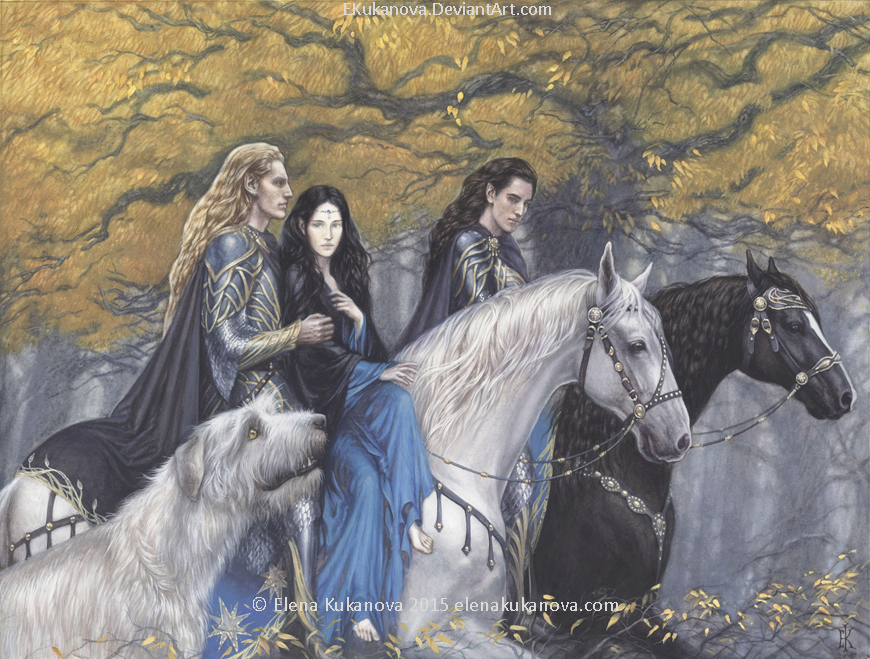
celegorm_and_curufin_finds_luthien_by_ekukanova-d9at902.jpg
 
Celegrm and Curufin almost seem like a case of folie à deux to me. Usually when they got together they had a delusion that they were entitled to do anything for status and even get away with it - even kidnapping the princess of Doriath and completely ignoring Finrod being in life danger in hopes of a coup in Nargothrond.

Curufin was told to be the one who's most like his father in skill etc. That was passed on to Celebrimbor, though he strongly disagreed with Curufin's actions.

Maedhros probably was the natural leader of the pack as the eldest and kept them all in line when he could, and also one of the most level headed, so maybe Fëanor saw something like Nerdanel in him. I don't know what he thought about the Maedhros' friendship with Fingon, since he had first resented Fingolfin, then sworn being brethren with him and finally betraying him by abandoning his whole family (save Anairë) on the ice.

He most likely was fond of Amrod and Amras too since he took them with him - against Nerdanel's wishes though which was cruel to her.
 
Sorry I haven't been active in my own thread (I've been away), but these are all interesting ideas, and I agree it does seem like Fëanor didn't care much (in a compassionate way) for his sons, and in particular the idea that Fëanor is a narcissist, which would be odd considering how few elves seem to have any faults whatsoever, though a very interesting thought nonetheless.
 
Last edited:
It was just a glimpse of thought, nothing conclusive. At least if he was a human someone would call him a narcissist, but Elves do have a higher resistance to their own flaws.

Finwë was very obsessed over getting more children which is one reason why he chose Indis (who again had such a crush in Finwë that she would not marry anyone else). But in the end he clearly favoured Fëanor over the two daughters and two sons he had with Indis.

I would say that the similarities between the two are that both really, even desperately wanted to be fathers yet neither necessarily deserve "father of the yéni" award because of everything that transpired. That's why Mandos was satisfied that Finwë declared that he would stay in his Halls, because he woudn't have let him out anyway (ouch).

Míriel in her turn regretted that she wasn't there for Fëanor, but she was was glad that Indis' children exist, because they could undo the hurt that Fëanor had caused.
 
Something else I've found interesting would be if that somehow Míriel survived, would Fëanor still have turned out the same way, and still created the Silmarils, or would his mother turn him from the dark path Morgoth led him down?
 
It wasn't really the matter of "survival" in the case of Míriel. She could have been re-embodied if she so wanted but she chose to stay in Mandos.

There's also a story in HoME where she changes her mind (related to Finwë wanting to stay in Mandos for the dilemma of two wives) and returns to the same body that was preserved. But she didn't find her life the same and returned to Mandos in her living body and then chose to serve Vairë who had been steadfast in defending her when the Valar were debating about her.

So Míriel in her living body and Finwë and Fëanor as spirits, not wanting or able to leave Mandos. Talk about a strange, bittersweet family reunion.
 
Really interesting question, I think Fëanor did love his sons in a certain degree but they were probably not his priority.

But in the end he clearly favoured Fëanor over the two daughters and two sons he had with Indis.

I have a big doubt now but I thought Finwe had only 2 sons with Indis ? Or did I misunderstood you sentence ?
 
It has been far too long since I read the Silmarillion, I can barely remember all of these things (let alone the stuff from HoME), I'll probably re-read it after I'm finished with Otherland.
 
Many Tolkien fan would consider Findis, Írimë and Argon as canon, because there's really nothing to deny their existence either.
 
I think Fëanor was very fond of his sons. The love between Fëanor and his father Finwë was extremely strong.

Children learn to love from their parents. Teaching children to love is one of the most important, if not the most important lesson parents give their children. Míriel Serindë can be criticized for her “abandonment” of Fëanor and Finwë, but perhaps in her heart of hearts, she foresaw what would become of her only child, and could not bear to watch it happen. I believe I recall that her weariness of life and her abandoning her hröa was a sign of Arda Marred.

It wasn’t children Finwë craved: it was the companionship of a wife. Even in death, the Elves could be reunited within the bounds of Arda with their loved ones: the Valar could release them from Mandos and re-embody them. Míriel refused re-embodiment: she did not have the heart to go on. The Valar relented in the marriage of Finwë to Indis because Finwë was deprived of his companion.

From such parents Fëanor must have learned to love. He loved Nerdanel, who was wiser than he, in part because he recognized her wisdom, in addition to her skill and knowledge, which he admired. He was jealous of his father’s love, a sign of possessiveness, a flaw in his that took root and grew until it finally destroyed him and all his family.

We sometimes recall in our observations and speculations that the ill luck of Túrin Turambar and his family was due to the singular malice of Morgoth toward Húrin and his children. The whole of the short, sad life of Túrin took place in only 35 years. But Fëanor was exposed to the malice of Morgoth for far, far longer during the Years of the Trees: thousands of years of the sun, if I understand matters correctly. Subtly and slowly Morgoth twisted Fëanor’s thinking on Arda and the Valar during Morgoth’s long sojourn in Valinor. He concentrated upon and nurtured that possessiveness in Fëanor’s personality.

Of the Sons of Fëanor, we are told that Curufin was his father’s favorite, most like his father in mind and body. The great skill in craftsmanship was passed through Curufin to his son Celebrimbor; if there were other grandsons of Fëanor in Middle-earth, we are not told of them.

Another matter to consider is his twins and their names. Fëanor gave each son his own name. Nerdanel gave the twins the same name, and it seems odd to me that she did not at first distinguish them from one another. When Fëanor insisted she give the boy his own amilessë (“mother-name”), she called him “Umbarto” (“Fated”), which disturbed Fëanor so much that he dared to alter it to “Ambarto” (“Upwards-exalted”). Amras Ambarto was aboard ship when his father Fëanor burned the stolen ships of the Teleri at Losgar. Fëanor concealed his dismay at the death of his youngest son in a show of false bravado; but bravado is a mask to hide behind.

Finally this, too: If Finwë and Míriel taught Fëanor to love, Fëanor and Nerdanel taught their sons, too: and the Sons of Fëanor loved and admired their father in return. They followed him into ill deeds and exile. Was it foolish? Yes, certainly, and all the evil they committed in his name even more so. But they did this out of love and loyalty to their father: love and loyalty returned to one who loved them. No question that they inherited also their father’s possessiveness in varying degrees, though at the end, Maglor begged Maedhros to forego the Silmarils wrested from Morgoth by the Host of the West, and was constrained only by his elder brother’s bond to their Oath, an ill-twisted sense of nobility in Maedhros to commit an act Maglor deemed unnecessary and wicked.

But I am afraid Valandil’s observation is likely correct: As Fëanor’s possessiveness consumed him, I wonder if he did not come to see his sons as extensions of himself; while his father Finwë saw all his children as independent persons whom he loved, even if his clear favorite was his eldest, Fëanor.

Over and over Tolkien condemns possessiveness. Fëanor is a prime example of how possessiveness can destroy even the very best people. Many times, Tolkien tells us that Fëanor was the greatest of all the Noldor, and that is much to say. Morgoth was possessive and selfish, so much so that when he could not solely possess Arda, he sought to ruin and destroy it entirely. Gollum is another exemplar of possessiveness, his withered mind and body the result of his enslavement to the Ring. For that is what possessiveness is: slavery to a thing, perhaps even to another person through that thing, as became of the Nazgûl. Into the mouth of Aragorn Tolkien puts his observation on possessiveness : “One who cannot cast away a treasure at need is in fetters.”

Fëanor was in fetters, and the chains on his mind and heart affected even his sons and his love for them. Love hopes and seeks the best for others: But the seven Sons of Fëanor came all to sad and shameful ends.
 
Last edited:
Painfully screaming in desperation:

'But how shall our voices reach to Ilúvatar beyond the Circles of the World? And by Ilúvatar we swore in our madness, and called the Everlasting Darkness upon us, if we kept not our word!. Who shall release us?'
 
Painfully screaming in desperation:
The answer would appear to be Varda. She's the one who blessed the Silmarils so they would recognize if the hands that bore them were doing the work of evil, and thus would burn them. That's how Maedhros and Maglor knew that their oath was void.

She's one of the few that ever affected the Silmarils: Yavanna, Nienna, Fëanor and then Varda. So the credits over them don't belong to Fëanor only. Perhaps that's why Varda had a say on their fate.
 
'why should we longer serve the jealous Valar, who cannot keep us nor even their own realm secure from their Enemy? And though he be now their foe, are not they and he of one kin? Vengeance calls me hence, but even were it otherwise I would not dwell longer in the same land with the kin of my father's slayer and of the thief of my treasure
zealotry_g.jpg

'Here once was light, that the Valar begrudged to Middle-earth, but now dark levels all
AEldredIanMiller2180.jpg
 

Today's events

Similar threads

Back
Top