Radaghast
Well-Known Member
- Joined
- May 31, 2021
- Messages
- 2,851
In the book, the Moria chapters are probably my favorite in the entire book. Among other reasons, it's nice to see the whole Fellowship together in action and, as a consequence, it's sad to have to see them break up. This is also one sequence that didn't really need to be changed much at all. But it has been changed, quite a bit. And I feel the movie flubs it, and rather badly. Movie fans might love it, but for me, the flaws just leap out. So I wanted to make a post focusing on these flaws and how they correspond to the book. I dunno, maybe I'm being pedantic here, but it's something I kind of wanted to get out of my system for a while now.
Anyway, without further ado, here's an itemized list of things that I think are wrong with the film sequence along with comparisons to the far superior book sequence. These points all refer to the theatrical cut. I've not seen any special or extended editions:

Anyway, without further ado, here's an itemized list of things that I think are wrong with the film sequence along with comparisons to the far superior book sequence. These points all refer to the theatrical cut. I've not seen any special or extended editions:
- First of all, even the reasons for going into Moria differ between book and film. In the book, Gandalf argues for going through Moria, correctly reasoning that there are no other safer options. The decision to go through Moria is forced when the Fellowship hear the howling of wargs not very far off. In the movie LotR: FotR, Gandalf fears Moria — because he somehow already knows there is a Balrog there — but when the Fellowship are foiled at Caradhras, he is shown to be indecisive and leaves the decision entirely to Frodo (way to exhibit leadership there, brah!). The wargs are left out of the first film, and transplanted to the next. Thus, a potentially awesome sequence and a chance for Gandalf to display some wizardry is left on the cutting room floor for reasons I can't even begin to fathom. Of course, in the next film, the wargs look nothing like wolves and are in a scene that doesn't occur in the book. Anyway, moving on...
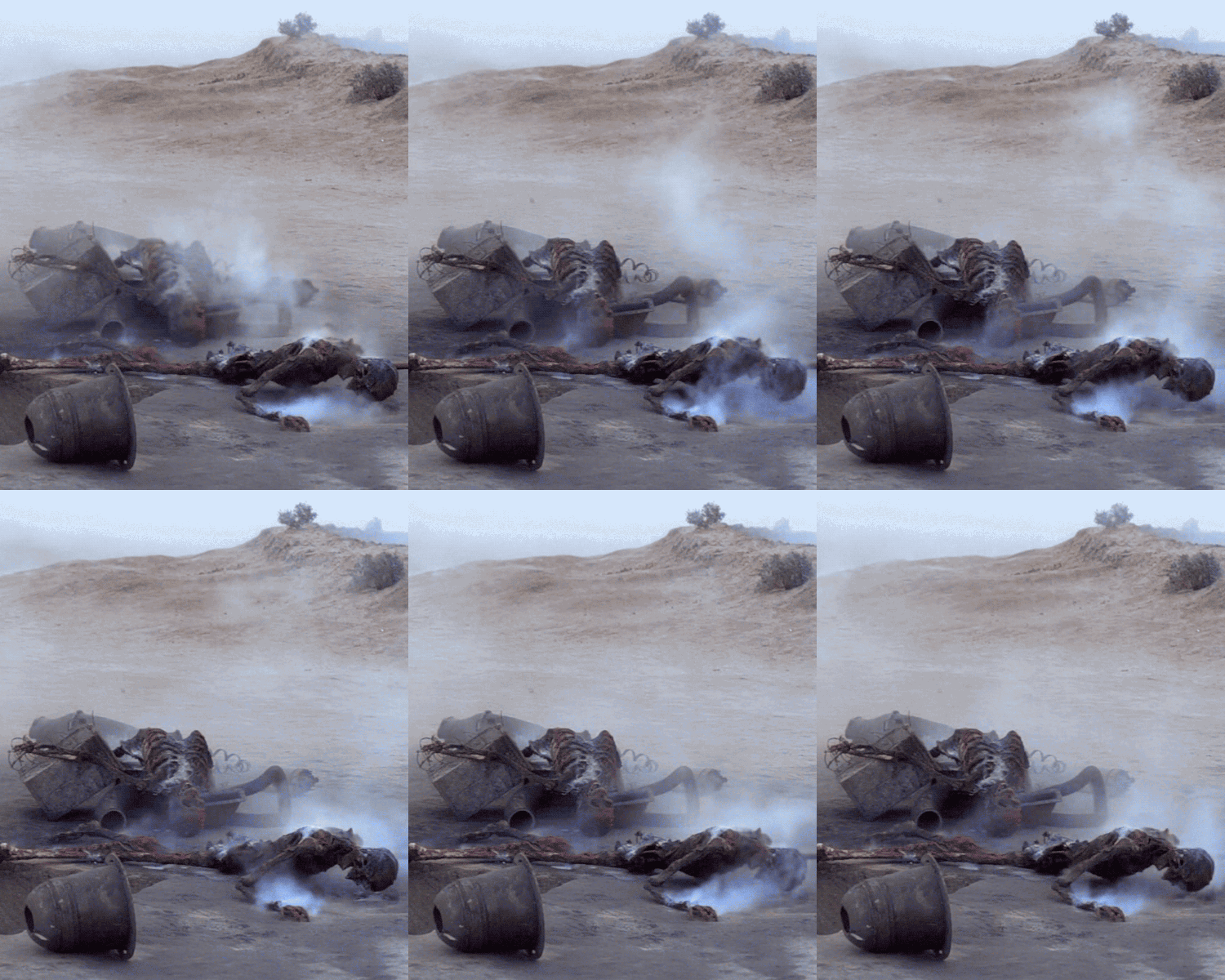
- In the script, I don't see the attempted colonization of Moria by Balin mentioned anywhere, so this whole thing with Gandalf reading from the book found in the Chamber of Mazarbul seems like it would come out of nowhere to one who has never read The Lord of the Rings. And, going further back a bit, that Gimli thinks that there would be "roaring fires, beer and red meat on the bone" might seem completely stupid to anyone who has read LoR. But, I guess in this alternate universe, Balin really did have a colony there? And with all that good stuff Gimli mentions? So, does this mean in this alternate take the dwarves only recently disturbed the Balrog? If so, how does Gandalf know about it? And how are the dwarves reduced to skeletons so quickly? Or did the screenwriters just honestly not know what they were doing? Whatever the case, I'm confused and I can't see the rationale for any of the changes here. Some insight and clarification here would be much appreciated.
- Next, we come to Pippin and the well. In the book, he drops a stone. In the movie, it's an armored skeleton attached to a chain wrapped around a bucket, for some reason. For some other weird reason, Pippin has to twist the bolt or arrow sticking out of it. Also, in the book, the dropped stone isn't immediately followed by the attack by orcs. The Company treks for quite a while between Pippin's stone and the attack in the Chamber of Mazarbul, and it's never even that clear that Pippin's stone is what alerts the orcs to the party. I don't have a problem with the film condensing this. I do have a problem with the movie 'upgrading' the stone with a suit of armor and making Pippin look even more like a dipwad than he's already been shown to be to this point. It's a relatively minor complaint but I wanted to be thorough as possible.
- The orcs attack after the skeleton falls down the well. There is a prolonged fight in which everyone fights. Everyone, that is, except Frodo, the principle character in the book. Sam, in particular, seems eager to show his mettle, and is able to dispatch orcs with ease with his frying pan (leading me to wonder why we should be concerned if orcs can be dispatched with hobbit-sized cookware). Frodo is less eager. When he does fight, he is defensive at best, and runs whenever possible. Granted, it's a troll he's running from, so it's somewhat understandable, but the impression of cravenness he gives off is, for me, hard to not see; like it's something Peej wants to emphasize. Frodo even calls out to Aragorn for help. To me, it just comes off as a little, I dunno...pathetic? I honestly don't see the reason for making Frodo to be a useless wuss in this movie. Finally, the troll impales him, or seems to. Frodo passes out, and it's at this moment that the fight comes to a dead stop. The timing is just impeccable and convenient. Every last orc in the room has been slain and the party has time to gasp at the apparent death of Frodo and then mourn...until he comes to and they discover he is okay... aaand there isn't a mark on him, thanks to his mithril shirt. This is nonsense, but more on that later. Finally, though, the timeout the orcs have gracefully granted is over and the next orc sortie approaches the chamber, causing the Fellowship to finally flee.
- In the book, Frodo actually takes the troll out of the fight by stabbing it in the foot. The fight is not so long as the Company flees the Chamber as soon as they are able. Actually, that first battle is described in one paragraph:
How many there were the Company could not count. The affray was sharp, but the orcs were dismayed by the fierceness of the defence. Legolas shot two through the throat. Gimli hewed the legs from under another that had sprung up on Balin’s tomb. Boromir and Aragorn slew many. When thirteen had fallen the rest fled shrieking, leaving the defenders unharmed, except for Sam who had a scratch along the scalp. A quick duck had saved him; and he had felled his orc: a sturdy thrust with his Barrow-blade. A fire was smouldering in his brown eyes that would have made Ted Sandyman step backwards, if he had seen it.
- The Lord of the Rings, "The Bridge of Khazad-Dhûm"
- An "almost man-high orc-chieftain" then enters the Chamber, stabs Frodo with a spear and pins him against a wall before the orc his felled by Aragorn, who picks up the unconscious Frodo as they all flee. Frodo shortly comes to and tells Aragorn that he is okay and to let him down. This might not offer the opportunity to milk as much drama as humanly possible, but it sure makes a heck of a lot more sense and there would be ways to dress it up a little. Also, it would make the action more frenetic, a definite plus, I think. Anyway, later, after the party has escaped Moria, we see that the spear-thrust was turned by Frodo's armor, but it still left a "blackened bruise", and that the rings of the shirt had been driven through a leather coverlet "into the flesh." This is in stark contrast with Frodo bearing a full-on thrust with a spear wielded something nearly the size of an elephant and not suffering so much as a scratch. Apart from this not making any physical sense — a mithril chain shirt would not prevent the wearer from, say, being bludgeoned to death let alone prevent any injury — if movie-Frodo suffered no harm whatsoever why does he make that "Oh, doodie, I'm dead" face after he is seemingly impaled? And if an orc not quite as tall as a man could drive steel rings through leather to inflict the flesh, what might a much-taller-than-a-man troll do? Did Peter Jackson actually read the book or just skim through the Cliffs Notes?
- The party is surrounded by orcs and it seems they're done for. Even if the orcs are incompetent, they're just too many. But then the orcs perk up and hear something in the distance, and they all flee. Gimli laughs, assuming they are running from them (Peter Jackson can't seem to resist the urge to make Gimli look like a fool, I guess). Also, it turns out, they can climb surfaces like roaches, an ability not seen before or since. I guess it's to make them seem more threatening. But after we see their kryptonite seems to be frying pans, the effort seems lost. Anyway, as it turns out, that they're fleeing from the Balrog. So, doesn't that make the approach of the Balrog actually rather...fortuitous? Even in consideration of incompetent orcs?
- The party flees the Chamber, then hear the (timely) approach of the Balrog. They then stand there for a full 46 seconds (not counting the time it takes the orcs to sense the Balrog's coming) before Gandalf finally pulls his proverbial thumb out of his proverbial backside and tells them to run. 46 seconds is a substantial slice of time to get a head start on the still unseen and slowly approaching Balrog, but the Fellowship just waste it standing there staring. This might build tension at the moment, but after all is said and done it just fails to make any logical sense. Also, at any point during this lengthy pause, orcs could have shot at them from behind pillars and whatnot (they probably would have missed, badly, but at least it wouldn't have been for lack of trying).
- Gandalf tells Aragorn to "lead them on. The bridge is near." Okay, call me pedantic if you will, but this line is out of place. In the book, Gandalf says this because he stays behind to try to keep the Balrog from following them. In the movie, Gandalf doesn't stay behind. To make this even more ridiculous, Aragorn seems to want to push past Gandalf to fight the Balrog, then is shocked when Gandalf pushes him back. WTH? Why is Aragorn trying to go against Gandalf's orders? Why is Gandalf even giving him orders when he hasn't split with the group? He could have just said, "There's the bridge! Keep going!" Done. Stop trying to follow the book when it doesn't make sense to, FHS.
- "The bridge is near". Well, near enough. It is also on a level with where they currently are as clearly seen in the screen grab below, which shows Gandalf and Aragorn's point of view. So, why then do the Fellowship then descend several sets of stone stairs to get to the bridge? I've looked at this scene a bunch of times and still can't make heads nor tails of it. Can someone shed any light? Or is this something the filmmakers inserted later to try to draw more action out of the sequence and/or to give tribute to the Indiana Jones franchise?
- Does this collapsing stairs scene add anything in particular to the film? Or does it just serve to make the orcs look even more incompetent? Seriously, they can't hit any of the Fellowship while they're vulnerable and moving relatively slowly while trying not to fall off a collapsing stone staircase, while Legolas can shoot them right between the eyes when they have cover and are in almost total darkness. I'm sorry, but it's just too ridiculous for me to accept. I just...can't.
- As the party descends, the stairs crumble behind them. It's implied that the pursuing Balrog is what's causing this destruction. But if the stairs are crumbling behind them, how then is the Balrog following them? We know those wings (which it shouldn't have because the Balrog does not actually have them in the book) are useless and that it can't fly, so what's the deal? It is also nowhere in sight when the Fellowship are on the stairs. The crumbling stairs look incredibly fake to me, incidentally; they strongly put in my mind the impression of styrofoam.
- Did anyone in the audience actually fear that any of the Fellowship would fall? Please, these are just fake thrills and a massive waste of time, time that could have been better spend elsewhere, such as Gandalf's firestorm against the Wargs.
- The Balrog then magically appears behind the Fellowship just before they are about to cross the bridge. Again, this doesn't add up with the crumbling stairs, nor does it jive with the slow pace of the Balrog. Even with 46 seconds spent gawping in its direction, the party still seems like they should have had a good head start.
- In the film, after Gandalf causes the Balrog to fall into the chasm, its whip wraps about his legs and he stumbles and clutches the edge of the abyss. Only, the whip doesn't stay wrapped around his legs. So, Gandalf just lets go for...no visible reason whatsoever. Why? Just...why? Of course, in the book the whip attached to the weight of the Balrog is what drags Gandalf down. So, once again, on the one hand we have nonsense, and on the other, perfect sense.
Last edited:
 At first I was impressed by the cinematography and casting (especially