• Welcome to The Tolkien Forum! Connect with fellow Tolkien enthusiasts and join a community that is over two decades old, and still going strong. We look forward to meeting you.  Register

📖👀 Chapter 5 (📔Book IV): The Window on the West

📖👀 LOTR Reading Project

Rivendell_librarian

Active Member
Joined
Aug 19, 2018
Messages
770
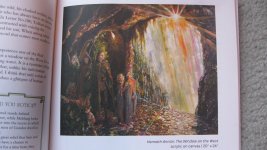
There is not much action in this chapter but it is a substantial chapter nonetheless. Faramir, his Rangers, Frodo and Sam move from the circular pool to a secret hideout closer to the Anduin. The impression that the Rangers are a disciplined, well led and well organised force is reinforced as they are instructed to make the move in small groups flanking the main group led by Faramir and including the hobbits. Frodo and Sam arrive in time to see the beauty of the "Window on the West" which is a curtain of water from a waterfall across the cave entrance illuminated by the setting sun. This is another instance of a reminder of The Last of the Mohicans which was not in Tolkien's library according to Oronzo Cilli but surely is the kind of book a schoolboy Tolkien would read.

This is another example of a period of hospitality and food following a sequence of chapters of movement and action. Isn't Tolkien rather Dickensian in his dwelling on the details of meals partaken as we see the well organised Rangers produce a more than passable meal in such rough and ready circumstances? There is the question of bread again, but they could easily have the use of a stone grinder and an oven might be contrived to not emit easily visible smoke. Butter and cheese could be stored in a suitable cold store in the cave as could the pale yellow wine. The west side of the Anduin (Anorien) was still occupied by Gondor and so likely to still have working farms which could send supplies over the river. That would not be without risk, so this could be an example of some of the unsung heroes of the War of the Ring. We read about a quasi religious ritual as the Rangers spend a silent moment facing the West (the direction of Numenor and Elvenhome) before eating.

There is quite a lot of background about the history of Numenor, Gondor and Rohan, and we learn a bit more about the visits of Gandalf to Minas Tirith. Faramir gives an Arthurian account of his seeing the dead Boromir in his funeral boat. Faramir makes the correct inference that this means that some of the Fellowship survived the attack that killed Boromir despite Frodo's pessimism. There is a well described moment of tension after Sam gives the game away about the Ring and he and Frodo back up against the wall of the cave and reach for their swords. The Rangers fall silent but the moment passes as Faramir passes the test that was beyond his brother. For me, the main interest lies in what we learn about the two brothers and their relationship.

The relationship between siblings is for many people their longest relationship and sibling rivalry is a feature of common experience. Boromir and Faramir are alike yet not alike. Faramir knows Boromir's weaknesses as well as his strengths and perceives that Boromir would have tried to take the Ring from Frodo. We get the impression of a strong, brave yet overly ambitious Boromir who being older and stronger would have usually outmatched Faramir in their youthful sparring, whereas Faramir would trail after Gandalf on his visits seeking understanding from him. Gandalf was reticent with him (too preoccupied?). Faramir says "I have had teaching" but was this from someone else? What is described is the more cautious wiser Faramir in contrast with the rasher Boromir. Faramir is a man who prefers peace to war and is clearly held in great respect by his Rangers. Faramir wonders about the Shire - "a realm of peace and content" where "gardeners must be in high honour". Did Faramir ever visit the Shire?

At the end of the chapter Sam tells Faramir he has the air "of Gandalf, of wizards". Is this the air of Numenor, or something intrinsic to Faramir himself?
 
Last edited:
There is not much action in this chapter but it is a substantial chapter nonetheless. Faramir, his Rangers, Frodo and Sam move from the circular pool to a secret hideout closer to the Anduin. The impression that the Rangers are a disciplined, well led and well organised force is reinforced as they are instructed to make the move in small groups flanking the main group led by Faramir and including the hobbits. Frodo and Sam arrive in time to see the beauty of the "Window on the West" which is a curtain of water from a waterfall across the cave entrance illuminated by the setting sun. This is another instance of a reminder of The Last of the Mohicans which was not in Tolkien's library according to Oronzo Cilli but surely is the kind of book a schoolboy Tolkien would read.

This is another example of a period of hospitality and food following a sequence of chapters of movement and action. Isn't Tolkien rather Dickensian in his dwelling on the details of meals partaken as we see the well organised Rangers produce a more than passable meal in such rough and ready circumstances? There is the question of bread again, but they could easily have the use of a stone grinder and an oven might be contrived to not emit easily visible smoke. Butter and cheese could be stored in a suitable cold store in the cave as could the pale yellow wine. The west side of the Anduin (Anorien) was still occupied by Gondor and so likely to still have working farms which could send supplies over the river. That would not be without risk, so this could be an example of some of the unsung heroes of the War of the Ring.

There is quite a lot of background about the history of Numenor and Gondor, and we learn a bit more about the visits of Gandalf to Minas Tirith. There is a well described moment of tension after Sam gives the game away about the Ring and he and Frodo back up against the wall of the cave and reach for their swords. The Rangers fall silent but the moment passes as Faramir passes the test that was beyond his brother. For me, the main interest lies in what we learn about the two brothers and their relationship. (to be continued)
"'I would not snare even an orc with a falsehood.' said Faramir."
Quite rude to the Orcs, plus a little bit po-faced of Faramir here, who isn't one of my favourite characters. He seems a little anodyne for my tastes, perhaps deliberately so to highlight the contrast with Boromir?

The fact that the ring seems to have almost zero temptation for him doesn't really make a lot of sense here either; we've seen again and again how the really powerful figures in the tale are scared to even touch the ring yet Faramir seems able to almost dismiss it out of hand?

'Many are my names in many countries, he said. Mithrandir among the Elves, Tharkun to the Dwarves; Olorin I was in my youth in the West that is forgotten, in the south Incanus, in the North Gandalf; to the East I go not'. How much history is involved here that we will never know!
 
The fact that the ring seems to have almost zero temptation for him doesn't really make a lot of sense here either; we've seen again and again how the really powerful figures in the tale are scared to even touch the ring yet Faramir seems able to almost dismiss it out of hand?
Gandalf has been to Minas Tirith many times, and (book) Faramir seems, by temperament, to have been something like (book) "Aragorn junior". Not being the heir also probably helped keep him away fro obsessing about power, like his father and older brother.

RotK, Book Five, chapter IV "The Siege of Gondor" p. 821 has the following said by Denethor (Faramir has just returned from Henneth Annûn):
"See, you have spoken skilfully, as ever; but I, have I not seen your eye fixed on Mithrandir, seeking whether you said well or too much? He has long had your heart in his keeping."

This is the part I would love, using a very sturdy one-volume hardback, to batter PJ about the head with for ... I dunno ... about half an hour? 😈
Faramir very probably had been instructed by, and had understood, Gandalf, while pa and bro very likely had done neither.
And Frodo and the One Ring were near Faramir for less than one day.
What
is
the
friggin'
problem???
 
Gandalf has been to Minas Tirith many times, and (book) Faramir seems, by temperament, to have been something like (book) "Aragorn junior". Not being the heir also probably helped keep him away fro obsessing about power, like his father and older brother.
Faramir actually says of Gandalf:
'I first saw him when I was a child, and he has been twice or thrice since then'. I'm not sure how much actual contact/teaching Gandalf would have given Faramir all in all, as he himself says further in the chapter:
'Mithrandir never spoke to us of what was to be, nor did he reveal his purposes...I learned a little of him, when he would teach (and that was seldom)'.
RotK, Book Five, chapter IV "The Siege of Gondor" p. 821 has the following said by Denethor (Faramir has just returned from Henneth Annûn):
"See, you have spoken skilfully, as ever; but I, have I not seen your eye fixed on Mithrandir, seeking whether you said well or too much? He has long had your heart in his keeping."
Hasn't Denethor by this time been pretty much ensnared by Sauron through his use of the Palantir?
'The Pyre of Denethor': 'the vision of the great might of Mordor that was shown to him fed the despair of his heart until it overthrew his mind'

I think PJ did a decent job with the rather dull Faramir (though I do have a low threshhold when it comes to the movie trilogies); the material he has to work with has always seemed stilted and one-dimensional.

And Frodo and the One Ring were near Faramir for less than one day.
Smeagol was near the ring for a heartbeat and he committed murder to get it.
Gandalf physically recoils when Frodo offers him the ring in 'The Shadow of the Past".
To have Faramir basically just ignore this hugely powerful artefact seems a little odd, to say the least.
 
You seem to be judging the characters (and more) as though they were 20th/21st century contemporaries. That would be a mistake even with books of the 19th century to perhaps 1918 (which some historians see as the true end of that century), never mind earlier.
JRRT's sources of inspiration were mainly (not exclusively) much older. His own invention, the Hobbits, were modeled on late 19th century rural England, the Shire the most "modern" (and anachronistic) society in Middle-earth. Any characters that show modernity in form of speech - Smaug, Saruman - or in nature-destroying industrialism - Saruman again, much more hugely so Sauron, in a small way the Master of Laketown and Ted Sandyman in the Shire - are invariably shown as evil.
No question that PJ tried to "modernize" - perhaps more correctly "filmify" - the books. Parts of his changes are simply forgeries. Audiences (including critics) unfamiliar with the books - and some familiar with them - might consider PJ's film trilogy a pinnacle of blockbuster fantasy. I retain my opinion that it could have been far worse, as it undoubtedly would be should filming begin now, 25 years later. I continue to consider the films to be far below the books. Much of it is due to the nature of film, needing to simplify, too often dumb down intricacies. But that still leaves quite a bit that's PJ's own personal fault, his personal decisions.
 
Rather like The Shadow of the Past this chapter provides much background information but also provokes a few questions as well, as the above discussion shows. Why are the human Aragorn and Faramir able to avoid the temptation to obtain the Ring by force? I like the idea of Faramir as a junior Aragorn. He is certainly a southern Aragorn leading a band of Rangers to protect Gondor's eastern borders as Aragorn is a Ranger (the leader?) who protects the good peoples of Eriador.

Who was it who "taught" Faramir if not Gandalf who was there only a few times and was quite reticent? How did Gandalf persuade Denethor to give him access to the archives? Had Faramir ever visited Lorien, and if not who from Gondor did?
 
There is not much action in this chapter
Not much action? Don’t forget about the Battle of The Fiery Hobbit (the Dagor Samollach):

These last words were more than he could bear…’See here, Captain!’ He planted himself squarely in front of Faramir, his hands on his hips, and a look on his face as if he was addressing a young hobbit who had offered him what he called ‘sauce’ when questioned about visits to the orchard…
 
Last edited:
Any characters that show modernity in form of speech - Smaug, Saruman - or in nature-destroying industrialism - Saruman again, much more hugely so Sauron, in a small way the Master of Laketown and Ted Sandyman in the Shire - are invariably shown as evil.
Agreed. Saruman goes a long way to destroying the idyllic (idealised?) Shire in the name of 'progress'; but I really wouldn't see Sandyman in the same league - he is an unpleasant character who gives in to his worst characteristics, but I'd say he is more weak than fully-blown evil?
I continue to consider the films to be far below the books. Much of it is due to the nature of film, needing to simplify, too often dumb down intricacies. But that still leaves quite a bit that's PJ's own personal fault, his personal decisions.
I honestly think PJ is a huge fan of the books, so I woud say that the films are very different from the books, and not far below. As you say, film is very different from literature, so there are limitations in the medium that no one could escape.
After that, I regard the fims as basically fanfic on a grand scale; the stuff I don't like I ignore, the stuff I like I really look forward to. I never really conflate book and film, so I have no serious problems in either medium.
 
Why are the human Aragorn and Faramir able to avoid the temptation to obtain the Ring by force? I
I like the idea that the ring has an affect on individuals; Aragorn, with his travails in the wild, seems more cautious and guarded as to what he will have to deal with. Faramir seems to almost ignore the ring altogether, which makes him, to me at least, a difficult character to engage with. Is he there to contrast with other characters (Aragorn and Boromir?)
 
The contrast I see:

Aragorn - born to hold power and position, but to a degree, wary of it knowing it must come in its time. The ring COULD be a danger to him because he is a powerful figure, yet overall, it has very little impact on him. He is schooled and aware of its dangers, and focused on the good of all free peoples.

Boromir - born to power, destined to wield it in a limited sense, ready to grasp it at the earliest opportunity, and prepared to both protect and increase that power by whatever means to achieve the goals set before him. There is a slight 'darkness' to him in a sense perhaps, given his singular focus on his own people. A much more limited view than Aragorn's. Thus, the ring is a danger to his inherent nature and character, and he is unable to resist its pull on him.

Faramir - not born to power, fully satisfied with his lot in life, with no aspirations other than to be good at what he does on behalf of the people in his assigned position(s) and sphere of influence. Thus he has no 'inherent' or obvious darkness upon which the ring can quickly work. Faramir is somewhat a representative of 'everyman,' working to be and do the best he can with what he has. A rather humble member of a powerful family, with rather good prospects and a sense of purpose, proud of his heritage and seeking to uphold the good name of his family - and no more.

Gollum - inherently dark of character already, opportunistic, a ripe victim for the ring, thus succumbs immediately to its pull.

Frodo - no real aspirations at all, fully satisfied with food and drink and a bit of cheer. The 'everyman' who is born, lives, and dies, with no real plan or purpose other than to enjoy life along the way.

Tolkien pictures for us in all his characters, the least, the greatest, every station and position in life along the way, and every shade of 'good and evil' we can find.

The rings reaction to them, and their reaction to the ring, are consistent with the characters.

The most difficult reactions to the ring to interpret, may be those seen among the Orcs... but to be fair, I believe very few of the Orcs in its proximity are even aware of it - save perhaps one (or two).

The greatest struggles with the ring are seen in Galadriel and Gandalf I believe, who have long dealt with their temptations, and only overmaster them with great difficulty.
 
Gandalf has been to Minas Tirith many times, and (book) Faramir seems, by temperament, to have been something like (book) "Aragorn junior". Not being the heir also probably helped keep him away fro obsessing about power, like his father and older brother.

RotK, Book Five, chapter IV "The Siege of Gondor" p. 821 has the following said by Denethor (Faramir has just returned from Henneth Annûn):
"See, you have spoken skilfully, as ever; but I, have I not seen your eye fixed on Mithrandir, seeking whether you said well or too much? He has long had your heart in his keeping."

This is the part I would love, using a very sturdy one-volume hardback, to batter PJ about the head with for ... I dunno ... about half an hour? 😈
Faramir very probably had been instructed by, and had understood, Gandalf, while pa and bro very likely had done neither.
And Frodo and the One Ring were near Faramir for less than one day.
What
is
the
friggin'
problem???

I absolutely love this part:
RotK, Book Five, chapter IV "The Siege of Gondor" p. 821 has the following said by Denethor (Faramir has just returned from Henneth Annûn):
"See, you have spoken skilfully, as ever; but I, have I not seen your eye fixed on Mithrandir, seeking whether you said well or too much? He has long had your heart in his keeping."

This is the part I would love, using a very sturdy one-volume hardback, to batter PJ about the head with for ... I dunno ... about half an hou
r?
 
I wonder why the chapter title is just a bit different from Faramir’s quote ‘This is the Window of the Sunset, Henneth Annun…’. That would have made a nice title as well.

The reverence and terminology associated with the view here compares nicely (IMO) to the Westward view described elsewhere in the story. Examples: ‘grey rain curtain’ versus ‘grey veil of falling water’, ‘window’ versus ‘glass’, ‘white shores’ versus ‘The White Mountains’, ‘silver’ in both, ‘beyond’ in both, etc.

The Window view:
The level shafts of the setting sun behind beat upon it…curtained with threaded jewels of silver and gold…kindled with an unconsuming fire… … …grey veil of falling water… … …’we look towards Numenor that was, and beyond to Elvenhome that is, and to that which is beyond Elvenhome and will ever be’

Elsewhere:
…the grey rain-curtain turned all to silver glass and was rolled back, and he beheld white shores and beyond them a far green country under a swift sunrise.


Henneth Annun: The Window on the West

From 'The Art of Mercy in Middle-earth'
Paintings Inspired by Tolkien's Legendarium
by Miriam Ellis
1774395265080.jpeg
 

Attachments

  • 1774395084469.jpeg
    1774395084469.jpeg
    228.9 KB · Views: 39
Last edited:
Back
Top