Rivendell_librarian
Active Member
- Joined
- Aug 19, 2018
- Messages
- 770
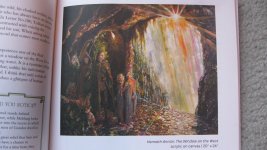
There is not much action in this chapter but it is a substantial chapter nonetheless. Faramir, his Rangers, Frodo and Sam move from the circular pool to a secret hideout closer to the Anduin. The impression that the Rangers are a disciplined, well led and well organised force is reinforced as they are instructed to make the move in small groups flanking the main group led by Faramir and including the hobbits. Frodo and Sam arrive in time to see the beauty of the "Window on the West" which is a curtain of water from a waterfall across the cave entrance illuminated by the setting sun. This is another instance of a reminder of The Last of the Mohicans which was not in Tolkien's library according to Oronzo Cilli but surely is the kind of book a schoolboy Tolkien would read.
This is another example of a period of hospitality and food following a sequence of chapters of movement and action. Isn't Tolkien rather Dickensian in his dwelling on the details of meals partaken as we see the well organised Rangers produce a more than passable meal in such rough and ready circumstances? There is the question of bread again, but they could easily have the use of a stone grinder and an oven might be contrived to not emit easily visible smoke. Butter and cheese could be stored in a suitable cold store in the cave as could the pale yellow wine. The west side of the Anduin (Anorien) was still occupied by Gondor and so likely to still have working farms which could send supplies over the river. That would not be without risk, so this could be an example of some of the unsung heroes of the War of the Ring. We read about a quasi religious ritual as the Rangers spend a silent moment facing the West (the direction of Numenor and Elvenhome) before eating.
There is quite a lot of background about the history of Numenor, Gondor and Rohan, and we learn a bit more about the visits of Gandalf to Minas Tirith. Faramir gives an Arthurian account of his seeing the dead Boromir in his funeral boat. Faramir makes the correct inference that this means that some of the Fellowship survived the attack that killed Boromir despite Frodo's pessimism. There is a well described moment of tension after Sam gives the game away about the Ring and he and Frodo back up against the wall of the cave and reach for their swords. The Rangers fall silent but the moment passes as Faramir passes the test that was beyond his brother. For me, the main interest lies in what we learn about the two brothers and their relationship.
The relationship between siblings is for many people their longest relationship and sibling rivalry is a feature of common experience. Boromir and Faramir are alike yet not alike. Faramir knows Boromir's weaknesses as well as his strengths and perceives that Boromir would have tried to take the Ring from Frodo. We get the impression of a strong, brave yet overly ambitious Boromir who being older and stronger would have usually outmatched Faramir in their youthful sparring, whereas Faramir would trail after Gandalf on his visits seeking understanding from him. Gandalf was reticent with him (too preoccupied?). Faramir says "I have had teaching" but was this from someone else? What is described is the more cautious wiser Faramir in contrast with the rasher Boromir. Faramir is a man who prefers peace to war and is clearly held in great respect by his Rangers. Faramir wonders about the Shire - "a realm of peace and content" where "gardeners must be in high honour". Did Faramir ever visit the Shire?
At the end of the chapter Sam tells Faramir he has the air "of Gandalf, of wizards". Is this the air of Numenor, or something intrinsic to Faramir himself?
This is another example of a period of hospitality and food following a sequence of chapters of movement and action. Isn't Tolkien rather Dickensian in his dwelling on the details of meals partaken as we see the well organised Rangers produce a more than passable meal in such rough and ready circumstances? There is the question of bread again, but they could easily have the use of a stone grinder and an oven might be contrived to not emit easily visible smoke. Butter and cheese could be stored in a suitable cold store in the cave as could the pale yellow wine. The west side of the Anduin (Anorien) was still occupied by Gondor and so likely to still have working farms which could send supplies over the river. That would not be without risk, so this could be an example of some of the unsung heroes of the War of the Ring. We read about a quasi religious ritual as the Rangers spend a silent moment facing the West (the direction of Numenor and Elvenhome) before eating.
There is quite a lot of background about the history of Numenor, Gondor and Rohan, and we learn a bit more about the visits of Gandalf to Minas Tirith. Faramir gives an Arthurian account of his seeing the dead Boromir in his funeral boat. Faramir makes the correct inference that this means that some of the Fellowship survived the attack that killed Boromir despite Frodo's pessimism. There is a well described moment of tension after Sam gives the game away about the Ring and he and Frodo back up against the wall of the cave and reach for their swords. The Rangers fall silent but the moment passes as Faramir passes the test that was beyond his brother. For me, the main interest lies in what we learn about the two brothers and their relationship.
The relationship between siblings is for many people their longest relationship and sibling rivalry is a feature of common experience. Boromir and Faramir are alike yet not alike. Faramir knows Boromir's weaknesses as well as his strengths and perceives that Boromir would have tried to take the Ring from Frodo. We get the impression of a strong, brave yet overly ambitious Boromir who being older and stronger would have usually outmatched Faramir in their youthful sparring, whereas Faramir would trail after Gandalf on his visits seeking understanding from him. Gandalf was reticent with him (too preoccupied?). Faramir says "I have had teaching" but was this from someone else? What is described is the more cautious wiser Faramir in contrast with the rasher Boromir. Faramir is a man who prefers peace to war and is clearly held in great respect by his Rangers. Faramir wonders about the Shire - "a realm of peace and content" where "gardeners must be in high honour". Did Faramir ever visit the Shire?
At the end of the chapter Sam tells Faramir he has the air "of Gandalf, of wizards". Is this the air of Numenor, or something intrinsic to Faramir himself?
Last edited: