• Welcome to The Tolkien Forum! Connect with fellow Tolkien enthusiasts and join a community that is over two decades old, and still going strong. We look forward to meeting you.  Register

a small question about tengwar uses...

fourtwonine

New Member
Joined
Jan 2, 2005
Messages
7
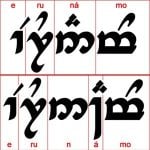
hi, my name is daniel and i've been working with quenya for about a year now - trying to learn to translate and speak... i've been writing quenya with english characters and am (i think) ready to move onto tengwar... to start with, i've tried my name... now, i haven't really found anything that discusses whether or not you can play with tengwar and "make it your own" or if you are bound totally by the rules... i'm attaching an image with two different versions of my name (daniel = erunámo) - the first being what i believe is the correct tengwar and the second being what i'd like to use for visual purposes (to break apart the "n" and the "m" with a vowel carrier)... my question is this: is it okay to do things like this with tengwar and also, have i even translated correctly??? thank you!!!

daniel
 

Attachments

  • different-erunamo.jpg
    different-erunamo.jpg
    18.5 KB · Views: 66
The first is valid, but reads "Erunamo", with a short a.

The second is also valid, actually the more often seen way to write "Erunámo", I would think.
 
can you explain why in the first example the a is short??? how would i make it long??? thanks!!!

i'm so confused on short and long a...

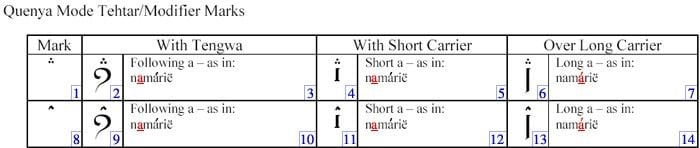
i'm attaching an image from my tengwar book...

it shows the word namárië and different uses of the letter "a"...

can someone help in explaining the boxes on the chart??? i labeled then with numbers (1 thru 14) to possibly make it easier to reference in your reply... thank you in advance for your help...
 

Attachments

  • a.jpg
    a.jpg
    20 KB · Views: 65
fourtwonine said:
can you explain why in the first example the a is short??? how would i make it long??? thanks!!!
Basically you indicated long a by placing the a-tehta on a long carrier in your second example.

'Long vowels were usually represented by placing the tehta on the 'long carrier', of which a common form was like an undotted j. But for the same purpose the tehtar could be doubled. This was, however, only frequently done with the curls, and sometimes with the 'accent'. Two dots was more often used as a sign for following y.' Appendix E

It is also noted that the three dots, most usual in forming writing for a, were variously written in quicker styles, a form like a circumflex being often employed (in Quenya the vowel sign for a was 'often' omitted altogether).

Galin
 
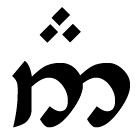
i understand how i indicated the long a in my second example, but why is it that in my first example that it's a short a??? after doing more reading, i still can't get passed thinking that "ná" should be represented as in the image i'm attaching to this image... can you explain why it is wrong???
 

Attachments

  • ná.jpg
    ná.jpg
    3.5 KB · Views: 50
I would say that it 'lacks' indication of length where it's wanted.

In romanized Quenya the acute accent marks length (a is short while á is long). Here it's the acute accent that indicates length; or to say it another way, here the lack of an acute accent indicates a short vowel.

In Elvish writing there are various ways to indicate length. And with respect to the desired scenario here: generally one could double the tehtar to indicate length, but Appendix E notes that this was only frequently done with the curls and sometimes with the 'accent' and etc. ... or, long vowels were usually represented by placing the tehta on a long carrier.

And since you desired a carrier here anyway, and are working with the three dots (a-tehta) this worked out well with respect to transliterating Erunámo.

Galin
so splitting the "ná" syllable is not a bad thing???

...
 
With respect to this example a long carrier happens to work out well, as the vowel is long (and an a). If the vowel had been long o you could have put a curl on a long carrier, for instance, or, if desired, doubled the curl (noting the passage from Appendix E already quoted in the thread).

Tolkien's transcription of the word namárie (The Road Goes Ever On) indeed has three dots (a-tehta) on the long carrier for long a. And his númen and malta look fine together there too ...

:)

Incidentally I intended to reword my reply (posted yesterday, that you quoted) and deleted it before anyone posted (as far as I knew at least).

Galin
 
Last edited:
thank you for your help on this... i'm very excited to learn a new writing system and i'm sure i'll be returning for more support along the way...

thanks!!!

erunámo
 

Today's events

Back
Top