• Welcome to The Tolkien Forum! Connect with fellow Tolkien enthusiasts and join a community that is over two decades old, and still going strong. We look forward to meeting you.  Register

About Wainriders tactics and strategy

Hisoka Morrow

Eastern Anduin Battlefield Commander
Joined
Apr 17, 2020
Messages
854
As you guys have known Wainriders were dreaded for their vehicles.
And why I don't use chariots or wagons these two words?It's simple, these animals-drag stuff were already PROVED USELESS IN FRONT OF CAVALRIES!!!!!! This has been already proved in the warring states period of china. Even in other western military history, animals-drag vehicles were proved mostly useless in very early period even as early as the classical age, unless in special situation like Battle of Samarra where the targets were in low morale(and such"better result" was just still a Pyrryhic win)
Yeah, here comes a big problem, if Wainriders really use antique like chariots or wagons, they're supposed to be sticking ducks before the norsemen, obviously typical nomad ,reasonably to be the nemesis to factions use chariots or wagons as main force. China's warring state, Persia Scythia war, Akexanar's conquest and so on, are the best proof.
So what do you think?Might Wainriders use circle formation like the pilgrims in the Huth's war and the Goths in Adrainopole(AD378)?Or gmith they got early tanks yet Toikein described them via indirect ways?^^
 
As you guys have known Wainriders were dreaded for their vehicles. ...
I'm not sure that's what they were feared for. Wains are big, heavy, slow cargo vehicles, basically. Pretty much useless for warfare, and I don't recall JRRT describing their preferred manner of fighting in any detail, if at all. Perhaps for warfare they did use chariots, though, to use a modern analogy (and stretch it a bit) successful manufacturers of 40-ton trucks aren't known to have produced successful Formula 1 race cars. And as modern reconstructive archaeologist have found, building a chariot that doesn't immediately fall apart with the rough handling to be expected in battle is not easy at all.

As to chariots vs. cavalry, that may be. But at least up to the end of the Bronze age roughly around 1200 BC, chariots were the weapons of choice. Among the first recorded cavalry, as far as I remember, are the Scythians, first appearing in the 7th century BC. So with the first mention of the Wainriders being in 1851 Third Age (over 200 years after the Great Plague, to answer a question from another post of yours), when do we have the first mention of cavalry? The later Rohirrim were closely related to the Northmen of Rhovanion, but that does not necessarily mean that the latter were already a cavalry-based nation. As they at least partly lived in southern Greenwood, that does speak much for cavalry. The Éothéod, direct ancestors of the Rohirrim, moved north in the Anduin vales under their leader Frumgar (Father of Fram, the one who killed the dragon Scatha and made its teeth into a necklace) in 1977 TA, after the Witch-king of Angmar had been defeated and disappeared from the North, and probably Angmar fell into disarray if not ruin, and no longer was seen as a threat. Were the Éothéod already cavalry-based? I can find no definite statement either way. The first to definitely to be defined as cavalry were the Rohirrim under Eorl the Young, coming to the aid of Gondor in 2510 TA and then settling in Calenardhon, which then became Rohan. So over 600 years earlier, like in the real world, there might not have been a cavalry to oppose the Wainriders, if one supposes them to have had chariots.

Just one aside to the supposed superiority of cavalry:
In the Battle of the Golden Spurs or Battle of Courtrai in 1302, Flemish infantry pike-men routed the cavalry of Philip IV of France (also called Philip the Fair, but by all accounts a rather unsavory character - meaning run-of-the-mill for royalty and aristocracy of the time). While Philip ultimately won that 1297–1305 war, the French nobility suffered heavy losses. They were to repeat this, with massively greater losses, against English longbowmen at the battles of Crécy in 1346 and Agincourt in 1415.
 
Last edited:
As you guys have known Wainriders were dreaded for their vehicles.
And why I don't use chariots or wagons these two words?It's simple, these animals-drag stuff were already PROVED USELESS IN FRONT OF CAVALRIES!!!!!! This has been already proved in the warring states period of china. Even in other western military history, animals-drag vehicles were proved mostly useless in very early period even as early as the classical age, unless in special situation like Battle of Samarra where the targets were in low morale(and such"better result" was just still a Pyrryhic win)
Yeah, here comes a big problem, if Wainriders really use antique like chariots or wagons, they're supposed to be sticking ducks before the norsemen, obviously typical nomad ,reasonably to be the nemesis to factions use chariots or wagons as main force. China's warring state, Persia Scythia war, Akexanar's conquest and so on, are the best proof.
So what do you think?Might Wainriders use circle formation like the pilgrims in the Huth's war and the Goths in Adrainopole(AD378)?Or gmith they got early tanks yet Toikein described them via indirect ways?^^

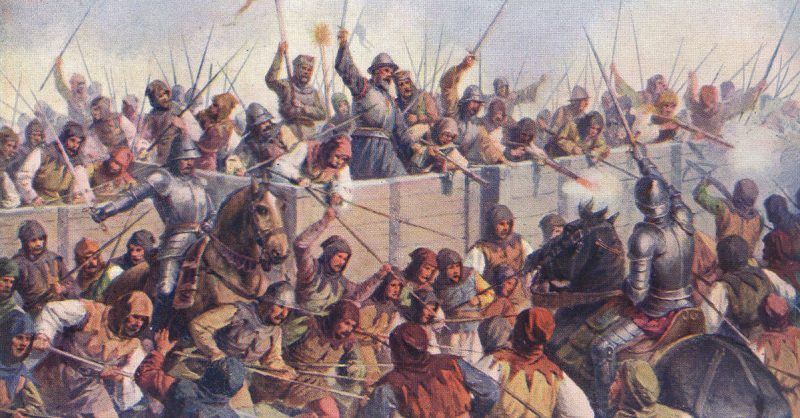
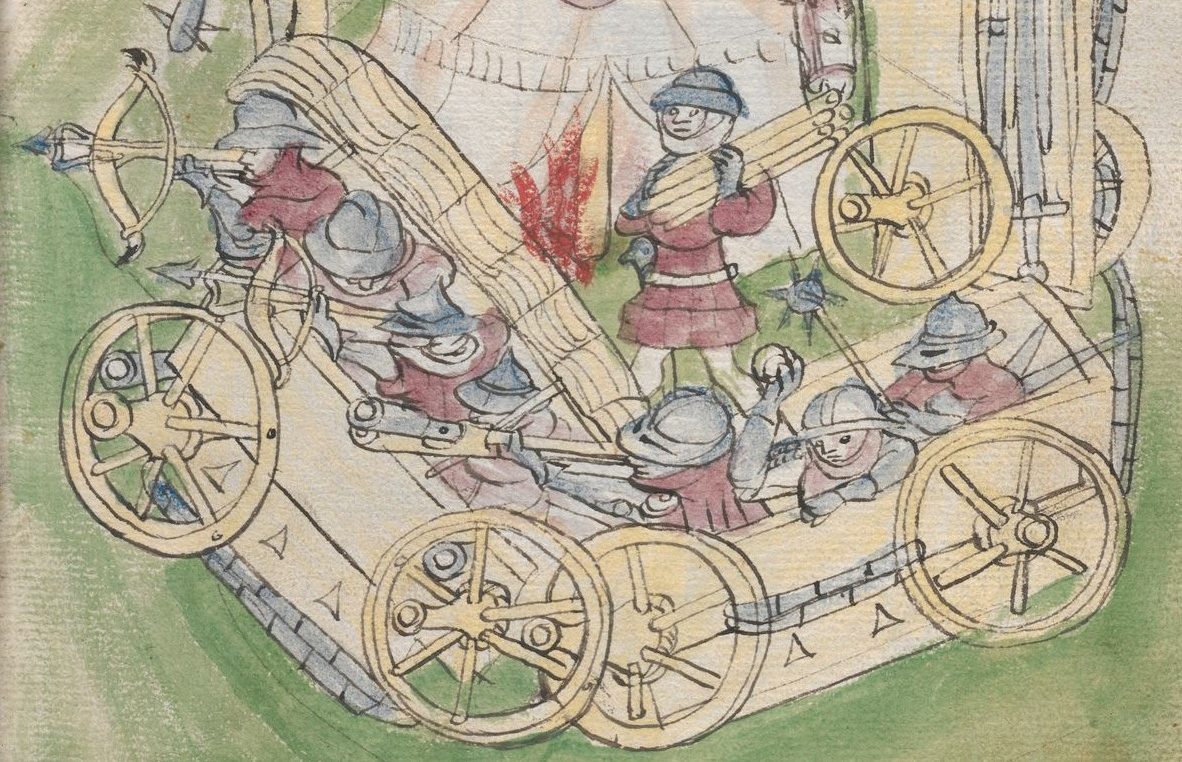
I do not think Wainriders used chariots. They used wains - that is, wagons or carts. And these are very much not useless. Historically, Hussites used wagons very successfuly against cavalry armies, and even before them Hungarians had used wagons to fortify camps.

I imagine they used something similar to Hussite wagon tactics:
 
I'm not sure that's what they were feared for. Wains are big, heavy, slow cargo vehicles, basically. Pretty much useless for warfare, and I don't recall JRRT describing their preferred manner of fighting in any detail, if at all. Perhaps for warfare they did use chariots, though, to use a modern analogy (and stretch it a bit) successful manufacturers of 40-ton trucks aren't known to have produced successful Formula 1 race cars. And as modern reconstructive archaeologist have found, building a chariot that doesn't immediately fall apart with the rough handling to be expected in battle is not easy at all.

As to chariots vs. cavalry, that may be. But at least up to the end of the Bronze age roughly around 1200 BC, chariots were the weapons of choice. Among the first recorded cavalry, as far as I remember, are the Scythians, first appearing in the 7th century BC. So with the first mention of the Wainriders being in 1851 Third Age (over 200 years after the Great Plague, to answer a question from another post of yours), when do we have the first mention of cavalry? The later Rohirrim were closely related to the Northmen of Rhovanion, but that does not necessarily mean that the latter were already a cavalry-based nation. As they at least partly lived in southern Greenwood, that does speak much for cavalry. The Éothéod, direct ancestors of the Rohirrim, moved north in the Anduin vales under their leader Frumgar (Father of Fram, the one who killed the dragon Scatha and made its teeth into a necklace) in 1977 TA, after the Witch-king of Angmar had been defeated and disappeared from the North, and probably Angmar fell into disarray if not ruin, and no longer was seen as a threat. Were the Éothéod already cavalry-based? I can find no definite statement either way. The first to definitely to be defined as cavalry were the Rohirrim under Eorl the Young, coming to the aid of Gondor in 2510 TA and then settling in Calenardhon, which then became Rohan. So over 600 years earlier, like in the real world, there might not have been a cavalry to oppose the Wainriders, if one supposes them to have had chariots.

Just one aside to the supposed superiority of cavalry:
In the Battle of the Golden Spurs or Battle of Courtrai in 1302, Flemish infantry pike-men routed the cavalry of Philip IV of France (also called Philip the Fair, but by all accounts a rather unsavory character - meaning run-of-the-mill for royalty and aristocracy of the time). While Philip ultimately won that 1297–1305 war, the French nobility suffered heavy losses. They were to repeat this, with massively greater losses, against English longbowmen at the battles of Crécy in 1346 and Agincourt in 1415.
OK, even if the Rhovanion weren't supposed to be cavalry-dominant, yet infantry weren't proved to be preferred preys for chariots either.
During the China-Warring state, massive military reform of the vassals of Zhou was due to a series of factual battles proving the the inferiority of chariots between them and all kinds of savage hordes. These inferiority includes terrain flexibility, mobility, and so forth.
Unless in some special condition, Julian the Apostate in the Battle of Samarra, which the Romans had already suffered from heavy losses on their morale, the Persian chariots maybe had done some works, yet still unable to bring them victory in front of the well-disciplined roman army.
I wonder Ondoher really get crushed like a piece of cake or not. After all, Gondor armies weren't supposed to suck so easily.


I do not think Wainriders used chariots. They used wains - that is, wagons or carts. And these are very much not useless. Historically, Hussites used wagons very successfuly against cavalry armies, and even before them Hungarians had used wagons to fortify camps.

I imagine they used something similar to Hussite wagon tactics:
Hmm....=''=...then here comes to a big problem, Toikein description about Wainriders seem aggressive, obviously opposite to the vehicles tactics you provide( of course it's another matter in special cases like wains armed with heavy fire-power).
Or maybe those Wainriders fight like mechanic infantry-moving fast into your front and then bomb your ass back to the stone age. One more proof support this infer, the terrain. In front of the Black-Gate, there're mountains favor infantries everywhere, making vehicles no more than sticking ducks before them, unless those vehicles size are small enough so that they got more flexibility and get used as transport simply.
So might the Wainriders are fire-power dominant?This is just my personal guess anyway, what do you think?^^
 
I do not think Wainriders used chariots. They used wains - that is, wagons or carts. And these are very much not useless. Historically, Hussites used wagons very successfuly against cavalry armies, and even before them Hungarians had used wagons to fortify camps.

I imagine they used something similar to Hussite wagon tactics:
Good stuff!
But I note that even starting with the Hussites, firearms became progressively more important, more and more so over time. And the "Wagenburg" ("wagon fortress") is in the main a defensive form of warfare, depending on enemy attackers wearing themselves down on the defensive positions before taking offensive action. I had already read about the Ottoman Turks fighting like this, but not, as far as I can remember, that they had also adopted the "Wagenburg" from the Hungarians, and thus ultimately from the Hussites.

So the Wainriders fighting like the Hussites et. al. minus firearms.
 
Good stuff!
But I note that even starting with the Hussites, firearms became progressively more important, more and more so over time. And the "Wagenburg" ("wagon fortress") is in the main a defensive form of warfare, depending on enemy attackers wearing themselves down on the defensive positions before taking offensive action. I had already read about the Ottoman Turks fighting like this, but not, as far as I can remember, that they had also adopted the "Wagenburg" from the Hungarians, and thus ultimately from the Hussites.

So the Wainriders fighting like the Hussites et. al. minus firearms.

Yeah. Although, wasn't there something about chariots "smashing" into Gondorian lines? Which does not fit with either chariot or wagon warfare.
 
Yeah. Although, wasn't there something about chariots "smashing" into Gondorian lines? Which does not fit with either chariot or wagon warfare.
Not quite, at least not in what I've found. I used my 2003 hardcover illustrated (by Ted Nasmith) edition of Robert Foster's "The Complete Guide to Middle-earth" to find where in JRRT's writings the Wainriders are mentioned. Fortunately, the page references included, besides two other editions, my 2002 hardcover illustrated (by Alan Lee) three-volume, but continuously paginated edition of LoTR.

This led to Appendix A, section (iv) "Gondor and the Heirs of Anarion", on page 1060:
"The third evil was the invasion of the Wainriders, which sapped the waning strength of Gondor in wars that lasted for almost a hundred years. The Wainriders were a people, or a confederacy of many peoples, that came from the East; but they were stronger and better armed than any that had appeared before. They journeyed in great wains, and their chieftains fought in chariots. Stirred up, as was afterwards seen, by the emissaries of Sauron, they made a sudden assault upon Gondor, and King Narmacil II was slain in battle with them beyond Anduin in 1856 [Third Age]."

One thought: if the journeyed in wains, would they have also fought with the same wains? The wains described as being used by the Hussites and later seemed to me to be dedicated war wains. Even the Vikings had different ships for raids and commerce, and never mind the difference between (rowed) war galleys and mostly sail-propelled merchant ships centuries later (tourist cruise ships are for some reason totally ignored at these times ;)). It could be that the wains were dual-use, but needed some refitting to convert them from transport to warfare (even modern troop transporters, and never mind battle tanks, make lousy caravans / trailers). With then throws up the question what the non-warring population - and the Wainriders impress me as whole populations on the move, like the "Germanic" tribes that troubled the (western) Roman Empire right up to its demise, rather than purely war parties - used for accommodations while the wains were being used in warfare. Pitched tents, perhaps?

Then the statement, that the chieftains fought in chariots. Now, unless we equate "chieftain" with modern military ranks of the level of lieutenants, or even sergeants, that does not add up to many chariots. And both massed pike-men as as well as massed archers (the machine guns of the later middle ages) could inflict massive losses on anything involving horses. But JRRT has not, as far as I know, provided any details about specialized troops on either side to be helpful in solving such speculations. Fodder for countless fanfics, RPGs, games, yes, entire non-trivial industries … 🤓
 
Not quite, at least not in what I've found. I used my 2003 hardcover illustrated (by Ted Nasmith) edition of Robert Foster's "The Complete Guide to Middle-earth" to find where in JRRT's writings the Wainriders are mentioned. Fortunately, the page references included, besides two other editions, my 2002 hardcover illustrated (by Alan Lee) three-volume, but continuously paginated edition of LoTR.

This led to Appendix A, section (iv) "Gondor and the Heirs of Anarion", on page 1060:
"The third evil was the invasion of the Wainriders, which sapped the waning strength of Gondor in wars that lasted for almost a hundred years. The Wainriders were a people, or a confederacy of many peoples, that came from the East; but they were stronger and better armed than any that had appeared before. They journeyed in great wains, and their chieftains fought in chariots. Stirred up, as was afterwards seen, by the emissaries of Sauron, they made a sudden assault upon Gondor, and King Narmacil II was slain in battle with them beyond Anduin in 1856 [Third Age]."

One thought: if the journeyed in wains, would they have also fought with the same wains? The wains described as being used by the Hussites and later seemed to me to be dedicated war wains. Even the Vikings had different ships for raids and commerce, and never mind the difference between (rowed) war galleys and mostly sail-propelled merchant ships centuries later (tourist cruise ships are for some reason totally ignored at these times ;)). It could be that the wains were dual-use, but needed some refitting to convert them from transport to warfare (even modern troop transporters, and never mind battle tanks, make lousy caravans / trailers). With then throws up the question what the non-warring population - and the Wainriders impress me as whole populations on the move, like the "Germanic" tribes that troubled the (western) Roman Empire right up to its demise, rather than purely war parties - used for accommodations while the wains were being used in warfare. Pitched tents, perhaps?

Then the statement, that the chieftains fought in chariots. Now, unless we equate "chieftain" with modern military ranks of the level of lieutenants, or even sergeants, that does not add up to many chariots. And both massed pike-men as as well as massed archers (the machine guns of the later middle ages) could inflict massive losses on anything involving horses. But JRRT has not, as far as I know, provided any details about specialized troops on either side to be helpful in solving such speculations. Fodder for countless fanfics, RPGs, games, yes, entire non-trivial industries … 🤓

I found the following in Unfinished Tales. I bolded the relevant parts, but in short, Wainriders do utilize:
- fortified camps of wagons
- war chariots
- cavalry

So it appears that wagons are only used for travel and field fortifications, while combat order is more typical infantry + cavalry + chariots. So civilians would remain in fortified wagon camp while army fought outside it, and if necessary retreated to the camp. Goths in Battle of Adrianople used wagon camp, and I believe they might be inspiration for wainriders.

Hussite wains actually started out as normal cargo wans, but were indeed later modified to proper war wagons.

They were slow to recover; but their weakness was not tested for a long time. No doubt the people further
east had been equally afflicted, so that the enemies of Gondor came chiefly; from the south or over sea.
But when the invasions of the Wainriders began and involved Gondor in wars that lasted for almost a
hundred years, the Northmen bore the brunt of the first assaults. King Narmacil II took a great army north
into the plains south of Mirkwood, and gathered all that he could of the scattered remnants of the
Northmen; but he was defeated, and himself fell in battle. The remnant of his army retreated over the
Dagorlad into Ithilien, and Gondor abandoned all lands east of the Anduin save Ithilien. 5
As for the Northmen, a few, it is said, fled over the Celduin (River Running) and were merged with the
folk of Dale under Erebor (with whom they were akin), some took refuge in Gondor, and others were
gathered by Marhwini son of Marhari (who fell in the rearguard action after the Battle of the Plains). 6
Passing north between Mirkwood and Anduin they settled in the Vales of Anduin, where they were joined
by many fugitives who came through the Forest. This was the beginning of the Éothéod, 7 though nothing
was known of it in Gondor for many years. Most of the Northmen were reduced to servitude, and all their
former lands were occupied by the Wainriders. 8
But at length, King Calimehtar, son of Narmacil II, being free from other dangers, 9 determined to avenge
the defeat of the Battle of the Plains. Messengers came to him from Marhwini warning him that the
Wainriders were plotting to raid Calenardhon over the Undeeps; 10 but they said also that a revolt of the
Northmen who had been enslaved was being prepared and would burst into flame if the Wainriders
became involved in war. Calimehtar therefore, as soon as he could, led an army out of Ithilien, taking care
that its approach should be well known to the enemy. The Wainriders came down with all the strength that
they could spare, and Calimehtar gave way before them, drawing them away from their homes. At length
battle was joined upon the Dagorlad, and the result was long in doubt. But at its height horsemen that
Calimehtar had sent over the Undeeps (left unguarded by the enemy) joined with a great éored 11 led by
Marhwini assailed the Wainriders in flank and rear. The victory of Gondor was overwhelming - though
not in the event decisive. When the enemy broke and were soon in disordered flight north towards their
homes Calimehtar, wisely for his part, did not pursue them. They had left well nigh a third of their host
dead to rot upon the Dagorlad among the bones of other and nobler battles of the past. But the horsemen of
Marhwini harried the fugitives and inflicted great loss upon them in their long rout over the plains, until
they were within far sight of Mirkwood. There they left them, taunting them: "Fly east not north, folk of
Sauron! See, the homes you stole are in flames!" For there was a great smoke going up.
The revolt planned and assisted by Marhwini had indeed broken out; desperate outlaws coming out of the
Forest had roused the slaves, and together had succeeded in burning many of the dwellings of the
Wainriders, and their storehouses, and their fortified camps of wagons. But most of them had perished in
the attempt; for they were ill-armed, and the enemy had not left their homes undefended: their youths and
old men were aided by the younger women, who in that people were also gained in arms and fought
fiercely in defence of their homes and their children. Thus in the end Marhwini was obliged to retire
again to his land beside the Anduin, and the Northmen of his race never again returned to their former
homes. Calimehtar withdrew to Gondor, which enjoyed for a time (from 1899 to 1944) a respite from war
before the great assault in which the line of its kings came near to its end.
In the meanwhile the Wainriders licked their wounds, and plotted their revenge. Beyond the reach of the
arms of Gondor in lands east of the Seat of Rhûn from which no tidings came to its Kings, their kinsfolk
spread and multiplied, and they were eager for conquests and booty and filled with hatred of Gondor
which stood in their way. It was long, however, before they moved. On the one hand they feared the might
of Gondor, and knowing nothing of what passed west of Anduin they believed that its realm was larger
and more populous than it was in truth at that time. On the other hand the eastern Wainriders had been
spreading southward, beyond Mordor, and were in conflict with the peoples of Khand and their
neighbours further south. Eventually a peace and alliance was agreed between these enemies of Gondor,
and an attack was prepared that should be made at the same time from north and south.
Little or nothing, of course, was known of these designs an movements in Gondor. What is here said was
deduced from the events long afterwards by historians, to whom it was also clear that the hatred of
Gondor, and the alliance of its enemies in concerted action (for which they themselves had neither the
will nor the wisdom) was due to the machinations of Sauron. Forthwini, son of Marhwini, indeed warned
King Ondoher (who succeeded his father Calimehtar in the year 1936) that the Wainriders of Rhovanion
were recovering from their weakness and fear, and that he suspected that they were receiving new strength
from the East, for he was much troubled by raids into the south of his land that came both up the river and
through the Narrows of the Forest. 13 But Gondor could do no more at that time than gather and train as
great an army as it could find or afford. Thus when the assault came at last it did not find Gondor
unprepared, though its strength was less than it needed.
Ondoher was aware that his southern enemies were preparing for war, and he had the wisdom to divide
his forces into a northern army and a southern. The latter was the smaller, for the danger from that quarter
was held to be less. 14 It was under the command of Eärnil, a member of the Royal House, being a
descendant of King Telumehtar, father of Narmacil II. His base was at Pelargir. The northern army was
commanded by King Ondoher himself. This bad always been the custom of Gondor, that the King, if he
willed, should command his army in a major battle, provided that an heir with undisputed claim to the
throne was left behind. Ondoher came of a warlike line, and was loved and esteemed by his army, and he
had two sons, both of age to bear arms: Artamir the elder, and Faramir some three years younger.
News of the oncoming of the enemy reached Pelargir on the ninth day of Cermië in the year 1944. Eärnil
had already made his dispositions: he had crossed the Anduin with half his force, and leaving by design
the Fords of the Poros undefended had encamped some forty miles north in South Ithilien. King Ondoher
had purposed to lead his host north through Ithilien and deploy it on the Dagorlad, a field of ill omen for
the enemies of Gondor. (At that time the forts upon the line of the Anduin north of Sarn Gebir that had
been built by Narmacil I were still in repair and manned by sufficient soldiers from Calenardhon to
prevent any attempt of an enemy to cross the river at the Undeeps.) But the news of the northern assault
did not reach Ondoher until the morning of the twelfth day of Cermië, by which time the enemy was
already drawing near, whereas the army of Gondor had been moving more slowly than it would if
Ondoher had received earlier warning, and its vanguard had not yet reached the Gates of Mordor. The
main force was leading with the King and his Guards, followed by the soldiers of the Right Wing and the
Left Wing which would take up their places when they passed out of Ithilien and approached the
Dagorlad. There they expected the assault to come from the North or North-east, as it had before in the
Battle of the Plains and in the victory of Calimehtar on the Dagorlad.
But it was not so. The Wainriders had mustered a great host by the southern shores of the inland Sea of
Rhûn, strengthened by men of their kinsfolk in Rhovanion and from their new allies in Khand. When all
was ready they set out for Gondor from the East, moving with all the speed they could along the line of the
Ered Lithui, where their approach was not observed until too late. So it came to pass that the head of the
army of Gondor had only drawn level with the Gates of Mordor (the Morannon) when a great dust borne
on a wind from the East announced the oncoming of the enemy vanguard. 15 This was composed not only
of the war-chariots of the Wainriders but also of a force of cavalry far greater than any that had been
expected.
Ondoher had only time to turn and face the assault with his right flank close to the Morannon,
and to send word to Minohtar, Captain of the Right Wing behind, to cover his left flank as swiftly as he
could, when the chariots and horsemen crashed into his disordered line. Of the confusion of the disaster
that followed few clear reports were ever brought to Gondor.
Ondoher was utterly unprepared to meet a charge of horse men and chariots in great weight. With his
Guard and his banner he had hastily taken up a position on a low knoll, but this was of no avail. 16 The
main charge was buried against his banner, and it was captured, his Guard was almost annihilated, an he
himself was slain and his son Artamir at his side. The bodies were never recovered. The assault of the
enemy passed over them and about both sides of the knoll, driving deep into the disordered ranks of
Gondor, hurling them back in confusion upon those behind, and scattering and pursuing many others
westward into the Dead Marshes.
Minohtar took command. He was a man both valiant an warwise. The first fury of the onslaught was spent,
with far less loss and greater success than the enemy had looked for. The cavalry and chariots now
withdrew, for the main host of the Wainriders was approaching. In such time as he had Minohtar raising
his own banner, rallied the remaining men of the Centre and those of his own command that were at hand.
He at once sent messengers to Adrahil of Dol Amroth, 17 the Captain of the Left Wing, commanding him
to withdraw with all the speed he could both his own command and those at the rear of the Right Wing
who had not yet been engaged. With these forces he was to take up a defensive position between Cair
Andros (which was manned) and the mountains of Ephel Dúath, where owing to the great eastward loop
of the Anduin the land was at its narrowest, to cover as long as he could the approaches to Minas Tirith.
Minohtar himself, to allow time for this retreat, would form a rearguard and attempt to stem the advance
of the main host of the Wainriders. Adrahil should at once send messengers to find Eärnil, if they could,
and inform him of the disaster of the Morannon and of the position of the retreating Northern Army.
When the main host of the Wainriders advanced to the attack it was then two hours after noon, and
Minohtar had withdrawn his line to the head of the great North Road of Ithilien, half a mile beyond the
point where it turned east to the Watchtowers of the Morannon. The first triumph of the Wainriders was
now the beginning of their undoing. Ignorant of the numbers and ordering of the defending army they had
launched their first onslaught too soon, before the greater part of that army had time out of the narrow land
of Ithilien, and the charge of their chariots and cavalry had met with a success far swifter and more
overwhelming than they had expected. Their main onslaught as then too long delayed, and they could no
longer use their greater numbers with full effect according to the tactics they had intended, being
accustomed to warfare in open lands. It may well be supposed that elated by the fall of the King and the
rout of a large part of the opposing Centre, they believed that they had already overthrown the defending
army, and that their own main army had little more to do than advance to the invasion and occupation of
Gondor. If that were so, they were deceived.
The Wainriders came on in little order, still exultant and singing songs of victory, seeing as yet no signs of
any defenders to oppose them, until they found that the road into Gondor tamed south into a narrow land of
trees under the shadow of the dark Ephel Dúath, where an army could march, or ride, in good order only
down a great highway. Before them it ran on through a deep cutting...
Here the text abruptly breaks off, and the notes and jottings for its continuation are for the mostpart
illegible. It is possible to make out, however, that men of the Éothéod fought with Ondoher; and also that
Ondoher's second son Faramir was ordered to remain in Minas Tirith as regent, for it was not permitted
by the law that both his sons should go into battle at the same time (a similar observation is made earlier
in the narrative, p.305). But Faramir did not do so; be went to the war in disguise, and was slain. The
writing is here almost impossible to decipher, but it seems that Faramir joined the Éothéod and was
caught with a party of them as they retreated towards the Dead Marshes. The leader of the Éothéod
(whose name is indecipherable after the first element Marh-) came to their rescue, but Faramir died in his
arms, and it was only when he searched his body that he found tokens that showed that he was the Prince.
The leader of the Éothéod then went to join Minohtar at the head of the North Road in Ithilien, who at that
very moment was giving an order for a message to be taken to the Prince in Minas Tirith, who was now
the King. It was then that the leader of the Éothéod gave him the news that the Prince had gone disguised
to the battle, and had been slain.
The presence of the Éothéod and the part played by their leader may explain the inclusion in this
narrative, ostensibly to be an account of the beginnings of the friendship of Gondor and the Rohirrim, of
this elaborate story of the battle between the army of Gondor and the Wainriders.
The concluding passage of the fully-written text gives the impression that the host of the Wainriders were
about to receive a check to their exaltation and elation as they came down the highway into the deep
cutting; but the notes at the end show that they were not long held up by the rearguard defence of Minohtar.
"The Wainriders poured relentlessly into Ithilien," and "late on the thirteenth day of Cermië they
overwhelmed Minohtar," who was slain by an arrow. He is here said to have been King Ondoher's sister-
son. "His men carried him out of the fray, and all that remained of the rearguard fled southwards to find
Adrahil." The chief commander of the Wainriders then called a halt to the advance, and held a feast.
Nothing more can be made out; but the brief account in Appendix A to The Lord of the Rings tells how
Eärnil came up from the south and routed them:
In 1944 King Ondoher and both his sons, Artamir and Faramir, fell in battle north of the Morannon, and
the enemy poured into Ithilien. But Eärnil, Captain of the Southern Army, won a great victory in South
Ithilien and destroyed the army of Harad that had crossed the River Poros. Hastening north, he gathered to
him all that he could of the retreating Northern Army and came up against the main camp of the
Wainriders, while they were feasting and revelling, believing that Gondor was overthrown and that
nothing remained but to take the spoil. Eärnil stormed the camp and set fire to the wains, and drove the
enemy in a great rout out of Ithilien. A great part of those who fled before him perished in the Dead
Marshes.
In the Tale of Years the victory of Eärnil is called the Battle of the Camp. After the deaths of Ondoher and
both his sons at the Morannon Arvedui, last king of the northern realm, laid claim to the crown of Gondor;
but his claim was rejected, and in the year following the Battle of the Camp Eärnil became King. His son
was Eärnur, who died in Minas Morgul after accepting the challenge of the Lord of the Nazgûl, and was
the last of the Kings of the southern realm.
 
"Here the text abruptly breaks off, and the notes and jottings for its continuation are for the most part illegible."

As happened so often in JRRT's writings. Compared to what was printed with his approval during his lifetime, the amount of "Unfinished Tales" is so much larger. And as these include variants of the same tale - something like eight for "Beren and Lúthien"? - written over a period of decades, often confusing and contradictory. But that is fodder for (almost) endless discussions, and fanfics, for that matter. :)
 
I found the following in Unfinished Tales. I bolded the relevant parts, but in short, Wainriders do utilize:
- fortified camps of wagons
- war chariots
- cavalry

So it appears that wagons are only used for travel and field fortifications, while combat order is more typical infantry + cavalry + chariots. So civilians would remain in fortified wagon camp while army fought outside it, and if necessary retreated to the camp. Goths in Battle of Adrianople used wagon camp, and I believe they might be inspiration for wainriders.

Hussite wains actually started out as normal cargo wans, but were indeed later modified to proper war wagons.
So...according to this description-"But it was not so. The Wainriders had mustered a great host by the southern shores of the inland Sea of
Rhûn, strengthened by men of their kinsfolk in Rhovanion and from their new allies in Khand."
WTF!!!@@.......OK......What a great slap to my fanfic😅😅😅. So this means the Wainriders got enough Northmen recons for geographic guides, making them able to pass through the mountains around Mordor supposed to be the obstacles of their dominant units(Cavs, vehicles, and so forth)
How great...

So...let's make these conclusion about Toikein's description to Wainriders
1.Their tactics and strategy relied on well-prepared environment like terrain and chances(surprising attack like what they did to Ondorher) a lot
2.They mastered Combined-Arms
3.Their "indirect military methods"(Political, diplomatic, and so on) has been mature. For instance, they might use Northmen spies to let their vehicles and Cavs pass through the mountains like how the German passed via Arracourt in WWII.
 
Last edited:
3.Their "indirect military methods"(Political, diplomatic, and so on) has been mature. For instance, they might use Northmen spies to let their vehicles and Cavs pass through the mountains like how the German passed via Arracourt in WWII.
I think that is contradicted by this statement by JRRT, near the beginning of the second, larger quote by Aldarion yesterday:
"Little or nothing, of course, was known of these designs an movements in Gondor. What is here said was
deduced from the events long afterwards by historians, to whom it was also clear that the hatred of
Gondor, and the alliance of its enemies in concerted action (for which they themselves had neither the
will nor the wisdom
) was due to the machinations of Sauron."
This might mean the (large) alliances with the people of Khand and further south - with whom they had first come into conflict, so Sauron probably had to step in to stop that. What they were capable of below that level, who knows?
 

Today's events

Similar threads

Back
Top