• Welcome to The Tolkien Forum! Connect with fellow Tolkien enthusiasts and join a community that is over two decades old, and still going strong. We look forward to meeting you.  Register

What 📔book are you reading right now?

I just finished Eldest and am now frantically searching for a copy of the next book in the trilogy, Brisingr. The only copy I could find was in Spanish for some reason. I didn't like the elves in Eldest, especially Arya, but the rest of the book was pretty good, with an interesting twist at the end.
I’ve never read the series but know people who enjoyed it. I think I still have a copy of Eragon from when the movie came out. I saw it in theaters and didn’t like it but have heard the book is better. At one point on TTF there was a pretty active thread that was all about how he ripped off Tolkien for his books. I don’t have an opinion either way since I’ve never read the books.

Edit:Found the thread and apparently I did post some reviews I’d found about the book 😂

Post in thread 'Christopher Paollini's Eragon. (merged)'
https://thetolkien.forum/threads/christopher-paollinis-eragon-merged.17194/post-477247
 
Last edited:
One person's take:
minusxwings.jpg
 
I didn't like the elves in Eldest, especially Arya
I don't like the elves either, they're too arrogant, and perfect (which is what Paolini was going for). Actually, I don't particularly care for elves in most fantasy settings.
I saw it in theaters and didn’t like it
The film is terrible, and has barely anything in common with the books.

I really enjoy the Inheritance Cycle (even though he did copy Star Wars).
 
Well, there are several small similarities to Star Wars, I must agree, but Paolini was only 15 when he started writing the book and 17 when he published it, so I think he can be excused for a few minor similarities. The only similarities to LOTR that I noticed was that the Razac seemed inspired by the Nazgûl.
 
I don't like the elves either, they're too arrogant, and perfect (which is what Paolini was going for). Actually, I don't particularly care for elves in most fantasy settings.

The film is terrible, and has barely anything in common with the books.

I really enjoy the Inheritance Cycle (even though he did copy Star Wars).
I found it very odd that the elves could give themselves plastic surgery via magic... That felt very weird.
 
I’ve never read the series but know people who enjoyed it. I think I still have a copy of Eragon from when the movie came out. I saw it in theaters and didn’t like it but have heard the book is better. At one point on TTF there was a pretty active thread that was all about how he ripped off Tolkien for his books. I don’t have an opinion either way since I’ve never read the books.

Edit:Found the thread and apparently I did post some reviews I’d found about the book 😂

Post in thread 'Christopher Paollini's Eragon. (merged)'
https://thetolkien.forum/threads/christopher-paollinis-eragon-merged.17194/post-477247
My own perception of the book may be warped because I read it years ago. That said, all I can remember about it is how similar to Star Wars it was. I'm not kidding, the plot and characters are almost exactly the same. I think the Tolkien similarities end with the typical fantasy setting, European inspirations and traditional dragons--there weren't many story beats that seemed similar to lotr, now that I've read both. So . . . I guess I'm here to say that meme is really not an exaggeration, in my opinion 😅.

I have never seen the movie, but I have heard it's one of those infamous adaptation flops that most people hate, up there with the Avatar: The Last Airbender movie and the first Percy Jackson movie.

Full respect to Idril for enjoying the series though, I always think it's wonderful when I see someone loving a piece of media that I couldn't.
 
Having recently finished The Lord of the Rings and looking to relieve some bookshelf space (yes I know about floor space), I've started reading a second hand paperback I've had for ages: The House on the Strand by Daphne du Maurier. Set in Cornwall of course, not London, the main character (Richard Young) is staying for the summer in the home of a Professor friend who has devised a drug that takes a person c700 years back in time to the 13th/14th century where RY witnesses the lives and loves of the local gentry. It's very engaging.
 
Not a book... just a timely article (from the world's oldest magazine, The Spectator.)

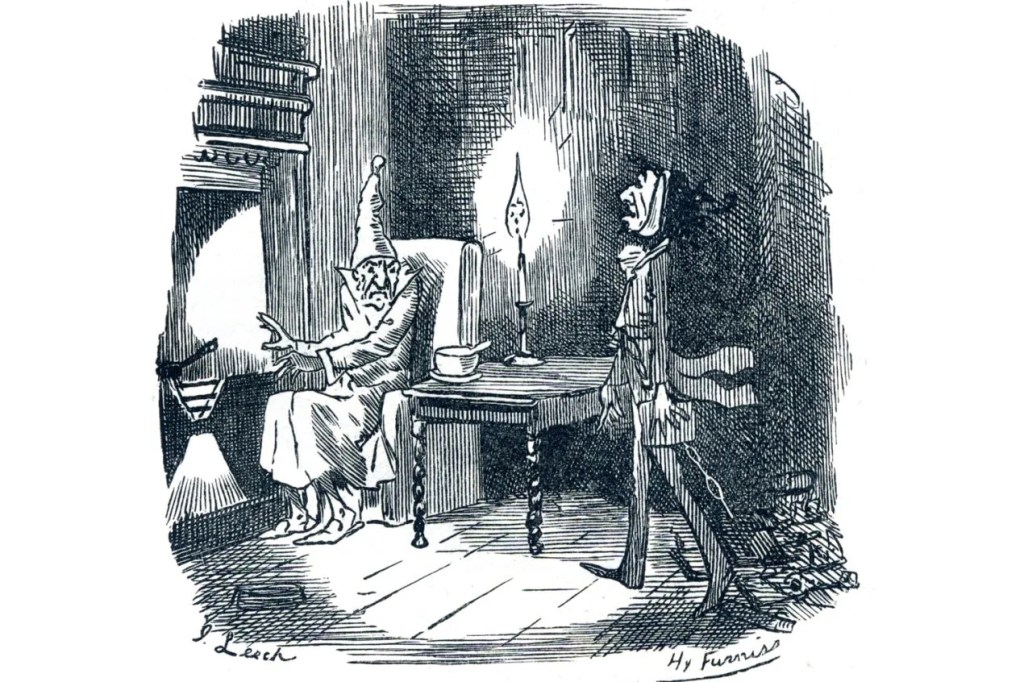
The longevity of A Christmas Carol ​

by Joshua Young

Dickens wrote it in six weeks, amid explosions of laughter and tears at his desk
Tuesday, December 24, 2024

christmas carol


It was November 1843, two years after Prince Albert first introduced Britain to the tradition of the Christmas tree. Charles Dickens was thirty-one, and yet to grow his beard. A dire report on child labor the previous year had worked him up into a compassionate rage. Just as pressingly, Dickens needed cash. The author was already famous for The Pickwick Papers and Oliver Twist, but the public was struggling with Martin Chuzzlewit and, to top it off, his wife Catherine was pregnant again.

Dickens wrote A Christmas Carol in six weeks, amid explosions of laughter and tears at his desk. He knew straight away it was his best work yet, and commissioned a fancy edition to celebrate, complete with gold-edged paper and hand-colored pictures. It was published on December 19 and had sold out by Christmas Eve, but the book was very expensive to manufacture, and profits were meager. It was also immediately pirated, although when Dickens sued for damages, the pirates went bankrupt, leaving him to foot the legal bills. So in the first year, A Christmas Carol lost money, and Dickens moved his family to Italy to manage their expenses.

In all, though, it was an overnight triumph. Half of London wrote to thank Dickens for what felt like a personal Christmas gift. Within two months, eight separate theatrical adaptations had been staged. The historian Thomas Carlyle took a break from working on his “Great Man” theory to throw two banquets in the spirit of the story. Ever since, the Carol has sold like mince pies, prompting the strongest and strangest reactions in its readers. In 1867, one American industrialist felt himself completely transformed, and sent 200 turkeys to his employees. By the 1880s, Vincent van Gogh was re-reading it every Christmas: perhaps it helped to save his other ear.

In A Christmas Carol, we encounter Ebenezer Scrooge on Christmas Eve, Bah Humbugging his nephew for falling in love: “the only thing in the world more ridiculous than a merry Christmas.” But he is scheduled for redemption through a series of ghostly visions. In Christmas Past, we see Scrooge’s genesis as a friendless teenager, fearful of a hard-hearted father. In Christmas Present, we meet the impoverished family of Bob Cratchit — the clerk whom Scrooge perpetually refrigerates in his freezing cold office — enjoying their budget goose. We fear for the prospects of Tiny Tim, the crippled son who fits on Bob’s shoulder. And in Christmas Yet to Come, the fatal blow is dealt. If Scrooge refuses to reform, Tiny Tim will surely die — and when Scrooge dies himself, no one will miss him.

But when Scrooge wakes up, it’s still only Christmas Day. Nothing can stop him blessing the local urchins, delivering a turkey to the Cratchits and raising Bob’s salary the following morning. Amid these festivities, Christ takes a back seat, but resurrection is the theme: of Scrooge, of Tim, and of Christmas itself, which always comes round again. As readers, we learn how rarely we live as if we actually knew we were going to die — and how different we might want to be if we ever saw ourselves from the outside.

New readers find the Carol shorter and funnier than expected, but more importantly deeper. There is the scene from Christmas Past when Scrooge’s fiancée cancels their engagement, and the roots of his greed are explained:
“You fear the world too much,” she answered, gently. “All your other hopes have merged into the hope of being beyond the chance of its sordid reproach.”
Underneath the story of a man who obviously doesn’t try, A Christmas Carol is really about the extraordinary difficultly of being kind: the well of sadness, fear and mistakes that traps us in our worst instincts. It is as magical and charismatic as anything by Dickens, written with the special confidence of a writer who knew not only that he had a good idea, but that he was doing a good deed.

Yet the truest test of a myth is whether it can be retold just as well as the original. Dickens himself started the trend, cutting the text down for the 127 public readings he gave over the ensuing years of his life, every bit as dramatic and hysterical as a one-man pantomime. But even he might have been humbled by the delights of the Muppets Christmas Carol version. Michael Caine would have earned his knighthood for his teary and sensitive Scrooge alone, foiled perfectly by the embattled and deserving Kermit. Just as splendid is Miss Piggy in her terrifying rages, and Gonzo as Dickens himself, explaining the concept of omniscient narration. The film did middlingly in its day, impaired by condescending reviews; but it has aged superbly and continues to improve lost children.

A Christmas Carol was written to point the finger at the Scrooge in everyone, but perhaps nowadays most of us feel like Scrooge and Cratchit at the same time. We keep to our own business; the other side is full of humbug; by any objective measure, we are preposterously uncharitable. Yet we can hardly believe how little we get for a year of exhausting work. Somehow, between a nervous future and the miserable past, we have a good Christmas.

Dickens has been criticized for believing that kindness alone could save us, in the place of an agenda for structural change. Nowadays everyone and his uncle has an agenda for structural change — but is no easier to point to a well-meaning person. Meanwhile in some walks of life, outright villainy has returned. No other book leaves you with the same feeling of instant moral resurrection, on top of a massive serving of festive cheer. Almost two centuries since its publication, A Christmas Carol remains a flight of utterly bewildering, huge-hearted genius: the greatest possible Christmas present.
 
Last edited:
I got these for ChristmasView attachment 39318
Wonderful presents! You will enjoy them your whole life.
And don't lend them, ever, no matter how much someone begs you.
I have bought paperbacks of the books people wanted to borrow from me, loaned those to the person(s), and despite all assurances they would be returned, I never saw them again, (which I totally expected to happen.) Better to lose some money on paperbacks than lose those books you [now] have.
 
Last edited:
The longevity of A Christmas Carol
Another book pressed upon me by my Persistent Sister - (those who may have read the Preface to my book-in-progress will be aware of her) - which, as a typical younger brother, I devoutely refused to engage with.
Until just this year - and just now. I have put it down only moments ago, after my first full reading (and extensive highlighting.)

Having indulged the numerous movie versions of it throughout the years, I determined it time to do a thorough read and begin my comparison of fidelity to text, characters, sequences of events, and the like.

By this time next year, after much additional work and pondering, I hope to render my verdict as to "my favorite version" along with some few reasons why.

(All this just in the 'for what it's worth' department.)
 
Another book pressed upon me by my Persistent Sister - (those who may have read the Preface to my book-in-progress will be aware of her) - which, as a typical younger brother, I devoutely refused to engage with.
Until just this year - and just now. I have put it down only moments ago, after my first full reading (and extensive highlighting.)

Having indulged the numerous movie versions of it throughout the years, I determined it time to do a thorough read and begin my comparison of fidelity to text, characters, sequences of events, and the like.

By this time next year, after much additional work and pondering, I hope to render my verdict as to "my favorite version" along with some few reasons why.

(All this just in the 'for what it's worth' department.)
As humorous as it is, the Muppet Christmas carol is actually very faithful to the book, dialogue-wise.
 
As humorous as it is, the Muppet Christmas carol is actually very close to the book, dialogue-wise.
Yes, I enjoyed this version for a number of reasons, though it's been awhile since I've watched it. It will be reviewed with an Entish "critical" eye once again, along with all the others.

Naturally, each will be carefully reviewed consistent with its fidelity to the book's intent, as well as its dialogue, inclusions and exclusions, sequence of events, etc. And each will have its own written critique.

At the end of the day, what we will have will be. - ***GASP*** - Ent's OPINION on the matter. (Actually, at the end of it we will have more a perspective than an opinion, but I won't quibble over words in this case.)

I fear I may then need to return to other of Dickens' works, as I suspect he's put more into them than I previously gave him credit for. Some of his inclusions in Christmas Carol alone were a bit of a surprise to me - unexpectedly, if happily, so.
 
Beowulf: A Translation and Commentary
I will be interested in your book review on this one. (Perhaps you could write one up for the Forum. hint hint.)
I've got it sitting in my e-Library but have not indulged yet. (at least it doesn't gather dust in the e-Library - in the 'traditional' sense.)
 

Similar threads

Back
Top