Aldarion
Active Member
- Joined
- May 30, 2019
- Messages
- 983
Moved reply from this thread to avoid off-topicing much...
It is not fanfic. I do not explain it in detail before because, frankly, it should be obvious to anyone who has even superficial knowledge of Gondor's and Byzantine history both. If nobody here understands relation and similarities of Byzantium and Gondor, then this site does not have that much credibility to be undermined to begin with. (Sorry if tone of response seems aggressive, but what you wrote is basically combination of personal attack and emotional blackmail). And no, Gondor is not just Byzantine Empire - it also has influences of Holy Roman Empire and ancient Egypt - but parallels with Byzantine Empire are the most obvious - though this might simply be due to me having more knowledge about Byzantine Empire than about ancient Egypt (or HRE, for that matter).
First, we have Tolkien's own statements that Gondor is analogous to the Byzantine Empire:
"In the south Gondor rises to a peak of power, almost reflecting Númenor, and then fades slowly to decayed Middle Age, a kind of proud, venerable, but increasingly impotent Byzantium."
"Now we come to the half-ruinous Byzantine City of Minas Tirith"
Tolkien has also located Minas Tirith at latitude of Florence. This latitude (43,77) is similar though not exactly the same to that of Constantinople (41,01) and Rome (41,9).
Second, we have history of Arnor and Gondor:
1) Arnor and Gondor were formed by survivors of disaster - Elendil, Isildur and Anarion. Rome was likewise founded by survivors of a disaster - Eneas, Romulus and Remus.
2) Arnor and Gondor were technically under one crown, with king of Arnor being superior to king of Gondor, but in practice they acted as separate states. This is exact same situation as Roman Empire post-395 (and even earlier), where Emperor of Western Empire was (typically but not always) the senior Augustus and technically ruled both halves of the Empire, but in practice the Eastern Empire - being more powerful - did as it pleased. Similarly, it is clear that Gondor quite quickly outstrips Arnor in terms of political and military power, despite former being technically a "senior" kingdom.
3) Arnor was politically "superior" as seat of Elendil, but Gondor was economically, demographically and militarily stronger - much like Western Roman Empire had distinction of containing Rome, but was in all other aspects (demography, economy, military) inferior to Eastern Roman Empire.
4) Western Roman Empire was lost to conquest from the North (Germans), and Arnor was lost to conquest from the North (Angmar).
5) Arnor splits into three kingdoms, much like Frankish Empire - which claimed descent from Western Roman Empire - did.
6) Gondor keeps going on for much longer than Arnor (WRE - ERE).
7) Arvediu attempted to gain throne of Gondor, but was rejected by the Dunedian who gave crown to Earnil. Similarly, when Charlemagne offered to marry Empress Irene, thus uniting both empires under the same ruler, Byzantines rejected not just the marriage but Irene as well (she was already deeply unpopular). Later, Otto I. also tried to unite Holy Roman Empire and Byzantine Empire, by offering a marriage of his son Otto II. to Byzantine princess, but this was again rejected.
8) In a last-ditch effort to save Arnor, Gondor sends a naval expedition - which fails at fulfilling the goal. This is roughly similar to Byzantine expedition aimed at saving North Africa to Empire (launched under Theodosius III) which was a failure, albeit for different reasons.
9) During height of its power, Gondor conquers areas of Rhun and Harad for a short while. Roman Empire had conquered Mesopotamia for a short while under Trajan (even names are similar - Turambar / Trajan, though it could be a coincidence).
10) Many of the enemies which threatened Gondor were eastern nomads - Wainriders, Balchoth etc. - which were noted for usage of wagons and chariots. Similarly, Eastern Roman Empire was threatened by numerous nomads, some of which also relied heavily on wagons. Pechenegs used wagons in a laager, and Battle of Adrianople in 378 AD was lost partly because of Gothic use of wagon fort.
11) King Eldacar managed to win back the throne with help of Northmen. Similarly, Basil II kept his throne thanks to the alliance with Prince Vladimir of Kiev.
12) Gondor declined thanks to Kin-Strife, constant warfare and the plague. Byzantine Empire also declined thanks to these factors - it was Justinian's Plague and recurrent occurences of the disease which first caused the loss of Justinian's reconquest, but also the subsequent inability to defend against Arab expansion. Later 14th century decline from which the Empire never recovered was also caused by plague.
13) Gondor lost its largest harbour (Umbar) thanks to Dark Numenoreans, but permanent loss was only due to Men of Harad. Likewise, Byzantium lost its largest harbour (Alexandria) several times thanks to various rebellions (and then Persians), but the final loss was to Arabs.
14) Constantine XI remained in foklore as "marble king" whose return would signal resurrection of the Empire. Return of Aragorn signals resurrection of United Kingdom of Arnor and Gondor.
Third, there is sociopolitical organization:
1) We have literally no evidence of subinfeudation. All "fiefs" are of roughly similar size, and all lords only rule these fiefs. No lord is superior to another, but all of them answer to the Steward at Minas Tirith. This organization is essentially identical to Byzantine thematic system with elements of Anglo-Saxon fyrd, rather than anything which could be described as "feudal". See here and here.
2) Imrahil is commander of forces of Belfalas, but he himself is Lord of Dol Amroth. There is no direct connection between the two as in feudal system.
3) Unlike feudal system, Gondor is highly centralized - to the point that fall of Minas Tirith is generally understood to also mean the fall of Gondor, and City is often equalized with Gondor as such. Byzantine Empire after 7th century was centered on Constantinople, the only major urban centre remaining within the Empire (there were a few other cities, but none anywhere as significant as pre-Conquest Alexandria, Carthage, Antioch). When Constantinople fell in 1203. and again in 1204., the Empire fractured, with occupied Latin Empire as well as Byzantine-controlled Nicaea, Epirus and Trebizond. Empire of Nicaea managed to reconquer Constantinople, but Epirus and Trebizond both remained independent.
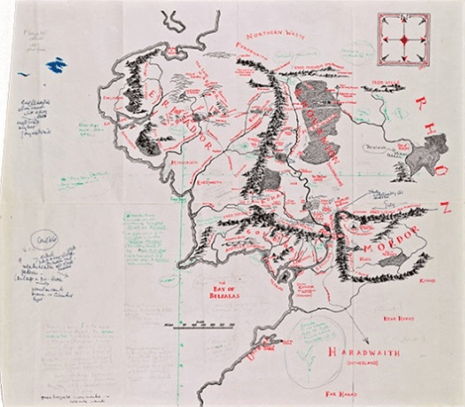
Fourth, there is strategic and physical geography:
1) Gondor controls pass over Anduin at Osgilliath, and thus is a main target of attack. This is basically the situation of Constantinople during existence of the Empire, and later, Belgrade and Budapest during Hungarian-Ottoman and Habsburg-Ottoman wars. Byzantine Empire essentially controlled land route into southeastern Europe from Near East, which made it a target of conquerors during its entire existence.
2) Gondor defends realms of men against threats coming out of the East and South, whereas Arnor defends them against threat from North (Angmar). This is similar to how Byzantine Empire defended Europe against threats from the East (Arabs, Turks) and South (Arabs) while Frankish Empire defended Europe and Mediterranean against threats from the West (technically southwest - Arabs) and North (Vikings, Germans).
3) Eastern borders of Gondor are defined by the mountains (Ephel Duath) and then retreat to the river (Anduin). This again is similar to both Byzantine Empire (Taurus-Antitaurus > retreat to Bosphorus and Dardanelles after Manzikert) and Hungary (Carpathian Mountains > retreat to Danube and beyond after Mohacs). Unlike Byzantium, new border is a river, but unlike Hungary, said border is more-or-less permanent (whereas Hungary to west of Danube was quickly conquered after Battle of Mohacs, and new border was defined by hills, marshes and forrests as opposed to a river).
4) Strategic importance of Minas Tirith as well as its layered defences are clear parallel to Constantinople. Minas Tirith has seven walls + the Rammas Echor. Rammas Echor is a clear analogue to Constantinople's Anastasian Walls. Also, Constantinople will have had seven layers of defences if all the walls had survived:
6) On the other hand, Constantinople's physical geography and its location on a crucial waterway is paralleled better by Osgilliath. There is also the fact that dome of Osgilliath is given importance (Hagia Sophia?).
7) Minas Tirith is falling into disrepar by the time of War of the Ring, with only half the people living in the city as should be physically possible. Constantinople could have had 500 000 residents within its Theodosian Walls, but for most of its history actual number varied from 50 000 to 200 000. Much of the land within the city was abandoned, becoming farmland and even pasture, and at worst points Constantinople was basically a collection of walled villages encompassed by massive Theodosian walls.
8) After Arab invasions in 7th century, Byzantine Empire became an essentially garrison state, where learning and philosophy were abandoned in favour of sheer survival. Cities retracted, literacy dropped (albeit not as much as in Western Europe) and masonry from old buildings was used to build city walls for now much smaller settlements. This is precisely what has happened in Gondor: Boromir is favoured over Faramir in part precisely because latter is interested in lore more than in warfare. Faramir's speech to Frodo is also quite clear about this change in attitude which is indicative of militarization of society.
9) Byzantine Empire had an extensive beacon system which connected Constantinople to Cilicia. Gondor had two systems of beacons, one connecting Minas Tirith to southern fiefs, and another connecting Minas Tirith to border of Rohan.
10) Gondor at its height encircled Bay of Belfalas, much like Byzantine Empire encircled much of Mediterranean Sea.
11) Outermost wall of Minas Tirith was never breached until Witch King used magic to breach the City Gate. Likewise, Theodosian Walls of Constantinople were never breached until invention of gunpowder. There was however one time when Theodosian Walls were nearly defeated after earthquake brought down the walls in 448, but quick reconstruction prevented the catastrophe. This might have been alluded to by Tolkien's statement that Wall of Minas Tirith could not be breached except by an earthquake, though it is more likely statement was merely descriptory.
12) Osgilliath however is more similar to Constantinople in that it was original capital of the Eastern Empire, and was besieged multiple times.
Fifth, culture and architecture:
1) Gondorian kings are given nicknames based on the peoples they had defeated - Romendacil, Umbardacil. LIkewise, Roman Emperors often took nicknames based on the opponents they had vanquished - Germanicus, Africanus for Ancient Rome, or Bulgarokontos for Byzantine Empire.
2) Osgilliath has a great dome which collapses at one point, similar to Hagia Sophia.
3) In Gondor, Sindarin was day-to-day language with Quenya being only used by learned men. In Byzantium, Greek was day-to-day language with Latin only used by learned men (and, until Justinian, in administration as well).
I say that Gondor is "obviously" based on Byzantine Empire because nothing else fits what can be seen from the books. If you know a state which just so happens to have the sociopolitical and military organization similar enough to serve as basis of that of Gondor, please, go ahead and explain how it fits the points above. Now, Byzantine Empire is not the only basis for Gondor - there are major influences from Holy Roman Empire, Hungary and Egypt - but it is clearly the primary one.
I am more surprised each time with your ever-reiterating Byzantine stuff.
In these parts we discuss literature facts, not fanfic.
You have been challenged several times before. about your sources of that Byzantine idée-fixe of yours.
Where did JRRT confirm that???
Pls beware that, by proposing nonsense for facts in this TTF forum area, you are not only confusing prospective readers; you are also undermining the credibility of this site.
Give us your exact references where JRRT confirmed Gondor=Byzantine.
It is not fanfic. I do not explain it in detail before because, frankly, it should be obvious to anyone who has even superficial knowledge of Gondor's and Byzantine history both. If nobody here understands relation and similarities of Byzantium and Gondor, then this site does not have that much credibility to be undermined to begin with. (Sorry if tone of response seems aggressive, but what you wrote is basically combination of personal attack and emotional blackmail). And no, Gondor is not just Byzantine Empire - it also has influences of Holy Roman Empire and ancient Egypt - but parallels with Byzantine Empire are the most obvious - though this might simply be due to me having more knowledge about Byzantine Empire than about ancient Egypt (or HRE, for that matter).
First, we have Tolkien's own statements that Gondor is analogous to the Byzantine Empire:
"In the south Gondor rises to a peak of power, almost reflecting Númenor, and then fades slowly to decayed Middle Age, a kind of proud, venerable, but increasingly impotent Byzantium."
"Now we come to the half-ruinous Byzantine City of Minas Tirith"
Tolkien has also located Minas Tirith at latitude of Florence. This latitude (43,77) is similar though not exactly the same to that of Constantinople (41,01) and Rome (41,9).
Second, we have history of Arnor and Gondor:
1) Arnor and Gondor were formed by survivors of disaster - Elendil, Isildur and Anarion. Rome was likewise founded by survivors of a disaster - Eneas, Romulus and Remus.
2) Arnor and Gondor were technically under one crown, with king of Arnor being superior to king of Gondor, but in practice they acted as separate states. This is exact same situation as Roman Empire post-395 (and even earlier), where Emperor of Western Empire was (typically but not always) the senior Augustus and technically ruled both halves of the Empire, but in practice the Eastern Empire - being more powerful - did as it pleased. Similarly, it is clear that Gondor quite quickly outstrips Arnor in terms of political and military power, despite former being technically a "senior" kingdom.
3) Arnor was politically "superior" as seat of Elendil, but Gondor was economically, demographically and militarily stronger - much like Western Roman Empire had distinction of containing Rome, but was in all other aspects (demography, economy, military) inferior to Eastern Roman Empire.
4) Western Roman Empire was lost to conquest from the North (Germans), and Arnor was lost to conquest from the North (Angmar).
5) Arnor splits into three kingdoms, much like Frankish Empire - which claimed descent from Western Roman Empire - did.
6) Gondor keeps going on for much longer than Arnor (WRE - ERE).
7) Arvediu attempted to gain throne of Gondor, but was rejected by the Dunedian who gave crown to Earnil. Similarly, when Charlemagne offered to marry Empress Irene, thus uniting both empires under the same ruler, Byzantines rejected not just the marriage but Irene as well (she was already deeply unpopular). Later, Otto I. also tried to unite Holy Roman Empire and Byzantine Empire, by offering a marriage of his son Otto II. to Byzantine princess, but this was again rejected.
8) In a last-ditch effort to save Arnor, Gondor sends a naval expedition - which fails at fulfilling the goal. This is roughly similar to Byzantine expedition aimed at saving North Africa to Empire (launched under Theodosius III) which was a failure, albeit for different reasons.
9) During height of its power, Gondor conquers areas of Rhun and Harad for a short while. Roman Empire had conquered Mesopotamia for a short while under Trajan (even names are similar - Turambar / Trajan, though it could be a coincidence).
10) Many of the enemies which threatened Gondor were eastern nomads - Wainriders, Balchoth etc. - which were noted for usage of wagons and chariots. Similarly, Eastern Roman Empire was threatened by numerous nomads, some of which also relied heavily on wagons. Pechenegs used wagons in a laager, and Battle of Adrianople in 378 AD was lost partly because of Gothic use of wagon fort.
11) King Eldacar managed to win back the throne with help of Northmen. Similarly, Basil II kept his throne thanks to the alliance with Prince Vladimir of Kiev.
12) Gondor declined thanks to Kin-Strife, constant warfare and the plague. Byzantine Empire also declined thanks to these factors - it was Justinian's Plague and recurrent occurences of the disease which first caused the loss of Justinian's reconquest, but also the subsequent inability to defend against Arab expansion. Later 14th century decline from which the Empire never recovered was also caused by plague.
13) Gondor lost its largest harbour (Umbar) thanks to Dark Numenoreans, but permanent loss was only due to Men of Harad. Likewise, Byzantium lost its largest harbour (Alexandria) several times thanks to various rebellions (and then Persians), but the final loss was to Arabs.
14) Constantine XI remained in foklore as "marble king" whose return would signal resurrection of the Empire. Return of Aragorn signals resurrection of United Kingdom of Arnor and Gondor.
Third, there is sociopolitical organization:
1) We have literally no evidence of subinfeudation. All "fiefs" are of roughly similar size, and all lords only rule these fiefs. No lord is superior to another, but all of them answer to the Steward at Minas Tirith. This organization is essentially identical to Byzantine thematic system with elements of Anglo-Saxon fyrd, rather than anything which could be described as "feudal". See here and here.
2) Imrahil is commander of forces of Belfalas, but he himself is Lord of Dol Amroth. There is no direct connection between the two as in feudal system.
3) Unlike feudal system, Gondor is highly centralized - to the point that fall of Minas Tirith is generally understood to also mean the fall of Gondor, and City is often equalized with Gondor as such. Byzantine Empire after 7th century was centered on Constantinople, the only major urban centre remaining within the Empire (there were a few other cities, but none anywhere as significant as pre-Conquest Alexandria, Carthage, Antioch). When Constantinople fell in 1203. and again in 1204., the Empire fractured, with occupied Latin Empire as well as Byzantine-controlled Nicaea, Epirus and Trebizond. Empire of Nicaea managed to reconquer Constantinople, but Epirus and Trebizond both remained independent.
Fourth, there is strategic and physical geography:
1) Gondor controls pass over Anduin at Osgilliath, and thus is a main target of attack. This is basically the situation of Constantinople during existence of the Empire, and later, Belgrade and Budapest during Hungarian-Ottoman and Habsburg-Ottoman wars. Byzantine Empire essentially controlled land route into southeastern Europe from Near East, which made it a target of conquerors during its entire existence.
2) Gondor defends realms of men against threats coming out of the East and South, whereas Arnor defends them against threat from North (Angmar). This is similar to how Byzantine Empire defended Europe against threats from the East (Arabs, Turks) and South (Arabs) while Frankish Empire defended Europe and Mediterranean against threats from the West (technically southwest - Arabs) and North (Vikings, Germans).
3) Eastern borders of Gondor are defined by the mountains (Ephel Duath) and then retreat to the river (Anduin). This again is similar to both Byzantine Empire (Taurus-Antitaurus > retreat to Bosphorus and Dardanelles after Manzikert) and Hungary (Carpathian Mountains > retreat to Danube and beyond after Mohacs). Unlike Byzantium, new border is a river, but unlike Hungary, said border is more-or-less permanent (whereas Hungary to west of Danube was quickly conquered after Battle of Mohacs, and new border was defined by hills, marshes and forrests as opposed to a river).
4) Strategic importance of Minas Tirith as well as its layered defences are clear parallel to Constantinople. Minas Tirith has seven walls + the Rammas Echor. Rammas Echor is a clear analogue to Constantinople's Anastasian Walls. Also, Constantinople will have had seven layers of defences if all the walls had survived:
- The Long Wall.
- The Theodosian Wall(s).
- The Wall of Constantine.
- The Severan Wall of New Byzantium.
- the Wall of Old Byzantium.
- The outer wall of the Great Palace.
- The wall around the inner part of the Great Palace.
6) On the other hand, Constantinople's physical geography and its location on a crucial waterway is paralleled better by Osgilliath. There is also the fact that dome of Osgilliath is given importance (Hagia Sophia?).
7) Minas Tirith is falling into disrepar by the time of War of the Ring, with only half the people living in the city as should be physically possible. Constantinople could have had 500 000 residents within its Theodosian Walls, but for most of its history actual number varied from 50 000 to 200 000. Much of the land within the city was abandoned, becoming farmland and even pasture, and at worst points Constantinople was basically a collection of walled villages encompassed by massive Theodosian walls.
8) After Arab invasions in 7th century, Byzantine Empire became an essentially garrison state, where learning and philosophy were abandoned in favour of sheer survival. Cities retracted, literacy dropped (albeit not as much as in Western Europe) and masonry from old buildings was used to build city walls for now much smaller settlements. This is precisely what has happened in Gondor: Boromir is favoured over Faramir in part precisely because latter is interested in lore more than in warfare. Faramir's speech to Frodo is also quite clear about this change in attitude which is indicative of militarization of society.
9) Byzantine Empire had an extensive beacon system which connected Constantinople to Cilicia. Gondor had two systems of beacons, one connecting Minas Tirith to southern fiefs, and another connecting Minas Tirith to border of Rohan.
10) Gondor at its height encircled Bay of Belfalas, much like Byzantine Empire encircled much of Mediterranean Sea.
11) Outermost wall of Minas Tirith was never breached until Witch King used magic to breach the City Gate. Likewise, Theodosian Walls of Constantinople were never breached until invention of gunpowder. There was however one time when Theodosian Walls were nearly defeated after earthquake brought down the walls in 448, but quick reconstruction prevented the catastrophe. This might have been alluded to by Tolkien's statement that Wall of Minas Tirith could not be breached except by an earthquake, though it is more likely statement was merely descriptory.
12) Osgilliath however is more similar to Constantinople in that it was original capital of the Eastern Empire, and was besieged multiple times.
Fifth, culture and architecture:
1) Gondorian kings are given nicknames based on the peoples they had defeated - Romendacil, Umbardacil. LIkewise, Roman Emperors often took nicknames based on the opponents they had vanquished - Germanicus, Africanus for Ancient Rome, or Bulgarokontos for Byzantine Empire.
2) Osgilliath has a great dome which collapses at one point, similar to Hagia Sophia.
3) In Gondor, Sindarin was day-to-day language with Quenya being only used by learned men. In Byzantium, Greek was day-to-day language with Latin only used by learned men (and, until Justinian, in administration as well).
I say that Gondor is "obviously" based on Byzantine Empire because nothing else fits what can be seen from the books. If you know a state which just so happens to have the sociopolitical and military organization similar enough to serve as basis of that of Gondor, please, go ahead and explain how it fits the points above. Now, Byzantine Empire is not the only basis for Gondor - there are major influences from Holy Roman Empire, Hungary and Egypt - but it is clearly the primary one.
Last edited: