• Welcome to The Tolkien Forum! Connect with fellow Tolkien enthusiasts and join a community that is over two decades old, and still going strong. We look forward to meeting you.  Register

Gondor as Byzantine Empire and other parallels

Aldarion

Active Member
Joined
May 30, 2019
Messages
983
Moved reply from this thread to avoid off-topicing much...

I am more surprised each time with your ever-reiterating Byzantine stuff.
In these parts we discuss literature facts, not fanfic.

You have been challenged several times before. about your sources of that Byzantine idée-fixe of yours.
Where did JRRT confirm that???

Pls beware that, by proposing nonsense for facts in this TTF forum area, you are not only confusing prospective readers; you are also undermining the credibility of this site.

Give us your exact references where JRRT confirmed Gondor=Byzantine.

It is not fanfic. I do not explain it in detail before because, frankly, it should be obvious to anyone who has even superficial knowledge of Gondor's and Byzantine history both. If nobody here understands relation and similarities of Byzantium and Gondor, then this site does not have that much credibility to be undermined to begin with. (Sorry if tone of response seems aggressive, but what you wrote is basically combination of personal attack and emotional blackmail). And no, Gondor is not just Byzantine Empire - it also has influences of Holy Roman Empire and ancient Egypt - but parallels with Byzantine Empire are the most obvious - though this might simply be due to me having more knowledge about Byzantine Empire than about ancient Egypt (or HRE, for that matter).

First, we have Tolkien's own statements that Gondor is analogous to the Byzantine Empire:
"In the south Gondor rises to a peak of power, almost reflecting Númenor, and then fades slowly to decayed Middle Age, a kind of proud, venerable, but increasingly impotent Byzantium."
"Now we come to the half-ruinous Byzantine City of Minas Tirith"


Tolkien has also located Minas Tirith at latitude of Florence. This latitude (43,77) is similar though not exactly the same to that of Constantinople (41,01) and Rome (41,9).

Second, we have history of Arnor and Gondor:
1) Arnor and Gondor were formed by survivors of disaster - Elendil, Isildur and Anarion. Rome was likewise founded by survivors of a disaster - Eneas, Romulus and Remus.
2) Arnor and Gondor were technically under one crown, with king of Arnor being superior to king of Gondor, but in practice they acted as separate states. This is exact same situation as Roman Empire post-395 (and even earlier), where Emperor of Western Empire was (typically but not always) the senior Augustus and technically ruled both halves of the Empire, but in practice the Eastern Empire - being more powerful - did as it pleased. Similarly, it is clear that Gondor quite quickly outstrips Arnor in terms of political and military power, despite former being technically a "senior" kingdom.
3) Arnor was politically "superior" as seat of Elendil, but Gondor was economically, demographically and militarily stronger - much like Western Roman Empire had distinction of containing Rome, but was in all other aspects (demography, economy, military) inferior to Eastern Roman Empire.
4) Western Roman Empire was lost to conquest from the North (Germans), and Arnor was lost to conquest from the North (Angmar).
5) Arnor splits into three kingdoms, much like Frankish Empire - which claimed descent from Western Roman Empire - did.
6) Gondor keeps going on for much longer than Arnor (WRE - ERE).
7) Arvediu attempted to gain throne of Gondor, but was rejected by the Dunedian who gave crown to Earnil. Similarly, when Charlemagne offered to marry Empress Irene, thus uniting both empires under the same ruler, Byzantines rejected not just the marriage but Irene as well (she was already deeply unpopular). Later, Otto I. also tried to unite Holy Roman Empire and Byzantine Empire, by offering a marriage of his son Otto II. to Byzantine princess, but this was again rejected.
8) In a last-ditch effort to save Arnor, Gondor sends a naval expedition - which fails at fulfilling the goal. This is roughly similar to Byzantine expedition aimed at saving North Africa to Empire (launched under Theodosius III) which was a failure, albeit for different reasons.
9) During height of its power, Gondor conquers areas of Rhun and Harad for a short while. Roman Empire had conquered Mesopotamia for a short while under Trajan (even names are similar - Turambar / Trajan, though it could be a coincidence).
10) Many of the enemies which threatened Gondor were eastern nomads - Wainriders, Balchoth etc. - which were noted for usage of wagons and chariots. Similarly, Eastern Roman Empire was threatened by numerous nomads, some of which also relied heavily on wagons. Pechenegs used wagons in a laager, and Battle of Adrianople in 378 AD was lost partly because of Gothic use of wagon fort.
11) King Eldacar managed to win back the throne with help of Northmen. Similarly, Basil II kept his throne thanks to the alliance with Prince Vladimir of Kiev.
12) Gondor declined thanks to Kin-Strife, constant warfare and the plague. Byzantine Empire also declined thanks to these factors - it was Justinian's Plague and recurrent occurences of the disease which first caused the loss of Justinian's reconquest, but also the subsequent inability to defend against Arab expansion. Later 14th century decline from which the Empire never recovered was also caused by plague.
13) Gondor lost its largest harbour (Umbar) thanks to Dark Numenoreans, but permanent loss was only due to Men of Harad. Likewise, Byzantium lost its largest harbour (Alexandria) several times thanks to various rebellions (and then Persians), but the final loss was to Arabs.
14) Constantine XI remained in foklore as "marble king" whose return would signal resurrection of the Empire. Return of Aragorn signals resurrection of United Kingdom of Arnor and Gondor.

Third, there is sociopolitical organization:
1) We have literally no evidence of subinfeudation. All "fiefs" are of roughly similar size, and all lords only rule these fiefs. No lord is superior to another, but all of them answer to the Steward at Minas Tirith. This organization is essentially identical to Byzantine thematic system with elements of Anglo-Saxon fyrd, rather than anything which could be described as "feudal". See here and here.
2) Imrahil is commander of forces of Belfalas, but he himself is Lord of Dol Amroth. There is no direct connection between the two as in feudal system.
3) Unlike feudal system, Gondor is highly centralized - to the point that fall of Minas Tirith is generally understood to also mean the fall of Gondor, and City is often equalized with Gondor as such. Byzantine Empire after 7th century was centered on Constantinople, the only major urban centre remaining within the Empire (there were a few other cities, but none anywhere as significant as pre-Conquest Alexandria, Carthage, Antioch). When Constantinople fell in 1203. and again in 1204., the Empire fractured, with occupied Latin Empire as well as Byzantine-controlled Nicaea, Epirus and Trebizond. Empire of Nicaea managed to reconquer Constantinople, but Epirus and Trebizond both remained independent.

Fourth, there is strategic and physical geography:
1) Gondor controls pass over Anduin at Osgilliath, and thus is a main target of attack. This is basically the situation of Constantinople during existence of the Empire, and later, Belgrade and Budapest during Hungarian-Ottoman and Habsburg-Ottoman wars. Byzantine Empire essentially controlled land route into southeastern Europe from Near East, which made it a target of conquerors during its entire existence.
2) Gondor defends realms of men against threats coming out of the East and South, whereas Arnor defends them against threat from North (Angmar). This is similar to how Byzantine Empire defended Europe against threats from the East (Arabs, Turks) and South (Arabs) while Frankish Empire defended Europe and Mediterranean against threats from the West (technically southwest - Arabs) and North (Vikings, Germans).
3) Eastern borders of Gondor are defined by the mountains (Ephel Duath) and then retreat to the river (Anduin). This again is similar to both Byzantine Empire (Taurus-Antitaurus > retreat to Bosphorus and Dardanelles after Manzikert) and Hungary (Carpathian Mountains > retreat to Danube and beyond after Mohacs). Unlike Byzantium, new border is a river, but unlike Hungary, said border is more-or-less permanent (whereas Hungary to west of Danube was quickly conquered after Battle of Mohacs, and new border was defined by hills, marshes and forrests as opposed to a river).
4) Strategic importance of Minas Tirith as well as its layered defences are clear parallel to Constantinople. Minas Tirith has seven walls + the Rammas Echor. Rammas Echor is a clear analogue to Constantinople's Anastasian Walls. Also, Constantinople will have had seven layers of defences if all the walls had survived:
  1. The Long Wall.
  2. The Theodosian Wall(s).
  3. The Wall of Constantine.
  4. The Severan Wall of New Byzantium.
  5. the Wall of Old Byzantium.
  6. The outer wall of the Great Palace.
  7. The wall around the inner part of the Great Palace.
5) Rome and Constantinople were both built on seven hills, where Minas Tirith has seven concentric walls on a single hill. Though, its circular shape is likely inspired by Plato's description of Atlantis.
6) On the other hand, Constantinople's physical geography and its location on a crucial waterway is paralleled better by Osgilliath. There is also the fact that dome of Osgilliath is given importance (Hagia Sophia?).
7) Minas Tirith is falling into disrepar by the time of War of the Ring, with only half the people living in the city as should be physically possible. Constantinople could have had 500 000 residents within its Theodosian Walls, but for most of its history actual number varied from 50 000 to 200 000. Much of the land within the city was abandoned, becoming farmland and even pasture, and at worst points Constantinople was basically a collection of walled villages encompassed by massive Theodosian walls.
8) After Arab invasions in 7th century, Byzantine Empire became an essentially garrison state, where learning and philosophy were abandoned in favour of sheer survival. Cities retracted, literacy dropped (albeit not as much as in Western Europe) and masonry from old buildings was used to build city walls for now much smaller settlements. This is precisely what has happened in Gondor: Boromir is favoured over Faramir in part precisely because latter is interested in lore more than in warfare. Faramir's speech to Frodo is also quite clear about this change in attitude which is indicative of militarization of society.
9) Byzantine Empire had an extensive beacon system which connected Constantinople to Cilicia. Gondor had two systems of beacons, one connecting Minas Tirith to southern fiefs, and another connecting Minas Tirith to border of Rohan.
10) Gondor at its height encircled Bay of Belfalas, much like Byzantine Empire encircled much of Mediterranean Sea.
11) Outermost wall of Minas Tirith was never breached until Witch King used magic to breach the City Gate. Likewise, Theodosian Walls of Constantinople were never breached until invention of gunpowder. There was however one time when Theodosian Walls were nearly defeated after earthquake brought down the walls in 448, but quick reconstruction prevented the catastrophe. This might have been alluded to by Tolkien's statement that Wall of Minas Tirith could not be breached except by an earthquake, though it is more likely statement was merely descriptory.
12) Osgilliath however is more similar to Constantinople in that it was original capital of the Eastern Empire, and was besieged multiple times.

Fifth, culture and architecture:
1) Gondorian kings are given nicknames based on the peoples they had defeated - Romendacil, Umbardacil. LIkewise, Roman Emperors often took nicknames based on the opponents they had vanquished - Germanicus, Africanus for Ancient Rome, or Bulgarokontos for Byzantine Empire.
2) Osgilliath has a great dome which collapses at one point, similar to Hagia Sophia.
3) In Gondor, Sindarin was day-to-day language with Quenya being only used by learned men. In Byzantium, Greek was day-to-day language with Latin only used by learned men (and, until Justinian, in administration as well).

I say that Gondor is "obviously" based on Byzantine Empire because nothing else fits what can be seen from the books. If you know a state which just so happens to have the sociopolitical and military organization similar enough to serve as basis of that of Gondor, please, go ahead and explain how it fits the points above. Now, Byzantine Empire is not the only basis for Gondor - there are major influences from Holy Roman Empire, Hungary and Egypt - but it is clearly the primary one.
 
Last edited:
Well thank you Aldarion for this impressive answer to a question that was not asked to you.

The question was a very simple one: Give us your exact references where JRRT confirmed Gondor=Byzantine.

Your only relevant part is this:

First, we have Tolkien's own statements that Gondor is analogous to the Byzantine Empire:​
"In the south Gondor rises to a peak of power, almost reflecting Númenor, and then fades slowly to decayed Middle Age, a kind of proud, venerable, but increasingly impotent Byzantium."​
"Now we come to the half-ruinous Byzantine City of Minas Tirith"​

Factually, to both quotes:

1. "In the south Gondor rises to a peak of power, almost reflecting Númenor, and then fades slowly to decayed Middle Age, a kind of proud, venerable, but increasingly impotent Byzantium."​
​
I remember this quote very well; it comes from letter 131 to Milton Waldman. JRRT made that comparison indeed, to illustrate the Arnor/Gondor evolution.​
You make a capital mistake in logic here though. Let us imagine a conversation about "animals running on 4 feet": if I compared my daughter’s dog with a cat for that similar propriety, does that make you conclude that my daughter’s dog is a cat? Your "proof" is utterly meaningless!​

2. "Now we come to the half-ruinous Byzantine City of Minas Tirith"​
​
You did not answer the question: from which exact text from JRRT did you find this? Out of which context you took this is impossible to know. And euh, Minas Tirith=“half-ruinous”…!?​

Though admittedly rich in comparisons with Byzantium (your message is interesting and impressive reading after all, I'll give you that!), you can invent similar analogies to old South-African warfare, to the Holy Roman Empire (as you seem to admit), or to quite a few other empires that rose and fell in history due to internal strife or whatever else. Yeah, and what about a comparable latitude, right. ☺

Just remember: JRRT expressed irritation about people looking for all sorts of analogies unintended by him (I must admit I can’t find the exact quote right now but I will try again to locate it later).

In conclusion:
  1. If indeed you have nothing concrete from JRRT to share, then Gondor=Byzantium is wrong and Byzantium=fanfic is right.
  2. Unless ... you could still share something factual from JRRT? I promise you: I'd be a fair loser with minimally concrete proof! Keep digging, Aldarion (or shut up about Byzantium).
 
Well thank you Aldarion for this impressive answer to a question that was not asked to you.

The question was a very simple one: Give us your exact references where JRRT confirmed Gondor=Byzantine.

Your only relevant part is this:

First, we have Tolkien's own statements that Gondor is analogous to the Byzantine Empire:​
"In the south Gondor rises to a peak of power, almost reflecting Númenor, and then fades slowly to decayed Middle Age, a kind of proud, venerable, but increasingly impotent Byzantium."​
"Now we come to the half-ruinous Byzantine City of Minas Tirith"​

Factually, to both quotes:

1. "In the south Gondor rises to a peak of power, almost reflecting Númenor, and then fades slowly to decayed Middle Age, a kind of proud, venerable, but increasingly impotent Byzantium."​
​
I remember this quote very well; it comes from letter 131 to Milton Waldman. JRRT made that comparison indeed, to illustrate the Arnor/Gondor evolution.​
You make a capital mistake in logic here though. Let us imagine a conversation about "animals running on 4 feet": if I compared my daughter’s dog with a cat for that similar propriety, does that make you conclude that my daughter’s dog is a cat? Your "proof" is utterly meaningless!​

2. "Now we come to the half-ruinous Byzantine City of Minas Tirith"​
​
You did not answer the question: from which exact text from JRRT did you find this? Out of which context you took this is impossible to know. And euh, Minas Tirith=“half-ruinous”…!?​

Though admittedly rich in comparisons with Byzantium (your message is interesting and impressive reading after all, I'll give you that!), you can invent similar analogies to old South-African warfare, to the Holy Roman Empire (as you seem to admit), or to quite a few other empires that rose and fell in history due to internal strife or whatever else. Yeah, and what about a comparable latitude, right. ☺

Just remember: JRRT expressed irritation about people looking for all sorts of analogies unintended by him (I must admit I can’t find the exact quote right now but I will try again to locate it later).

In conclusion:
  1. If indeed you have nothing concrete from JRRT to share, then Gondor=Byzantium is wrong and Byzantium=fanfic is right.
  2. Unless ... you could still share something factual from JRRT? I promise you: I'd be a fair loser with minimally concrete proof! Keep digging, Aldarion (or shut up about Byzantium).

1) So because Tolkien (to my knowledge) never said that Rohirrim are based on Anglo-Saxons, then "Rohirrim are inspired by Anglo-Saxons" is wrong (it is incomplete - Anglo-Saxons are not the only inspiration - but they very much are an inspiration)? If it looks like a duck, swims like a duck, and quacks like a duck, then it probably is a duck. And Tolkien did in fact say that Gondor is analogous to (or at least inspired by) Byzantium, multiple times if memory serves me right. But merely parroting his statements is no fun, and besides, how he described Gondor matters much more than any statements he could have made about Gondor.
2) Reference is Hammond and Scull, "Reader's Companion". And yes, Minas Tirith is very much half-ruinous: Return of the King makes it clear that its population at the time of War of the Ring was half of what it could have been.

This is the full paragraph. It comes from the "Reader's Companion", "EXTRACTS FROM A LETTER BY J.R.R. TOLKIEN TO MILTON WALDMAN, ?LATE 1951, ON THE LORD OF THE RINGS":
The Fifth Book returns to the precise point at which Book Three ended. Gandalf on his great horse (with the Hobbit Peregrin Took) passing along the great 'north-road', South to Gondor. Now we come to the half-ruinous Byzantine City of Minas Tirith, and meet its grim lord, the old proud wizard-like Steward, Denethor. He prepares for war and hopeless siege. The last levies from the remaining fiefs march in. The great darkness comes. The Nazgul ride the air, cowing all hearts. Slowly the assault begins and mounts in fire and terror. Denethor commits suicide. The Sorcerer-King, Captain of the Black Riders, overthrows the 'unbreakable' gates of the City. Gandalf alone is left to face him.

I do not care whether something is a "fanfic" or not. What I care about is whether it is correct. And yes, I am aware that Tolkien did not like allegory. But allegories and inspirations, or allegories and analogies, are not the same thing. I very much doubt that he pulled anything out of thin air; human mind requires ideas to breed ideas (much like Rings of Power and gold). Hence, everything in Tolkien's opus had to have come from somewhere.

And no, neither analogies to old South-African warfare nor to Holy Roman Empire work. You can find some parallels anywhere, yes. But there is a point after which parallels can no longer be accidental. Holy Roman Empire, for example, simply does not work as parallel for Gondor:
  • Its political structure is completely different.
  • Its military structure is significantly different.
  • Its geography is completely different.
  • Its history is very different.
Yes, there are elements of Holy Roman Empire in Gondor, but these are minimal. Far more pronounced are elements of ancient Egypt (division into Northern and Southern kingdom, shape of the crown, focus on tombs, embalming, huge monuments - compare Argonath to Abu Simbel or Colossi of Memnon). But these do not negate Gondor's similarities to Byzantium - or vice-versa. Gondor is not Byzantine Empire, but is very much inspired by it. And since I am familiar with Byzantine Empire, but only familiar with Egypt on a rather superficial level, it is natural for me to focus on former and only occasionally mention the latter.

In the end, what matters is what he wrote, and what can be concluded from it. After all, Byzantium is hardly the only thing he was inspired by, and I very much doubt he even mentioned, let alone listed, all of his inspirations. You may disagree with my conclusions, and I would be more than happy to debate you on that, but I will not "shut up about Byzantium" regardless of whether you accept Tolkien's words as proof of his inspiration.
 
And Tolkien did in fact say that Gondor is analogous to (or at least inspired by) Byzantium, multiple times

Where Aldarion? Where?????

You cannot answer the question. You avoid the question, and you avoid it all the time. You are empty-handed.
And JRRT is no longer there to defend himself.

Why so many words Aldarion ... in French they'd call it "noyer le poisson".

From there on, how you can dream up Byzantine army numbers (down to the last single soldier) or Byzantine tax collectors in Gondor, as you did in other treads, is no business in the original forum (where from we are now diverted but where facts of literature are discussed).

I propose you to keep your Byzantium away from there.
Is that still not reasonably enough for you...?
 
Last edited by a moderator:
...
First, we have Tolkien's own statements that Gondor is analogous to the Byzantine Empire:
"In the south Gondor rises to a peak of power, almost reflecting Númenor, and then fades slowly to decayed Middle Age, a kind of proud, venerable, but increasingly impotent Byzantium."
...
I say that Gondor is "obviously" based on Byzantine Empire because nothing else fits what can be seen from the books. If you know a state which just so happens to have the sociopolitical and military organization similar enough to serve as basis of that of Gondor, please, go ahead and explain how it fits the points above. Now, Byzantine Empire is not the only basis for Gondor - there are major influences from Holy Roman Empire, Hungary and Egypt - but it is clearly the primary one.
Aldarion, if you were to say that Gondor has similarities, even many similarities, with the Byzantine Empire, I would not quibble. That said, I am not that impressed with finding similarities (I am impressed with the effort you must have put in searching for them), as there have been enough studies (perhaps concentrating a bit more on numerology) that if we wish to find similarities, we will. The danger is becoming blind for (at times glaring) differences which weaken the argument that we wish to put forward.

But as you jump from JRRT's statement "a kind of proud, venerable, but increasingly impotent Byzantium" for Gondor in its decayed Middle Age to "Gondor is "obviously" based on Byzantine Empire", I disagree. That comes close to being allegory. There I would, echoing Merroe, firmly ask for an unequivocal, written statement by JRRT himself making this equation.

I will reply to you list of similarities with perhaps a handful of not-so-trivial differences between Arnor and Gondor vis-á-vis Western Empire and Eastern Empire.

First and simplest, Arnor is called the Northern Kingdom (and it's a bit more to the west), Gondor the Southern Kingdom (and a bit more to the east, leaving aside very temporary conquests in the east), while you state above that Rome and Constantinople are basically at the same latitude; and the latter are both in the Mediterranean. This is not trivial. If Hobbiton is supposed to be at about the latitude of Oxford, then that's 51°45' N. Annuminas and Fornost seem to be about 95 miles (153 kilometers) north of that, which is a bit south of 53° N, or the northern German plains. A place not a few of those Germanic tribes started migrating away from due to worsening climate after the Roman Optimum centered around the reign of Augustus, leading ultimately to the fall of the Western Roman Empire. Agriculture and everything dependent on it (so until very recently, almost everything) are quite different at such differing latitudes.

Arnor and Gondor were founded pretty much at the same time. But at no time, certainly in the Third Age, could Arnor ever have been more powerful than Gondor. By contrast, Rome was the center of power for centuries even before it became (officially) an empire under Augustus, never mind Constantine moving the capital to Byzantion over three hundred years later. And certainly Arnor never was able to expand much, in contrast to Rome's beginnings as a city-state, never mind found Gondor centuries later. There never were two distinct Roman capital cities before Constantine.

You then shift the comparison from the (by then defunct) Western Roman Empire to the Frankish or Carolingian one. That would have had to be the Éothéod, leading a large alliance of other Northmen, becoming rulers of Arnor somehow. Whatever that business of Pope Leo III crowning Charlemagne "Roman" Emperor was - among other things Leo had agendas of his own, against the Byzantine ruler who was duly not amused - it hardly re-established a Western "Roman Empire" (despite all of the fuss electing an "Holy Roman Emperor" caused for centuries until Napoleon Bonaparte put an end to that farce), and even the Carolingian one only survived intact for one generation after Charlemagne. Arnor managed over 800 years ...

And then the bit instigated from "Western Rome", in this case the popes, the crusades. Especially infamous the Fourth Crusade with the sack of Constantinople. To stay with the imperfect HRE - ERE comparison, as if descendants of that hypothetical Éothéod, sort of nasty mega-Rohirrim, had, while ostensibly on their way to deal with Mordor, sacked Gondor (or perhaps "only" Osgiliath) instead. They never did make it to Mordor, but sure helped Sauron a lot.

Again, similarities, yes, perhaps more with the Byzantine Empire than HRE, but as you stated above, you are more familiar with Byzantium. A specialist on the HRE might find quite a few similarities there and put them forward against your "claims" - and would probably also fall into the trap of ignoring (glaring) differences.
 
Last edited:
"It is not fanfic. I do not explain it in detail before because, frankly, it should be obvious to anyone who has even superficial knowledge of Gondor's and Byzantine history both. If nobody here understands relation and similarities of Byzantium and Gondor, then this site does not have that much credibility to be undermined to begin with. (Sorry if tone of response seems aggressive, but what you wrote is basically combination of personal attack and emotional blackmail). And no, Gondor is not just Byzantine Empire - it also has influences of Holy Roman Empire and ancient Egypt - but parallels with Byzantine Empire are the most obvious - though this might simply be due to me having more knowledge about Byzantine Empire than about ancient Egypt (or HRE, for that matter)."
I still have to agree with Erendis, Merroe, and Gando (!) here. It's fine if you want to try and extend that Byzantium reach of Tolkien's statement, but it is in effect your interpretation, which, makes it more fanfic and less fact. To disparage this whle site because you don't see others thinking as you do on it is quite close-minded, and quite rude I may add. Your presentations here do make for some fascinating reading though.
 
I think Ologando and Halasían are correct here, Aldarion. I happen to agree with you that Minas Tirith may be in large part based upon Constantinople before its fall, and Gondor therefore upon Byzantium, but with the hounds baying at your heels, your best and wisest move might be to rephrase your argument to something like “Tolkien seems to have used Byzantium as a model for Minas Tirith.” That statement seems nearly irrefutable, and leaves room for other additions, changes, and applicabilities (as opposed to allegories), too.

Constantinople is clearly not the only model for Minas Tirith nor Byzantium for Gondor, but they are indeed very, very similar.
 
Where Aldarion? Where?????

I have just cited some of them.

Aldarion, if you were to say that Gondor has similarities, even many similarities, with the Byzantine Empire, I would not quibble. That said, I am not that impressed with finding similarities (I am impressed with the effort you must have put in searching for them), as there have been enough studies (perhaps concentrating a bit more on numerology) that if we wish to find similarities, we will. The danger is becoming blind for (at times glaring) differences which weaken the argument that we wish to put forward.

But as you jump from JRRT's statement "a kind of proud, venerable, but increasingly impotent Byzantium" for Gondor in its decayed Middle Age to "Gondor is "obviously" based on Byzantine Empire", I disagree. That comes close to being allegory. There I would, echoing Merroe, firmly ask for an unequivocal, written statement by JRRT himself making this equation.

I say that Gondor is "obviously" based on Byzantine Empire because, as far as I can see, nothing else fits even though it is almost as obvious (to me) that Byzantine Empire is not the sole inspiration for Gondor.
  1. Gondor is far too centralized for a feudal state, with absolutely no evidence for insubfeudation. But on the other hand, its provincial governors are also military commanders, which is much more decentralized than Roman or early Byzantine provincial system. That is basically what Byzantine thematic system is all about. Look at commanders coming to Minas Tirith - each leads their own force, and none of them are subordinate to one another, as would be the case in feudal system.
  2. Gondor is also centered on a single extremely-fortified city - while other fortresses do exist, it is clear that everyone believes that fall of Minas Tirith would mean fall of Gondor. This again is the same as Byzantine Empire which was centered on Constantinople.
  3. And then we have all the other organizational, sociological and historical similarities I have listed in the OP which I will not repeat here.
Again, if you can find a single state which "checks all the boxes" I have listed other than Byzantine Empire, I will concede. I have not found such. No, Gondor is not allegory for Byzantine Empire, but is clearly inspired by it. Allegory and inspiration are not the same.

I have not had to put all that much of effort into searching for similarities I have listed (though I did spend effort double-checking them, especially on a LotR side). I have spent a lot of time researching Byzantine Empire for other purposes, and most of these similarities were glaringly obvious as soon as I started a reread. Had I put significant effort into making the list, said list would likely be much longer, and each point would be much more extensive.

I will reply to you list of similarities with perhaps a handful of not-so-trivial differences between Arnor and Gondor vis-á-vis Western Empire and Eastern Empire.

First and simplest, Arnor is called the Northern Kingdom (and it's a bit more to the west), Gondor the Southern Kingdom (and a bit more to the east, leaving aside very temporary conquests in the east), while you state above that Rome and Constantinople are basically at the same latitude; and the latter are both in the Mediterranean. This is not trivial. If Hobbiton is supposed to be at about the latitude of Oxford, then that's 51°45' N. Annuminas and Fornost seem to be about 95 miles (153 kilometers) north of that, which is a bit south of 53° N, or the northern German plains. A place not a few of those Germanic tribes started migrating away from due to worsening climate after the Roman Optimum centered around the reign of Augustus, leading ultimately to the fall of the Western Roman Empire. Agriculture and everything dependent on it (so until very recently, almost everything) are quite different at such differing latitudes.

Arnor and Gondor were founded pretty much at the same time. But at no time, certainly in the Third Age, could Arnor ever have been more powerful than Gondor. By contrast, Rome was the center of power for centuries even before it became (officially) an empire under Augustus, never mind Constantine moving the capital to Byzantion over three hundred years later. And certainly Arnor never was able to expand much, in contrast to Rome's beginnings as a city-state, never mind found Gondor centuries later. There never were two distinct Roman capital cities before Constantine.

You then shift the comparison from the (by then defunct) Western Roman Empire to the Frankish or Carolingian one. That would have had to be the Éothéod, leading a large alliance of other Northmen, becoming rulers of Arnor somehow. Whatever that business of Pope Leo III crowning Charlemagne "Roman" Emperor was - among other things Leo had agendas of his own, against the Byzantine ruler who was duly not amused - it hardly re-established a Western "Roman Empire" (despite all of the fuss electing an "Holy Roman Emperor" caused for centuries until Napoleon Bonaparte put an end to that farce), and even the Carolingian one only survived intact for one generation after Charlemagne. Arnor managed over 800 years ...

And then the bit instigated from "Western Rome", in this case the popes, the crusades. Especially infamous the Fourth Crusade with the sack of Constantinople. To stay with the imperfect HRE - ERE comparison, as if descendants of that hypothetical Éothéod, sort of nasty mega-Rohirrim, had, while ostensibly on their way to deal with Mordor, sacked Gondor (or perhaps "only" Osgiliath) instead. They never did make it to Mordor, but sure helped Sauron a lot.

Again, similarities, yes, perhaps more with the Byzantine Empire than HRE, but as you stated above, you are more familiar with Byzantium. A specialist on the HRE might find quite a few similarities there and put them forward against your "claims" - and would probably also fall into the trap of ignoring (glaring) differences.

It might be problem with terminology I had used - English is not my first language - but as I have pointed out in OP, I do not believe that Byzantine Empire is the sole inspiration for Gondor, but I do believe it is the primary one. Likewise, I never stated that Tolkien did a one-for-one transplant from history to fantasy, but was rather inspired by certain historical events - but he obviously shifted them around and changed them. Again, it is not a copy-paste job. All the differences you list are basically hairsplitting.
  1. Arnor and Gondor both show - much like Numenor - inspirations from Egypt as well (and I have pointed that out even in the OP, but you appear to have missed it). "Northern Kingdom" and "Southern Kingdom" thing you mention obviously play into Egyptian inspiration. However, the manner of division (kingdoms were divided by brothers) is likely inspired by Roman Empire - especially in the light of the fact that Arnor is later divided into three kingdoms, much like Frankish Empire (which claimed to be "resurrected" or "continued" Western Roman Empire) was.
  2. Difference in history re:foundation and conquest you point out is because Numenor is basically Atlantis (if Atalante does not make it clear...). Imagine if Roman Empire was not Roman but rather Atlantean Empire, and then Atlantis sank, leaving its colonies to fend for themselves. That is basically situation of Arnor and Gondor. Again, Arnor is not Western Empire transplant, nor is Gondor a Byzantium transplant; but WRE and Byzantine Empire were major sources of inspiration for two kingdoms.
  3. Symbolic superiority of Arnor in spite of its weakness you cite as counter to my belief actually supports said belief. Ever since Roman Empire achieved its full extent (cca AD50) and even before that, it was Eastern portion of the Empire which was more powerful economically, culturally, sociologically and - eventually - militarily. But Emperor himself was for long time in the West, and even after division it was oftentimes Western Emperor who was senior Augustus (Valentinian I. took West as senior Augustus while giving his brother - a junior Augustus - eastern provinces). And Western Empire of course always had Rome itself. Military balance only gradually shifted eastwards. At time of Augustus (in 14 AD), Western areas of the Empire had 20 legions, while Eastern portions had 8 legions (so 71-39). But this gradually changed. At time of Septimius Severus, there were 16 legions in the West to 17 legions in the East (48-52). And at time of Theodosius, West had 15 legions to East's 27 legions (36-64). Despite that, Valentinian I. (who ruled cca. 370 - 160 years after Septimius Severus and 30 years before Theodosius) took clearly weaker West while giving stronger East to his junior partner. This is again similar to what happened with Arnor and Gondor: during the time of Last Alliance Arnor was clearly militarily superior to Gondor, but as time passed, Arnor only weakened while Gondor (initially at least) grew stronger, until latter eventually achieved uncontestable military superiority. Despite that, it was kings of Arnor who - through Elendil and Isildur - had a claim to High Kingship, though they obviously never pushed it (until Arvedui, who was rejected by southern kingdom, much like Byzantine Empire rejected at least two offers at marriage alliance from Frankish and later Holy Roman Emperors). And by the time Gondor itself declined, Arnor was no more, just as Western Roman Empire was long gone by the time of Plague of Justinian (which started the decline of Eastern Roman Empire). In fact, by the time Gondor achieved greatest territorial extent (cca TA 1050), Arnor had already long ceased to exist, having broken up into three kingdoms in TA 861. - just as Western Empire was a memory by the time of Justinian I. (ruled from 527., where WRE fell in 480. at latest).
  4. Again, I never said that Tolkien transplanted history on a one-for-one basis. Yes, decline of Arnor is not copy-paste of decline of Western Roman Empire. Rather, I point out that history of Arnor appears to be inspired by - or, rather, use various elements of - the history of Western Roman Empire and Frankish Empire. Closest analogue would be if Frankish Empire was actual Western Roman Empire which then got split into three states, which then proceeded to get exterminated instead of developing into France, Germany and Italy-Switzerland-BENELUX, respectively. Quite different from actual history, but also clearly inspired by it.
  5. Migration of barbarians into Western Roman Empire is not paralleled by / used as inspiration for migration of Rohirrim, but rather is closer to that of Hobbits. Hobbits migrated into increasingly depopulated Arnor, and were given land under condition of providing (military?) service to Kingdom of Arnor. This is basically what Western Roman Empire did with its own barbarian foederati by granting them housing and eventually lands under hospitalitas system. Marcho and Blanco are inspired by Hengest and Horsa who led Anglo-Saxons to Britain, and Hobbit "obsession" with geneaology is also inspired by Anglo-Saxon culture.
Overall, Tolkien used various sources and freely mixed-and-matched them. This means that GRRM-style copy-pasta job you appear to be expecting is simply not there; but that is also why identifying Tolkien's potential sources of inspiration is much more fun. Fact that there are indeed glaring differences between Gondor and Byzantium (or Arnor and WRE) does not negate equally - or even more - glaring similarities.

What you are saying is akin to stating that Vetronian Empire from my own worldbuilding project is not inspired by Western Roman Empire because it gets invaded by underwater demons instead of barbarians and manages to survive until 15th century where Western Roman Empire fell in 5th century. But I know what I had as inspiration for my setting. Since Tolkien is long dead, however, we cannot ask him where he drew his inspiration from - all we can do is speculate.

I still have to agree with Erendis, Merroe, and Gando (!) here. It's fine if you want to try and extend that Byzantium reach of Tolkien's statement, but it is in effect your interpretation, which, makes it more fanfic and less fact. To disparage this whle site because you don't see others thinking as you do on it is quite close-minded, and quite rude I may add. Your presentations here do make for some fascinating reading though.

I am not "disparaging the site because I do not see others thinking as I do". I am disparaging the notion that discussion on Tolkien's potential inspiration should be avoided because it does not deal in cold, hard facts. This is what I was responding to with the quote you are replying to:
Pls beware that, by proposing nonsense for facts in this TTF forum area, you are not only confusing prospective readers; you are also undermining the credibility of this site.
Merroe here basically attempted to preemptively close off any possibility of discussion on Tolkien's inspiration by stating that such discussion is "nonsense" which somehow "undermines the credibility of this site". I do not see how it could - in every literary discussion I have participated, including forums such as ASoIaF forum, discussing author's inspiration is perfectly normal. When it comes to Tolkien specifically, you have whole books discussing that stuff. No author draws inspiration from thin air, it is coming from somewhere. Now, I do understand that I might have discussed it in wrong forum area - which is why I started this thread as I figured "Hall of Fire" would be appropriate for such discussion - but his statement that I am "proposing nonsense for facts" (when I have never "proposed it for facts", and have also explained, multiple times as Merroe noted, where my belief that Gondor is inspired by Byzantium comes from, so it is hardly nonsense either) is not something I could simply ignore in cold blood.

I think Ologando and Halasían are correct here, Aldarion. I happen to agree with you that Minas Tirith may be in large part based upon Constantinople before its fall, and Gondor therefore upon Byzantium, but with the hounds baying at your heels, your best and wisest move might be to rephrase your argument to something like “Tolkien seems to have used Byzantium as a model for Minas Tirith.” That statement seems nearly irrefutable, and leaves room for other additions, changes, and applicabilities (as opposed to allegories), too.

Constantinople is clearly not the only model for Minas Tirith nor Byzantium for Gondor, but they are indeed very, very similar.

And again, I have never stated they are the only inspirations (thus "and other parallels" in thread title, as I was expecting this thread to move beyond Byzantium at some point - as it already appears to be doing), just that they are (to me) the most obvious ones. There were discussions on this site about Tolkien's inspirations before (geographic, mythological-religious, mythological etc.). I do not see why discussing his historical inspirations should be such a problem. And as I have said before, the reason why I focused on Byzantine Empire is because I am most familiar with it; but I took care to leave room for discussing other potential sources of inspiration Professor had, hence "and other parallels" in the title.
 
...
I say that Gondor is "obviously" based on Byzantine Empire because, as far as I can see, nothing else fits even though it is almost as obvious (to me) that Byzantine Empire is not the sole inspiration for Gondor.
...
Again, if you can find a single state which "checks all the boxes" I have listed other than Byzantine Empire, I will concede. I have not found such. No, Gondor is not allegory for Byzantine Empire, but is clearly inspired by it. Allegory and inspiration are not the same.

I have not had to put all that much of effort into searching for similarities I have listed (though I did spend effort double-checking them, especially on a LotR side). I have spent a lot of time researching Byzantine Empire for other purposes, and most of these similarities were glaringly obvious as soon as I started a reread. Had I put significant effort into making the list, said list would likely be much longer, and each point would be much more extensive.
...
It might be problem with terminology I had used - English is not my first language - but as I have pointed out in OP, I do not believe that Byzantine Empire is the sole inspiration for Gondor, but I do believe it is the primary one. Likewise, I never stated that Tolkien did a one-for-one transplant from history to fantasy, but was rather inspired by certain historical events - but he obviously shifted them around and changed them. Again, it is not a copy-paste job. All the differences you list are basically hairsplitting.
...
Your command of English puts many certified native speakers that I have known to shame, there is no problem of understanding your arguments. It is with your assumptions and thus consequently conclusions that I continue to quibble.

One question out of curiosity: "I have spent a lot of time researching Byzantine Empire for other purposes", which seems quite obvious to me. Did you research the Byzantine Empire before of after having read LoTR?

You say "nothing else fits". Which could simply mean that the history of the Byzantine Empire "checks all the boxes", as you also state. This could be pure coincidence. JRRT might have drawn "inspiration" for all of your checked boxes from, as an hypothetical example, say five different regions, nations and time periods. All of them would fail to "checks all the boxes" as does the Byzantine Empire, but still it would not be even the primary inspiration you deduce. And I have the feeling that you may be ignoring, or perhaps simply not be equally well-read, in at least 500 years of Rome, be it republic or empire, before Constantine moved the capital (not that I am; but Rome had dealings with Easterlings well east of Byzantion centuries earlier; the part of the Southrons could be taken by Carthage).

Have you ever considered that your research of the Byzantine Empire far exceeds that JRRT himself ever did? Considering the time he was writing LoTR, even experts of the time might not have had all the information available today. And why would JRRT have been interested enough, never mind have the time, to get into some of the details you have given? Both his professional and his private interests (as he stated himself often enough) were with language, not with the history and organization of real-world states, nations or empires. Perhaps with the exception of the "Anglo-Saxons" on whom he modelled the Rohirrim. UT contains several sections dealing with the Rohirrim and their being "Anglo-Saxons with horses". Nothing of the sort about Gondor. Much of what he wrote in an explanatory fashion in letters to readers mentioning Egypt and Byzantium was just that, trying to give readers without our benefit of Sil, UT, and HoMe a feeling (or "taste", as he might have said) of what he was aiming at. And I have stated my skepticism about leaning too heavily on statements in his letters, even when these statements were not (as some were) at variance with what he had committed to manuscript - but of course at the time not published yet. To deduce primary inspiration pointing to the Byzantine Empire (or Egypt, or the "Holy Roman Empire", or whatever) is taking this slender "evidence" beyond what it can truly provide.

Similarities, yes, you have found many, and they do make fascinating reading, as has been mentioned already. But I remain unconvinced about your claim to primary inspiration.
I spent some time yesterday looking for two quotes by JRRT (most likely in letters, too) that point in a different direction, but without success. I have to give them from memory.
One was that JRRT stated that a writer, or specifically he himself, would locate his stories in the regions familiar to him as "home". Being the north-west of Europe, e.g. England and the lands bordering the North Sea on its eastern shores, Belgium to Denmark, perhaps. More to the point is what he excluded as being inspiration to him, including the Aegean.
Another was, IIRC, the answer to a reader's question about how one should imagine the reunited kingdoms under Aragorn. The answer was, again IIRC, "an efficient re-established Holy Roman Empire" (which would make this something the historical one certainly never was).
 
Last edited:
One question out of curiosity: "I have spent a lot of time researching Byzantine Empire for other purposes", which seems quite obvious to me. Did you research the Byzantine Empire before of after having read LoTR?

After. I was still in classical Roman Empire phase when I first read LotR (I was a kid back then, grandad had a picture book about Roman Army - this one, specifically - and from there followed logical outcome.

You say "nothing else fits". Which could simply mean that the history of the Byzantine Empire "checks all the boxes", as you also state. This could be pure coincidence. JRRT might have drawn "inspiration" for all of your checked boxes from, as an hypothetical example, say five different regions, nations and time periods. All of them would fail to "checks all the boxes" as does the Byzantine Empire, but still it would not be even the primary inspiration you deduce. And I have the feeling that you may be ignoring, or perhaps simply not be equally well-read, in at least 500 years of Rome, be it republic or empire, before Constantine moved the capital (not that I am; but Rome had dealings with Easterlings well east of Byzantion centuries earlier; the part of the Southrons could be taken by Carthage).

It might be, but that is rather unlikely. It comes down to context and Occam's Razor:
1) Occam's Razor: Byzantine Empire fits most of things which we know about Gondor. If it is a choice between one source of inspiration which fits, and five different sources of inspiration which have to be Frankensteined in order to fit, and in a way to fit said one source, then former is a more logical and likely answer than the latter (though as I noted, Byzantium does not fit everything about Gondor).
2) Context: Tolkien was writing European mythology, with Shire being (rural) England. This makes it very likely that many if not all other elements present in Lord of the Rings are drawn from European mythology and history, which means that it is Europe which should be looked at first when studying where he drew his inspirations from (including however Middle East and North Africa).
3) Tolkien's own statements may not be direct proof of anything, but they do prove that he was thinking of European-Mediterranean cultural area when writing Lord of the Rings. In said area, Byzantine Empire fits the best (with, again, elements of Egypt and perhaps few other civilizations being present).

I am not ignoring last 500 years of Roman Empire, but again: the evidence does not fit. Roman Empire had a standing, fully-professional and mobile army. Gondor's army at the time of Lord of the Rings is clearly provincial, as can be seen from scene where reinforcements arrive to Minas Tirith, thus ruling out pre-Middle Byzantine Roman army as a source of inspiration. There are three medieval European military systems (that I know of) which roughly fit what is seen of Gondorian military organization: Anglo-Saxon fyrd, Carolingian lantweri and Byzantine themata. Of three, themata were (relatively) highly professional part-time soldiers, lantweri were conscripts / land defense militia, while fyrd was in-between the two models and moved from one extreme to another depending on when exactly we are talking about.

Which brings us back to history I have discussed. Anglo-Saxon fyrd is unlikely as inspiration for Gondor's military system, because Gondor itself is clearly a highly developed (if not overtly urban) civilization, and at any rate Rohirrim fit Anglo-Saxon culture much more closely (their attitude to death, to heroism in battle, and so on). Gondor however has outright Byzantine view of war, and Faramir's speech outlines what I like to call the Byzantine conundrum: "we too have become more like them, and can scarcely claim the title High. We are become Middle Men, of the Twillight, but with memory of other things. For as the Rohirrim do, we now love war and valour as good things in themselves, both as sport and an end (...)". While I am not certain Tolkien intended so close of a parallel, Byzantines had the same conflict between recognizing need for war, valour of a soldier, and their own beliefs which held that killing is a sin. This attitude stood in stark contrast to that of "Franks", who reveled in warfare, slaughter and carnage. Rohirrim attitudes to death are however Anglo-Saxon, and Meduseld itself is dropped straight from Beowulf.

Above means that fyrd is unlikely as an inspiration. So what about lantweri? They were a general call to arms. But this call to arms was typically a purely local matter, intended to oppose raiders. Such forces would likely be completely incapable of sending any troops for defence of Minas Tirith (though my knowledge of lantweri is not so great that I could make such a claim with certainty). It is clear however that lantweri were actually rather ineffective at opposing proper war bands such as Viking raiders - against a proper army, they would and did get slaughtered (issue was not equipment, but rather discipline). Yet Gondor's provincial troops are able to check attacks by the Corsairs, and also clearly form majority of Gondor's military power which is still formidable even at the end of Third Age. And going back to culture, Franks, too, had "heroic" view of the war: medieval knightly chivalry was an attempt at reconciliation of Frankish obsession with warfare and Christian aversion towards the same. Which again does not fit Gondor.

All of this leaves only Byzantine themata as basis of Gondor's military organization, though as I noted, it is probably not the only inspiration. Gondor is clearly not a feudal state; what we see of political and military organization of Gondor itself as well Sauron's focus on Minas Tirith both point towards a fairly centralized state of a Byzantine model. Army is distinctly provincial, as noted in discussion of other two models. Yet Gondor has two things which neither of other two states had: a) eras of naval dominance (though long past by the time of War of the Ring) and b) massive fortifications. Anglo-Saxons were primarily infantry army, while Franks were outright aquaphobic, with only one unsuccessful attempt at naval dominance for the entire duration of Frankish state. Gondor had Ship-Kings, and as late as 2980 was capable of mounting offensive naval expeditions (though not exactly major ones). Gondor also built major fortifications during its height: MInas Tirith, Minas Anor, Aglarond and Orthanc. None of them would be ever surpassed by anything built outside Mordor (Barad-dur was noted as being larger and stronger than Minas Tirith). This recalls how Constantinople remained the most fortified city of Medieval Europe throughout its existence, while London and Paris were - until later Middle Ages - basically villages by comparison.

Have you ever considered that your research of the Byzantine Empire far exceeds that JRRT himself ever did? Considering the time he was writing LoTR, even experts of the time might not have had all the information available today. And why would JRRT have been interested enough, never mind have the time, to get into some of the details you have given? Both his professional and his private interests (as he stated himself often enough) were with language, not with the history and organization of real-world states, nations or empires. Perhaps with the exception of the "Anglo-Saxons" on whom he modelled the Rohirrim. UT contains several sections dealing with the Rohirrim and their being "Anglo-Saxons with horses". Nothing of the sort about Gondor. Much of what he wrote in an explanatory fashion in letters to readers mentioning Egypt and Byzantium was just that, trying to give readers without our benefit of Sil, UT, and HoMe a feeling (or "taste", as he might have said) of what he was aiming at. And I have stated my skepticism about leaning too heavily on statements in his letters, even when these statements were not (as some were) at variance with what he had committed to manuscript - but of course at the time not published yet. To deduce primary inspiration pointing to the Byzantine Empire (or Egypt, or the "Holy Roman Empire", or whatever) is taking this slender "evidence" beyond what it can truly provide.

Indeed I have. And if Tolkien did indeed base Gondor's military primarily on Byzantine model, it can then be seen that Tolkien's description of Gondor's military actually reflects some of rather outdated notions about Byzantine thematic troops, such as belief that thematic infantry were soldiers-peasants (as put forth by Ostrogorsky, for example). We know today that even thematic infantrymen were actually part-time professionals who, in addition to plot of land, received wages from central government. Yet there is no mention of such payments by Tolkien, and many of troops who come to Minas Tirith from provinces are clearly not professional soldiers.

At any rate, Tolkien does not go into specifics of military organization that would have required him to study Byzantine or Anglo-Saxon military organization in detail. He gave us enough about Gondor's military organization to conclude the following:
1) soldiers are not full-time professionals of a standing army, as evidenced by highly varying levels of equipment among provincial troops
2) military is organized on territorial basis as evidenced by identification of troops with provinces*

* Forlong and "Men of Lossarnach", "The men of Ringlo Vale behind the son of their lord, Dervorin, striding on foot: three hundreds. From the uplands of Morthond, the great Blackroot Vale, tall Duinhir with his sons, Duilin and Derufin, and five hundred bowmen. From the Anfalas, the Langstrand far away, long line of men of many sorts, hunters and herdsmen and the men of little villages, scantily equipped save for the household of Golasgil their lord. From Lamedon, a few grim hillmen without a captain. Fisher-folk of the Ethir, some hundred or more spared from the ships. Hirluin the Fair of the Green Hills from Pinnath Gelin with three hundreds of gallant green-clad men. And last and proudest, Imrahil, Prince of Dol Amroth, kinsman of the Lord, with gilded banners bearing his token of the Ship and the Silver Swan, and a company of knights in full harness riding their horses; and behind them seven hundreds of men at arms, tall as lords, grey-eyed, dark-haired, singing as they came.".
Notice several things:
  • Army is distinctly provincial. All the troops are identified primarily by the province they come from. There is not the trace of feudal or else tribal identification (by families and tribes, respectively). Aside from description cited above, there is also the fact that Aragorn comes "leading a great valour of the folk of Lebennin and Lamedon and the fiefs of the South". Again, territorial identification.
  • While lords are important figures, they are primarily commanders and leaders. Notice how Imrahil is Prince of Dol Amroth, not Prince of Belfalas. And the fact that he is noted as "kinsman" of Denethor - and thus also distantly related to the line of Kings - means that his title and authority likely ultimately stem from Denethor himself, as opposed to his inherited ownership over lands in province (or province itself). This is something which reminds of Byzantine Komnenian system, where aristocracy were all directly related to the Emperor and imperial family, yet their authority still stemmed from Imperial offices. In short, nothing feudal about it.
All of this fits Byzantine territorial organization (though again, it is not the only model which fits).

There is also the fact that Tolkien did, in fact, provide us with (at least some elements of) political organization of Numenor as well as Kingdoms in Exile (citations pulled from here as I was too lazy to search for originals):
"A Numenorean king was monarch, with the power of unquestioned decision in debate; but he governed the realm with the frame of ancient law, of which he was administrator (and interpreter) but not maker."
"In the days that followed his crowning the King sat on his throne in the Hall of Kings and pronounced judgements...And there were brought before him many to receive his praise and reward for their valour;"
"In all debatable matters of importance domestic, or external, however, even Denethor had a Council and at least listened to what the Lords of the Fiefs and the Captains of the Forces had to say."


This again is a system that is rather Byzantine in nature. Ruler has apparently unlimited authority, but in practice his authority is still limited by tradition - by the "ancient law" in Gondor, by Roman political tradition and Christian moral in Byzantium. And a ruler which in some way breaks, or is perceived as breaking, said tradition, can be rebelled against: Gondor experienced Kin strife for this reason, while Byzantine Emperors had to deal with rebellions regular as clockwork.

There is also evidence of attitude towards rank that is less feudal and more Byzantine. Beregond was ordinary man and ordinary soldier, yet was promoted to Captain of White Company for his loyalty to Faramir. Thorongil became a "great leader of men" and Captain of Gondor despite being a de facto foreign mercenary, and nobody having a clue about his nobility. At the same time however, Gondor's hierarchy is much more formal than that of Rohan, where Merry interacts with Theoden almost as if man is his grandfather, and hierarchy itself is much more horizontal than that of Gondor.

You may find this interesting; it in fact repeats some of my points but also discusses other political entities in Middle-Earth. I found it by accident while searching for quotes:

Overall, Tolkien's sociological, political and military systems are too consistent and logical to say that he was "not interested" in such things.

And lastly, as noted in OP, both history and geostrategic situation of Gondor do parallel Byzantine Empire to a great extent.

Similarities, yes, you have found many, and they do make fascinating reading, as has been mentioned already. But I remain unconvinced about your claim to primary inspiration.
I spent some time yesterday looking for two quotes by JRRT (most likely in letters, too) that point in a different direction, but without success. I have to give them from memory.
One was that JRRT stated that a writer, or specifically he himself, would locate his stories in the regions familiar to him as "home". Being the north-west of Europe, e.g. England and the lands bordering the North Sea on its eastern shores, Belgium to Denmark, perhaps. More to the point is what he excluded as being inspiration to him, including the Aegean.
Another was, IIRC, the answer to a reader's question about how one should imagine the reunited kingdoms under Aragorn. The answer was, again IIRC, "an efficient re-established Holy Roman Empire" (which would make this something the historical one certainly never was).

I am familiar with latter quote ("progress of the tales ends in what is far more like the re-establishment of an effective Holy Roman Empire with its seat in Rome." ). However, Gondor itself has abolutely nothing in common with historical Holy Roman Empire. Reunited Kingdom under Aragorn may have: we know that Shire remains de facto independent.

As for stories being located in the regions familiar to him, that is NW Europe, Middle Earth - even just north-Western portion (as delineated by Umbar, Mordor and Sea of Rhun) is too large to be merely "lands bordering the North Sea". And that quote you referred to (about north-west of Europe) is also completely contradicted by this quote (assuming you are not misremembering, as this quote might in fact be what you are referring to): “The action of the story takes place in the North-West of ‘Middle-earth’, equivalent in latitude to the coastlands of Europe and the north shores of the Mediterranean (…) If Hobbiton and Rivendell are taken (as intended) to be about the latitude of Oxford, then Minas Tirith, 600 miles south, is at about the latitude of Florence. The Mouths of Anduin and the ancient city of Pelargir are at about the latitude of ancient Troy.” So it is quite clear that story is not located merely in areas inspired by northwestern Europe, but also includes Mediterranean as well.

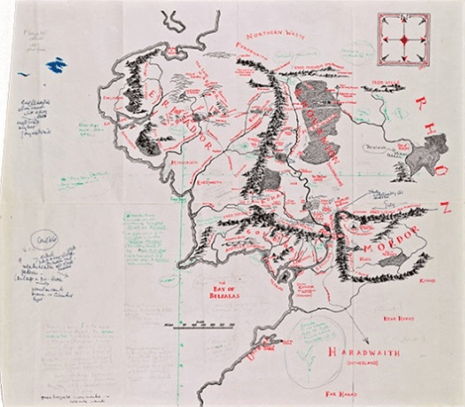
Searching for quotes, I found a collection of "geographical" quotes of Tolkien:

The action of the story takes place in the North-west of ‘Middle-earth’, equivalent in latitude to the coastlands of Europe and the north shores of the Mediterranean…. If Hobbiton and Rivendell are taken (as intended) to be at about the latitude of Oxford, then Minas Tirith, 600 miles south, is at about the latitude of Florence. The Mouths of Anduin and the ancient city of Pelargir are at about the latitude of ancient Troy (Letters, no. 294 from March 1968).

Hobbiton is assumed to be approx at latitude of Oxford. The green vertical line is marked at distances of 100 miles (2cms to map scale). So you can roughly judge the climate and Fauna/Flora etc. Minas Tirith is about a latitude of Ravenna (but is 900 miles east of Hobbiton, more near Belgrade). Bottom of the map (1400 miles) is about a lattitude of Jerusalem. Umbar & City of Corsairs –about that of Cypres. green horizontal is also marked in 100 mile intervals.

If Hobbiton and Rivendell are taken (as intended) to be at about the latitude of Oxford, then Minas Tirith, 600 miles south, is at about the latitude of Florence.


And also found this collection of related trivia:

In a letter to his publishers, John Ronald Reuel Tolkien wrote that The Shire - home to the "little people" better known as hobbits - was "more or less a Warwickshire village of about the period of [Queen Victoria's] Diamond Jubilee" in 1897.

In a newspaper interview Tolkien fondly recalled the area, saying the Shire was "inspired by a few cherished square miles of actual countryside at Sarehole".

Following an Italian holiday in 1955, Tolkien, somewhat light-heartedly, referred to Venice as Gondor. However, this was after he had written Lord of the Rings. He also wrote that Gondor's power to build "the gigantic and massive" resembled the ancient Egyptians.


As well as transcription of annotated map of Middle Earth which also has some interesting parts (although already disclosed above):
- Hobbiton is at latitude of Oxford
- Minas Tirith is near latitude of Ravenna, but to the east
- Umbar is latitude of Cyprus

This "latitude of Florence/Ravenna, but to the east" might suggest Belgrade, as Constantinople is farther south. In fact, mountains to east of Belgrade have a squarish shape, rather similar to Mordor. Very definitely not Northern Europe.

Although by searching for this stuff, I found out another interesting thing: some of geographic features of Gondor and Mordor are inspired by India and areas near it:
But when you look at general shape of northwestern Middle Earth, it is clearly inspired by underwater geography of Atlantic ocean:

Now, all of these pertain purely to geography, but they do show that geography does not, in fact, argue against the possibility of Gondor being (in part) inspired by Byzantium. Rather, it very much argues for such a possibility (as well as several other possibilities besides).

Well, regardless whether anyone changes their opinion due to this discussion or not, I'm quite sure it will have been a good learning experience for everyone involved. :D
 
I'll put it this way:
You have amassed quite a bit of circumstantial evidence; though there may be other circumstantial evidence that you missed, as an attorney for the defense would point out, which weakens a prosecutor's argument (the prosecution side in some countries does not quite "miss" such "unwelcome" evidence, not to put it in harsher terms).
The easiest solution for the prosecution would be the "defendant's" confession. This we definitely do not have, as I see it.
But just circumstantial evidence is not enough. There are the matters of opportunity and motive.
Opportunity should have been quite sufficient at a university of Oxford's standing; though again I see a possible issue with even Oxford not having all the information that you were able to research, as it simply did not exist at the time.
But my most serious doubts stem from motive: I don't believe JRRT was that interested in history unless it cast a light of philology. And JRRT quite clearly was a philologist with a focus on English and its close neighbors spoken in northern Germany and Scandinavia, the latter very much including Iceland. Even in the time he was (not really) studying "Classics", the Greek side of it would very probably have been "pre-Macedonian", so at least a good deal more than half a millennium before anything which could be called "Byzantine".
(An aside: do we have any inkling during what time frame the "Eastern Roman" empire morphed into the "Byzantine" one?)

Tom Shippey had the opportunity, as he mentions in the preface to the second edition of 1992, of receiving a letter from JRRT dated 13 April 1970, commenting on an essay Shippey had submitted to JRRT for critique. The essay would, more than a decade later, become, or at least become part of, his 1982 first edition of "The Road to Middle-earth". Shippey notes that it took him quite a while, basically up to the publication of the 1992 second edition, to "get" some of the gently put criticisms by JRRT, as they were put quite obliquely.
I hypothesize your being able to submit your essay to JRRT for similar critique. Well, I can definitely imagine JRRT commenting on quite a few of your details with "You don't say! I never knew that about the Byzantine Empire." 😜

So I see you mass of circumstantial evidence foundering on the rocks of motive. I could also imagine JRRT, while being bemused at the "primary inspiration" you assume him to have had, to allow you to have your personal applicability of Gondor to the Byzantine Empire. I certainly won't be visualizing Gondorians as Byzantines. Not to be wondered, I really can't even visualize the Byzantines as Byzantines! If I were to be given a multiple-choice test with pictures of clothing, armor, weapons, jewelry, architecture and whatnot with the goal of picking out what the Byzantine one was (in a European context), I would probably fail miserably. This may be one area where PJ, or rather the Weta Workshop crew (when not pushed in wrong directions by PJ), responsible for so much of the background atmosphere that I found fitting at least for the LoTR films, may now be my (by now already a bit dim) visualization of Gondor (and much else - Hobbiton!).
 
I'll put it this way:
You have amassed quite a bit of circumstantial evidence; though there may be other circumstantial evidence that you missed, as an attorney for the defense would point out, which weakens a prosecutor's argument (the prosecution side in some countries does not quite "miss" such "unwelcome" evidence, not to put it in harsher terms).
The easiest solution for the prosecution would be the "defendant's" confession. This we definitely do not have, as I see it.
But just circumstantial evidence is not enough. There are the matters of opportunity and motive.
Opportunity should have been quite sufficient at a university of Oxford's standing; though again I see a possible issue with even Oxford not having all the information that you were able to research, as it simply did not exist at the time.
But my most serious doubts stem from motive: I don't believe JRRT was that interested in history unless it cast a light of philology. And JRRT quite clearly was a philologist with a focus on English and its close neighbors spoken in northern Germany and Scandinavia, the latter very much including Iceland. Even in the time he was (not really) studying "Classics", the Greek side of it would very probably have been "pre-Macedonian", so at least a good deal more than half a millennium before anything which could be called "Byzantine".
(An aside: do we have any inkling during what time frame the "Eastern Roman" empire morphed into the "Byzantine" one?)

Tom Shippey had the opportunity, as he mentions in the preface to the second edition of 1992, of receiving a letter from JRRT dated 13 April 1970, commenting on an essay Shippey had submitted to JRRT for critique. The essay would, more than a decade later, become, or at least become part of, his 1982 first edition of "The Road to Middle-earth". Shippey notes that it took him quite a while, basically up to the publication of the 1992 second edition, to "get" some of the gently put criticisms by JRRT, as they were put quite obliquely.
I hypothesize your being able to submit your essay to JRRT for similar critique. Well, I can definitely imagine JRRT commenting on quite a few of your details with "You don't say! I never knew that about the Byzantine Empire." 😜

So I see you mass of circumstantial evidence foundering on the rocks of motive. I could also imagine JRRT, while being bemused at the "primary inspiration" you assume him to have had, to allow you to have your personal applicability of Gondor to the Byzantine Empire. I certainly won't be visualizing Gondorians as Byzantines. Not to be wondered, I really can't even visualize the Byzantines as Byzantines! If I were to be given a multiple-choice test with pictures of clothing, armor, weapons, jewelry, architecture and whatnot with the goal of picking out what the Byzantine one was (in a European context), I would probably fail miserably. This may be one area where PJ, or rather the Weta Workshop crew (when not pushed in wrong directions by PJ), responsible for so much of the background atmosphere that I found fitting at least for the LoTR films, may now be my (by now already a bit dim) visualization of Gondor (and much else - Hobbiton!).

Problem with opportunity and motive is that we simply cannot know anything about opportunities and motives which JRRT had unless he disclosed them himself. Which, for the most part, he did not. However, late 19th and early 20th century is the time of development of Byzantine studies as an independent discipline. Karl Hopf, Vasiliy Vasilievski both started writing about Byzantine history long before Tolkien started writing Lord of the Rings. Opportunity was there.

Going back to motives, we do know that Tolkien was interested in Goths: Vidugavia is a clearly Gothic-ish name. And eastern Romans had a long, and varied, history with Goths, going from Third to Sixth centuries, and ranging from war, to alliance, to war.... Battle of Pelennor is likely inspired by Battle of Cataluanian Fields, which while happening in the West was merely an outcome of a series of events heavily involving the Eastern Roman Empire. And even beyond history, Tolkien's interest did extend to Southern Europe: he was also versed in the Bible and the Greek mythology.

I do not think Tolkien was "only interested in history if it cast a light of philology". Philology might have been his primary interest, but his worldbuilding is too deep for him not to have interest in history beyond that. Tolkien's works also display the understanding of military organization and logistics which most other fantasy works do not have: there is literally nothing that human armies do in his books which could not have been done by a corresponding historical army. Reason why Minas Tirith and Minas Morgul are so close together is because otherwise Witch King's assault would have been impossible. And his descriptions of war preparations - be in preparations of Ar-Pharazon, of the Last Alliance, or awareness of need and frequency of last-ditch repairs to defences before a siege (Helm's Deep and Rammas Echor both get such repairs) show a deep understanding of medieval military operations which is simply lacking in most of today's fantasy authors. That is not something mere interest in philology could provide.

EDIT: RE: VIsualizations, Tolkien almost certainly did not intend for Gondorians to be visualized as Byzantines. Byzantines were pretty much the heirs of antiquity. And while Renaissance (and many people today) had an image of "pearly white" Antiquity, reality was quite a bit different. Antiquity was not white; rather, it was very colourful - just as Middle Ages were also rather colourful instead of being all beiges-and-browns. But Gondor is typically described as associated to bichrome of black and white (I imagine living there would be a bit like watching an old TV!). There are no colours there, so at "first look" at least, you would not associate them with Byzantium.
EDIT2: Found this on architecture:

EDIT: RE: An aside, that depends. Byzantines never called themselves such, they always considered themselves Romans. But for historians, there are several possible "morphing" points: final fall of Western Roman Empire (which fell with pretty much a whisper, so when that happened can vary by some century at least), replacement of Latin language with Greek one under Justinian, or Arab conquests which destroyed (what was left of) ancient civilization and brought Europe - Byzantium included - into Middle Ages.
 
Last edited:
Happy to see an in-depth discussion (finally…!) about the Byzantine comparison. This reading gets ever more interesting!

A side-issue (meaning it may nag just me personally) is Aldarion’s earlier quote he gave as JRRT’s “confirmation” for the “Gondor=Byzantium” hypothesis:

This is the full paragraph. It comes from the "Reader's Companion", "EXTRACTS FROM A LETTER BY J.R.R. TOLKIEN TO MILTON WALDMAN, ?LATE 1951, ON THE LORD OF THE RINGS":
The Fifth Book returns to the precise point at which Book Three ended. Gandalf on his great horse (with the Hobbit Peregrin Took) passing along the great 'north-road', South to Gondor. Now we come to the half-ruinous Byzantine City of Minas Tirith, and meet its grim lord, the old proud wizard-like Steward, Denethor. He prepares for war and hopeless siege. The last levies from the remaining fiefs march in. The great darkness comes. The Nazgul ride the air, cowing all hearts. Slowly the assault begins and mounts in fire and terror. Denethor commits suicide. The Sorcerer-King, Captain of the Black Riders, overthrows the 'unbreakable' gates of the City. Gandalf alone is left to face him.

This quote is not mentioned in the following books:
  1. “The Letters of JRR Tolkien” compiled by Humphrey Carpenter and Christopher Tolkien
  2. “The J. R.R.Tolkien Companion & Guide”(both “Chronology” and “Reader’s Guide”) by Christina Scull & Wayne G. Hammond, published 2006.
  3. “The J. R.R.Tolkien Companion & Guide – Reader’s Guide” Parts I and II, by Christina Scull & Wayne G. Hammond, published 2017.
  4. “The Tolkien Companion” by JEA Tyler
  5. “The Road to Middle-Earth” by Tom Shippey (an edition from 2012)
  6. “Critical Companion to JRR Tolkien” by Jay Ruud (2011 edition)
  7. “The complete Guide to Middle-Earth” by R. Foster (1993 edition)
Regarding the first one (the “Letters”), it does include the mentioned letter (it's under number 131), but there can be a doubt if it was reproduced there in full (it was a very long letter).

Nonetheless, and unless I overlooked it: none of these sources includes this quote, although some of these are quite extensive and eminent works (in fact, none of them supports the “Gondor=Byzantium“ hypothesis in any way).

Could anyone specify which is the source of that quote…?
 
This is the full paragraph. It comes from the "Reader's Companion", "EXTRACTS FROM A LETTER BY J.R.R. TOLKIEN TO MILTON WALDMAN, ?LATE 1951, ON THE LORD OF THE RINGS":
This quote is not mentioned in the following books:
Could anyone specify which is the source of that quote…?
What Aldarion means is the Hammond / Scull 2005 "The Lord of The Rings - A Reader's Companion", not to be found in your above list. What is included in the chapter bearing exactly the title Aldarion cited is the part in JRRT's letter to Waldman about LoTR which is skipped over in Carpenter's "Letters" with those ominous three dots. It starts on page 742 of the H-S book, what Aldarion quoted is to be found on the second half of page 746. 100% score for Aldarion here.
@Aldarion : That I can be stubborn as a mule should no longer surprise you. I repeat what I stated above:
"Not to be wondered, I really can't even visualize the Byzantines as Byzantines!" 😜
But I have another quibble that I will address in a separate post. 🤨
 
What Aldarion means is the Hammond / Scull 2005 "The Lord of The Rings - A Reader's Companion", not to be found in your above list. What is included in the chapter bearing exactly the title Aldarion cited is the part in JRRT's letter to Waldman about LoTR which is skipped over in Carpenter's "Letters" with those ominous three dots. It starts on page 742 of the H-S book, what Aldarion quoted is to be found on the second half of page 746. 100% score for Aldarion here.

Thanks - I finally found it now! Great discussions. :)
 
I do not think Tolkien was "only interested in history if it cast a light of philology". Philology might have been his primary interest, but his worldbuilding is too deep for him not to have interest in history beyond that. Tolkien's works also display the understanding of military organization and logistics which most other fantasy works do not have: there is literally nothing that human armies do in his books which could not have been done by a corresponding historical army. Reason why Minas Tirith and Minas Morgul are so close together is because otherwise Witch King's assault would have been impossible. And his descriptions of war preparations - be in preparations of Ar-Pharazon, of the Last Alliance, or awareness of need and frequency of last-ditch repairs to defences before a siege (Helm's Deep and Rammas Echor both get such repairs) show a deep understanding of medieval military operations which is simply lacking in most of today's fantasy authors. That is not something mere interest in philology could provide.
As to the first part I highlighted, I think JRRT's lecture (and later paper) "The Monsters and the Critics" on Beowulf very much shows him as dealing very severely with historians who had wailed "why did the Beowulf poet not give us more on Ingeld and all the rest that we are interested in?!?" To compress JRRT's answer (in a language he would certainly not have approved of) "The Beowulf post didn't give a shit about any (including your) whiny nagging. Get a reality check, he was writing a friggin' Fairy Story (for adults - I have called LoTR the Beowulf for our days), and if you are looking for other things, you are simply totally daft!".
This is, I would guess, perhaps limited to his "professional" interest (but JRRT never really, for himself, divided "profession" and "hobby" (a term that is much too weak for Middle-earth).

As to JRRT's understanding military, yes, he had the extremely dubious "privilege" of experiencing the horrific (for both sides) Battle of the Somme of mid-1916. And as John Garth in his "Tolkien and the Great War" wrote, he went practically everywhere on foot while near the front. Now I do not wish, retrospectively, that other writers of Fantasy (or the Fantastic) should have had such horrific first-hand experience (Shippey mentions Orwell being almost fatally wounded in the Spanish Civil War, or Vonnegut being in Dresden when it was annihilated by bombing in 1945). But I have, to the contrary, often had the impression that JRRT gave little thought to the issue of supply lines and auxiliaries (certainly on the side of the baddies who seemed to be able to throw limitless troops into battle without the slightest regard to supply logistics).

But you post "Reason why Minas Tirith and Minas Morgul are so close together is because otherwise Witch King's assault would have been impossible." Going either by Christopher's map in my 2002 hardcover edition of LoTR, or Karen Wynn Fonstad's "Atlas", that would appear to be a distance of a bit over 40 miles, or around 65 kilometers. If greater distance seems to you "impossible", what am I to make of the distance of over 150 miles or 240 kilometers (by CRT's map) or over 170 miles or almost 280 kilometers by Fonstad's map? I have searched (unsuccessfully - have I ever mentioned that you can be annoying [a comment my wife and I bandy about back-and-forth regularly]) for a post of yours where you give the extreme limit of any non-fossil-fuel-using military unit, including draft animals, at 300 - I think it was kilometers. Unopposed, I'd guess.

No, JRRT was not involved with logistics in WW I (nor was he, luckily for him as a subaltern officer, a second lieutenant, leader of a platoon, unlike his TCBS friend R.Q. Gilson, killed on the very first day of The Somme, 01 July 1916). And if there is anything that JRRT detested more than industrialization, it would be its application to warfare. Not that he approved much of more ancient warfare. His "The Homecoming of Beorhtnoth Beorhthelm's Son" is a scathing indictment of the dark, negative side of the "Theory of Northern Courage" that some simplemindedly may have thought him to have endorsed without qualification. I think you are again taking circumstantial evidence beyond what it actually supports.
 
As to the first part I highlighted, I think JRRT's lecture (and later paper) "The Monsters and the Critics" on Beowulf very much shows him as dealing very severely with historians who had wailed "why did the Beowulf poet not give us more on Ingeld and all the rest that we are interested in?!?" To compress JRRT's answer (in a language he would certainly not have approved of) "The Beowulf post didn't give a shit about any (including your) whiny nagging. Get a reality check, he was writing a friggin' Fairy Story (for adults - I have called LoTR the Beowulf for our days), and if you are looking for other things, you are simply totally daft!".
This is, I would guess, perhaps limited to his "professional" interest (but JRRT never really, for himself, divided "profession" and "hobby" (a term that is much too weak for Middle-earth).

And he did show rather dismissive attitude towards people who were nagging him about details which he did not feel like developing - and he himself did not really consider a lot of things, such as day-to-day logistics of Minas Tirith (seven gates in seven walls are not enough for a city of size implied for it to survive - it would require seven gates just in main wall), Moria (where do dwarves grow food?) or Mordor (there are no rivers - how do they get food from Sea of Nurnen to Barad-dur - that is some 200 miles!). But though he might have disliked warfare, it does form a major aspect of his work, and it is rather unlikely he half-arsed it.

As to JRRT's understanding military, yes, he had the extremely dubious "privilege" of experiencing the horrific (for both sides) Battle of the Somme of mid-1916. And as John Garth in his "Tolkien and the Great War" wrote, he went practically everywhere on foot while near the front. Now I do not wish, retrospectively, that other writers of Fantasy (or the Fantastic) should have had such horrific first-hand experience (Shippey mentions Orwell being almost fatally wounded in the Spanish Civil War, or Vonnegut being in Dresden when it was annihilated by bombing in 1945). But I have, to the contrary, often had the impression that JRRT gave little thought to the issue of supply lines and auxiliaries (certainly on the side of the baddies who seemed to be able to throw limitless troops into battle without the slightest regard to supply logistics).

His understanding of military is unlikely to be limited to merely his experiences in World War I. In fact, said experiences - though they heavily inform Tolkien's work at some points (most obviously Dead Marshes and Siege of Minas Tirith) - would be of naturally limited utility in understanding medieval warfare, military organization and logistics. But if memory serves me, Anglo-Saxon epics (I have not really read any, though, so going by tertiary sources here) are rather warfare-oriented. Studying them, as Tolkien did, would naturally lead person to develop significant level of understanding of warfare as was waged at the time - much like studying Croatian heroic ballads will lead one to develop rather deep understanding of life (mostly warfare) on Croatian-Ottoman border. But I do believe he might have done research on stuff beyond what could be gleamed merely from epics themselves. I just can't know that.

But you post "Reason why Minas Tirith and Minas Morgul are so close together is because otherwise Witch King's assault would have been impossible." Going either by Christopher's map in my 2002 hardcover edition of LoTR, or Karen Wynn Fonstad's "Atlas", that would appear to be a distance of a bit over 40 miles, or around 65 kilometers. If greater distance seems to you "impossible", what am I to make of the distance of over 150 miles or 240 kilometers (by CRT's map) or over 170 miles or almost 280 kilometers by Fonstad's map? I have searched (unsuccessfully - have I ever mentioned that you can be annoying [a comment my wife and I bandy about back-and-forth regularly]) for a post of yours where you give the extreme limit of any non-fossil-fuel-using military unit, including draft animals, at 300 - I think it was kilometers. Unopposed, I'd guess.

Infantry army can march 10-12 miles a day and carry roughly 10 days of supply on person. Wagon train and presence of the fleet (as noted Mordor was building in Osgilliath) would significantly increase that distance - but only within range of waterways. So what matters here is not actually distance of Minas Tirith to Minas Morgul, but rather of Minas Morgul to Osgilliath and then of Osgilliath to Minas Tirith. Regardless of what exact numbers you use, fact still remains that Minas Tirith and Minas Morgul are extremely close. Compare =<170 miles Minas Tirith - Morgul distance to 1 000 miles from Constantinople to Baghdad, or 500 miles from Constantinople to Byzantine border in 9th century. And there were military expeditions in premodern times mounted over distances much, much longer than those. Of course, those were armies which relied either on fleet train or on foraging.

Overall, logistics work even with Fonstad's setup (assuming 120 miles Minas Morgul to Osgilliath) but are at the outer bounds of possible with infantry army - and pretty much explain why Witch King opted for an assault instead of circumvallation of the city. In fact, in such a view destruction of Rammas Echor can be explained by the necessity to minimize obstructions to whatever resupply scheme Morgul forces had managed to set up, rather than by sheer hatred (though former probably wouldn't require complete destruction of the wall).

Regarding my post, I couldn't find it, but I did find my calculations on Mythic Scribes forum (I think I used Roman, not English, miles in the post):
Basically:
  • Infantryman can carry 14 - 17 days of supply with himself at most, though as noted more usual number is 10 days. All-infantry army can cover some 8-12 miles per day. So distance is some 80 - 120 miles (130 - 200 km), or 120 - 180 miles (200 - 290 km) at the outside.
  • Mule can carry around 14-15 days of supplies - with most of supplies going to mule, of course. This would overall require around 1-2 mules per soldier, and allow army to reach 350 km.
  • Mules puling wagon would easily incrase this distance to 700 km (420 miles) at least, but would require more than four weeks to cover that distance (25 km / 15 miles per day). If you are willing to go to above extreme (majority, that is cca 3/4 of wagon space going to mule fodder), you can increase distance to 8 weeks or 1 400 km, but that would require massive number of mules.
Overall, distance from Minas Morgul to Osgilliath can be covered with a lot of fodder being left over with either pack mules or mule-pulled wagons. And if Osgilliath is used as a forward supply base, then siege of Minas Tirith is relatively easy to set up, logistically speaking. What is not easy is moving deeper into Gondor - which is why Minas Tirith needs to be taken (beyond its political and symbolic significance) - it can serve as a supply base (especially if granaries are taken intact) and at very least it opens up Osgilliath supply route.

No, JRRT was not involved with logistics in WW I (nor was he, luckily for him as a subaltern officer, a second lieutenant, leader of a platoon, unlike his TCBS friend R.Q. Gilson, killed on the very first day of The Somme, 01 July 1916). And if there is anything that JRRT detested more than industrialization, it would be its application to warfare. Not that he approved much of more ancient warfare. His "The Homecoming of Beorhtnoth Beorhthelm's Son" is a scathing indictment of the dark, negative side of the "Theory of Northern Courage" that some simplemindedly may have thought him to have endorsed without qualification. I think you are again taking circumstantial evidence beyond what it actually supports.

I have never linked his logistical knowledge to his service in World War I. Logistics in Lord of the Rings are very much medieval. But they do exist, and they play a significant role in shaping the events:
  • Faramir notes that Witch King had spent time building and massing barges in eastern Osgilliath before assault.
  • Osgilliath is the key because only there can Anduin be crossed - which is important both for assault itself and for resupply of Sauron's army.
  • Witch King decides on assault on Minas Tirith due to a) possible reinforcements arriving and b) logistical concerns (Mordor's army is huge)
  • First thing Numenoreans do when going back to Middle Earth is to secure ports for resupply. First thing Sauron does is to attemt to deny them these ports.
  • Feanor causes kinslaying because he knows how much easier it is to cross ocean in ships.
  • One of Sauron's more important successes was his capture of Umbar - fact that he apparently spent a lot of time and manpower on that shows that he had finally understood importance of sea control.
And logistics are not connected to industrialization. Army of Flintstones and assorted cavemen is just as dependant on logistics as a modern mechanized army - though logistics themselves are completely different, of course.

If Tolkien had had Sauron ignore logistics like he was in late-show Game of Thrones, Sauron would have just marched an army around Ered Mithrin and Ettenmoors into Rivendell. But he didn't, so Sauron couldn't.

@Aldarion : That I can be stubborn as a mule should no longer surprise you. I repeat what I stated above:
"Not to be wondered, I really can't even visualize the Byzantines as Byzantines!" 😜
But I have another quibble that I will address in a separate post. 🤨

Stubborness is good. Makes for good discussion.
 
...
And even beyond history, Tolkien's interest did extend to Southern Europe: he was also versed in the Bible and the Greek mythology.
...
Extend, probably. But I would guess somewhat peripheral . The Greek Mythology that may have interested him is, by nature, to him a heathen mythology as was that (little) to be discovered in the Eddas and Norse Sagas about Norse Mythology (far less than most people realize, and very late compared to what the "Germanii" may have believed in in comparison to Julius C.'s time). Byzantium (as I need not tell you) was Christian. Which leads me to ...

As to Bible, he was not a theologian, as he stated more than once. And as he also more than once stated a preference for pre-Vatican-II-Council Catholicism, while one of the decisive statements by V II was about recognizing the other Christian churches - Wiki: "Notably, [Pope Paul VI's] meeting with Ecumenical Patriarch Athenagoras I in 1964 in Jerusalem led to rescinding the excommunications of the Great Schism, which took place in 1054." After a mere 910 years ...
I don't think JRRT ever mentioned anything about his views on the Eastern Orthodox Church (he was busy enough dealing with that "Ultonian Church of Englander" C.S. Lewis 😁), though he may possibly have had a slightly more benign attitude towards them - when he thought about them at all - than towards those Lutheran / Calvinist / etc. "heretics". (The EOs, by the way, basically considered all Catholics to be heretics - among other things that "filoque" issue ...).

And what JRRT thought of "textual criticism" (or more neutral analysis) of the Bible is another thing I do not have an idea about (though this is one subject I have read quite a lot about). One item being reversing the order in the New Testament "Matthew, Mark, ...", as scholars believe to be able to show that Mark's writings are the older. Or the division into four hypothesized "sources" for the Old Testament (Hebrew Tanakh) into "Yahwist", "Elohist", "Deuteronomist", and "Priestly" sources.

JRRT's Catholicism, as he pointed out several times, was the "Roman" one (there are others, one splitting off after the Vatican I promulgation of Papal infallibility, others much older - but all certainly massively dwarfed by Rome). That would be Augustinian (Augustine being the first of the Latin "Fathers" of the Church, all previous ones, such as Origines, having written in Greek). I would say neither his Roman Catholicism nor his interest in "pagan" Greek Mythology - or philosophy, be it Socrates, Plato, or Aristoteles - points towards Byzantium.

(I must complain to our forum wizard mazzly: there is only a boring horse in the selection of the "Smilies" button, certainly not anything to be unequivocally to be identified as a mule - or as you might prefer, a donkey. 🤪)

*sigh*

"Not to be wondered, I really can't even visualize the Byzantines as Byzantines!"

(*insert mule's bray here*)
 
I’m glad this thread has cooled down a bit.

I’ve read “Gondor as a pre-Byzantium” speculation on the web since the late 1990s, when Tolkien articles and essays first began to appear on the internet and I could search for them. Olorgando beat me to the punch on the long section in Reader’s Companion, which is now lying open on my desk.

A few points here:
  • Tolkien was very much aware of ancient warfare and of the history of both the Western and Eastern Roman Empire: It was an essential part of his profession as a philologist. Philology is not merely linguistics, but languages in their contexts as history. The continual invasions of both Rome and Constantinople by northern and eastern peoples were of critical interest to Tolkien: the first language he learned as a young teenager was Visigothic, if I recall correctly, the language of invaders who overthrew Roman government in the western Mediterranean. He was also well-versed in the battles, tactics, and strategies of wars in the Classical, Dark, and Middle Ages, as shows in his writing.
  • The sheer horrors of World War I did inspire much of Tolkien’s descriptions of Mordor, the Dead Marshes (in No-man’s Land on the Western Front, the bodies of the dead could be seen beneath greasy pools: sometimes the skin of the dead would come loose from their faces and float to the tops of the pools), and the desert of Dagorlad before the Black Gates. But he was even more horrified by the enormous evil personified in Hitler and Stalin, the utter destruction of the atomic bombs, and the demonization of soldiers in the armies of the enemies of Britain. Though these last three evils became apparent during World War II (and demonization of the Germans in particular was absolutely an element of World War I propaganda as well), Tolkien says they did not play a role in the development of Lord of the Rings.
  • It is all too easy to become overwrought when one’s dearly-beloved beliefs are challenged or contradicted. Do I not know this all too well myself! We do well to remember that all participants on the board do not concur with our deeply-held beliefs. And in saying this, some of you may find, if you look, that I publicly ripped into another board member many years ago: But in my defense, it was because he had been belittling others for their beliefs, while his own dear idiosyncratic and contradictory holdings were built on shaky sand: exposing and undermining them was all too easy!
  • There are differences between men and women: that’s a fact, not speculation or opinion. The French used loudly to proclaim Vive la difference! and the rest of Western Civilization laughed and repeated it with gusto. Today, Western Civilization is crumbling, literally burning, the Gramscian damage of nearly a century of Marxist lies and propaganda. Tolkien objected to changes in the Roman liturgy, according to his grandson Simon, who reported that

    [I]t was soon after the Church had changed the liturgy from Latin to English. My Grandfather obviously didn’t agree with this and made all the responses very loudly in Latin while the rest of the congregation answered in English. I found the whole experience quite excruciating, but my Grandfather was oblivious.
    ​
    We can well imagine what the old Professor would have thought of the current state of affairs at his beloved Oxford, and its obsequious obeisance to the inane prattlings of Critical Theory with its idiotic Marxist underpinnings: he would definitely not approve, nor should we imagine his opinions of its practitioners be in any way complimentary.
That said, I do agree that Minas Tirith is in many ways a reflection of Constantinople, and Gondor in many ways is a “foreshadowing” (if we may use so strong a term as to presume a fictional land foreshadows a great and illustrious realm in the real world of men) of Byzantium. I think the conclusion that Tolkien used that pattern to build Minas Tirith and Gondor is unmistakable, as the fracturing of Arnor reflects the fracturing of the Western Empire; but there are a great wealth other examples upon which he also drew to build his subcreation of Middle-earth. He knew them all, and used them, drawing water from a deep well of history and literature that almost breathes life into his mythos.

I am not certain to which reference in Reader’s Companion Olorgando and Aldarion refer. The passage of the “half-ruinous Byzantine City of Minas Tirith” is originally from Tolkien’s long letter to Milton Waldman, the longest in Letters of JRR Tolkien; but in my 2005 edition of Reader’s Companion, on its pages 569-571, referencing LotR page 848 and RotK page 124 (as “848 (III:124)”), Hammond and Scull comment,

After periods of great power and glory, by 1453 the Byzantine Empire had lost most of its territories and was facing the growing power of invaders from the east, the Ottoman Turks. Tolkien himself recognized the parallels between this and the once great Númenórean realms in exile. He wrote to Milton Waldman in ?late 1951: “But in the north Arnor dwindles ... and finally vanishes. In the south Gondor rises to a peak of power, almost reflecting Númenor, and then fades slowly to decayed Middle Age, a kind of proud, venerable, but increasingly impotent Byzantium. …”
​
 
Extend, probably. But I would guess somewhat peripheral . The Greek Mythology that may have interested him is, by nature, to him a heathen mythology as was that (little) to be discovered in the Eddas and Norse Sagas about Norse Mythology (far less than most people realize, and very late compared to what the "Germanii" may have believed in in comparison to Julius C.'s time). Byzantium (as I need not tell you) was Christian. Which leads me to ...

I am not suggesting that he was interested in Byzantine mythology, but that his interest was not limited just to Northern Europe, despite what some - even some of his own statements - may suggest (and what you, in fact, have suggested - context!). And if he was interested in Southern Europe and potential clash of civilizations (as suggested by his East vs West dychtonomy, with Sauron controlling East - he was originally in Rhun before he moved to Mordor - and Numenoreans controlling the West), then Byzantium would have been an unavoidable reading.

As to Bible, he was not a theologian, as he stated more than once. And as he also more than once stated a preference for pre-Vatican-II-Council Catholicism, while one of the decisive statements by V II was about recognizing the other Christian churches - Wiki: "Notably, [Pope Paul VI's] meeting with Ecumenical Patriarch Athenagoras I in 1964 in Jerusalem led to rescinding the excommunications of the Great Schism, which took place in 1054." After a mere 910 years ...
I don't think JRRT ever mentioned anything about his views on the Eastern Orthodox Church (he was busy enough dealing with that "Ultonian Church of Englander" C.S. Lewis 😁), though he may possibly have had a slightly more benign attitude towards them - when he thought about them at all - than towards those Lutheran / Calvinist / etc. "heretics". (The EOs, by the way, basically considered all Catholics to be heretics - among other things that "filoque" issue ...).

You do not need to be theologian to be "versed" in the Bible. And I do not see why him being a Catholic would prevent him from appreciating Byzantine Empire which did, after all, save Western civilization, Catholicism included. In fact, Boromir's little "shield of the West" speech could well have been given by any of various Byzantine Emperors between 7th and 15th centuries (or even earlier...).

JRRT's Catholicism, as he pointed out several times, was the "Roman" one (there are others, one splitting off after the Vatican I promulgation of Papal infallibility, others much older - but all certainly massively dwarfed by Rome). That would be Augustinian (Augustine being the first of the Latin "Fathers" of the Church, all previous ones, such as Origines, having written in Greek). I would say neither his Roman Catholicism nor his interest in "pagan" Greek Mythology - or philosophy, be it Socrates, Plato, or Aristoteles - points towards Byzantium.

I do not see why his theological interests are relevant to his historical ones. Nothing he has written points towards India either, yet geography of Gondor and Mordor is based - in part at least - on areas of British India and Tibet, as shown in the link I had provided already.
 

Today's events

Similar threads

Back
Top