

In the final years of the Third Age, The War of the Ring ensued. Forces of darkness unite to find the One ring and conquer the lands for Sauron. The people of Middle-earth, those that are free from Sauron's influence, fought his forces, despite knowing that their only hope was in the destruction of the Ring. The fate of Endor lay in the hands of two Hobbits. They must destroy the One Ring at the place of its creation in Mount Doom, but no one can bear to destroy it. The war exposed the weakening of the Elves of Middle-earth (also called Endor) and showed the rise of Men in the West. It ended with the Reunion of the Kingdom under the lineage of High King Elendil, and the beginning of a new age.
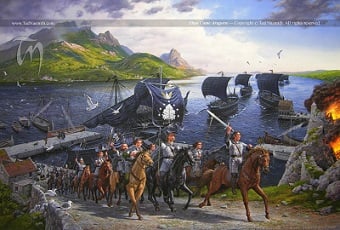 Thus Came Aragorn by Ted Nasmith. After the first defeat of the evil lord Melkor in the first age, Sauron fled to Mordor, where he established the Barad-Dur Tower to grow in secret. From his realm in Mordor. He made attacks on men and elves who didn't succumb to his treachery over the ages. In the third ages, after the Ring of Power became lost in the war of the Last Alliance. Sauron moved to Dol Guldur (Hill of Dark Sorcery), located in the south of Mirkwood, where he prepared for the final war against the free people.
Sauron grew secretly in Dol Guldur. He had established himself there and made it his stronghold and the base of his evil operations. Sauron waited through centuries for the weakening of the Kingdoms of men for him to finally strike and find his One Ring to bind them all. In the War of the Ring, Sauron's forces had all the tactics and weaponry to conquer Middle-earth, therefore they underestimated the free people. The war resulted in the loss of life to the many people of Rohan and Gondor. Hundreds of thousands took part in the war—The forces of the free people and the servants of the Dark Lord.
Battles were aimed at Sauron's forces from Gondor, Dale, and Rohan, then others in Erebor, Lorien (Vala Irmo), and Mirkwood. In the year 2851, Saruman was already acting in his interest to get the ring of power. By the third century in the Third Age, Saruman's evil intentions weren't a secret anymore, he was the third rival with his army of over 10,000 soldiers.
Saruman wanted the location of the ring, he had intended to ally with Sauron to find it and then betray him. His evil was evident, and he caused the Battle of Isen Fords, and then the Battle of Bywater. The death of Saruman in the book differed from the film. In the book, he died at Bag End, in the Shire, when Grima Wormtongue slashed his throat after the War of the Ring ended. But in the film, he died when Grima, one of his bewitched followers stabbed him from behind, and he fell to his doom. After the War ended and Sauron's spirit was defeated, Gandalf crowned Aragorn as King Elessar. He pardoned the race of men who fought behind the Dark Lord, and he began a new era of mutual acceptance and relationship amongst the Men of Middle-earth, Elves, and the Dwarves.
Sauron grew secretly in Dol Guldur. He had established himself there and made it his stronghold and the base of his evil operations. Sauron waited through centuries for the weakening of the Kingdoms of men for him to finally strike and find his One Ring to bind them all. In the War of the Ring, Sauron's forces had all the tactics and weaponry to conquer Middle-earth, therefore they underestimated the free people. The war resulted in the loss of life to the many people of Rohan and Gondor. Hundreds of thousands took part in the war—The forces of the free people and the servants of the Dark Lord.
Battles were aimed at Sauron's forces from Gondor, Dale, and Rohan, then others in Erebor, Lorien (Vala Irmo), and Mirkwood. In the year 2851, Saruman was already acting in his interest to get the ring of power. By the third century in the Third Age, Saruman's evil intentions weren't a secret anymore, he was the third rival with his army of over 10,000 soldiers.
Saruman wanted the location of the ring, he had intended to ally with Sauron to find it and then betray him. His evil was evident, and he caused the Battle of Isen Fords, and then the Battle of Bywater. The death of Saruman in the book differed from the film. In the book, he died at Bag End, in the Shire, when Grima Wormtongue slashed his throat after the War of the Ring ended. But in the film, he died when Grima, one of his bewitched followers stabbed him from behind, and he fell to his doom. After the War ended and Sauron's spirit was defeated, Gandalf crowned Aragorn as King Elessar. He pardoned the race of men who fought behind the Dark Lord, and he began a new era of mutual acceptance and relationship amongst the Men of Middle-earth, Elves, and the Dwarves.
Origins of War of the Ring
The beginning of the war can be traced to the time when Bilbo Baggins first received Thorin Oakenshiled and his dwarf companions had a party at Bilbo's place in Bag End. Gandalf had recounted to Frodo in Minas Tirith that things were no longer under control as the effects of the events in the Middle-earth had spread even to Rivendell. The City of Dale and the Kingdom underneath the mountain had fallen, and the only hope to offset Sauron in the North was the Dwarven Kingdom of Erebor. But even Erebor had its problem with Smaug, a potential ally of Sauron, just behind it. Gandalf planned that if Smaug was defeated, the North would become further strengthened as there would be no internal foes to face.
Impact of Gandalf in the War
Gandalf was the leader of the free people in the sense that he strategized and designed tactics as one of the most learned. Mithrandir would search, and examine ancient maps and records in archives from past events of Endor, to know the best approach when faced with enemies. He also gathered allies to the best of his ability. Gandalf also took the time to implement his strategies and tactics, as seen in the case of Smaug. He planned to annihilate Smaug even before the War started because of the high possibility of becoming a hindrance in their cause. Gandalf always had his plans clear in his mind. He helped the Dwarves to reclaim their home in Erebor, and desolate Smaug to get closer to the goal of the Free Peoples.
The Roles of the other Wizard
The activities of Saruman are well-known, he redesigned his fate and distanced himself from the primary goal of the Istari in Arda. He made himself become so overwhelmed by the want of power that he became an enemy of the free people. He wanted the control that The Ring could offer. Although he told Gandalf that he would take the ring and use it to rule over Endor with peace and equity, Gandalf and the other Istari knew that the power of the Ring was forged for evil, and no being has the will to overpower the original will of the ring. He abandoned his position as the leader of the Wizards and became Saruman of many colors. The Blue Wizards were two friends, Alatar and his best friend, Pallazo. One had followed the other to the East of Arda to teach the people of the east their abilities and spread the words of revolution against the evil of Sauron. The Blue Wizard taught the men of the east their magic and intended to indoctrinate them during the learning that Sauron would destroy them once they aid him in his quest. However, Blue Wizards seem to have failed in their mission as the east remained a vulnerable people and powerful support for Sauron.
Radagast the Brown, also called Aiwendil, the Bird Tamer, was less adventurous than the other wizards. He concerned himself with tending to plants and animals and having few mentions in the times that preceded the War of the Ring. In the War, he was instrumental as he lived on the west of Mirkwood and kept watch over Dol Guldur. When Saruman began his search for The Ring on Gladden Fields he offered his help innocently by sending animals to search with him, and as spies to observe Sauron's activities.
Radagast the Brown, also called Aiwendil, the Bird Tamer, was less adventurous than the other wizards. He concerned himself with tending to plants and animals and having few mentions in the times that preceded the War of the Ring. In the War, he was instrumental as he lived on the west of Mirkwood and kept watch over Dol Guldur. When Saruman began his search for The Ring on Gladden Fields he offered his help innocently by sending animals to search with him, and as spies to observe Sauron's activities.
Events of the War of the Ring
Events of the South
Sauron was aware of how strong the Kingdom of Gondor can be, so he plotted the downfall of Gondor in his grand strategy. He planned to take over Minas Tirith by creating internal problems that the nations would struggle with and would distract them from the reality of events of Middle-earth. To ensure that Gondor would find no help, he supported Saruman to establish himself towards the west of Rochan, in Isengard. He intended to invade Gondor, which would be left with no support in Minas Tirith as Rohan soldiers struggled with Saruman and his Isengard attack. Sauron then sent the Allies of Mordor, Corsairs to Gondor to cause problems in the south. The assault left Gondor sending lesser forces to keep guard at Minas Tirith while the majority waited on the coast in preparation for the Corsairs. Despite Sauron's well-thought strategy, it failed in the end, and he met the reunited forces of the Gondor and the Northern Rohan.
Rohan
The main events of the war commenced as Saruman's forces passed the Fords of Isen. The heir of King Theoden, Theodred led forces to catch the enemies unawares. In the year 3019 T. A, he overran the leading unit of Saruman's Orcs that were going out from Isengard, but he had to retreat when the Orcs received reinforcements. Then forces of Theodred retreated to one of the Fords' islands but soon met his end when the orcs ambushed them on the island.
Grimbold survived and held the island with the help of Elfheim, who arrived with reinforcements of Helm's Deep forces. Theodred, the West Bank's Marshall was killed, but the Battle in the Fords of Isengard was a triumph for the people of Rohan. Erkenbrand took charge of the Westfold forces.
He stationed Grimbold and had him and Elfhelm hold the Fords. But they were soon overpowered by the forces in Isengard and caused to scatter into different parts of the Westfold. With the forces scattered, Saruman had no resistance during the passage. Gandalf advised King Theoden to relocate to Helm's Deep while he gathers the forces that are scattered in Westfold. He then exiled Gríma Wormtongue from Edoras. King Theoden reached helm's Deep without hindrance but this security wouldn't last. The Orcs and men from the wild from Saruman's servants attacked Helm's Deep.
Aragorn, the elf Legolas and their dwarf companion, Gimli, gave their support but the battle looked lost until Gandalf arrived with the scattered forces of Erkenbrand and Hourns from Treebeard. The servants of Saruman stood no chance against these new allied forces, the men became captives and the Orcs were destroyed. The captives realized they had been misled by Saruman to believe the Rohirrim were evil and cruel, so they gave their oath of allegiance. Treebeard and the other Ents joined the battle because of Saruman's brutal exploration of the forest. The Ents of Fangorn Forest agreed to aid Gandalf's cause and see to the destruction of Isengard and Treebeard took over the command of Isengard.
Grimbold survived and held the island with the help of Elfheim, who arrived with reinforcements of Helm's Deep forces. Theodred, the West Bank's Marshall was killed, but the Battle in the Fords of Isengard was a triumph for the people of Rohan. Erkenbrand took charge of the Westfold forces.
He stationed Grimbold and had him and Elfhelm hold the Fords. But they were soon overpowered by the forces in Isengard and caused to scatter into different parts of the Westfold. With the forces scattered, Saruman had no resistance during the passage. Gandalf advised King Theoden to relocate to Helm's Deep while he gathers the forces that are scattered in Westfold. He then exiled Gríma Wormtongue from Edoras. King Theoden reached helm's Deep without hindrance but this security wouldn't last. The Orcs and men from the wild from Saruman's servants attacked Helm's Deep.
Aragorn, the elf Legolas and their dwarf companion, Gimli, gave their support but the battle looked lost until Gandalf arrived with the scattered forces of Erkenbrand and Hourns from Treebeard. The servants of Saruman stood no chance against these new allied forces, the men became captives and the Orcs were destroyed. The captives realized they had been misled by Saruman to believe the Rohirrim were evil and cruel, so they gave their oath of allegiance. Treebeard and the other Ents joined the battle because of Saruman's brutal exploration of the forest. The Ents of Fangorn Forest agreed to aid Gandalf's cause and see to the destruction of Isengard and Treebeard took over the command of Isengard.
Gondor
In Osgiliath
Three centuries passed and Gondor still struggled with the attacks of the Easterlings, even as the Kingdom shrunk. The War of the Ring was imminent, so Faramir who was the captain of the forces in Gondor separated the forces into sections. He stationed the two major fronts in Osgiliath and Cair Andros. When the Great Signal started at Minas Morgul and was subsequently answered in Mount Doom, the full-scale Battle of Osgiliath began. Sauron's forces ravaged the fortresses, The captain of Gondor, Faramir, retreated to Causeway Forts, then Minas Tirith as the Battle intensified.
In Pelennor Fields
Everywhere was filled with tension, The Nazgûl threatened from above to spread confusion and fear. The forces of Gondor held onto the last fortress but were unable to sustain their repulsion as Minas Tirith Gate finally fell and the Nazgûl Lord gained entrance. The servants of Sauron took control of the battle until King Theoden led Thousands of Rohirrim forces, and Aragorn came from the Southern Gondor with more forces. Kingdoms became united in their struggle and defeated the forces of Sauron. Victory in the war came at a price, the forces of Sauron lost the Witch-King, but the free people lost Theoden of Rohan and Denethor of Gondor.
In Morannon
The final battle occurred in Morannon at the entrance of the Black Gate. Aragorn led more than six thousand soldiers from the West. It was an audacious move, and no one would have made such a confrontation except one with the Ring of Power. That was the distraction that the Free People wanted. Sauron thought that Aragorn showed such effrontery because he held the ring of power, so he focused his attention on him and his forces, but he was wrong, the bigger threat was already in his Fortress. Frodo and Sam Gamgee had the ring and had infiltrated Mordor. When they finally managed to destroy the ring with the help of Gollum, the force of Sauron lost and the spirit of their master became forever weakened.
Northern Stage
Mordor's war tactics were centered on the south. Sauron attempted to capture the Free People's land from Rhovanion by deploying his orcs and wild men. Sauron had intentions to use the army of his main operational base in Dol Guldur, southern Mirkwood in the defeat of Lothlórien. He would then proceed to Hithlagaer, destroying the Eldar of Rivendell, head to Rohan, and finally Gondor. But The Realm of Thranduil in the Woodland caused the first upset by dividing the forces of Dol Guldur in two. Dol Guldur would have to face the Elves of the Wood to proceed. Sauron also planned to use the Easterlings to aid the orcs on Woodland Realm and later connect them with the army of orcs heading to Lothlorien, after being victorious over the Woodland Elves. Sauron's plan on the Woodlands failed. This was because Erebor had been restored by the Dwarf leader Thorin II and his companions with the help of Gandalf the Grey and Bilbo Baggins. The dwarves, along with the people of Dale foiled Sauron's Easterling plans and prevented the connection of Sauron's force in Lothlorien. River Anduin separated the two battle stages from the north and the south. The line runs along the border of Rohan and lies between Gondor and Lothlorien. Orc armies that had fled Lothlorien sought to gain entrance into Rohan through the river, while other Orc armies that headed towards Minas Tirith were destroyed by the Fangorn Forest Ents when the Ents attacked them until they drowned in River Anduin.
City of Dale and Erebor
The outcome of the events in the north is crucial to the War of the Ring. When Sauron realized he wouldn't receive any aid from the dwarven Kingdom in his search for his Ring of Power, therefore, he decided to destroy them as well. He sent men from the east to Dale, the army from the east met the men of Dale and the dwarves, then the war in the north began. The Easterling fought the Army of Dale and the Dwarves for three days. The restored city of Dale was destroyed and the Men moved to Erebor to seek refuge. Erebor was better fortified and long prepared for events like this. The Dwarves in the Erebor had experienced destruction previously and had made preparations that would help prevent future events like it.
The desolation of Smaug and the outcome at the Battle of five armies came at a huge price. They made fortification that would best prevent the infiltration of Orcs. They also knew that they wouldn't enjoy the support of Eagles and Beorn as they did in the centuries that passed. The Iron Hill was to the north what Minas Tirith was to the war in the south. The Easterlings made works of beleaguerment: wild rams, catapults, scimitars to overrun the other party, and make them surrender, but they found the dwarves and the people of Dale and Lonely Mountains a worthy opponent. The survivors hastened to Erebor to take refuge behind the Iron Hills. The war at Erebor was fierce, the Easterlings were prepared and ferocious. Each fight party knew that a failure at Erebor would be a great loss and the determinant of the War of the Ring. The weapons of the Easterlings were deadly maces and Scimitars to carve the life out of dwarves and Men of Dale.
The Dwarves and Army of Men from Dale also didn't fall short in causing horrific harm to the Easterlings, the party of the dwarves pelted them with rocks of Erebor that crumbled the Easterlings, also they had spears and harmers designed for death, and they show no pity in their cause. Each fighting party had painful losses. King Brand of Dale died in the War, he fell by the gate of Erebor, Dain II, the King Erebor, also died defending the body of the King of Dale. When news of Sauron's defeat reached from the south, the Easterlings lost their morale, they understood that they would be fighting a lost battle and scattered. The heirs to the throne of Dale and sons of Dain went out of the Lonely Mountains to further demoralize them.
The desolation of Smaug and the outcome at the Battle of five armies came at a huge price. They made fortification that would best prevent the infiltration of Orcs. They also knew that they wouldn't enjoy the support of Eagles and Beorn as they did in the centuries that passed. The Iron Hill was to the north what Minas Tirith was to the war in the south. The Easterlings made works of beleaguerment: wild rams, catapults, scimitars to overrun the other party, and make them surrender, but they found the dwarves and the people of Dale and Lonely Mountains a worthy opponent. The survivors hastened to Erebor to take refuge behind the Iron Hills. The war at Erebor was fierce, the Easterlings were prepared and ferocious. Each fight party knew that a failure at Erebor would be a great loss and the determinant of the War of the Ring. The weapons of the Easterlings were deadly maces and Scimitars to carve the life out of dwarves and Men of Dale.
The Dwarves and Army of Men from Dale also didn't fall short in causing horrific harm to the Easterlings, the party of the dwarves pelted them with rocks of Erebor that crumbled the Easterlings, also they had spears and harmers designed for death, and they show no pity in their cause. Each fighting party had painful losses. King Brand of Dale died in the War, he fell by the gate of Erebor, Dain II, the King Erebor, also died defending the body of the King of Dale. When news of Sauron's defeat reached from the south, the Easterlings lost their morale, they understood that they would be fighting a lost battle and scattered. The heirs to the throne of Dale and sons of Dain went out of the Lonely Mountains to further demoralize them.
War in Lorien and Mirkwood
Dol Guldur launched attacks on Lothlorien three different times during the War of the Ring. The Elves of Lothlórien and Mirkwood decided to attack and destroy the last remaining fortress of Sauron's servants in Rhovanion, Dol Guldur, after the news of the defeat of Sauron had spread. Celeborn led the ranks out of Lothlorien and crossed River Anduin. The Nazgûl who were guards of the castle was destroyed, and its army fell to the Elves of Lórien. On the 6th of April, Galadriel reached the gates and used her power to destroy the walls. The forest was restored as the evil stronghold of the Dark Lord was destroyed. On the day Dol Guldur fell to the Lothlorien, Celeborn and the elven King Thranduil met to split and rename the forest. It was given the name Eryn Lasgalen. The east was renamed East Lorien and taken by Celeborn while Thranduil took the forests to the north of the Mountain of Mirkwood. He shared the forest in the middle to Woodmen and the shape-shifting Boernings.
The Shire
After the fall of the Sauron, Saruman charmed the Treebeard to free him from captivity using his wizard magic, he used his voice and was released in Isengard. He moved into the Shire, disguised as Sharkey, and took over from Sackville-Baggins to rule as chief. Under his rule, the Ruffian men infiltrated the Shire to cause damage. Meraidoc Brandybuck and Peregrin Took led armies against Sharkey and defeated him and his troop. The Hobbits then moved to the Hobbiton. In the Hobbiton, Frodo Baggins banished Saruman and his cohort, Wormtongue from the Shire. When Wormtongue saw what became of him, struck Saruman, and he too met his end after being struck by an arrow from the Hobbits. Saruman's fall marked the end of all War related to the Ring.
War Implications
The War had a great impact on all lands of Endor, especially the North and West. The War laid the course for the Reunification of the Kingdoms of Gondor with Arnor under the line of High king Elendil under King Elessar (Aragorn son of Arathorn), who lived 120 years more after his coronation. Faramir took over from his father, Denethor II, The Steward of Gondor, who fell in the war. Faramir kept his father's office and then received the title: Prince of Ithilien. The heir to the throne of Rohan, Theodred died in the Battle of Pelennor Fields, his father died too. The throne was given to Eomer, the nephew succeeded King Theoden. At Erebor, and within the Caves of Hornburg, the dwarf nation was re-established. The Ents retained Isengard and revitalized the pits of camps of Saruman.
The Ents reforested Isengard and renamed it Treegarth of Orthanc. In Dale, the successor of King Bard of Dale, King Brand fell in War, King Dain II iron foot was also killed. The son of King Brand, Bard the son of Brand the son of Bard succeeded him, and Thorin III succeeded his father, King Dain III. They all showed their loyalty and remained allies to King Elessar through his crowning onward. The declining power of the elves worsened as the Ring's destruction caused the power in the other three rings to fade, and all kingdoms that thrived with the power of the ring faded too. The ring bearers left Endor.
Lothlórien became an abandoned place. The Lothlórien Elves that did not leave Middle-earth moved eastwards of Mirkword's to the southern third which they called East Lórien. The Elven King Thranduil Continued his rule in Eryn Lasgalen in peace and harmony. Another elven colony existed in Ithilien. The Elves in Rivendell left over the sea. Life continued for Hobbits of the Shire, nothing changed from what it was before the war. King Elessar extended the lands of Shire and named it Westmarch in Shire Reckoning 1452, and confirmed it under the Sceptre of Annuminas a free land.
The races of the Atani that served under Sauron remained curtailed, nevertheless, unrepentant. The most notable was the powerful Easterlings. Most of the Easterlings were condemned to death as they suffered defeat in the Battle of Pelennor Fields. The Easterlings and the Haradrim retreated but didn't seize until after many territory related wars against King Elessar of the Reunited Kingdom and the Rohirrim. They were silenced by the might of the new King afterward and remained in silence. They showed signs of their wild nature but wouldn't dare to make their threat apparent. By the age that followed the third, the elves had lost all influence on Middle-earth. Their influence faded since the defeat of Sauron. The Orcs of Sauron became little mountain brigands that gathered in bands and weren't capable of any more destruction as they were famously known to do. All Nazgul were destroyed and Sauron faded into the empty void., like the first Dark Lord Melkor.
The Ents reforested Isengard and renamed it Treegarth of Orthanc. In Dale, the successor of King Bard of Dale, King Brand fell in War, King Dain II iron foot was also killed. The son of King Brand, Bard the son of Brand the son of Bard succeeded him, and Thorin III succeeded his father, King Dain III. They all showed their loyalty and remained allies to King Elessar through his crowning onward. The declining power of the elves worsened as the Ring's destruction caused the power in the other three rings to fade, and all kingdoms that thrived with the power of the ring faded too. The ring bearers left Endor.
Lothlórien became an abandoned place. The Lothlórien Elves that did not leave Middle-earth moved eastwards of Mirkword's to the southern third which they called East Lórien. The Elven King Thranduil Continued his rule in Eryn Lasgalen in peace and harmony. Another elven colony existed in Ithilien. The Elves in Rivendell left over the sea. Life continued for Hobbits of the Shire, nothing changed from what it was before the war. King Elessar extended the lands of Shire and named it Westmarch in Shire Reckoning 1452, and confirmed it under the Sceptre of Annuminas a free land.
The races of the Atani that served under Sauron remained curtailed, nevertheless, unrepentant. The most notable was the powerful Easterlings. Most of the Easterlings were condemned to death as they suffered defeat in the Battle of Pelennor Fields. The Easterlings and the Haradrim retreated but didn't seize until after many territory related wars against King Elessar of the Reunited Kingdom and the Rohirrim. They were silenced by the might of the new King afterward and remained in silence. They showed signs of their wild nature but wouldn't dare to make their threat apparent. By the age that followed the third, the elves had lost all influence on Middle-earth. Their influence faded since the defeat of Sauron. The Orcs of Sauron became little mountain brigands that gathered in bands and weren't capable of any more destruction as they were famously known to do. All Nazgul were destroyed and Sauron faded into the empty void., like the first Dark Lord Melkor.
Various Adaptations
There are lots of adaptations in Films, Animated movies, Video Games e.t.c. The work was a great success. There are action games that were designed around the events of the war:
- The Games Workshop's 2005 Strategy Battle Game of the Summer Online Campaign for The LOTR.
- The Fantasy Flight board game called WOTR for LOTR. [1] The hex and counter wargame produced by SPI in 1977 (which showed an evident influence on the Fantasy Flight version).
- The LOTR: WOTR, a computer game that is based on an RTS published in 2003 by Sierra Entertainment. [2]
- The BME series of RTS games was published in 2004 and then in 2006 by Electronic Arts.
- The board game was a miniature wargame from Nexus Editrice in the year 2004.


