• Welcome to The Tolkien Forum! Connect with fellow Tolkien enthusiasts and join a community that is over two decades old, and still going strong. We look forward to meeting you.  Register

🌋Mordor 🧌Orcs at Parth Galen

aragil

Just another loremaster
Joined
Aug 27, 2001
Messages
1,849
I'm a little bit pressed for time right now, otherwise I'd lay out my case. Anyways, it might be interesting to hear what you all think of the matter first.

Were there Mordor orcs at Parth Galen other than Grishnakh? Obviously there were Misty Mountain Maggots (MMMs) and the redoubtable Uruk-hai. But what about Orcs of the Eye?
 
The Great River
Frodo looked up at the Elf standing tall above him, as he gazed into the night, seeking a mark to shoot at. His head was dark, crowned with sharp white stars that glittered in the black pools of the sky behind. But now rising and sailing up from the South the great clouds advanced, sending out dark outriders into the starry fields. A sudden dread fell on the Company.

`Elbereth Gilthoniel!' sighed Legolas as he looked up. Even as he did so, a dark shape, like a cloud and yet not a cloud, for it moved far more swiftly, came out of the blackness in the South, and sped towards the Company, blotting out all light as it approached. Soon it appeared as a great winged creature, blacker than the pits in the night. Fierce voices rose up to greet it from across the water. Frodo felt a sudden chill running through him and clutching at his heart; there was a deadly cold, like the memory of an old wound, in his shoulder. He crouched down, as if to hide.

Not that this is any kind of hefty proof, but I think these Orcs on the east bank were Mordor Orcs because a) it is more likely that Orcs on the east bank would be those from Mordor and b) I find it unlikely that Orcs not from Mordor would be cheering a Nazgul, a creature they were unfamiliar with and would most likely fear.

But I guess you're inquiring about Parth Galen specifically. I'm not sure if there's any proof about that, but for some reason I doubt Grishnakh would have been the sole messenger of Lugburz. At least some Mordor Orcs must have been among those who attacked the Fellowship.
 
When Grishnakh and Ugluk had their little tiff, Ugluk and his pals took out their frustration on the smaller Moria Orcs, and Grishnakh disappeared for a few days. When Grishnakh reappeared near Fangorn, he had a dozen or so more Moria Orcs with him, so I'm guessing that he was alone originally.
Perhaps he met up with the Isengarders by chance, and the rest of his colleagues couldn't cross the river because Legolas shot down their transport...
 
Aule's got my thoughts exactly- except that Grishnakh shows up with 40 Mordor Orcs- this must be all that could be quickly mustered to try and reclaim the Ring from Ugluk & co.

Ithrynluin- Orcs on the East shore are certainly Mordor Orcs- the Anduin is impassable on foot from Osgiliath to the Carrock, so I seriously doubt any Isengard Orcs (or Moria Orcs) would be found on the East side.
Regarding transport on foot- it would be impossible to get from Sarn Gebir (where the Mordor Orcs attack) to Parth Galen on foot. This is actually written in the narrative- it says that the Fellowship portages around the rapids, but that after the rapids (i.e. 60 or so miles) there is no trail for those on foot. The only way to get to Parth Galen would be on the river, .... or in the air:
'Is Saruman the master or the Great Eye?' said the evil voice. 'We should go back at once to Lugbúrz.'
'If we could cross the Great River, we might,' said another voice. 'But there are not enough of us to venture down to the bridges.'
'I came across,' said the evil voice. 'A winged Nazgûl awaits us northward on the east-bank.'
 
My 2 cents...

I'd say Grish was either alone or member of a very very small party of a couple few orcs - much too small to pose a threat or influence either Uruks or even independent mountain maggots. The bottom line is we don't know if he was one or a member of a small crew. Also I kinda think Mordor had some ties to the Misty Mtn types and if so Grish 'may' have had some degree of 'connection' or 'liaison' w/ them and thus maybe he wasn't alone in a sense...? Either alone or w/ a VERY small party - my presumption is he was sent to the other side of the river to coordinate/communicate w/ Mordor's supposed allies. Cleary 'he' is not there in sufficient force to take on the Fellowship.

Also among the dead orcs at Parth (before we are intro'd to Grish) the language suggests 'some' orcs are of Isengard but others are... well we don't know exactly - either mountain maggots or possible a few mordor 'eye' orcs disposed of by Boromir et al.

We only really know of Grish's earlier departure at Parth (actually it was a 12 hour march west if I recall in a dell or something - not Parth) because he rejoined on a more or less directly eastern intercept (the LONGER route...?). Interestingly enough Aragorn specifically searched the area where I believe Grish separated or was last known to be in Ugluk's company and I don't think there was ANY mention of 1 or more orc's separating - that's an odd oversight for a Ranger specifically looking for clues in a place where the track was at that point only something like 6 to 12 hours old.

I find the thought of any orc cheering a Nazgul odd - but if any I suppose it would be a Mordor orc. Then again the Mordor orcs might be intimately familiar w/ the actual terror the Nazgul spread thus my quandary...? I always figured the Mordor management school was a philosopy of pure terror and near slavery than anything inspirational but who knows!

Yes, later Grish and co. magically reappeared in the same place and at the same time no less (near Fangorn several days later). I too recall he was w/ 40ish or so at that later time. His feat of magically arriving at the same time and place by a different/longer path (more or less directly East) is probably one of the few feats that eclipses the Uruk's athleticism that I can recall. How Grish did this invites some creative theories. The bottom line is that we'll never know the how's but in the end there he was... ;)

I refer to the Uruk's trek as the 'Death March' (and remember the maggots DID barely keep up while Aragorn and co fell behind) and Grish's ultimate rendevous near Fangorn I refer to as the 'Magic Rendevous'.

I always catch a lot of flak for this ever since I explored this aspect of the story but I find the whole death march and magical rendevous thing is a credibility goof on several levels for me. Tolkein doesn't even give us a good nugget of a magic bean explanation here either. But what the hay, it's fun to explore and analyze at any rate. ;o)

At this point I'm not sure it really matters whether or not Grish is solo or has 1 or a few companeros at Parth or later in the dell where they have the disagreement and he probably separates - the number is small enough to be ineffectual at that time.

What I do enjoy is the various theories on how Grish manages his rendevous w/ 40 Mordor orcs later on - those are some of the most imaginative theories to make everything fit - and many folks have a strong fundamental need to 'make things fit' neatly... Sometimes I'm one of them myself.

I previously worked out on a zoomed map of the area the basic paths and dates and distances involved graphically and uploaded the map but it seems my 'map' posts are treated to a different standard than others presently so I have no idea if this is still around but I have it on PC somewhere I think.
 
If I remember rightly, we know that orcs come across the river frequently to steal black horses for Mordor. This means that we can assume that the river crossing is quite feasible for the Mordor orcs.

Aragorn says at Parth Galen: "Here lie many who are not the folk of Mordor" [quote from memory]. That strikes me as ambiguous. It sounds as though he is saying that some ARE the folk of Mordor, but they are not specifically described.
 
RRRRRRRRRRRR!!!!!!!!!!!!!!!!!!!!

Stupid web-browser just deleted a longish post.

I'll cut to the chase:

Snaga- you're the one who originally pointed out to me that Aragorn's statement can be read to mean that there are no Mordor Orcs present. This is supported by Pippin's observations (Pippin always describes 'northern orcs' and Ugluk's lot as the two categories of Orcs), Gimli's gaff (he thinks that 's' stands for Sauron- if there were bodies of Orcs lying around bearing the eye he would be unlikely to make such a blunder), and Aragorn's later observations (when viewing the 5 dead orcs in the dell he mentions only Moria orcs and Isengarders, no mention of Mordorians having ever been present).

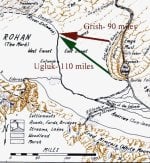
pgt- I made a map to argue the same point in another reality. Grishnakh cheated on the Death March- he flew north with the Nazgul to rejoin his cronies (the ones who attacked the Fellowship at Sarn Gebir). He then cut straight west across Rohan- a shorter trip than Ugluk & co, who had to travel Northwest to reach the same spot. The rendezvous point was an obvious one, it was right where the Entwash turned west into the forest, and would be the point at which Ugluk would have to arrive in order to reach Isengard by the shortest route without actually crossing the Entwash. Here's my map:
 

Attachments

  • lotrmap9.jpg
    lotrmap9.jpg
    83.6 KB · Views: 70
Near the beginning of the chapter “The Uruk-hai&#8221:
’Don't draw attention to yourself, or I may forget my orders. Curse the Isengarders! Uglúk u bagronk sha pushdug Saruman-glob búbhosh skai‣: he passed into a long angry speech in his own tongue that slowly died away into muttering and snarling.
In Appendex F:
The inscription on the Ring was in the ancient Black Speech, while the curse of the Mordor-orc in II, 53. was in the more debased form used by the soldiers of the Dark Tower, of whom Grishnákh was the captain.
Grishnákh was not alone then. The cursing Orc was also a Mordor-orc. Grishnákh is here said to be captain of “the soldiers of the Dark Tower”. I would not take this to mean all the soliders of the Dark Tower but to mean the soldiers of the Dark Tower who appear at that point in the story among the Uruk-hai.

When Griskhnákh reappers with about 40 Orcs Uglúk says nothing about there being a larger contingent. The text only says:
They had a red eye painted on their shields. Uglúk stepped forward to meet them.‘So you’ve come back?’ he said. ‘Thought better of it, eh?’
There is no suggestion that Grishnákh has a larger body with him than before.
 
jallan- I think Tolkien was in error when he attributed those words to a "soldier of the dark tower":

From the Uruk-hai
'If I had my way, you'd wish you were dead now,' said the other. 'I'd make you squeak, you miserable rat.' He stooped over Pippin bringing his yellow fangs close to his face. He had a black knife with a long jagged blade in his hand. 'Lie quiet, or I'll tickle you with this,' he hissed. 'Don't draw attention to yourself, or I may forget my orders. Curse the Isengarders! Uglúk u bagronk sha pushdug Saruman-glob búbhosh skai': he passed into a long angry speech in his own tongue that slowly died away into muttering and snarling.
...
Many loud yells in orc-speech answered him, and the ringing clash of weapons being drawn. Cautiously Pippin rolled over, hoping to see what would happen. His guards had gone to join in the fray. In the twilight he saw a large black Orc, probably Uglúk, standing facing Grishnákh, a short crook-legged creature, very broad and with long arms that hung almost to the ground. Round them were many smaller goblins. Pippin supposed that these were the ones from the North. They had drawn their knives and swords, but hesitated to attack Uglúk.
Uglúk shouted, and a number of other Orcs of nearly his own size ran up. Then suddenly, without warning, Uglúk sprang forwards, and with two swift strokes swept the heads off two of his opponents. Grishnákh stepped aside and vanished into the shadows. The others gave way, and one stepped backwards and fell over Merry's prostrate form with a curse. Yet that probably saved his life, for Uglúk's followers leaped over him and cut down another with their broad-bladed swords. It was the yellow-fanged guard. His body fell right on top of Pippin, still clutching its long saw-edged knife.
...

From The Riders of Rohan
'We have already overtaken some of those that we are hunting,' he said. 'Look!' He pointed, and they saw that what they had at first taken to be boulders lying at the foot of the slope were huddled bodies. Five dead Orcs lay there. They had been hewn with many cruel strokes, and two had been beheaded. The ground was wet with their dark blood.
'Here is another riddle!' said Gimli. 'But it needs the light of day and for that we cannot wait.'
'Yet however you read it, it seems not unhopeful,' said Legolas. 'Enemies of the Orcs are likely to be our friends. Do any folk dwell in these hills?'
'No,' said Aragorn. 'The Rohirrim seldom come here, and it is far from Minas Tirith. It might be that some company of Men were hunting here for reasons that we do not know. Yet I think not.'
'What do you think?' said Gimli.
'I think that the enemy brought his own enemy with him,' answered Aragorn. 'These are Northern Orcs from far away. Among the slain are none of the great Orcs with the strange badges. There was a quarrel, I guess: it is no uncommon thing with these foul folk. Maybe there was some dispute about the road.'

The guard that gives the speech is assumed to be a Northerner by Pippin. Pippin of course is no great judge of Orcs, but that particular Orc is killed and later observed by Aragorn, who also places him as a Northerner. Either Tolkien intended the Orc to be a Northerner but deliberately misled the readers, or else he originally intended for the Orc to be a northerner, but then forgot this 10+ years later when he wrote the appendix on language. I'm for option B. Any reason to believe option A is the case?

And again the text has Grishnakh urging Northerners to fight Ugluk. If he had 40+ Mordor Orcs and 100+ Moria Orcs then I doubt that Merry and Pippin would have gone off Westward. I think the obvious conclusion is that Grishnakh's gang of 40 Mordor Orcs were not present at the time of the conflict in the dell. Any reason to assume otherwise?
 
aragil said:
RRRRRRRRRRRR!!!!!!!!!!!!!!!!!!!!

Stupid web-browser just deleted a longish post.

Well it beats having your post disappear because you used the word MAP but didn't include an image. Oops I guess this post will be gone too...

I think your reasoning is about as good as this one is going to get.

Regarding your MAP (oops, I don't have an image myself but am using the word...) I would place the magical rendezvous much closer to where the river exits the forest.

Also in addition to Grish's ~90mi western trek he had to go X miles north (airborne?) on the MAP . COmbine those 2 legs of the triangle and Grish traveled much further in the same time than Ugluk's direct hypotenuse MAP route of teh triangle.

Airborne operations? It's outlandish but if the shoe fits... We have 40 orcs moved by Air-Nazgul but the Nazgul couldn't cross the river themselves then or see fit to simply chase down possible halfings that Grish, in the process of being airlifted, would certainly have reported?

The airborne theory always seems far fetched to me but how else could this possibly happen? I guess I just feel this whole episode has flaws in it and mostly I leave it at that nowadays.

Great analysis BTW - if I had my MAP handy I'd repost it but then the whole thing w/ me and MAP gets me in trouble. In fact I may already be in trouble since I didn't provide a MAP image when discussing a MAP with TEXT ONLY. I'm told I'm not allowed to discuss MAPs with text only. :(
 
The White Rider
'Also they have filled themselves with new doubts that disturb their plans. No tidings of the battle will come to Mordor, thanks to the horsemen of Rohan; but the Dark Lord knows that two hobbits were taken in the Emyn Muil and borne away towards Isengard against the will of his own servants. He now has Isengard to fear as well as Minas Tirith. If Minas Tirith falls, it will go ill with Saruman.'
----------------
And he does not know of the quarrel between his servants and the Orcs of Mordor.

From this we can tell that Sauron was somehow given a message by Grishnakh. Grishy must have somehow have gotten back to the Nazgul, and informed him of the deeds of Saruman's Orcs. It also says their that there were more than one of Sauron's Orcs present at the time in question.

The White Rider
'For already he [Sauron] knows that the messengers that he sent to waylay the Company have failed again. They have not found the Ring. Neither have they brought away any hobbits as hostages.

From this, we can deduce that Sauron knew about the Company and their path, and that he sent Grishnakh & co. to capture the hobbits. Whether this was a plan carried out seperately to Saruman's is nto revealed.
 
Aule- I don't think those passages particularly demonstrate that Grishy had anyone backing him up. First off, Gandalf was never anywhere near the Death Marching Orcs, so he would hardly be considered a reliable source to describe their make-up. Second of all, none of his words really contradict what we already know. Sauron sent Mordor Orcs to waylay the company at Sarn Gebir- this group would certainly be considered to be plural (this probably is also the company which Grishnakh originates from- check out how Ugluk teases him about 'his' Nazgul having another mount shot from under him). Also, Gandalf's words are spoken after Grishnakh rejoins Ugluk with 40+ Mordor Orcs- an event which Aragorn knew about (via Eomer), and which he could have communicated to Gandalf. Also, Moria Orcs are generically considered to be 'Sauron's creatures'- see Appendix B under the entry for ~TA 2475. I've always taken it that Ugluk beheading the two Moria Orcs was the first instance of open hostilities between Saruman and Sauron, even though those Orcs were MMMs and not Mordorians. In any case, 'against the will of his servants' could refer to the MMMs as well as Grishnakh. Finally, Grishnakh is not completely alone- he mentions that there is a Nazgul waiting just on the other side of the river. Grishnakh+Nazgul=servants (plural). According to my theory Grishnakh later meets up with the Nazgul in order for the Northward airlift operation- this is the opportunity for Grishnakh to communicate the treason of the Isengarders.
Read closely his language when he confronts Ugluk in the Dell. He says that he (singular) came across the River, and that he (again singular) is the trusted messenger of Sauron. The Moria Orcs demonstrate a loose allegiance towards Sauron and seem to consider Grishnakh's bid to return to Lugburz, though they seem dubious about venturing all the way down to Osgiliath ('the bridges').
Also read closely what happens when Aragorn surveys the slain Orcs around Boromir- no evidence of Mordorians, or the 5 dead Orcs in the dell- again no mention of Mordorians. When Pippin observes the return of Grishnakh he observes the Mordorians (Orcs bearing the sign of the eye) as something new- he did not see any such Orcs (other than Grishnakh) when he awoke at the dell, nor did he apparently see such Orcs when he was captured and Boromir was slain. And, most important IMO, if Grishnakh had other Mordor Orcs with him, why didn't they oppose Ugluk? The only Orcs that attempted to gainsay Ugluk are Northerners- this would have been the optimal moment for the Hidden Mordor Orcs to step forth. Instead Grishnakh slips off alone into the shadows.
 
Aragil said:
jallan- I think Tolkien was in error when he attributed those words to a "soldier of the dark tower"
If so, it yet shows that when writing Appendix F Tolkien did not think that Grishnákh was alone. See The Treason of Isengard (HoME 7) “The Uruk-hai”
Fight breaks out. Slain orc falls on top of Pippin with blade drawn. Pippin manges to cut wrist bands. Ties cord loosely again.
     Isengarders win. Mordor orcs are killed.
Aragil said:
The guard that gives the speech is assumed to be a Northerner by Pippin. Pippin of course is no great judge of Orcs, ...
I don’t see any assumptions made about the guard at that point.
Aragil said:
... but that particular Orc is killed and later observed by Aragorn, who also places him as a Northerner.
Aragorn doesn’t quite make that identification. The text reads:
     ‘I think that the enemy brought his own enemy with him,’ answered Aragorn. ‘These are Northern Orcs from far away. Among the slain are none of the great Orcs with the strange badges. There was a quarrel, I guess: it is no uncommon thing with these foul folk. Maybe there was some dispute about the road.’
Those words are not inconsistant with, for example, there being corpses of three Northern Orcs and two Mordor-orcs. Aragorn points out that these, that is the Orcs he is pointing at, are Northern Orcs. He also points out that among the slain are none of the great Orcs with the strange badges. Why say “Among the slain ...” if all the bodies are those of northern Orcs? More natural would be to say something like: “These are all Northern Orcs from far away, none of them the great Orcs with the strange badges.”

Note earlier in his draft, according to The Treason of Isengard, Tolkien writes:
     ‘These are not orcs of Mordor,’ said Trotter. ‘Some are from the Misty Mountains ...
In the published text this becomes:
     And Aragorn looked on the slain, and he said: ‘Here lie many that are not folk of Mordor. Some are from the North, from the Misty Mountains, ...
The absolute statement that the dead orcs are not orcs of Mordor is changed to wording that indicates only that many of them are not folk of Mordor.

The evidence (as often) is not as clear as one would like. But if one knew from some further writing of Tolkien’s that Tolkien saw Mordor-Orcs present at the time that he wrote the final versions of these passages nothing that Tolkien had written would be in contradiction to it.

That would not be true if a writing appeared saying the reverse. Of course we would then disregard the early draft material and the late statement in Appendix F.
Aragil said:
And again the text has Grishnakh urging Northerners to fight Ugluk. If he had 40+ Mordor Orcs and 100+ Moria Orcs then I doubt that Merry and Pippin would have gone off Westward. I think the obvious conclusion is that Grishnakh's gang of 40 Mordor Orcs were not present at the time of the conflict in the dell. Any reason to assume otherwise?
Grishnákh does not have the Northern Orcs to command. At least some of them want to head back north. Do any really want to go with Grishnákh? If full battle broke out between Uglúk and Grishnákh at that time the Northern Orcs would most likely side with the more numerous party (Uglúk’s troops) or make a break for it.

As so often, matters are ambiguous and argument from silence and what an author doesn’t say are not trustworthy.
 
Aulë said:
[/font]
From this we can tell that Sauron was somehow given a message by Grishnakh. Grishy must have somehow have gotten back to the Nazgul, and informed him of the deeds of Saruman's Orcs. It also says their that there were more than one of Sauron's Orcs present at the time in question.

It doesn't say anything about the Nazgul - he could have just as easily contacted another orc to relay his message...

But be that as it may let's assume he did contact the Nazgul... I still find it odd that the Nazgul - upon being informed of such and knowing the all importance of the mission to find 'Hobbits' did not themselves go flappin' across the forbiddin river and get the darn hobbits. Oh no, they were content to stay back and twiddle there thumbs and send 40 orcs - a force that Grish himself could and should have known would be insufficient to overpower the Uruk hai.

[/font]
From this, we can deduce that Sauron knew about the Company and their path, and that he sent Grishnakh & co. to capture the hobbits. Whether this was a plan carried out seperately to Saruman's is nto revealed.[/QUOTE]

We cannot deduce WHEN Sauron was ultimately informed of this or if we was informed during these events or AFTER these events nor that directly or indirectly ordered Grish on his amazingly speed and precise trek to his own demise.

aragil said:
[/font]Sauron sent Mordor Orcs to waylay the company at Sarn Gebir

I've always been of the opinion various Mordor orcs were posted or hanging out along the east bank in particular but in many locations... The #s of scattered orcs along there could have been quite high and covering many miles... Well at least that's the way I would have done it... ;)

Dumb question but how did Sauron 'know' to watch the river...? Was it because he now had a beed on their trek after Moria and presumed they were heading to Minas Tirith? Same applies to Saruman... How'd HE know to dispatch orcs along the river...?
 
pgt said:
It doesn't say anything about the Nazgul - he could have just as easily contacted another orc to relay his message...
No, he must have told the Nazgul, otherwise the message wouldn't have been able to cross the river. One thing that puzzles me about LotR, is that Tolkien says that the Nazgul weren't allowed to cross the Anduin, yet they must have done so to transport Grishy & co. across.
 
Aragil said:
Also read closely what happens when Aragorn surveys the slain Orcs around Boromir- no evidence of Mordorians,
Argorn states:
Here lie many that are not folk of Mordor. Some are from the North, from the Misty Mountains, if I know anything of Orcs and their kinds.
Supposing I said, “There were many interviewed today who did not speak good English”? Would that mean that none interviewed today spoke good English? “Here lie many who are not Americans.” That might mean that all those who lie there are not Americans but is more likely to mean that many of those who lie there are not American but that some are. Perhaps most of them are American.

If we knew from other sources that most of those lying dead were folk of Mordor, Aragorn’s statement would raise no problems. I think indeed, if anything, it suggests slightly that some of the dead were folk of Mordor or at least not distinguishable from folk of Mordor. We might also imagine that many of the Orcs were not obviously from Mordor or the north and Aragorn is disregarding them, pointing out only that whatever may be true of some of the dead Orcs, many of them are not Mordor-orcs.

Aragorn’s statement does not indicate that Aragorn denied there were Mordor-orcs among the dead and does not even deny that he recognized many Mordor-orcs among the dead.
Aragil said:
When Pippin observes the return of Grishnakh he observes the Mordorians (Orcs bearing the sign of the eye) as something new.
Not so.
... and there was Grishnákh again, and at his back a couple of score of others like him: long-armed crook-legged Orcs. They had a red eye painted on their shields.
There is no indication one way or the other about whether Pippin or Merry or anyone had seen Orcs with a red eye painted on their shields before. That may have been new or may not have been new.
Aragil said:
... nor did he apparently see such Orcs when he was captured and Boromir was slain.
An argument from silence, from what Tolkien does not describe. The white S-runes are not described in the description of the Hobbits being captured or anywhere else except in the short conversation on the matter.
Aule said:
No, he must have told the Nazgul, otherwise the message wouldn't have been able to cross the river.
Could have been shot across on an arrow, taken across by boat. Who knows? Once passing on the message, perhaps through another Orc, Grishnákh would naturally hurry back to Uglúk. He would know that Sauron wants the Hobbits desperately and that his main task is to get hold of them, not to stand around waiting for further orders.
Aule said:
One thing that puzzles me about LotR, is that Tolkien says that the Nazgul weren't allowed to cross the Anduin, yet they must have done so to transport Grishy & co. across.
Grisknákh actually says:
He won’t let them show themselves across the Great River yet, not too soon. They’re for the War-and other purposes.
The choice of the phrase show themselves doesn’t preclude a secret night crossing and recrossing, as long as the winged Nazgûl doesn’t show itself to any enemies who might be watching.

But the actual crossing of Orcs would normally be by boat. Grishnákh would certainly not have seriously suggested the idea that a Winged Nazgûl would fly-ferry the Orcs across the River, say five at a time. I suspect the Nazgûl would have had some Orkish support also along with one or more boats.
 
Aulë said:
One thing that puzzles me about LotR, is that Tolkien says that the Nazgul weren't allowed to cross the Anduin, yet they must have done so to transport Grishy & co. across.
The exact words were "He won't let them show themselves across the Great River yet, not too soon. They're for the War-and other purposes."
Presumably if the Nazgul did the ferrying under cover of darkness (and only just to the westward shore of the Anduin), then it would not be "showing" itself to any in Rohan or Gondor, and thus spoiling the surprise factor for the war (and other purposes). However, crossing Rohan to attack Ugluk and co. would have been running afoul of Sauron's intent (even though, as pgt points out, the potential payoff was quite large). Sauron could have done smarter things, like guard the entrance to Orodruin or allow the Nazgul to pursue Ugluk, but he didn't. We have to live with the fact that the bad guy did stupid stuff which was exploited by the good guys. "Oft evil will shall evil mar."

jallan said:
aragil said:
The guard that gives the speech is assumed to be a Northerner by Pippin. Pippin of course is no great judge of Orcs, ...
I don’t see any assumptions made about the guard at that point.
I guess this once again falls into the category of 'reasonable assumptions' based on the narrative. Pippin rolls over and sees
In the twilight he saw a large black Orc, probably Uglúk, standing facing Grishnákh, a short crook-legged creature, very broad and with long arms that hung almost to the ground. Round them were many smaller goblins. Pippin supposed that these were the ones from the North.
Since the guard was one of the first three killed, he was probably one of the 'smaller goblins' in close proximity to Ugluk and Grishnakh, which Pippin assumes to be "ones from the North".
I suppose alternative readings would be that Pippin didn't see the yellow-fanged guard when he made his supposition, or that Pippin was wrong in his supposition. Neither of these readings seems likely correct to me because Pippin's supposition is later backed up by Aragorn's pronouncement (see below), and in order for the guard to be slain he would have been relatively near to Ugluk, hence within Pippin's view at the time.

jallan said:
aragil said:
... but that particular Orc is killed and later observed by Aragorn, who also places him as a Northerner.
Aragorn doesn’t quite make that identification. ...Those words are not inconsistant with, for example, there being corpses of three Northern Orcs and two Mordor-orcs. Aragorn points out that these, that is the Orcs he is pointing at, are Northern Orcs. He also points out that among the slain are none of the great Orcs with the strange badges. Why say “Among the slain ...” if all the bodies are those of northern Orcs? More natural would be to say something like: “These are all Northern Orcs from far away, none of them the great Orcs with the strange badges.”
In order for you to say that Aragorn does not make that distinction, you first have to assume that he is only referring to a select subset of the orcs. There is no indication that he does so. He is never described as pointing at a two or three of the Orcs, therefore the most likely explanation (i.e. the one involving the least explanation outside what occurs in the text) is that he was referring to all five orcs. The fact is that here he names only Orcs from the North and Orcs from Isengard. He never mentions Orcs from Mordor as being present, and neither does he do so when looking at the Orcs from Parth Galen. Pippin does not recognize any of the Orcs in the party as being Mordor Orcs until Grishnakh reappears, and then the description of the Mordor orcs is that they are something new, not something that was at Parth Galen, then missing for two days, then suddenly reappearing at the Entwash. It may sometimes be difficult to argue something by silence from the author, but in cases where the omissions are as consistent as they are here, I think that the answer is quite obvious.

jallan said:
The absolute statement that the dead orcs are not orcs of Mordor is changed to wording that indicates only that many of them are not folk of Mordor.
I hate to argue linguistics with a linguist, but here I think you are wrong. I would parse the sentence as follows:
subject: many ... that are not folk of Mordor
verb: lie
object: here
I would parse the subject into a pronoun (many) and an adjectival element (that are not folk of Mordor). "Many" would then indicate "a large number" rather than "a relative large part of the whole". This reading is further backed up by Aragorn and Legolas's exchange with Gimli:
'I have not seen these tokens before,' said Aragorn. 'What do they mean?'
'S is for Sauron,' said Gimli. 'That is easy to read.'
'Nay!' said Legolas. 'Sauron does not use the Elf-runes.'
'Neither does he use his right name, nor permit it to be spelt or spoken,' said Aragorn. 'And he does not use white. The Orcs in the service of Barad-dûr use the sign of the Red Eye.'
If Mordor Orcs were present, why would Gimli make such an obvious error? Why wouldn't Legolas and Gimli simply point to a Red Eye? Simplest answer: because none were present.

jallan said:
Grishnákh does not have the Northern Orcs to command. At least some of them want to head back north. Do any really want to go with Grishnákh? If full battle broke out between Uglúk and Grishnákh at that time the Northern Orcs would most likely side with the more numerous party (Uglúk’s troops) or make a break for it.
This is not at all born out by the text. The Northerners do oppose Ugluk, and do so at the urging of Grishnakh, hence they are at least under his influence, if not officially under his command. The Northern Orcs ARE the more numerous party, and the fighting breaks out because they are opposing Ugluk. Why would they be less likely to oppose Ugluk with Mordor Orcs present? Who do you think the Northerners were fighting for? They certainly were not fighting against the invisible Mordor rabble. Moria Orcs are nominally creatures of Sauron- we know this from Appendix B. Grishnakh portrays Ugluk and Saruman as rebels ("'Is Saruman the master or the Great Eye?" ... "Who does he think he is, setting up on his own with his filthy white badges?"), and finally beseeches the Northerners to attack using an us (creatures of Sauron) against them (creatures of Saruman) argument: "Swine is it? How do you folk like being called swine by the muck-rakers of a dirty little wizard? It's orc-flesh they eat, I'll warrant." These are the last words spoken before the attacks occur. Later on, Pippin (or more properly, the narrator) portrays the conflict as having occurred between Northerners and Isengarders ("The Orcs were getting ready to march again, but some of the Northerners were still unwilling, and the Isengarders slew two more before the rest were cowed.").
And again, Grishnakh portrays himself as being alone: he never once uses first-person plural (as Ugluk does, repeatedly). He refers to himself as the trusted messenger (again singular) of Lugburz, and he says that he (alone) was able to cross the Anduin. When he suggests that they go to Lugburz it is implied that he (again alone) will leave with the rest of the Orcs behind. When Grishnakh does slip off, it is described as a singular event ("Grishnákh stepped aside and vanished into the shadows.) There is no indication of a general exodus of Mordor Orcs, and up until Grishnakh rejoins the group the rest of the Orcs are described as being exclusively Northerners and Isengarders. The simplest way to explain this is that Grishnakh is alone, otherwise non-Northerners would have
1) been described as opposing Ugluk, and
2a) been described as leaving with Grishnakh, or
2b) have been present when the entire party of Orcs is described in the following passage
There was some cursing and scuffling, and then most of the Northerners broke away and dashed off, over a hundred of them, running wildly along the river towards the mountains. The hobbits were left with the Isengarders: a grim dark band, four score at least of large, swart, slant-eyed Orcs with great bows and short broad-bladed swords. A few of the larger and bolder Northerners remained with them.
Notice- no Mordor Orcs described as being present. If no Mordor Orcs opposed Ugluk, no Mordor Orcs left with Grishnakh, and no Mordor Orcs were still with the group, then in my reading is that no Mordor Orcs ever existed. The author does not need to be any more explicit than this. I am not trying to argue in absolutes, I am trying to argue in "most-likelies". Invisible Mordor Orcs which are never described do not fall into the latter category. Barring an obvious statement by Tolkien, you will always be able give a counter (no matter how ridiculous) to every example, just as you have earlier said you can not diprove that "Eldar=star folk" means that the Elves are actually aliens. However, most people would agree that this is unlikely.
In any case, arguing absolutes is tiring. How about this: we can each state our case and then let the forum vote on which scenario seems more likely. The winner can then gloat like Shagrat over the body of Gorbag. The loser will be reduced to hanging his head in shame. Or would trusting the opinions of our fellow members be considered Argumentum ad populum?
 
Argil posted:
Since the guard was one of the first three killed, he was probably one of the 'smaller goblins' in close proximity to Ugluk and Grishnakh, which Pippin assumes to be "ones from the North".
I suppose alternative readings would be that Pippin didn't see the yellow-fanged guard when he made his supposition, or that Pippin was wrong in his supposition. Neither of these readings seems likely correct to me because Pippin's supposition is later backed up by Aragorn's pronouncement (see below), and in order for the guard to be slain he would have been relatively near to Ugluk, hence within Pippin's view at the time.
The body of the yellow-fanged guard falls directly on Pippin. So it is also likely enough he was not one of the smaller Orcs that Pippin saw around Grishnákh, that is, he had simply remained where he was beside Pippin until slain. Pippin does not identify the Orc-kind of that guard at all. Tolkien later identifies him as a Mordor-orc.
in order for you to say that Aragorn does not make that distinction, you first have to assume that he is only referring to a select subset of the orcs. There is no indication that he does so. He is never described as pointing at a two or three of the Orcs, therefore the most likely explanation (i.e. the one involving the least explanation outside what occurs in the text) is that he was referring to all five orcs. The fact is that here he names only Orcs from the North and Orcs from Isengard. He never mentions Orcs from Mordor as being present, and neither does he do so when looking at the Orcs from Parth Galen. Pippin does not recognize any of the Orcs in the party as being Mordor Orcs until Grishnakh reappears, and then the description of the Mordor orcs is that they are something new, not something that was at Parth Galen, then missing for two days, then suddenly reappearing at the Entwash. It may sometimes be difficult to argue something by silence from the author, but in cases where the omissions are as consistent as they are here, I think that the answer is quite obvious.
Unfortunately it is not obvious whether the smaller Orcs around Grishnákh include the guards that have gone to join the fray. They may be still on their way as Tolkien is describing things that happened almost all once. If we identify those guards as Mordor-orcs, everything still makes sense in the account. And Tolkien in Appenix F does later identify the yellow-fanged guard Orc as a Mordor-orc. If that is accepted, then Aragorn’s speech is either in error or quite correct but bears the meaning I have suggested, that Aragorn means only particular Orcs as northern Orcs, not that all who lie slain must be northern Orcs.

I agree this interpretation of Aragorn’s speech feels forced. But it might not have seemed forced to Tolkien if he was visualizing the situation in the way that I have suggested. Too simply say that Tolkien was in error in identifying the guard Orc as a Mordor-orc also seems forced, unfortunately. And we know from Tolkien’s original outline that, not written from a Hobbit viewpoint, that Tolkien first saw the quarrel as one between Saruman’s Orcs and Mordor-orcs.

As to Grishnákh’s return:
From that direction there now came hoarse cries, and there was Grishnákh again, and at his back a couple of score of others like him: long-armed crook-legged Orcs. They had a red eye painted on their shields.
There is no indication one way or the other whether Pippin had seen others like these before Grishnákh had fled or not.
Aragil said:
I would parse the subject into a pronoun (many) and an adjectival element (that are not folk of Mordor). "Many" would then indicate "a large number" rather than "a relative large part of the whole".
That is a possible parsing but not the normal idiomatic parsing. That parsing feels somewhat forced, though possible. Accordingly interpretation is ambiguous.
Aragil said:
If Mordor Orcs were present, why would Gimli make such an obvious error? Why wouldn't Legolas and Gimli simply point to a Red Eye?
Because it need not be an error. All Sauron’s Orcs need not have worn exactly the same device. For all Gimli knew the S-rune was reserved only for particular kinds of Orcs in Sauron’s service or a special rank or something of the kind. Neither Legolas or Aragorn answer Gimli with the claim that Sauron’s Orcs universally bear the Red Eye and never any other symbol, but instead with reasons why this particular symbol is almost certainly not one that would be used by Orcs in Sauron’s service.
Aragil said:
The Northerners do oppose Ugluk, and do so at the urging of Grishnakh, hence they are at least under his influence, if not officially under his command.
Both Grishnákh and the Northern Orcs have different ideas than Úgluk about what to do now and in that they are united but only in that. The Northern Orcs like Grishnákh’s suggestion no better than they like Uglúk’s.
Aragil said:
Moria Orcs are nominally creatures of Sauron- we know this from Appendix B.
So were Saruman’s Orcs till Saruman began using his own badges. Grishnákh still claims authority over them though he cannot assert it in practise. Later we will see Gorbag and Shagrat discussing the possiblity of slipping off and setting up on their own and later still a battle breaks out between them and their troops.

It seems that the real desire of the Northern Orcs is simply to head back north on their own. We are not told why Uglúk opposes this. I presume it is because he feels more secure with a large body of troops than a smaller one.

That both Northerners are Grishnákh are opposed to Úgluk indicates no more than opposition on a single issue, but for very different reasons.
Aragil said:
The simplest way to explain this is that Grishnakh is alone, otherwise non-Northerners would have
1) been described as opposing Ugluk, and
2a) been described as leaving with Grishnakh, or
2b) have been present when the entire party of Orcs is described in the following passage.
If Grishákh has decided to flee, because outnumbered, then any follows might flee with him. Again, we are not told what kind of Orcs the guards were, save by Tolkien’s later writing which says one of them was a Mordor-Orc, one of those who did oppose Úgluk. You assume they are not Mordor-orcs when the written account says nothing one way or the other. As for passage 2b, at that time I would not expect to see any Mordor-orcs with the party.
Aragil said:
I am not trying to argue in absolutes, I am trying to argue in "most-likelies". Invisible Mordor Orcs which are never described do not fall into the latter category.
Or do they fall into category of dark-haired Elves who are never mentioned in The Lord of the Rings outside one late Appendix? (One gathers from such other writing that in fact Tolkien saw most Noldor and Sindar as dark-haired but tended to note in his writing only the exceptions). Do they fall into the category of pointed-eared Hobbits. From nothing in the text of The Hobbit or The Lord of the Rings would we know that Tolkien pictured his hobbits with pointed ears? Was Frodo a non-smoker? Probably Tolkien would probably have so said if he had imagined this. Yet in fact throughout The Lord of the Rings Frodo is never described as smoking.

There is that one lone mention in all Tolkien’s published work to his Elves having pointed ears.

Arguments from silence are dubious.
Aragil said:
How about this: we can each state our case and then let the forum vote on which scenario seems more likely. The winner can then gloat like Shagrat over the body of Gorbag. The loser will be reduced to hanging his head in shame. Or would trusting the opinions of our fellow members be considered Argumentum ad populum?.

If course it would. If people voted a thousand-to-one that Tolkien was wrong about the Mordor-orc it wouldnଁ prove it or that he was right about the Modor-orc it wouldn’t prove it any more than a vote about whether Tolkien at the time he finished The Lord of the Rings saw Elves as having pointed ears.

I myself would not vote at all in such as contest as I admit that a mistake by Tolkien is a possibility. Accordingly it is not the kind of thing that voting can prove.

But my feeling is you go too far in pushing your idea that it is almost certainly a mistake, trying to read more into the text than the text will bear, a not uncommon tendency by many and part of the reason why history books covering ill-documented periods vary so widely. A difficulty with the first quarrel with Uglúk and Grishnákh is that Tolkien is in part representing the confusion that Pippin feels and doesn’t make things as plain as he probably would have done had he been writing omnisciently. Tolkien knew things in his mind that he does not tell and we will never know them. Why for example, are Merry and Pippin not being guarded by Saruman’s Uruk-hai?

The text as it stands can be justified if Tolkien was right about the Mordor-orc ... but I admit fully justified only with some difficulty in the matter of Aragorn’s identification of the five dead Orcs which by the easiest (which is not always the most correct) interpretation applies to all five dead Orcs.

On the other hand the easiest interpretation of Aragorn’s speech about the many Orcs are that many of the Orcs he sees are not identifiably Mordor-orcs, either saying nothing about the others outside the many because they are of ambiguous kind or tacitly identifying them with Mordor-orcs.

I believe these are the only two sentences in the text which cause difficulty either way. Everything else fits with no tension both with the idea that the guard Orc is a Mordor-orc as Tolkien later said and the idea that the guard Orc is not a Mordor-orc. Both sentences can be made to fit either way.
 
I am coming late to this discussion, but I would like to throw in an alternative interpretation to some of what has been said here. Why couldn't the cursing orc in the beginning of the Uruk-hai chapter be good old Grishnakh himself? He refers to orders and the only other orcs who refer to orders in the next few pages are Grishnakh and the redoubtable Ugluk. In his Black Speech curse he clearly refers to Ugluk and Saruman. Grishnakh is not specifically identified until a couple of pages later, but there is no reason that this could not have been him speaking. I always assumed it was.

Then when we look at the passage in Appendix F we have: "... while the curse of the Mordor-orc was in the more debased form used by the soldiers of the Dark Tower, of whom Grishnakh was the captain." Why can't the phrase "of whom Grishnakh was the captain" be read as merely specifically identfying the cursing "Mordor-orc" refered to earlier in the sentence? Under this interpretation of the two passages there is no conflict between the main text and the Appendix.
 
aragil said:
Snaga- you're the one who originally pointed out to me that Aragorn's statement can be read to mean that there are no Mordor Orcs present.
Just finally dug this up: http://thetolkien.forum/showthread.php?p=43809#post43809

There's actually a lot more there (150+ posts in the thread) analyzing the whole subject- surprisingly enough for me my "Nazgul-ferry" theory was actually brought forth by me over two years ago. The more things change ...


jallan- I think there is more evidence against the Yellow-fanged guard being Mordorian than just Aragorn's statement and Pippin's concussion-addled thinking, though those might be the most compelling.

1) Grishnakh speaks in quite specific language indicating that he is acting alone ("I came across", "their trusted messenger"). Orcs are quite capable of using first-person plural, as Ugluk amply demonstrates. Perhaps Grishnakh was overstating his own importance and therefore using awkward language, but this requires a reading somwhat out of the ordinary- therefore less likely.

2) Grishnakh is described as sssneaking off alone- others might have followed without being mentioned, but that eggsplanation requires invention outside the text, making it less likely.

3) If you want Grishnakh to leave with Mordor Orcs, then you have to explain why he shows up again. For me the simplest eggsplanation is that he had no back-up in the dell, so he went and got some from ~Sarn Gebir before returning to challenge Ugluk. However, if you propose that there were already Mordorians present, then you have to explain why Grishnakh left at all and where he went in the meantime. Not that these are impossible explanations, but assuming Grishnakh had backup is creating more problems than it solves, hence it is becoming less likely.

4) Grishnakh and any Orcs accompanying him have to travel a much longer route in order to join Ugluk's troop by heading west to the Entwash (and thereby avoiding the three hunters). If you account for flight via Nazgul, then one Orc (i.e. Grishnakh) could reasonably be allowed to do this. However, if you think Grishnakh was NOT alone, then you have to:
a) ignore Nazgul-ferrying but have Grishnakh + 2 score perform a feat elevating them to super-orcdom, shaving a day off of Aragorn, Gimli, and L's time while at the same time outdistancing them by nearly 50 miles. That's too impressive for any Orc in my book, hence unlikely.
b) allow Grishnakh to employ the Nazgul ferry, while leaving any of his compratiarts behind. This is problematic from a Grishnakh-strategy point of view- G needed every Orc he could get, and as it was he could not wrangle-up enough to oppose Ugluk (only 40 Mordorians to Ugluk's 4 score of Isengarders). Given the situation, it was unlikely G would leave any orcs behind.

5) The Ring was rather important to Sauron. If you suggest that Grishnakh had other Mordor-orcs with him in the dell, then you have a lot of explaining to do regarding Sauron's strategy in reclaiming the Ring. If he had several Orcs there, why didn't he have thousands? How could Ugluk + 80 Isengarders possibly outmanned Mordor's efforts to retrieve the Ring? An easy explanation is that Mordor didn't know about the Ring- only Grishnakh was sent across as a messenger to communicate with Moria and Isengard Orcs that were already present. Given the difficulty in crossing the Anduin, it is more likely that Grishnakh alone came across as a messenger, rather than Grishnakh came along with a few but not enough to reclaim the Ring.

6) Grishnakh manages to get the Northerners to oppose the Isengarders, but no Mordor Orcs (unless you count the yellow-fanged guard) are described as likewise opposing them. 100+ Maggots vs 80 Isengarders- a pretty even fight- Mordor Orcs could probably have swung the balance. Why then doesn't Grishnakh appeal to his own followers, rather than just to the Northerners? Grishnakh vanishes after just two Northerners have been cut down. Not that I'm implying Grishnakh is brave, but given that the Ring might be in the balance, wouldn't it behoove Grishnakh to see if 100+ MMMs + his own Mordor Orcs could hold out a little longer against Ugluk. Complete decimation of all Orcs would not have been a problem for Grishnakh- he could always have escaped by himself with the prisoners during the fighting, as he later did at the eaves of Fangorn. It seems likely to me that if Grishnakh had had fellows to help him out, then things would have occurred quite differently in the dell.

7) Pippin wakes up at about twilight, while he and Merry seem to have been captured by noon at the latest. What situation would cause the direction of the party to be questioned some six hours later? If Grishnakh et al were along with the Dell party the whole time, then why didn't they make a fuss about going to Mordor much earlier? And if Grishnakh had just arrived with a few lads to back him, how on earth did he manage to get one of his boys to be a guard for Pippin? In my opinion, Grishnakh going quietly in the direction of Isengard for 6 hours seems unlikely, as does his ability to insinuate his own troops as guards if he had just joined the group.

These are seven 'unlikelies' that can each be explained away. A single answer can make all of them go away: Grishnakh was alone. However, in order to argue that Grishnakh was there the whole time you have to argue a different reason for each of the above problems. And I'm not even mentioning Aragorn's identification, nor Pippin's which I don't think you really countered.

Greenwood- I like your tac, but unfortunately the same guard who blathers in Orcish is later identified by Pippin as among the slain. As just as it would have been for Grishnakh to have perished there, I'm afraid the snake persisted.
 

Today's events

Similar threads

Back
Top